An EV road trip from DC to Charlotte is absolutely doable in a single day with today’s charging networks, if you plan it smartly. Whether you’re in a 250‑mile Tesla or a 150‑mile first‑gen EV, this guide walks you through routes, fast‑charging options, and realistic range strategies so you’re not staring at a low‑battery warning somewhere in rural Virginia.
The quick take
Overview: DC to Charlotte in an EV
The most direct route from DC to Charlotte for most drivers follows I‑95 south through Virginia and then cuts over to I‑85 into North Carolina. That corridor is one of the best‑served EV routes on the East Coast, with a mix of Electrify America, other CCS networks, and Tesla Superchargers, many near food and restrooms.
DC → Charlotte EV trip at a glance
Start with a full battery
Route and distance: what you’re actually driving
Most navigation apps will route you from central DC to Charlotte via I‑495 → I‑95 South → I‑85 South. Depending on your exact start and end points, you’ll see roughly 390–405 miles and about 6 hours of wheel‑time without charging or meal stops.
- Segment 1: DC area to Fredericksburg/Richmond, VA – roughly 60–110 miles
- Segment 2: Richmond area to near the VA/NC border – roughly 100–140 miles
- Segment 3: VA/NC border to Greensboro/Charlotte – roughly 140–170 miles
Build in I‑95 traffic padding
Fast‑charging networks between DC and Charlotte
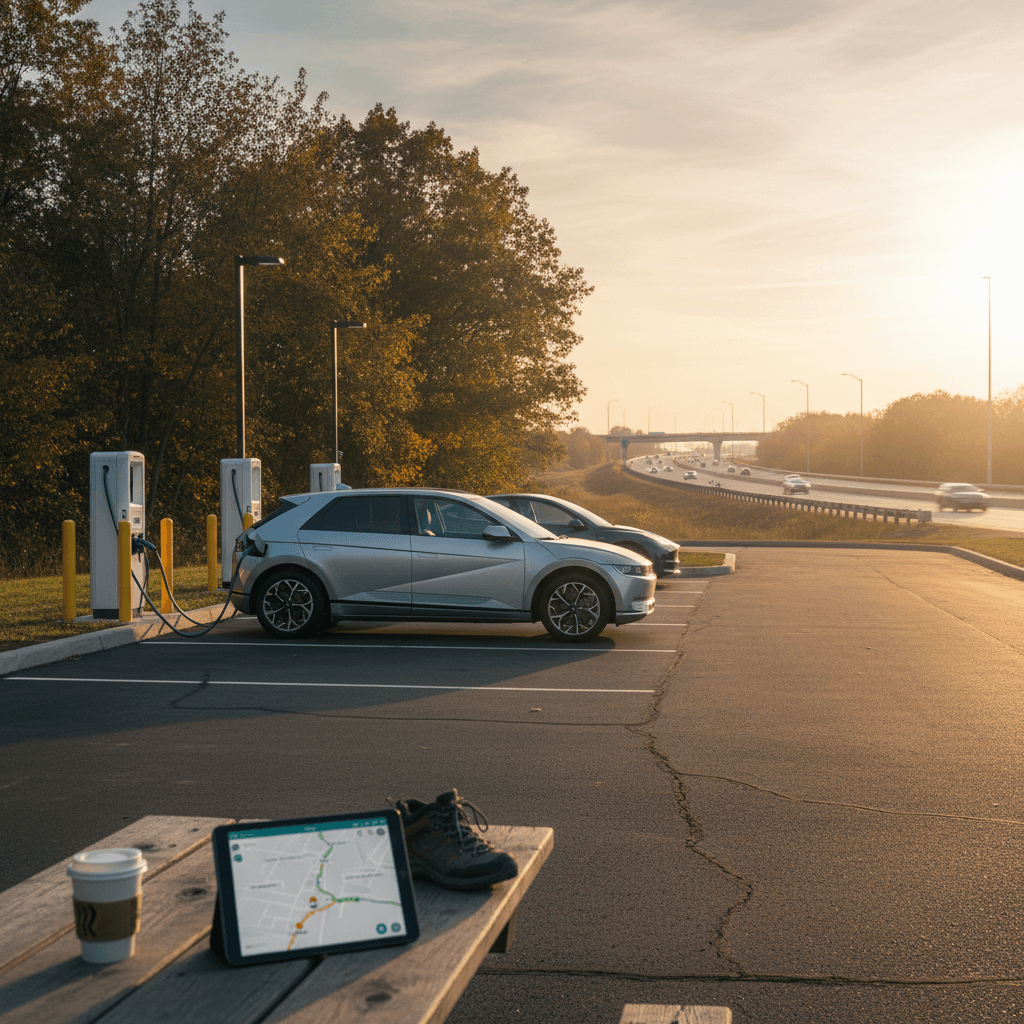
You’ll find multiple DC fast‑charging options on this route. The strongest coverage today comes from Electrify America and Tesla Superchargers, with additional support from networks like EVgo, ChargePoint, and regional providers at grocery stores and travel plazas.
Major fast‑charging networks on the DC–Charlotte corridor
You don’t need them all, but you should know who’s along the route.
Electrify America (CCS & CHAdeMO)
Best option for most non‑Tesla EVs on I‑95 and I‑85.
- Hyper‑fast chargers (often 150–350 kW).
- Sites at Walmarts, shopping centers, and travel plazas.
- Check the Electrify America app for live status and prices.
Tesla Supercharger (NACS)
Ideal if you drive a Tesla; increasingly usable for some non‑Teslas where access is enabled.
- Dense coverage along I‑95 and I‑85.
- Simple plug‑and‑charge for most Teslas.
- Some sites now support non‑Tesla EVs via the Tesla app and NACS/CCS support.
Other CCS networks
EVgo, ChargePoint, and others fill in gaps.
- Often located at grocery stores and shopping areas.
- Good backups if a main network site is busy or offline.
- Always check power rating; some are 50 kW, others 100 kW+.
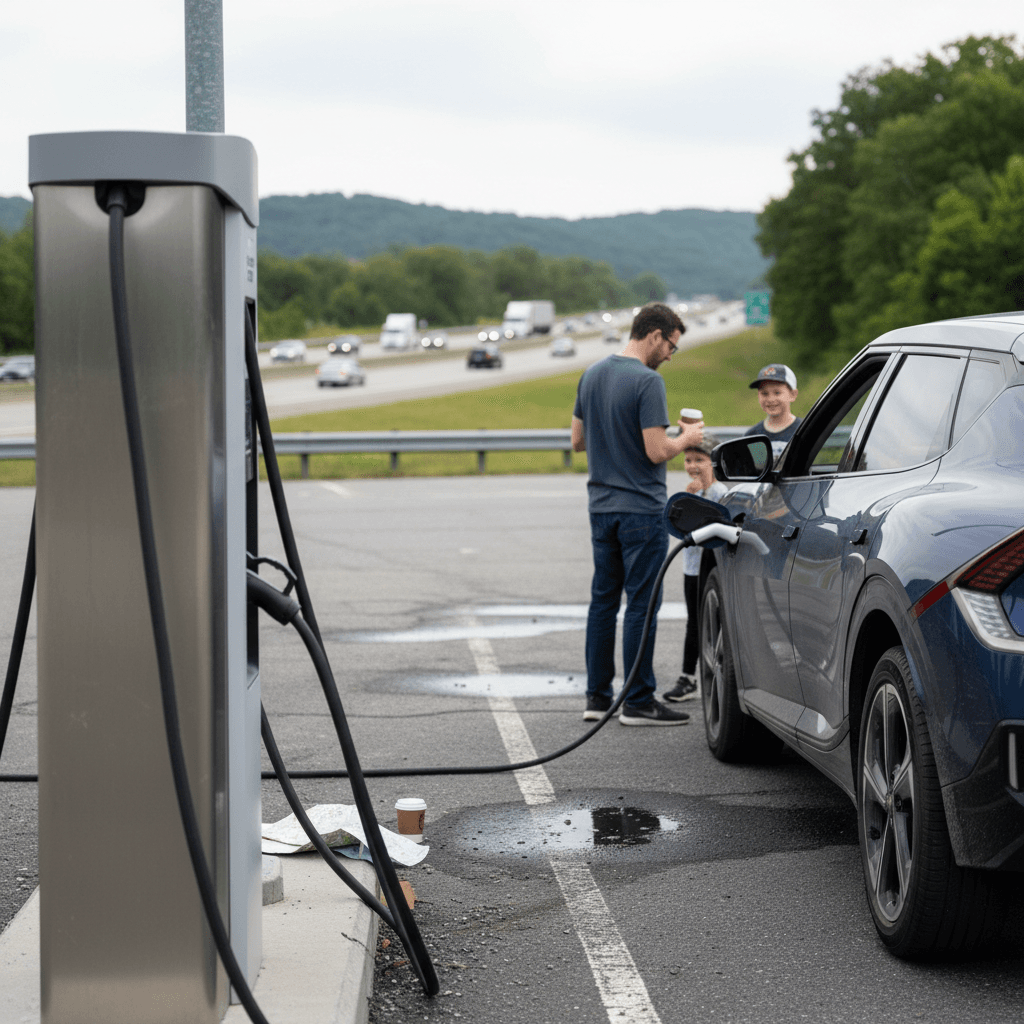
Network apps are non‑negotiable
Sample charging plans by EV range
Every EV is different, but you can sketch out a realistic plan once you know your usable highway range (not the brochure number). A good rule of thumb is to assume you’ll get about 70–80% of your rated range at 70 mph with climate control running.
Example DC → Charlotte plans by usable highway range
Approximate patterns assuming mild weather, 70 mph cruising, and leaving DC at 100% charge.
| EV highway range | Typical pattern | Charging sessions | Notes |
|---|---|---|---|
| ≈150 miles | 3 relatively short legs | 3 DC fast‑charge stops | Plan for ~120‑mile legs and aim to arrive with 15–20% battery. |
| ≈220 miles | 2 medium legs, 1 shorter | 2–3 DC fast‑charge stops | Most mainstream crossovers fall here; 2 stops in good conditions, 3 in winter or heavy rain. |
| ≈280+ miles | 2 long legs | 1–2 DC fast‑charge stops | Long‑range Teslas and similar can often do this with one solid charge mid‑route and a quick top‑off if needed. |
Treat these as templates, your exact stops will depend on the networks and stations you prefer.
Charge from low to about 70–80%
Best apps to plan your DC–Charlotte EV road trip
The right planner can turn this from “range anxiety experiment” into a straightforward drive. Most EV owners combine their car’s built‑in navigation with one or two third‑party tools.
Route‑planning tools worth using
Use at least one dedicated EV planner plus your network apps.
A Better Routeplanner (ABRP)
Highly configurable planning tool tailored to your exact EV.
- Input your model, wheel size, and driving style.
- Adjust for temperature, headwinds, and desired arrival %.
- Great for exploring “what‑if” scenarios before you leave.
PlugShare
Crowd‑sourced map of virtually all public chargers.
- User reviews and recent check‑ins reveal reliable sites.
- Filter by connector type and charging speed.
- Perfect for backups along I‑95 and I‑85.
Your car’s native nav
Don’t ignore what’s built into your EV.
- Tesla, Ford, Hyundai and others now route via fast chargers.
- Can precondition the battery for faster DC charging.
- Often integrates state‑of‑charge estimates on arrival.
Pre‑plan, then stay flexible
Real‑world range: speed, weather and how you drive
Manufacturers quote optimistic range numbers based on standardized tests. In the real world, things like speed, temperature, elevation and wind all nibble away at those numbers. Many drivers see roughly 15–25% less range at highway speeds than on the window sticker, and cold snaps can cut usable range even more.
Factors that eat into range
- High speed: Aerodynamic drag climbs quickly above 65 mph.
- Cold or very hot weather: Cabin heating or heavy A/C use is energy‑hungry.
- Strong headwinds or heavy rain: Both increase resistance.
- Roof boxes and bike racks: Add drag and weight.
Habits that extend range
- Set cruise control a few mph lower than you would in a gas car.
- Use Eco mode and smooth, gentle acceleration.
- Lean on seat and steering‑wheel heaters instead of blasting cabin heat.
- Keep tires properly inflated and remove unnecessary cargo.
Be extra conservative in winter
Budgeting time and money for the trip
Compared with a gas car, your EV trip adds time mostly at charging stops, not on the highway. The charging cost, meanwhile, depends on your vehicle’s efficiency and the pricing at the stations you choose.
Rough time and cost expectations: DC → Charlotte
Assumes public DC fast‑charging at typical U.S. highway rates and reasonable driving habits.
| EV type | Highway efficiency | Charging plan | Extra time | Approximate energy cost |
|---|---|---|---|---|
| Small EV (150‑mi range) | 3.0 mi/kWh | 3 DC fast charges | +90–120 minutes | $55–$75 |
| Mid‑range crossover (220‑mi range) | 3.0–3.5 mi/kWh | 2 DC fast charges | +60–90 minutes | $40–$60 |
| Long‑range sedan/SUV (280+ mi range) | 3.5+ mi/kWh | 1–2 DC fast charges | +40–70 minutes | $35–$55 |
Your actual costs will vary by network and local electricity pricing, but these ballparks help with planning.
Memberships can pay off
Overnights and destination charging options
If you’d rather split the drive over two days, or you’re building DC–Charlotte into a longer East Coast loop, destination charging becomes part of the plan. Look for Level 2 chargers at hotels, downtown parking decks, or near your friends’ or family’s homes so your car charges while you sleep or explore.
Finding a stay with easy EV charging
1. Filter hotels by EV charging
Most travel sites and hotel apps now let you filter for on‑site EV chargers. Still, call the property to confirm how many plugs they have and whether they’re guest‑only.
2. Check PlugShare around your destination
Search the neighborhood where you’ll stay for public Level 2 options at parking garages, municipal lots, or workplaces open to the public after hours.
3. Confirm parking fees and access
Some hotels charge separately for parking at their chargers, or the chargers may be in a valet‑only area. Ask about access hours and cost so you’re not surprised at check‑in.
4. Bring your portable Level 1/2 EVSE
If you can plug into a dedicated 120V or 240V outlet at a relative’s home, your portable charger can quietly refill the battery overnight, no public charging needed.
Avoid daisy‑chained cords
How Recharged can help you road‑trip with confidence
If you’re reading this because you’re thinking, “Maybe it’s time for an EV that can actually do this trip easily,” you’re not alone. A lot of DC and Charlotte‑area shoppers use the DC–Charlotte run as a benchmark for what they need from an electric car.
Make your next DC–Charlotte trip easier with the right used EV
Recharged is built to remove the guesswork from EV ownership.
Know the real battery health
Every vehicle on Recharged comes with a Recharged Score Report that includes verified battery diagnostics. You’ll know how much real‑world range to expect on a trip like DC to Charlotte before you buy.
Financing & trade‑in, fully online
Browse, finance, and even arrange your trade‑in or instant offer completely online. Our team can walk you through which used EVs fit your typical routes and budget.
Nationwide delivery & local support
Have your used EV delivered right to your driveway, or visit our Experience Center in Richmond, VA. Our EV specialists can help you set up charging apps and plan your first road trip.
Built for transparent EV ownership
FAQ: EV road trip DC to Charlotte
Frequently asked questions
The DC to Charlotte run is a great first real‑world test of living with an EV. With a bit of planning, choosing the right route, getting familiar with two or three charging networks, and understanding how your driving affects range, you can turn it into a low‑stress, repeatable trip. And if you’d like an expert hand choosing a used EV that can handle this and many other journeys with ease, Recharged is here to help you every mile of the way.