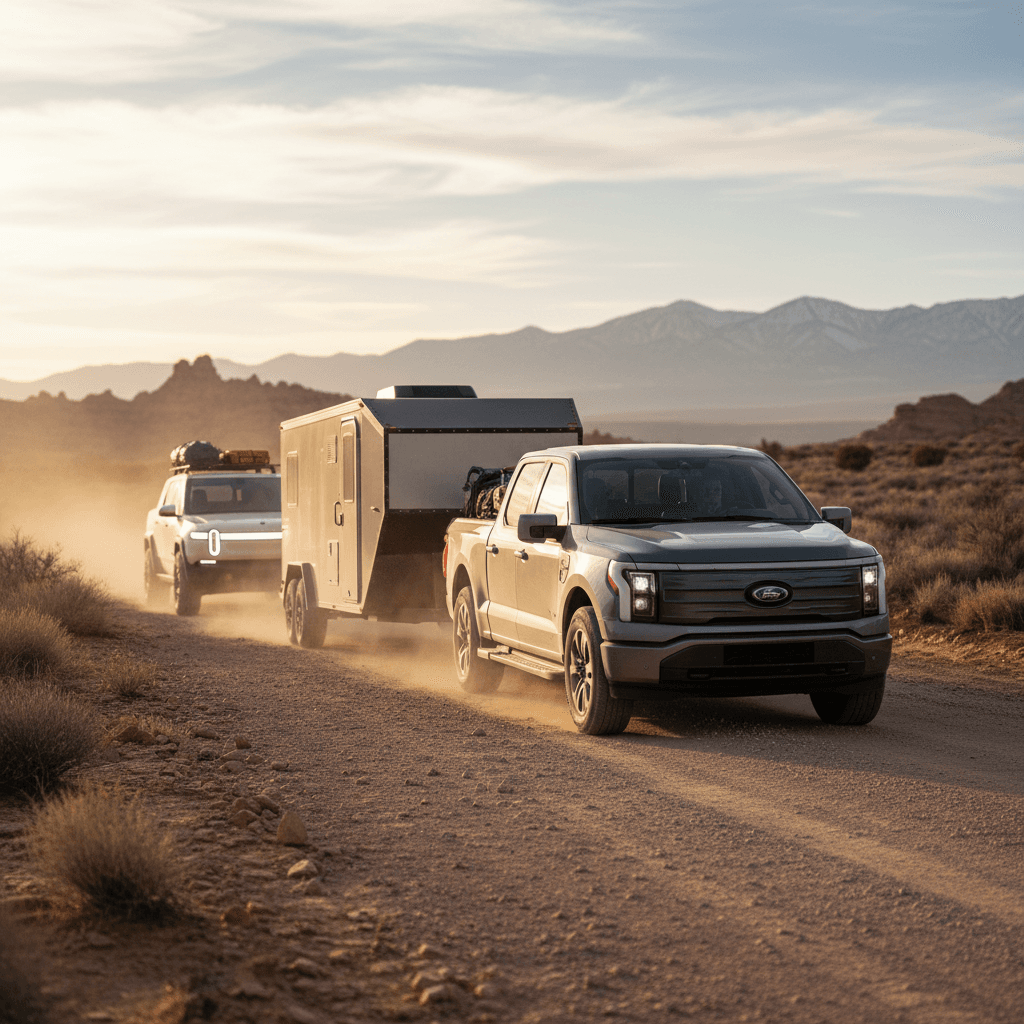
If you’re thinking about hitching a camper, boat, or utility trailer to your electric vehicle, the first question is obvious: **what EV towing range loss percentage should you expect**? The honest answer is that towing can cut your usable range roughly in half, and sometimes even more, but the exact number depends heavily on what you’re pulling and how you drive.
Key takeaway
How much range do EVs lose when towing?
Every EV and every trailer combination is different, but we now have enough testing data to talk in realistic ranges instead of guesses. Think in **bands** rather than a single number.
Typical EV towing range loss percentages
Approximate drops in usable range compared with driving solo, based on independent testing and owner reports.
Light, low trailer
Examples: small utility trailer, light PWC trailer, compact cargo box.
- ~20–35% range loss
- Often manageable with one extra charge stop
Mid-size, moderate weight
Examples: small/medium boat, pop-up camper, compact RV.
- ~35–50% range loss
- Plan for charging twice as often
Large, boxy camper
Examples: full-size travel trailer, tall toy hauler near max tow rating.
- ~50–70%+ range loss
- Real‑world range can drop to a third of the EPA rating
Independent tests of electric pickups towing near their maximum capacity have seen real‑world range fall to **about one‑third of the original EPA rating**. In other words, a truck rated for 300 miles solo might realistically do only 90–110 miles with a heavy, boxy trailer at highway speeds.
Don’t plan on the EPA rating
Real-world EV towing range loss examples
To make “EV towing range loss percentage” feel less abstract, let’s look at real test data and owner experiences from popular models. These aren’t lab numbers, they’re what drivers have actually seen on the road or test track.
Sample EV towing range results
Illustrative examples of range loss when towing, based on public road tests and independent evaluations. Numbers rounded for simplicity.
| EV model & setup | Solo range (approx.) | Towing scenario | Towing range (approx.) | Estimated range loss |
|---|---|---|---|---|
| Ford F-150 Lightning | ~280 miles EPA | Enclosed trailer near max tow at highway speeds | ~90 miles | ≈ 65% loss |
| Rivian R1T | ~320 miles EPA (varies by pack) | Similar heavy trailer, highway speeds | ~85 miles | ≈ 70% loss |
| BMW i4 eDrive40 | ~258 miles tested | Caravan ~85% of kerb weight | 113 miles | ≈ 56% loss |
| Tesla Model Y Long Range | ~260 miles tested | Similar caravan load | 113 miles | ≈ 57% loss |
| Hyundai Ioniq 5 (73 kWh RWD) | ~210 miles tested | Caravan at recommended match | 98 miles | ≈ 53% loss |
| Hyundai Ioniq 5 (AWD) – light boat | ~240 miles real‑world | ~1500 lb boat, mixed speeds | Range per kWh dropped from ~3.4 to ~2.0 mi/kWh | ≈ 40% efficiency loss |
Actual results vary by route, weather, speed, and trailer; treat these as ballpark guides, not promises.
Across multiple tests of crossovers, SUVs, and pickups pulling caravans or heavy trailers, the **average range shortfall has been in the 50–60% range**. That’s steeper than the roughly one‑third fuel‑economy hit many gas SUVs take when towing the same loads, largely because EVs start from a finite battery energy budget.
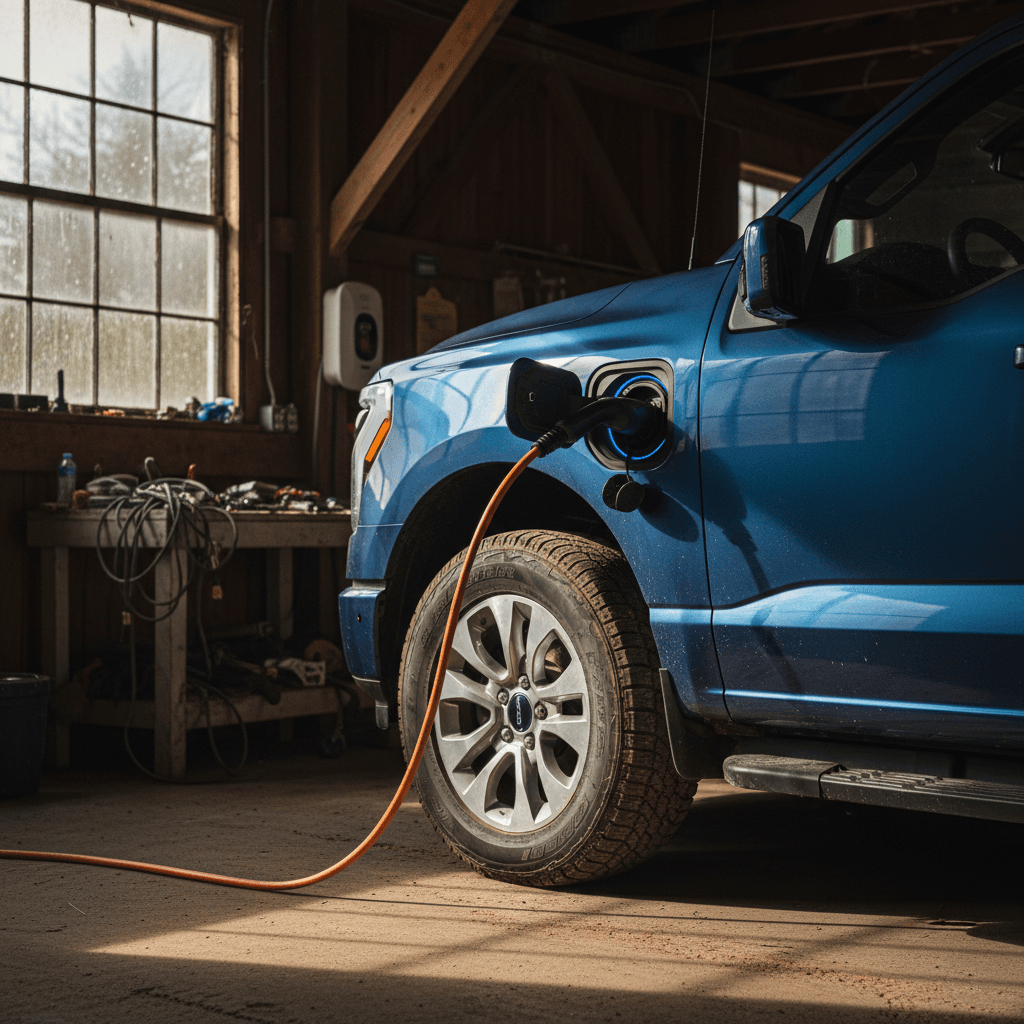
Factors that change EV towing range loss percentage
Two drivers can own the same EV and the same trailer and still see **very different towing range loss percentages**. That’s because towing efficiency is shaped by a handful of key variables.
6 big drivers of EV towing range loss
Dialing these in can turn a painful 60% range loss into something much more manageable.
1. Trailer size & shape
Aerodynamics often matter more than pure weight. A tall, flat‑front camper drags a huge hole in the air compared with a low boat or enclosed cargo trailer with a sloped nose.
2. Trailer weight & load
Heavier trailers demand more energy to accelerate and climb. Fully loaded campers or toy haulers can push some EVs right to their max tow rating, amplifying losses.
3. Speed
Drag rises with the square of speed. Jumping from 60 mph to 75 mph can dramatically increase energy use. Many EV owners see towing efficiency plunge above ~65 mph.
4. Weather & wind
Cold temps reduce battery efficiency and heating draws extra power. A steady headwind can feel like driving up an invisible hill, bad news with a tall trailer.
5. Terrain
Long climbs eat energy quickly. You regain some on the way down via regen, but not all. Hilly routes often mean more frequent fast‑charging stops.
6. Vehicle & battery
Larger battery packs, more efficient powertrains, and effective thermal management systems cope better with towing loads. Some EVs also have smarter trailer modes that adjust range estimates.
Simple rule of thumb
How to estimate your EV’s towing range
You don’t need a PhD in aerodynamics to make a smart plan. A back‑of‑the‑envelope calculation will put you much closer to reality than trusting the EPA sticker or the default range gauge.
Step-by-step: estimating your EV’s towing range
1. Start with a realistic solo range
Don’t use the window‑sticker EPA number if your real driving never matches it. Think about what you actually see on the highway today. If your crossover is rated for 300 miles but you really get about 240 on the interstate, start with **240 miles**.
2. Choose a loss percentage band
Pick a conservative band based on your trailer: **30–40% loss** for a small, low trailer; **40–60% loss** for a medium camper; **60–70%+** for a big, boxy trailer at or near max tow rating.
3. Apply the loss to your solo range
Multiply your solo range by (1 – loss). Example: 240 miles solo × (1 – 0.55) ≈ **108 miles** when you expect about a 55% loss. That’s your rough towing range assuming you arrive close to empty.
4. Add a safety buffer
You don’t want to roll into a charger at 0%. Many EV drivers try to stay above **10–20% state of charge (SoC)**. If you only want to use 80% of the battery (from 90% down to 10%), multiply that 108 miles by 0.8 → ~**86 miles practical leg distance**.
5. Cross-check with trip data or online reports
Search for your EV + trailer type and see what others are reporting. Real‑world stories from drivers in similar conditions help you validate whether your estimate is aggressive or conservative.
6. Test a shorter shakedown trip
Before a cross‑country adventure, do a **half‑day tow** on familiar roads. Note your mi/kWh towing versus solo. That ratio is your personal range‑loss percentage, and you can use it to refine your planning.
Quick mental shortcut
Planning road trips when towing with an EV
Once you know your approximate EV towing range loss percentage, the next step is structuring your trip so those limitations don’t ruin the vacation. That’s part math, part mindset.
Think in legs, not in total miles
Instead of asking, “Can my EV tow this 500‑mile trip?” ask, “Can I comfortably string together **60–100‑mile legs** between DC fast chargers?” Long trips become much more manageable when you break them into chunks that fit your realistic towing range and your preferred SoC window.
Apps like A Better Routeplanner, PlugShare, and many OEM navigation systems can model **elevation, speed, and weather**, which helps refine those legs further.
Prioritize easy-in, easy-out chargers
When you’re hitched up, tight urban chargers or short pull‑in spaces become a headache. Look for **pull‑through or trailer‑friendly charging stops**: highway plazas, big-box parking lots, or charging sites with room to swing wider turns.
It’s often worth stopping a little earlier at a trailer‑friendly charger rather than squeezing out the last few miles to a cramped location.
- Charge **more often, to a lower SoC**. DC fast‑charging usually slows dramatically above ~70–80%. Many towers find a rhythm of charging from ~10–20% up to ~60–70%.
- Build in **extra time** for each stop. Even if the charge itself is quick, bathroom breaks, food, and kids take time. When towing, assume each stop is 30–45 minutes door to door.
- Have a **Plan B charger** within 20–30 miles whenever possible, in case your first choice is full or offline.
- In cold weather or strong headwinds, lean on your most conservative towing range estimate, not the optimistic one you calculated on a perfect day.
Watch your exit options
EV towing vs. gas towing: how different is it?
If you’ve towed with a gas or diesel SUV, the basic physics haven’t changed. A heavy, non‑aero trailer punishes fuel economy no matter what’s under the hood. What’s different with EVs is how **visible** that penalty is and how **quickly** it can shrink your usable range.
EV vs. gas towing: what actually changes?
Both vehicle types suffer when towing; EVs just start from a smaller energy “tank.”
| Factor | Typical gas SUV | Typical EV |
|---|---|---|
| Energy loss from towing | Fuel economy often drops ~30–40% with a sizeable trailer | Range often drops ~40–60% with a sizeable trailer |
| Refueling/charging | 3–5 minutes nearly anywhere | 20–40 minutes at specific DC fast chargers |
| Planning needs | Basic gas-station awareness | Detailed charger planning & SoC management |
| Driving feel | More downshifts, engine noise, heat | Smooth torque, strong low‑speed pull, very quiet |
| Downhill control | Engine braking or transmission modes | Strong regenerative braking can help control speed and recapture some energy |
The percentage hit when towing can be similar, but the impact feels bigger in an EV because you have fewer total miles to give up.
From a pure numbers standpoint, **EVs and gas vehicles both take a substantial efficiency hit when towing**. The reason towing feels more limiting in an EV is simply that your “tank” is fixed and smaller than a big gas tank, and you can’t refuel everywhere in five minutes. Smart planning shrinks that gap.
Choosing an EV for regular towing
If towing is an occasional weekend chore, nearly any tow‑rated EV can work with enough planning. If you’ll tow a camper **often**, it’s worth prioritizing the right hardware from day one, especially in the used market.
What to look for in an EV you’ll tow with
These traits matter more than 0–60 times when there’s a trailer on the hitch.
Bigger usable battery
More kWh equals more miles of towing range. All else equal, a 90+ kWh pack gives you more flexibility than a 60 kWh pack, especially on hilly routes.
Serious tow rating
Check the manufacturer’s **braked tow rating** and payload. Many crossovers top out around 2,000–3,500 lbs, while electric trucks can be rated much higher. Stay well within the rating for comfort and range.
Fast, reliable DC charging
When you’re stopping more often, **charging speed really counts**. Look for EVs that can hold strong charge rates from ~10–60% and have access to robust networks (including NACS / Tesla Superchargers where supported).
Towing or trailer modes
Some EVs offer a dedicated towing mode that adjusts range estimates, stability control, and regen. This makes predicted range while towing more trustworthy.
Thermal management
Good battery cooling helps sustain performance when you’re pulling a heavy load in heat or cold and when you’re fast‑charging multiple times per day.
Stability & brakes
A long wheelbase, solid brakes, and electronic trailer‑sway control are huge confidence boosters when crosswinds or passing trucks hit your rig.
Think about your trailer too
How Recharged helps used EV buyers who plan to tow
If you’re shopping the used market, the big unknown is often the **battery**. Towing safely is one thing; towing confidently is another. That’s where a data‑driven used‑EV specialist like Recharged becomes valuable.
See real battery health, not just a guess
Every vehicle sold through Recharged includes a **Recharged Score Report** with verified battery diagnostics. Instead of gambling on how much usable capacity is left in a five‑year‑old pack, you’ll see a clear picture of battery condition, projected range, and charging performance.
If you know you’ll be towing, that transparency helps you decide whether the remaining capacity is enough for your planned trailer and routes.
End-to-end, EV‑savvy support
Recharged pairs that battery data with **EV‑specialist guidance**, nationwide delivery, financing options, and flexible selling solutions, trade‑in, instant offer, or consignment. You can complete the entire process digitally, or visit the Recharged Experience Center in Richmond, VA if you’d rather talk through towing scenarios in person.
Tell the team how, where, and what you plan to tow, and they can help you narrow in on used EVs whose tow ratings, range, and charging capabilities fit your real world.
Match the EV to your towing lifestyle
EV towing range loss FAQ
Frequently asked questions about EV towing range loss
Towing with an EV absolutely magnifies the importance of honest range expectations. Once you understand that a typical **EV towing range loss percentage sits in the 40–60% band** for most real‑world setups, it’s much easier to plan routes, choose the right trailer, and select an EV that fits your life. Do a little math up front, give yourself a comfortable buffer, and, if you’re shopping used, lean on clear battery health data and expert guidance so that your EV, your trailer, and your favorite destinations all line up without surprises.