If you google “EV rebates Durham” in early 2026, you’ll find a confusing mix of expired tax credits, active charger rebates, and articles that predate big policy changes. This guide cuts through that noise for Durham, North Carolina drivers: what’s still available, what has sunset, and how to actually lower the cost of buying and charging an electric vehicle today.
Timestamp this advice
Overview: What “EV rebates in Durham” really means in 2025–2026
When people talk about EV rebates in Durham, they usually mean three different buckets of savings:
- Federal tax credits for new and used EVs, plus home chargers. These were created by the Inflation Reduction Act but are being phased out under new federal budget legislation by September 30, 2025.
- State or local programs. North Carolina does not currently offer a statewide EV purchase rebate, but some local air‑quality and clean‑transportation initiatives sometimes support fleet or workplace charging projects.
- Utility programs, especially from Duke Energy, which serves most Durham households. These don’t discount the car itself, but can shave hundreds of dollars off the cost of installing a home Level 2 charger.
Most “EV rebates” don’t show up at the dealer
Quick checklist: Which EV savings can you still get?
Durham EV savings at a glance (2025–2026)
1. New EV federal tax credit (up to $7,500)
Still available for qualifying new clean vehicles placed in service <strong>before September 30, 2025</strong>, subject to income, MSRP, and battery/content rules. After that date, current law ends these credits.
2. Used EV federal tax credit (up to $4,000)
Available for qualifying used EVs bought from a registered dealer and delivered <strong>before September 30, 2025</strong>, with lower income caps and price caps (generally $25,000 or less).
3. Home EV charger federal credit (up to $1,000)
A separate credit for 30% of eligible hardware and installation costs for home EV charging, for chargers placed in service <strong>before June 30, 2026</strong>. Rural and low‑income census tract rules may apply; check IRS guidance before you install.
4. Duke Energy EV Charger Prep Credit
If you’re a <strong>Duke Energy residential customer in Durham</strong>, you may get up to roughly <strong>$500–$1,000</strong> back for electrical panel, wiring, and outlet work to support a Level 2 charger. The rebate does not cover the charger hardware itself.
5. Local & fleet grants
For most individual Durham drivers, there’s <strong>no city‑specific EV purchase rebate</strong> today. Local programs are more common for fleets, workplaces, or multifamily properties looking to install shared chargers.
Used EV buyer? Time matters.
Federal EV tax credits for Durham drivers (ending September 30, 2025)
Durham residents qualify for the same federal EV tax rules as drivers anywhere else in the U.S. The twist is timing: by late 2025, Congress passed a budget deal that accelerates the end of many Inflation Reduction Act incentives, including EV credits.
Key federal EV credit numbers for Durham shoppers
New clean vehicle credit (through September 30, 2025)
The modern version of the federal new clean vehicle credit offers up to $7,500 for qualifying EVs and plug‑in hybrids. To use it in Durham, you need all of the following:
- You buy a new EV or plug‑in hybrid from a registered dealer, not private‑party.
- Your modified adjusted gross income is within limits for your filing status (historically $150,000 for single, $300,000 for joint filers; check current IRS thresholds for the tax year you buy).
- The vehicle’s MSRP and battery sourcing meet IRS rules, which have tightened over time and exclude some popular models.
- The vehicle is placed in service (delivered and in your possession) on or before September 30, 2025 under current federal law.
Don’t assume every EV qualifies
Used clean vehicle credit (great fit for Durham buyers)
For Durham residents interested in a used EV, the federal used clean vehicle credit can be more accessible. It’s worth up to $4,000 or 30% of the sale price, whichever is lower, for qualifying vehicles bought before September 30, 2025.
- The car must be at least two model years old when you buy it.
- Sale price is generally capped at $25,000 to qualify for the full credit.
- You must buy from a licensed dealer (not a private individual).
- Your income must be below lower thresholds (historically $75,000 for single, $150,000 for joint filers; again, verify for the tax year of purchase).
- You can only claim the used EV credit once every three years.
How this connects to Recharged
Home EV charger credit (through June 30, 2026)
There’s also a federal credit for home charging equipment. For many Durham homeowners, this can cover 30% of the cost of a Level 2 charger and installation, up to $1,000, for chargers placed in service by June 30, 2026. In practice, your exact eligibility can depend on whether your address is in a qualifying census tract, so it’s essential to confirm with the IRS guidance or a tax professional before you rely on it.
Pro move: Pair federal charger credit with Duke rebate
Does North Carolina offer statewide EV rebates?
Here’s the blunt truth: as of early 2026, North Carolina does not offer a statewide EV purchase rebate or income‑tax credit for individual drivers. The state has historically focused more on infrastructure and utility‑run programs than direct point‑of‑sale rebates.
You’ll still see some older references online to state‑level proposals, but the most up‑to‑date incentive overviews make it clear that state EV incentives in North Carolina are effectively channeled through utilities like Duke Energy and occasional grant programs, not a universal purchase rebate.
What about state clean‑energy credits?
Duke Energy EV Charger Prep Credit in Durham
If you’re searching for “EV rebates Durham” and you’re a homeowner, the single most practical local incentive is Duke Energy’s EV Charger Prep Credit. Instead of discounting the car, this program helps you afford the electrical work that makes home charging possible.
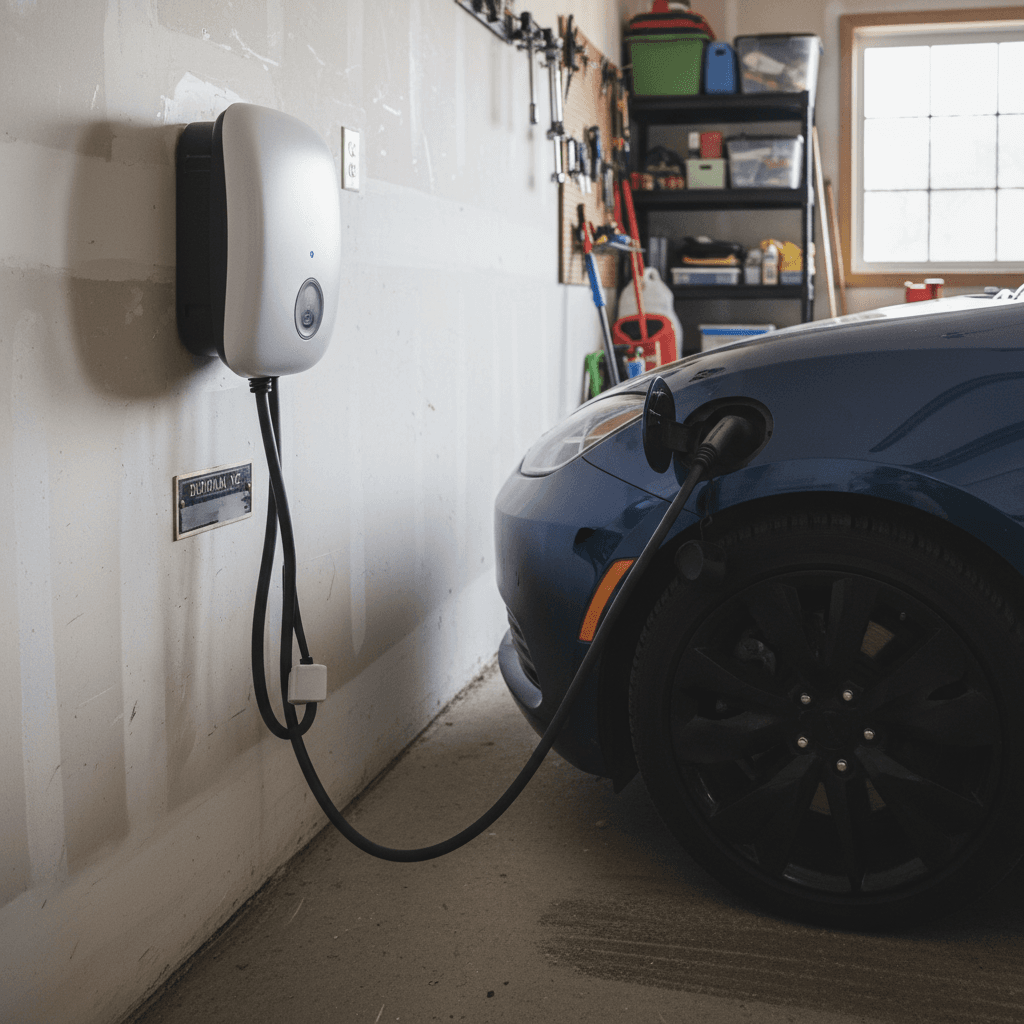
Who qualifies in Durham?
Eligibility hinges on your electric utility. Many, but not all, Durham addresses receive power directly from Duke Energy. If your bill comes from Duke Energy (not a municipal utility), you’re usually in the target group for the Charger Prep Credit. Renters may also benefit if their landlord is willing to install and apply for the credit.
Check who you actually pay for electricity
What the Duke Energy Charger Prep Credit covers
Costs that usually do qualify
- Running new conduit and wiring from your panel to the charger location.
- Panel upgrades or new breakers directly tied to the EV circuit.
- Installing a 240V outlet (e.g., NEMA 14‑50) or hardwired circuit for a Level 2 charger.
- Some related trenching or boring to get power to detached garages or parking areas.
Costs that usually don’t qualify
- The charger hardware itself (the wall‑box or portable EVSE).
- Mounting hardware, pedestal posts, or cosmetic work.
- Permitting fees or general electrical work unrelated to EV charging.
- Non‑Duke Energy customers, even within the broader Durham region.
For residential customers, third‑party breakdowns of the program indicate typical credits in the $500–$1,000 range per home, depending on how extensive your upgrades are and whether you’re installing a wall‑mounted charger or building out a brand‑new dedicated circuit. Commercial and multifamily customers can access higher per‑port incentives for public, workplace, or fleet charging.
How to apply as a Durham homeowner
- Confirm that Duke Energy is your electric utility by checking your monthly bill.
- Decide whether you’ll work with your own electrician or let Duke Energy connect you with an approved contractor.
- Install a Level 2 charger circuit (typically 40–60 amps on a dedicated 240V line) and keep all detailed invoices.
- Submit an application through Duke’s EV Charger Prep Credit portal, choosing either the customer credit (you get a check) or contractor credit (discount taken off the contractor’s invoice).
- Track timelines: paperwork generally must be submitted within a few months of the completion date shown on your permit or invoice. Apply as soon as your charger is live.
Match your charger size to your panel
Other local & regional EV programs around Durham
Beyond Duke Energy’s offering, EV incentives around Durham tend to be programmatic and time‑limited, think grants for school buses, transit fleets, or workplace charging clusters rather than permanent rebates for individual buyers.
Where else EV money shows up in the Triangle
These programs don’t replace personal rebates, but they make charging more available over time.
School & transit fleets
Workplace charging
Apartments & condos
Why this still matters if you’re just buying a car
How to stack rebates when you buy a used EV in Durham
For most Durham drivers, the best value play is a used EV plus home Level 2 charging. Here’s how a realistic stack of incentives might look if you moved quickly before the federal deadlines.
Example: Stacking EV incentives on a used purchase in Durham
Illustrative example only; actual eligibility depends on your income, vehicle, address, and tax situation.
| Item | Up‑front cost | Potential incentive | Notes |
|---|---|---|---|
| Used Nissan LEAF or Chevy Bolt purchased via Recharged | $18,000 | Up to $4,000 federal used EV credit | Must be under price cap; check IRS list. |
| Home Level 2 charger hardware | $700 | Up to $210 federal charger credit | 30% of hardware cost if address qualifies. |
| Electrical work: new 40A circuit & outlet | $1,200 | $500–$1,000 Duke Energy Charger Prep Credit | Exact amount depends on scope; hardware not included. |
| Total potential incentives | , | Roughly $4,700–$5,200 | Credits reduce your effective long‑term cost but may not arrive immediately. |
This scenario assumes purchase and installation before federal deadlines and that you qualify under IRS rules.
Talk to a tax professional before you rely on any credit
How Recharged helps Durham buyers capture every dollar
Incentive programs change faster than most shoppers can track, and the used EV market adds a layer of uncertainty about battery health and fair pricing. Recharged’s entire model is built to tame that complexity for buyers in Durham and across the country.
Three ways Recharged simplifies used EV incentives for Durham shoppers
From battery health to paperwork prep, the goal is a smoother, lower‑risk transition to electric.
Verified battery health
Dealer status for used EV credit
Expert, EV‑only support
Ready to find your next EV?
Browse VehiclesOn top of that, Recharged offers financing, trade‑ins, instant offers or consignment, and nationwide delivery, plus an in‑person Experience Center in Richmond, VA if you’d like to see vehicles up close before they head to Durham. Most of the process is digital, which fits naturally with comparing incentive scenarios and moving quickly before federal deadlines.
When to loop in Recharged
FAQs: EV rebates & incentives in Durham, NC
Frequently asked questions about EV rebates in Durham
Bottom line: Planning your EV purchase around Durham rebates
If you’re in Durham and trying to make sense of EV rebates, the picture in 2025–2026 is a mix of sunsetting federal tax credits and still‑strong utility support for home charging. The window for federal new and used EV credits effectively closes on September 30, 2025, while the federal home‑charger credit and Duke Energy’s Charger Prep Credit extend the runway for making home charging affordable.
The smartest move is to look at your situation holistically: your income and tax liability, your home’s electrical setup, and how many miles you actually drive. From there, you can decide whether to accelerate your purchase to catch federal credits or focus on long‑term operating‑cost savings and a high‑quality used EV with verified battery health.
If you’re leaning toward a used EV, Recharged is built for exactly this moment, combining a transparent battery‑health report, fair market pricing, and EV‑savvy support with the ability to buy completely online and have the car delivered to your driveway in Durham. That way, incentives become the icing on the cake rather than the only thing making the numbers work.