If you live in or around Charleston, SC and you’re shopping for an electric vehicle, you’ve probably heard about federal tax credits, EV rebates, and special rates for charging at home. The challenge is figuring out which **EV rebates in Charleston, SC** actually exist today, and which ones still apply if you’re buying a *used* EV instead of new.
Quick note on dates
Charleston EV rebates at a glance
Charleston EV savings snapshot (2025–2026)
Charleston doesn’t currently offer its own city-only EV rebate, but you can still stack **federal tax credits**, a few **South Carolina utility programs**, and **dealer pricing** to lower your total cost of ownership, especially if you’re open to a used EV.
Federal EV tax credits Charleston drivers can still use
Federal incentives are the single biggest source of **EV rebates for Charleston, SC** drivers. As of 2026, the main opportunity is the federal **Clean Vehicle Credit** for new EVs, plus a separate credit for used EVs and another for home charging equipment.
New Clean Vehicle Credit (up to $7,500)
For qualifying new EVs, you may be able to claim up to $7,500 as a federal income tax credit. The exact amount depends on battery sourcing, final assembly, and IRS eligibility rules.
- Vehicle must be on the IRS list of qualifying clean vehicles.
- Income caps apply based on your filing status.
- MSRP limits apply (sedans vs. SUVs/trucks).
- You need taxable income to benefit from the credit.
Point-of-sale option through dealers
Many dealers are now set up so you can elect to transfer the federal credit to the dealer at the time of purchase. In practice, that lets you treat the credit like an instant rebate, with the dealer reducing your purchase price or applying it as cash at closing.
You’ll still have to certify that you meet the IRS rules, and the IRS can claw back the benefit if you later turn out not to qualify, so it’s smart to confirm eligibility with a tax professional first.
Watch the 2025 deadline for leases
Used EV tax credit: how it helps Charleston buyers
If you’re shopping used, which is where Recharged focuses, there’s a separate **Used Clean Vehicle Credit** that can dramatically improve the math on a pre-owned EV.
Key rules for the used EV tax credit
Applies to many sub-$25,000 EVs bought from licensed dealers
Purchase price limit
The used EV must cost $25,000 or less before fees and taxes. That makes many 3–6 year-old EVs strong candidates.
Credit amount
You can claim 30% of the sale price up to a maximum of $4,000, as long as you meet IRS income and vehicle rules.
Basic eligibility
- Must buy from a licensed dealer (not private party).
- Model year at least 2 years old.
- First transfer of that vehicle as a used EV credit claim.
- Income caps apply; credit is nonrefundable.
Important timing note
At Recharged, every used EV comes with a **Recharged Score Report** that includes verified battery health and fair market pricing. That transparency makes it easier to see whether a given Charleston-area EV is priced under the $25,000 used-credit cap and how much value you may be able to unlock at tax time.
Federal tax credit for home EV chargers
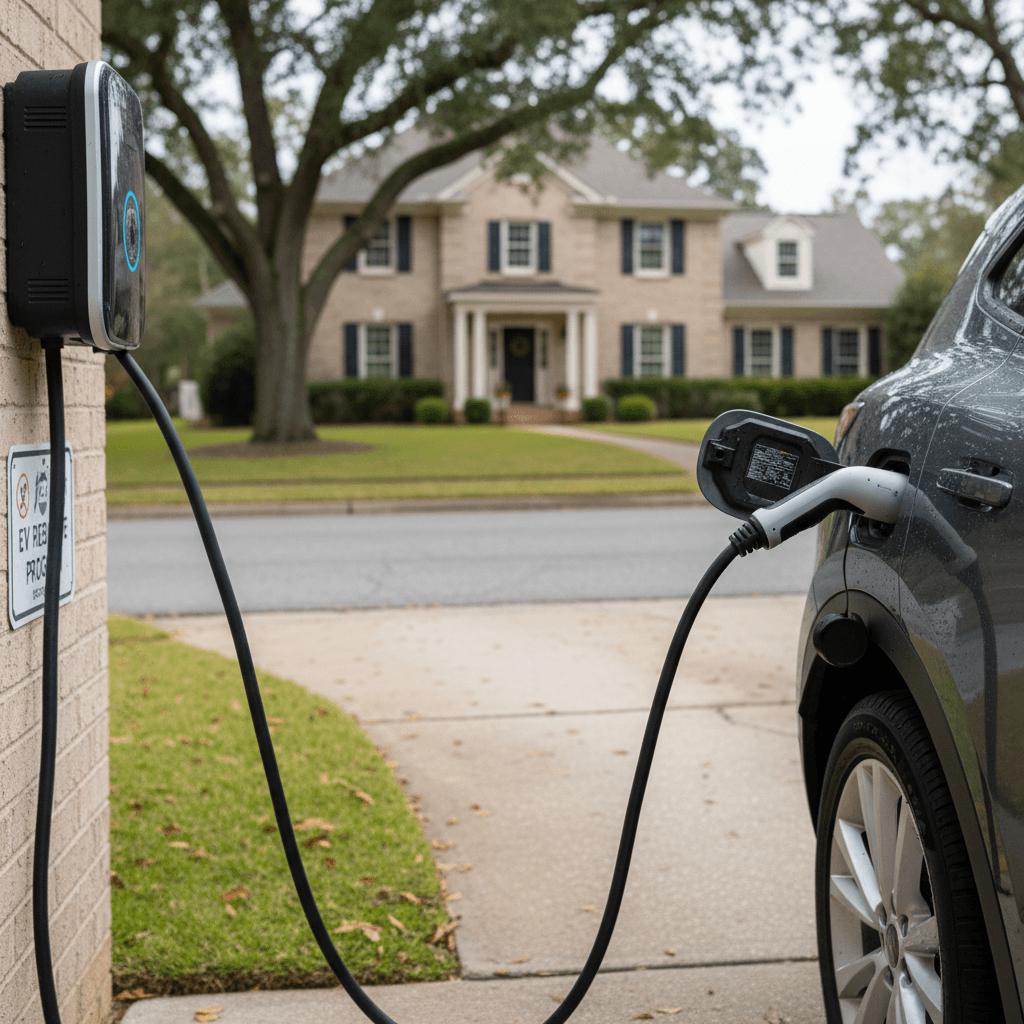
If you own a home in the Charleston area and plan to install a Level 2 charger, you may also qualify for a separate federal tax credit on residential charging equipment installed before **June 30, 2026**.
Federal residential EV charger credit – key facts
How Charleston homeowners can offset the cost of a Level 2 charger.
| Feature | Details |
|---|---|
| Credit amount | Up to 30% of the cost of qualified charging equipment, capped at $1,000 for residential installations. |
| What qualifies? | Home EV charging hardware and associated installation costs that meet IRS definitions of refueling/recharging property. |
| Where it applies | Primary residence in the U.S., including homes in Charleston, Mount Pleasant, North Charleston, Summerville and surrounding areas. |
| End date | Current federal guidance points to an end date of June 30, 2026 for this residential charger credit. |
| How to claim | Typically claimed on your federal income tax return using the appropriate IRS form for alternative fuel refueling property. |
Always verify the latest IRS rules, as incentive amounts and end dates can change.
Pair the credit with smart installation
State-level EV incentives (and fees) in South Carolina
Unlike some neighboring states, South Carolina does **not** currently offer a broad statewide purchase rebate for individual EV buyers, but there are two state-level items every Charleston driver should know about: an extra registration fee on EVs, and a pending proposal to expand a state alternative-fuel tax credit to more charging projects.
South Carolina EV policies that affect Charleston drivers
Extra EV registration fee
South Carolina adds a $120 biennial fee for battery-electric vehicles and a $60 biennial fee for plug-in hybrids, charged when you register or renew. That’s on top of regular registration costs, and it’s designed to replace lost gas-tax revenue.
Alternative fuel tax credit bill
Lawmakers are considering legislation (for the 2025–2026 session) that would expand an existing alternative fuel infrastructure tax credit so more EV chargers, and potentially individual taxpayers who install them, could qualify. As of early 2026 the bill is active, not yet a permanent benefit, so treat it as a possible future boost rather than guaranteed money.
Why the registration fee matters
Utility and local programs near Charleston
Most EV rebates that feel “local” to Charleston are actually offered by **utilities** rather than the city itself. Your options depend on who delivers electricity to your home or business.
Step 1: Identify your electric utility
1. Check your power bill
Look at your most recent electric bill to see whether your home is served by Dominion Energy South Carolina, Santee Cooper, or a local co-op/municipal utility. Different utilities have different EV programs.
2. Visit your utility’s EV page
Most major utilities maintain an EV-specific page listing current rebates, time-of-use rates, and any pilot programs. Search for your utility name plus “electric vehicle” or “EV rebates.”
3. Confirm program boundaries
Utility territories don’t always match city limits. A home with a Charleston mailing address might not be in the same service area as your workplace or rental property, so verify which meters each program covers.
Dominion Energy South Carolina
Dominion is a major electric provider in the Charleston region. While its South Carolina programs currently emphasize time-of-use rates and energy-efficiency incentives, its EV resources page points drivers to federal and state-level EV incentives and often highlights special pilot programs.
For residential customers, the most relevant opportunity is typically enrolling in a time-of-use (TOU) rate that offers cheaper electricity during off-peak hours. If you can schedule your EV charging for overnight, this can effectively act like an ongoing “rebate” on every kilowatt-hour you use to charge.
Santee Cooper & co-ops
Santee Cooper and some South Carolina cooperatives offer more targeted EV programs, including:
- Residential Level 2 charger rebates on prequalified models, sometimes allowing up to two rebates per household.
- Experimental EV time-of-use rates that reward off-peak home charging.
- Commercial grants or make-ready rebates (such as Santee Cooper’s EVolve grants) that help businesses and public sites add chargers.
While Santee Cooper doesn’t serve most of central Charleston, the broader Lowcountry region includes Santee Cooper customers. If you live or operate a business just outside the city, it’s worth checking whether these programs apply.
How this translates to real savings
How to stack EV rebates on a used EV from Recharged
Used EV shoppers in Charleston don’t have to miss out on incentives. If you plan ahead, you can combine **dealer pricing**, the **federal used EV credit**, and in some cases a **home charger credit** and utility rate programs.
1. Start with a fair used EV price
Every EV listed on Recharged includes a Recharged Score Report with verified battery health and fair market pricing. That helps you quickly identify vehicles that fall under the $25,000 price cap for the federal used EV credit while still offering strong range.
2. Confirm federal credit eligibility
Once you’ve found a candidate vehicle, verify that you meet IRS income caps and that the vehicle’s age and history make it eligible for the used EV credit. A licensed dealer, online or local, must be the seller for you to claim it.
3. Plan home charging
If you own your home in the Charleston area, price out a Level 2 installation. Between a potential federal charger credit and any utility rebates or off-peak rates, you can lower your all-in monthly cost and make daily driving simpler.
Factor in delivery and trade-in
Checklist: how to maximize EV savings in Charleston
Charleston EV savings checklist
1. Decide between new and used
If you want the largest possible federal credit and qualify on income, a new EV might unlock up to $7,500. If you prefer lower upfront cost, focus on sub-$25,000 used EVs that may qualify for up to $4,000 in federal credit instead.
2. Confirm your tax situation
Talk with a tax professional about whether you have enough federal tax liability to use the credit, and whether it’s better to claim it directly or transfer it to the dealer as a point-of-sale rebate.
3. Check for charger incentives
If you own a home, price out a Level 2 charger and confirm whether you can claim the federal charger credit before June 30, 2026. Ask your electrician for itemized invoices and keep all paperwork.
4. Enroll in a time-of-use rate if available
Contact Dominion Energy South Carolina or your local utility to ask about EV-friendly time-of-use or off-peak rates. Set your EV to charge overnight to capture the lowest per-kWh price.
5. Budget for the SC EV registration fee
Remember the extra $120 EV registration fee every two years. Include it in your total cost of ownership calculations so there are no surprises at renewal time.
6. Use transparent battery data
When buying used, lean on services like Recharged that provide battery health diagnostics and fair market pricing so you’re not guessing about long-term range or overpaying relative to incentives.
FAQ: EV rebates in Charleston, SC
Frequently asked questions about EV rebates in Charleston
Bottom line: are EV rebates worth the effort in Charleston?
For Charleston drivers, EV incentives aren’t a single big city check you mail in and forget. They’re a **stack** of federal tax credits, evolving state policies, utility rate options, and transparent vehicle pricing that, together, can tilt the math strongly in favor of going electric.
If you’re mainly focused on **EV rebates in Charleston, SC**, start by deciding whether a new or used EV fits your budget and tax situation, then layer in a potential home charger credit and any off-peak utility rates you can access. From there, use tools like Recharged’s **Recharged Score Report** to compare used EVs with clear battery health data and fair pricing, so you’re not giving back your rebate value in unexpected repairs or range loss.
Done right, you end up with a comfortable electric vehicle, predictable home charging costs, and a stack of incentives that quietly work in your favor every time you plug in, whether you’re commuting over the Ravenel Bridge or heading out of Charleston for a weekend road trip.