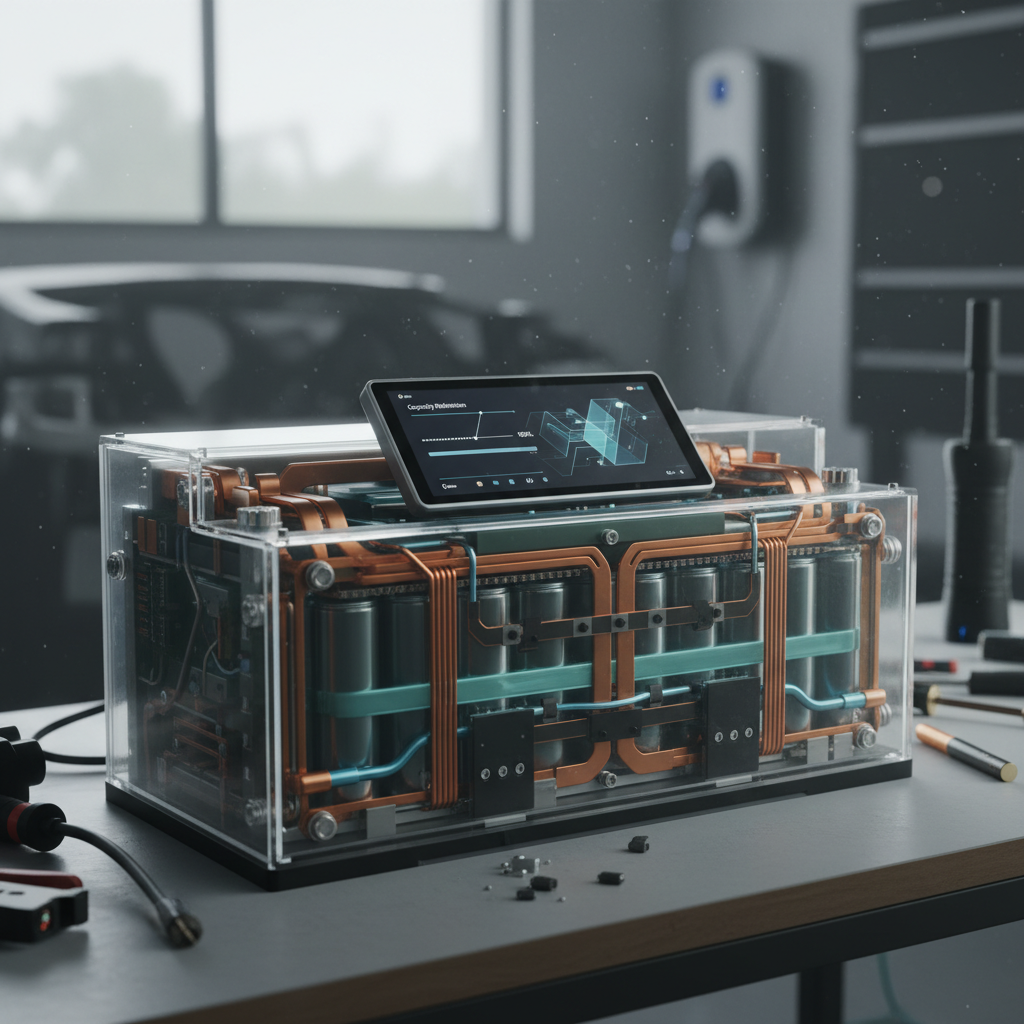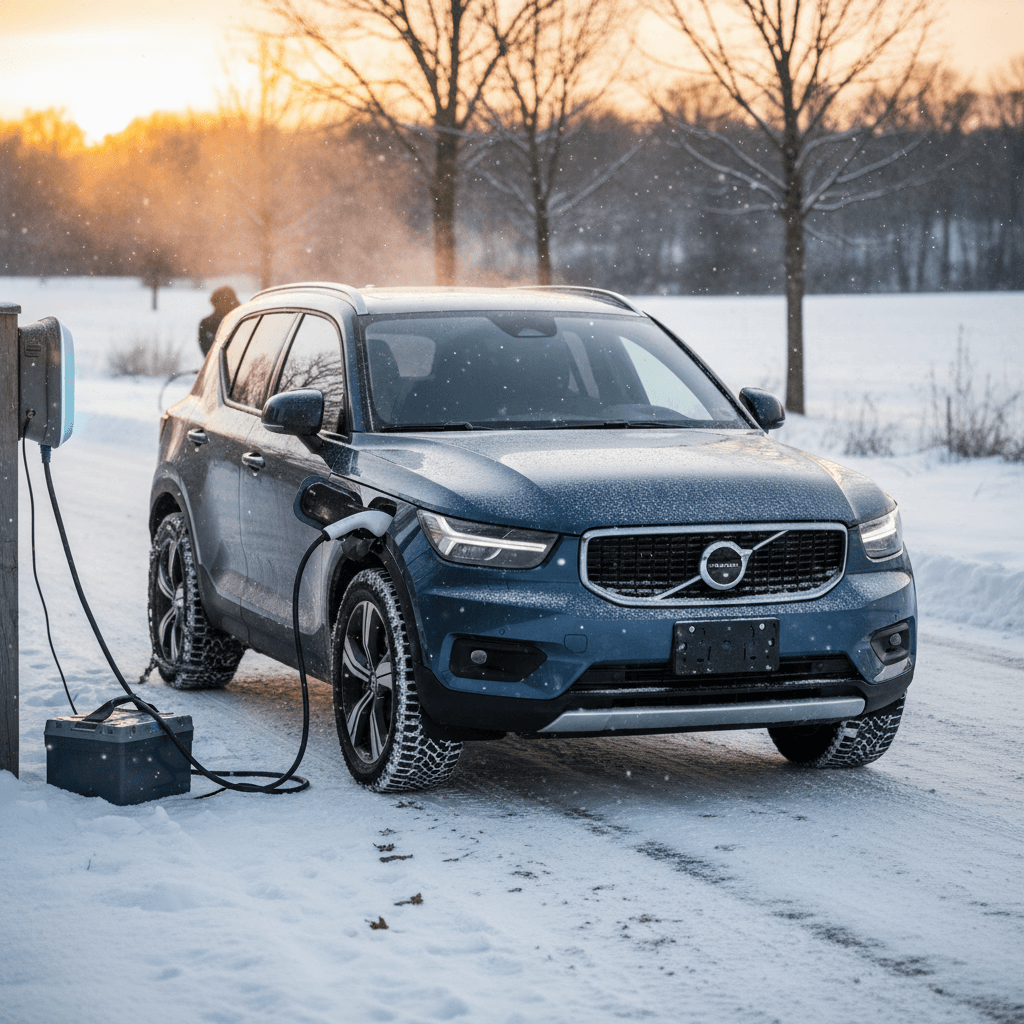
You glance at your dash and your stomach drops: yesterday your EV promised 260 miles on a full charge, today it’s barely cracking 210. When your EV range suddenly drops, it’s easy to assume the battery is dying. In reality, most abrupt changes come from how the car is being used, not from permanent damage. Let’s unpack what’s normal, what’s not, and what you can do about it.
Good news first
Why Your EV Range Can Suddenly Drop
Your EV doesn’t actually know the future; it makes an educated guess. That number on the dash is a range estimate, based on recent driving, temperature, terrain, HVAC use, and the battery’s measured state of charge. Change any of those inputs quickly and the estimate can move just as quickly.
The "guess‑o‑meter" problem
Many owners nickname the range display the guess‑o‑meter because it leans heavily on your recent driving history. If you spent last week in city traffic at 35 mph and today you hop on the interstate at 75 mph in 25°F weather, the car will rapidly revise its prediction downward.
Displayed range vs. true capacity
The important distinction: a lower estimate does not always mean your battery actually lost capacity. Sometimes the software simply became more honest about how you’re driving, or it adjusted after learning your habits.
Normal Battery Degradation vs. Sudden Range Loss
Typical Long‑Term EV Battery Degradation
Normal degradation is a slow, almost boring process: a couple of percentage points per year, not 30 miles overnight. A sudden EV range drop is usually an estimator reacting to new conditions. True step‑change failures, like a defective module, are rare and often covered by warranty. The trick is learning to tell the difference.
Short List: Main Causes of Sudden EV Range Drop
- Cold weather, especially below freezing, thickens battery chemistry and boosts energy used for cabin heat.
- High speed, headwinds, hills, or a new commute route that’s less efficient than before.
- Heavy HVAC use (heat, A/C, defrost, seat and steering‑wheel heaters).
- Recent software update that changed how the car estimates or displays range.
- Tire issues: low pressure, winter tires, bigger wheels, or misalignment increasing rolling resistance.
- Sustained fast‑charging and high‑heat operation slowly reducing usable capacity.
- Change in charge limit or display mode (e.g., switching from EPA‑rated to “based on recent driving”).
- Hidden loads like roof boxes or bike racks wrecking aerodynamics.
- Battery management system (BMS) recalibration after a deep discharge or full charge.
- In used EVs, a pack that’s already degraded or had a rough previous life.
Quick self‑check
Cold Weather: The #1 Culprit for Sudden Range Loss
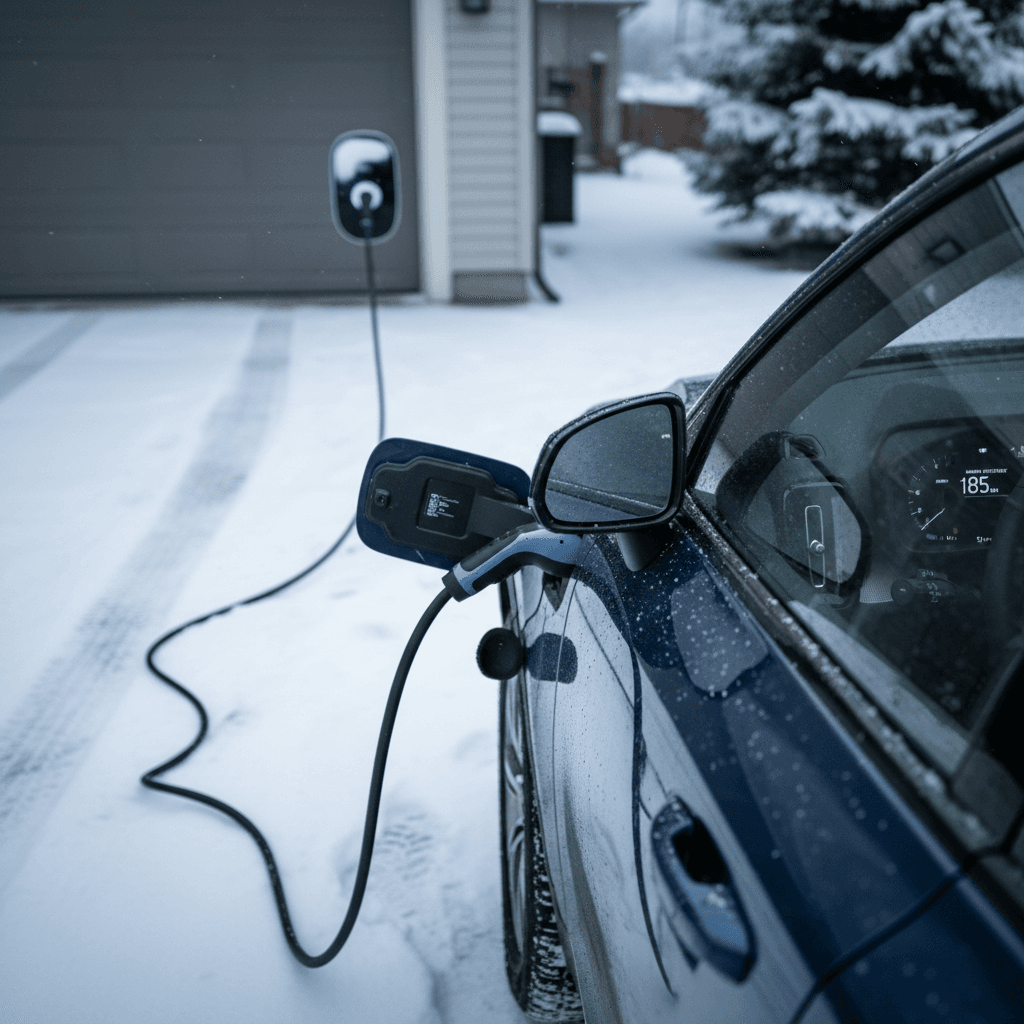
Winter is when social media fills up with screenshots of EVs losing 30–40% of their rated range. That isn’t your car “getting old overnight”; it’s physics and creature comforts ganging up on you.
How Winter Kills Your Range (Temporarily)
Three overlapping factors make your EV look suddenly thirsty in the cold.
Colder chemistry
At low temperatures, lithium‑ion chemistry slows down. Internal resistance goes up, so you get less usable energy and weaker regen until the pack warms up.
Cabin heat tax
Unlike gas cars, EVs can’t scavenge free heat from waste exhaust. Electric heaters and heat pumps draw power straight from the battery, often a big chunk on short trips.
Drag and rolling resistance
Cold, dense air and winter tires both add drag. At highway speeds and with soft, knobby tires, you’re literally pushing through thicker air on stickier rubber.
Expect big swings, not failure
- Precondition the car while plugged in, so cabin and pack warm up on grid power, not battery.
- Use seat and wheel heaters instead of blasting cabin heat when possible, they use less energy.
- On bitter days, plan more frequent, shorter legs on road trips and favor DC fast chargers with amenities so you can preheat and charge in comfort.
- If your EV offers an “eco” or winter drive mode, use it: it often softens throttle response and reins in HVAC draw.
Driving Style, Speed and Route Changes
If you’ve ever watched the instant consumption gauge while flooring an EV, you know how quickly electrons disappear. Aerodynamic drag increases with the square of speed, so going from 65 mph to 80 mph is not a minor lifestyle choice, it’s an efficiency crime.
Speed and aggression
- Frequent hard launches and high cruising speeds can chop your effective range by 15–30% compared to calm, mixed driving.
- If you recently switched from suburban errands to a long, fast commute, the range estimator will rapidly adjust down.
Route and elevation
- Hilly routes, sustained climbs, and headwinds all raise consumption vs. flat, sheltered roads.
- Navigation‑linked range estimators now factor elevation into their guesses. Change your route and the car may instantly revise its remaining miles.
Simple experiment
HVAC Usage: Heating, Cooling and Seat Warmers
Your climate controls are quietly one of the biggest energy consumers in an EV. Crank the heat to sauna or keep the A/C pegged on a humid August day and you’ll watch projected range tick down in real time.
How Cabin Comfort Steals Your Miles
Not all creature comforts hit the battery equally.
Resistive cabin heat
Old‑school resistive heaters are brutally effective and brutally inefficient. On short winter trips, they can eat more energy than the motors.
Heat pumps
Many newer EVs have heat pumps, which use far less energy than resistive heaters in mild cold. In deep cold, though, they still need help from resistive elements.
Seat & wheel heaters
These warm you, not the whole cabin. They’re surprisingly frugal: dial the cabin temp down and rely on these when you can.
Low‑hanging fruit
Software Updates and Range Estimator Recalibration
Automakers regularly tweak how range is calculated and displayed. Sometimes a silent over‑the‑air update makes the car more conservative, or more honest, overnight. Owners wake up, see 230 miles where 250 used to be, and assume the worst.
- An update can change the algorithm that predicts range from your recent efficiency.
- Some brands move from showing the official test‑cycle rating to a learned, real‑world value.
- In rare cases, a BMS update unlocks or locks away a bit of buffer at the top or bottom of the pack.
- After a deep discharge or a full, slow charge, the BMS may “re‑survey” the pack and revise its state‑of‑health estimate.
Check the release notes
Battery Health, Fast Charging and Real Degradation
Of course, batteries do age. Heat, high voltage, and high current all stress the chemistry. If your car lives at 100% in a hot garage and fast‑charges daily, the pack will age faster than one cruising a coastal climate at 40–80% state of charge.
Signs Your Range Drop Is Real Degradation
When it’s more than weather or software.
Persistent loss across seasons
If you lose ~15–20% of range and it doesn’t come back when temperatures and driving patterns normalize, that points to genuine capacity loss.
Error messages or warranty thresholds
Warnings about battery health, reduced power, or a dealer measuring capacity below your warranty threshold are signs of a hardware issue, not just an estimate quirk.
Time to see a specialist
Tire Pressure, Wheels and Weather: Rolling Resistance
Tires are where physics meets your wallet. Swap silent, low‑rolling‑resistance stock tires for aggressive all‑terrains or let your pressures sag 8–10 psi in cold weather, and your EV will feel like it’s towing a parachute.
Common Tire & Wheel Changes That Cut Range
Small choices at the corners of the car can turn into big hits at the battery.
| Change | Typical Effect on Range | Why It Matters |
|---|---|---|
| Under‑inflated tires (‑8 psi) | ‑3–5% | More deformation and heat = more rolling resistance. |
| Switch to winter tires | ‑5–10% | Softer rubber, deeper tread blocks, more drag in cold air. |
| Upsized wheels (e.g., 18"→20") | ‑3–8% | Heavier wheels and wider rubber increase inertia and frontal area. |
| Roof box / bike rack | ‑10–20% at highway speeds | Big aero penalty that gets worse the faster you go. |
If your range dropped right after a tire swap or wheel upgrade, look here first.
Easy win: check pressures
Charging Behaviors That Can Hurt Range Over Time
Sudden range drops usually aren’t caused by last night’s fast charge, but repeated habits over months and years add up. Think of it as diet and exercise for your battery.
Charging Habits That Protect Long‑Term Range
1. Avoid living at 100%
Charging to full for a trip is fine. Letting the car sit at 100% for days, especially in hot weather, accelerates aging. Many EVs let you cap daily charge at 70–80%.
2. Don’t regularly run to 0%
Deep discharges stress the chemistry. Aim to stay above 10–15% in normal use, and treat “0 miles” as the emergency lane, not your daily plan.
3. Treat fast‑charging as a tool, not a lifestyle
DC fast charging on road trips is what makes EVs brilliant. Doing it every single day instead of home or workplace Level 2 adds extra wear.
4. Let the car manage heat
If your EV supports battery preconditioning before a fast charge, use it. Warming or cooling the pack to its sweet spot reduces stress while you juice up.
5. Park smart
Whenever possible, park in shade or a garage. High ambient temps are one of the silent killers of battery longevity.
Diagnosing Sudden Range Drop: Step-by-Step
When your range estimate suddenly tanks, you don’t need a PhD in electrochemistry. You just need a simple, repeatable checklist that separates normal behavior from real trouble.
5‑Step Checklist to Understand Your Range Drop
1. Note the conditions
Write down temperature, recent trips, new routes, and whether you added winter tires, cargo boxes, or changed speeds. Many “mysteries” are solved right here.
2. Compare energy consumption
Most EVs show kWh/100 miles or mi/kWh. Has this jumped up recently? If consumption rose 20–30%, your range estimate is simply following the math.
3. Run a control drive
On a mild day, fully charge to your normal daily limit, set HVAC to a modest level, and drive a familiar mixed route at sane speeds. Compare how far you actually go vs. the previous baseline.
4. Watch behavior across a season
If you’re in winter or a heat wave, wait for a stretch of moderate weather. Does the range come back toward normal? That’s your sign this is conditional, not catastrophic.
5. Get a professional health report
If range stays depressed and you’re seeing performance issues or warnings, schedule a battery health assessment. For used EVs, look for a documented report like the <strong>Recharged Score</strong> so you’re not guessing.
Used EVs, Sudden Range Loss and the Recharged Score
If you already own a used EV, or you’re shopping for one, a sudden range drop hits differently. You’re not just thinking about today’s commute; you’re wondering what the previous owner did to the pack for 60,000 miles.
Why used EVs feel riskier
Battery health is the single biggest variable in a used EV’s real‑world value. Two identical cars on paper can have wildly different effective ranges depending on climate, charging habits, and mileage. Without data, it’s guesswork.
How the Recharged Score helps
Every vehicle sold through Recharged comes with a Recharged Score Report that includes verified battery health and fair‑market pricing based on that data. Instead of relying on the dash estimate, you get a diagnostic view of the pack, plus guidance from EV specialists who live and breathe this stuff.
That means fewer surprises, more confidence, and a much clearer idea of whether a given car’s range drop is normal, or a reason to walk away.
Buying or selling with confidence
FAQ: EV Range Suddenly Dropped
Frequently Asked Questions
Bottom Line: Protecting Your EV’s Range
When your EV range suddenly drops, it feels like someone just yanked boards out of the bridge you’re driving on. But in most cases, the villain isn’t failing hardware; it’s temperature, speed, tires, HVAC, or software finally telling you the unvarnished truth about how you use the car.
The playbook is simple: control what you can (speed, tire pressure, climate settings), pay attention to patterns across seasons, and lean on proper diagnostics, not just the dash number, when something feels off. If you’re in the market for a used EV, insist on a transparent battery health report so you’re buying the range you think you’re buying, not the range on a sunny day in a brochure.
At Recharged, that transparency isn’t an upsell; it’s the default. Every used EV we sell includes a Recharged Score Report, EV‑specialist support, and financing and trade‑in options to match. That way, whether your next car promises 180 miles or 320, you know exactly why, and what it will feel like in the real world you actually drive in.