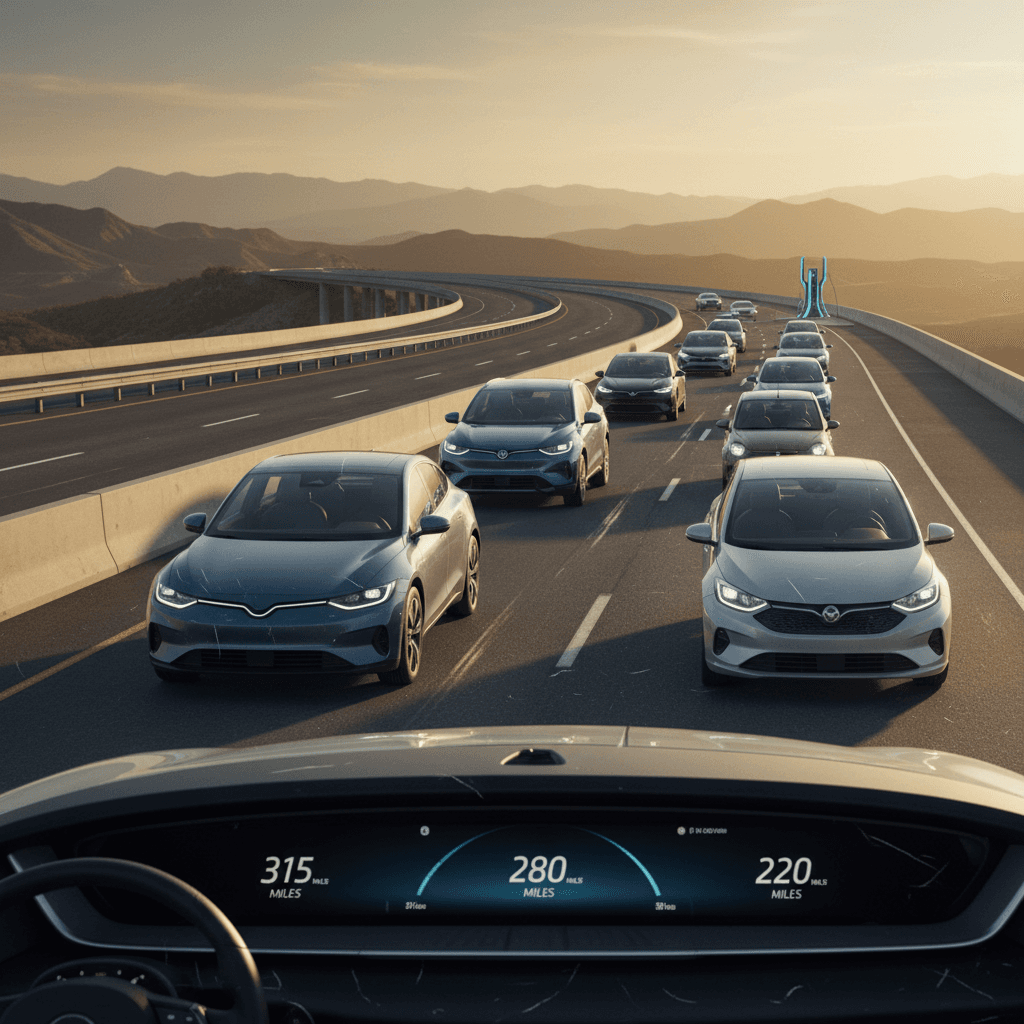
If you’ve started comparing electric cars, you’ve probably noticed one number dominates the conversation: range. A good EV range comparison in 2025 isn’t just about who claims 300 or 400 miles. It’s about how far you’ll actually go on your commute, in winter, on a 75 mph highway, and how that changes when the car is a few years old and sitting on a used lot.
Quick take
Why EV range comparison matters in 2025
Ten years ago, shoppers were choosing between 80- and 120‑mile electric cars. In 2025, you’re picking from compact crossovers that claim 260 miles and luxury sedans advertising 450–500 miles. A thoughtful EV range comparison helps you separate marketing bragging rights from what actually fits your life and budget.
- Avoid overpaying for more range than you’ll ever use
- Spot models whose real highway range lags behind the window sticker
- Understand why a 260‑mile SUV might be enough, while a 220‑mile city car might not be
- Compare new and used EVs on more than just battery size
Range is only half the story
How EV range is measured: EPA vs real world
In the U.S., the EPA combined range on the window sticker is your main benchmark. Automakers run standardized lab tests and then apply an adjustment factor so the number is closer to real drivers’ experience. For EVs, that usually means multiplying the lab result by about 0.7 and then blending city and highway results into a single number shown on the sticker.
EPA label vs. real-world range at a glance
Why your EV’s rated range doesn’t always match what you see on the road
| Scenario | What you see on the sticker | What drivers often see | Why it’s different |
|---|---|---|---|
| City-heavy commuting | 260 miles EPA combined | Close to 260 miles, sometimes more | Lower speeds and lots of regenerative braking help efficiency |
| Mixed driving, 65 mph max | 260 miles EPA | 220–240 miles | Highway speeds use more energy than city stop‑and‑go in an EV |
| Fast highway, 70–75 mph | 260 miles EPA | 180–220 miles | Aerodynamic drag climbs quickly above 65 mph |
| Winter, highway | 260 miles EPA | 150–200 miles | Cold batteries + cabin heat + high speed take a bigger bite |
| Summer, city with A/C | 260 miles EPA | 220–250 miles | A/C uses energy, but city speeds still favor efficiency |
These are general patterns, not guarantees, your results depend on speed, weather, and driving style.
Highway range is the real stress test
EV range comparison: longest-range models in 2025
Range bragging rights move fast, but as of late 2025 the same names keep showing up near the top of every EV range comparison chart: Tesla, Lucid, Chevrolet, Rivian, and Hyundai among others. Below is a snapshot of standout long‑range EVs based on recent EPA filings and manufacturer data.
2025 EV range comparison – long-range standouts
Representative examples of long-range EVs available in the U.S. for 2025. Values rounded to keep this chart readable.
| Model (2025 MY or latest) | Body style | Approx. EPA range (mi) | Battery size (kWh) | Notable for |
|---|---|---|---|---|
| Lucid Air (long-range trims) | Luxury sedan | 400–500+ | ~112–118 | Class-leading highway efficiency |
| Chevrolet Silverado EV RST | Pickup truck | ~460 | ~200+ | One of the longest-range trucks on sale |
| Tesla Model S Long Range | Luxury sedan | ~410–430 | ~100 | Mature fast-charging & software ecosystem |
| Rivian R1S Dual Max | 3-row SUV | ~410 | ~140 | Adventure-ready with big battery options |
| Tesla Model 3 Long Range | Compact sedan | ~390–405 | ~80–82 | Excellent range-to-price ratio |
| Hyundai Ioniq 6 Long Range | Sedan | ~340+ | 77.4 | Aerodynamic efficiency champ |
| Tesla Model Y Long Range | Compact SUV | ~320–340 | ~75 | Family-friendly size with strong range |
| Chevrolet Equinox EV FWD | Compact SUV | ~319 | ~85 | Value-focused long-range crossover |
Always verify exact trims and wheel sizes, range can swing by 20–40 miles within the same model line.
Don’t chase the absolute top number
EV range by price and segment
Most shoppers don’t buy “the longest‑range EV on the market.” You buy the best car you can afford in a segment that fits your life. Here’s how EV range comparisons shake out when you group models by price and type.
Typical 2025 EV range by budget
Approximate EPA ranges for mainstream trims (not stripped base models or ultra‑expensive halo cars).
Under $35,000 (new)
- Mostly compact hatchbacks and crossovers
- Typical range: ~220–270 miles
- Examples: entry trims of Chevrolet Equinox EV, some Hyundai/Kia models
Great for commuters with home charging, occasional longer trips.
$35,000–$55,000
- Core of the EV market in 2025
- Typical range: ~250–320 miles
- Examples: Tesla Model 3/Y, Hyundai Ioniq 5/6, Kia EV6, Ford Mustang Mach‑E
Balanced range, charging speed, and features for most families.
$55,000+
- Luxury sedans & SUVs, performance trims, big trucks
- Typical range: ~280–400+ miles
- Examples: Lucid Air, BMW iX, Rivian R1S/R1T, Silverado EV, Kia EV9
Top-end range with more space and power, but diminishing returns per dollar.
Used EVs: where the value hides
What really affects EV range on the road
The EPA number is a starting point, not a guarantee. In real life, range is fluid. Think of your battery like your smartphone: same device, very different battery life if you’re streaming video on 5G in winter vs. scrolling email on Wi‑Fi at home.
Main factors that change your real-world range
You’ll see the biggest swings on fast highways and in extreme temperatures.
Temperature
- Cold (below freezing): Cabin heat + cold-soaked battery can trim range by 20–40% on short trips.
- Very hot: A/C use and battery cooling also use energy, though usually less than winter heating.
Speed & aerodynamics
- Above ~65 mph, aerodynamic drag ramps up quickly.
- Going 75–80 mph instead of 65 mph can easily cost you 10–25% of your range.
Route & elevation
- Highway driving usually reduces EV range vs. city driving.
- Steep climbs burn extra energy; long descents can give some of it back via regen.
Battery age & size
- All lithium‑ion batteries lose some capacity over time.
- Larger packs tend to feel less sensitive to a few percent loss than smaller packs.
Aggressive driving is a range killer
How much EV range you actually need
Here’s where EV range comparison becomes personal. Instead of asking, “What’s the longest‑range EV I can afford?” start with, “How many miles do I realistically drive on a busy day, plus a safety buffer?”
Step 1: Know your daily max
- Add up your typical round‑trip commute, school runs, errands, and an unplanned side trip.
- For many drivers in the U.S., that’s 40–70 miles even on a busy day.
- Now add a 30–50 mile buffer for weather, detours, or forgetting to plug in.
If you land around 100 miles, an EV rated at 220–250 miles will feel very comfortable with home charging.
Step 2: Think about road trips
- How many times a year do you drive 300+ miles in a day?
- Are there DC fast chargers along your usual routes?
- Would you be happy stopping every 2–3 hours for 20–30 minutes?
If long highway trips are rare, you can prioritize price and everyday comfort over maximum range.
Rough rule-of-thumb ranges by lifestyle
City & inner-suburb commuters
If you mostly drive in town and can charge at home or work, a <strong>200–230‑mile</strong> EV is usually plenty, even with winter losses.
Daily highway commuters
If you regularly drive 60–90 miles a day at 65–75 mph, look for <strong>250–280 miles</strong> of EPA range for a comfortable buffer.
Frequent road-trippers
If you often drive 300+ mile days, a car rated <strong>300–350 miles</strong> makes stops less frequent and more flexible.
Two-car households
If there’s a gas or longer‑range vehicle in the driveway, you may be perfectly happy with a shorter‑range EV as the daily driver.
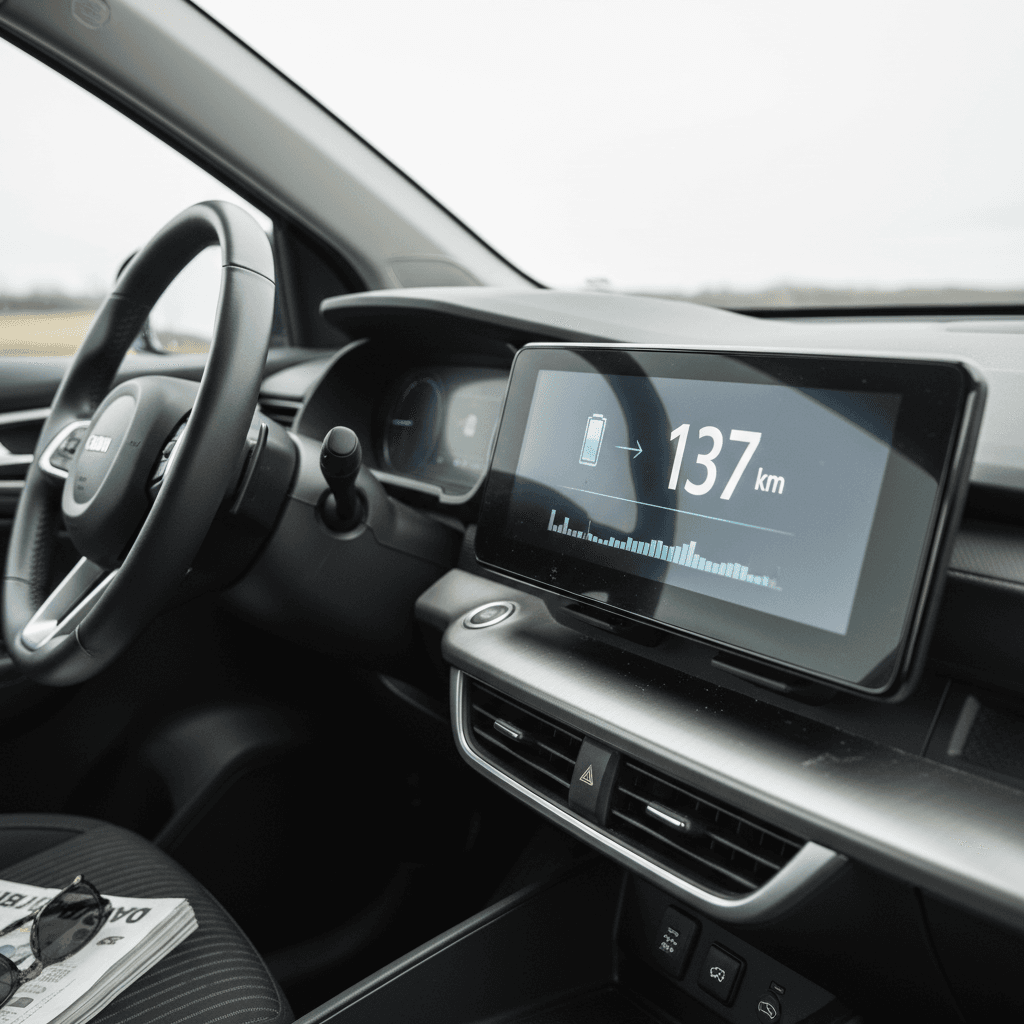
Comparing range on used EVs & battery health
Range comparison gets trickier once an EV has a few birthdays behind it. Two identical models on a used lot, same year, same trim, can deliver very different real‑world range depending on how they were charged and driven.
What to look at when comparing used EV range
Don’t just read the original window-sticker number and call it a day.
State of health (SoH)
Battery state of health is a percentage estimate of how much usable capacity remains vs. new.
- 95% SoH: almost all of the original range remains.
- 80% SoH: a 260‑mile car now behaves more like ~210 miles.
Age, mileage & climate
- High‑mileage highway cars can still have healthy packs if charged carefully.
- Vehicles that spent years in extremely hot climates may see faster degradation.
Charging history
- Balanced use of Level 2 home charging is gentle on batteries.
- Constant DC fast charging from 0–100% can accelerate wear.
Documentation & diagnostics
Look for service records, battery checks, and an independent report when possible. That’s where Recharged’s Score Report comes in.
How Recharged helps with used EV range
EV range comparison checklist when you’re shopping
You don’t need a spreadsheet and a PhD in battery chemistry to compare EV ranges. You just need to ask the same handful of questions about every car on your shortlist.
Side‑by‑side EV range comparison checklist
1. Note the EPA range for the exact trim
Wheel size, drivetrain (RWD vs AWD), and battery option all matter. A 20‑inch‑wheel AWD trim can have 30–40 fewer miles than the base model on smaller wheels.
2. Look up independent highway tests
Search for 70‑mph or road‑trip range tests. If a car consistently underperforms, mentally knock its real‑world highway range down a notch.
3. Factor in your climate
If you live with harsh winters or blazing summers, assume you’ll see <strong>15–30% less</strong> range on the toughest days and choose a battery accordingly.
4. Check charging speed and network access
A slightly shorter‑range EV that charges very quickly and uses a robust fast‑charging network can be easier to live with than a slower‑charging long‑range model.
5. For used EVs, demand battery health data
Ask for a recent battery report, onboard data, or a third‑party test. With Recharged, this is baked into the Recharged Score, so you’re not buying blind.
6. Test your real commute
If possible, take an extended test drive that mimics your daily route, speed, roads, and climate, to see how the range estimate behaves in your real world.
EV range comparison: FAQ
Frequently asked questions about EV range comparison
The bottom line on EV range comparison
An EV range comparison isn’t about winning a numbers contest. It’s about matching a battery to your life. Once you’re comfortably above your daily needs, with room for bad weather and the occasional long day, the better choice is often the EV that charges quicker, fits your family, and comes with transparent battery health information if you’re buying used.
That’s where Recharged comes in. Every used EV on our marketplace comes with a Recharged Score Report that translates technical battery data into plain‑language insights about real‑world range, value, and longevity. So instead of guessing how far your next EV will go, you can shop confidently, compare options side‑by‑side, and pick the one that will keep up with your life for years to come.