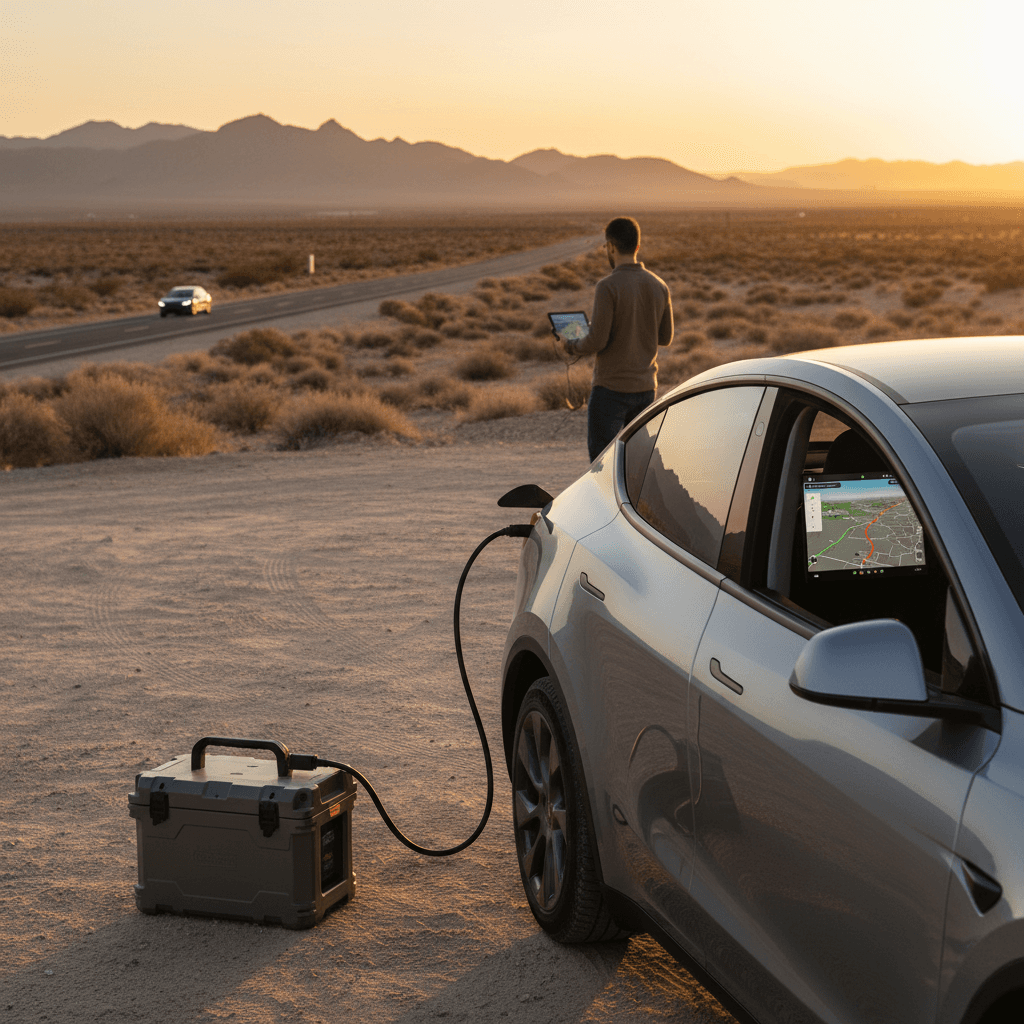
Range anxiety shows up the loudest the first time you point your EV at the horizon and plan to keep going. Suddenly that number on the dash feels less like a promise and more like a maybe. The good news: with the right EV range anxiety road trip tips, long-distance electric driving can be just as easy, and often more relaxing, than it ever was in a gas car.
Range anxiety is common, especially before your first trip
Why EV range anxiety feels worse on road trips
Daily driving is predictable: commute, errands, home to your own outlet. A road trip throws you into unfamiliar roads, new charging networks, and questions that only pop up at 10 p.m. in the middle of nowhere. What if the charger is broken? What if the weather turns? What if I misjudged that last mountain grade?
What actually drives range anxiety on the road
It’s less about battery size and more about uncertainty.
Unfamiliar routes
Charger reliability
Changing conditions
The antidote isn’t a bigger battery. It’s better information and a simple plan. Once you know how much range you really have in real-world conditions, and you’ve mapped a couple of backup options, the knot in your stomach loosens quickly.
Think “range confidence,” not “range anxiety”
Know your EV’s true road-trip range
That EPA range number on the window sticker is like a best-case scenario fuel economy figure. It’s useful for comparison, but your road-trip range is shaped by how you drive, where you drive, and the weather you drive through.
Range anxiety vs reality: what drivers report
- Start with your rated range, then assume 20–30% less for highway speeds, weather, and detours. If your car is rated at 300 miles, plan around 210–240 miles between ideal fast chargers.
- Use your EV’s energy screen or trip computer for a few weeks before your first big trip. Notice your average consumption (for example, 3.0 mi/kWh) at typical highway speeds.
- On your first long weekend trip, treat it as a shakedown. Keep legs shorter than you technically need, and watch how your state of charge (SoC) drops compared with the nav’s prediction.
Cold and heat are honest range thieves
Plan your EV road trip route like a pro
In a gas car, you pick an interstate and figure the rest out at exit signs. In an EV, the magic is in planning your charging before you roll. Once that’s done, you can relax and enjoy the scenery instead of white‑knuckling the state-of-charge gauge.
Best tools for planning EV charging stops
Use at least one, ideally two, so you always have a Plan B.
Built-in EV navigation
Third-party trip planners
Hotel and destination filters
Pre-trip EV planning checklist
Confirm your charging networks
Look at your route and note which networks dominate (for example, Tesla, Electrify America, EVgo, a GM–Pilot corridor). Make sure you’ve created accounts, downloaded apps, and added payment methods for at least the top two.
Map primary and backup chargers
For every planned fast-charge stop, identify at least one alternate station within 15–25 miles. Save them in your car’s nav or your phone so a detour is two taps away, not a 20-minute research project.
Decide your daily mileage goal
If you’re aiming for 500 miles in a day, sketch out roughly three legs of 160–180 miles. EVs are happiest stopping every 2–3 hours, which also happens to be perfect for drivers and passengers.
Plan charging with meal and rest breaks
Look for stations near food, coffee, playgrounds, or walking paths. Turning charging time into meal and stretch time makes those 20–40 minutes pass quickly, and feels less like a chore.
Check construction and weather
A quick look at road-closure maps and a weather app before you leave can keep you from discovering a mountain detour or cold front only after you’re committed to a marginal leg.
Let the car do the thinking, most of it
Smart charging strategies that cut anxiety in half
Most EV road-trip stress comes from watching the battery crawl from 80% to 100% at a slow charger while daylight fades. You can avoid that almost entirely by changing how you think about fast charging.
The 10–80% rule
The fastest way to cover ground in an EV is to:
- Arrive at fast chargers with 10–20% state of charge.
- Charge to about 70–80%, then unplug and go.
- Repeat every 120–200 miles, depending on your car.
Charging from 80% to 100% can take as long as going from 10% to 80%; it’s usually better to drive and grab your next fast charge than to top off “just in case.”
Pick an arrival buffer you trust
Decide on a minimum arrival buffer, the amount of charge you insist on having when you pull into a charger, and stick to it.
- New to EV road trips? Aim for a conservative 20–25% buffer.
- More experienced and on corridors with dense fast charging? Many drivers are comfortable with 10–15%.
- In winter or on mountain routes, add 5–10 percentage points to whatever you’d normally choose.
Don’t try to “stretch” between sketchy chargers
How charging strategy changes your day
Rough example for a modern EV with a 70–80 kWh battery on a 500‑mile day.
| Strategy | Number of fast-charge stops | Typical arrival SoC | Charge target | Time per stop | Total charging time |
|---|---|---|---|---|---|
| Top off twice | 2 | 25–30% | 95–100% | 45–60 min | 1.5–2.0 hours |
| 10–80% rule | 3 | 10–20% | 75–80% | 20–30 min | 1.0–1.5 hours |
| Ultra-cautious | 4 | 40–50% | 90–100% | 15–25 min | 1.5–2.0 hours |
Actual times vary by vehicle, charger power, and conditions, but the pattern holds: shorter, faster sessions keep you moving.
Use charging time as a feature, not a bug
Weather, speed and terrain: How they really hit range
The physics that matter most on an EV road trip are simple: going faster, climbing hills, and fighting extreme temperatures all use more energy. None of that has to be scary if you budget for it up front.
Three big range killers, and how to tame them
Plan around them and you remove the surprise factor.
Speed & headwinds
Rain and snow
Cold snaps and heat waves
Trust the projected arrival, not the static range number
What to pack so you always feel secure
You don’t need a trunk full of gadgets to beat EV range anxiety, but having a few thoughtful items on board turns "what if" scenarios into minor inconveniences instead of trip-enders.
Road-trip packing list for range peace of mind
Chargers and adapters
Pack your included Level 1 or Level 2 portable charger, plus any adapters your EV supports (for example, J1772 to NACS or vice versa). These let you take advantage of RV parks, friends’ garages, and unexpected outlets at destinations.
Charging apps and RFID cards
Install apps for the major networks on your route and log in before you leave. If a network offers an RFID card, activate it, it can be more reliable than shaky cell service at a remote highway plaza.
Extension cord and cable management
If your EV’s portable charger allows it and you know what you’re doing, a heavy‑duty outdoor‑rated extension cord can make awkward parking spots usable. Keep cords coiled and organized so you’re not wrestling a spaghetti pile in the rain.
Comfort kit for longer stops
A small bag with snacks, water, a blanket or jackets, and entertainment for kids turns an unplanned 40‑minute top‑up into a pleasant break instead of a small mutiny.
Printed backup plan
Screens die and apps crash. Jot down a handful of key charger addresses or exit numbers on paper, especially for quieter corridors. It’s low‑tech, but it’s a powerful anxiety reducer.
Respect electrical safety
Extra tips for families and tight schedules
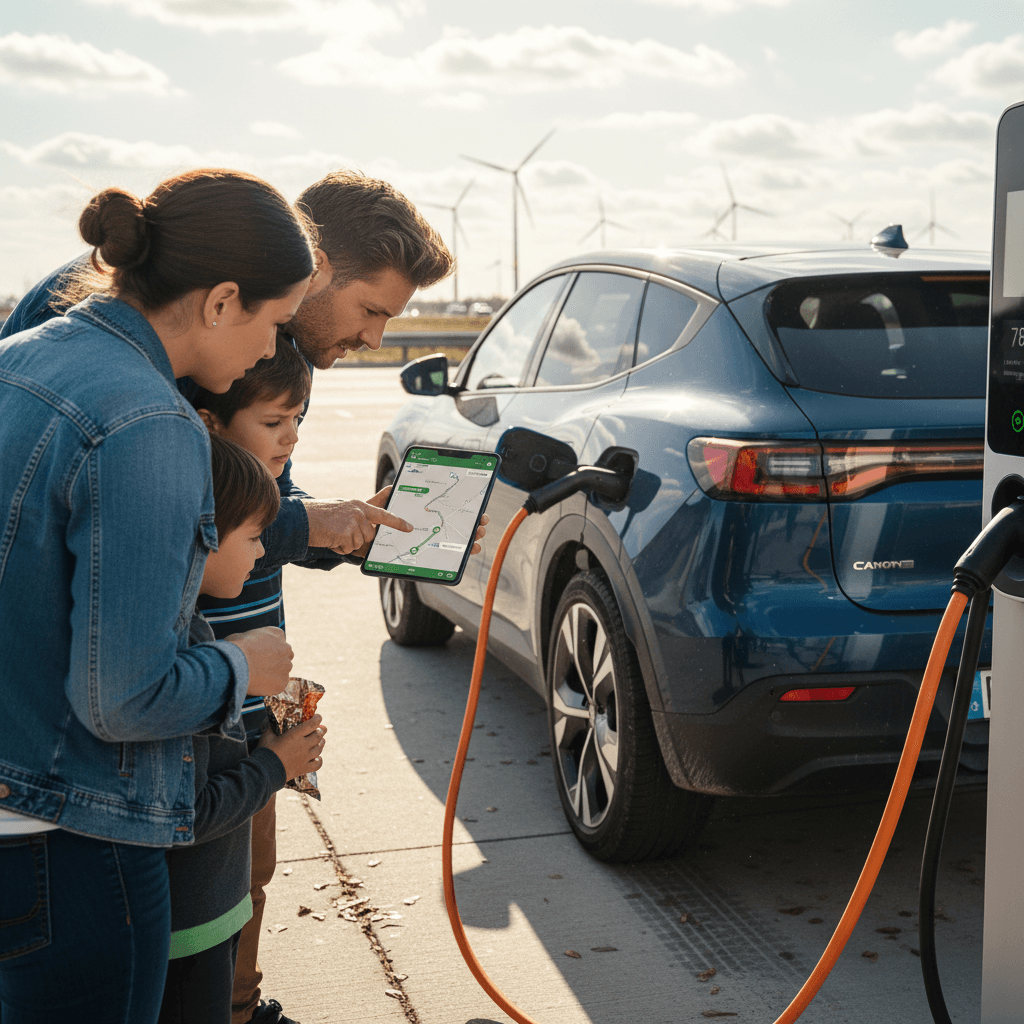
If you’re hauling kids, pets, or you’re due at Grandma’s by 5 p.m. sharp, your margins feel smaller. The trick is to decide up front where you’re willing to be flexible, arrival time, sightseeing, meal stops, so you’re not making stressed decisions on the fly.
Traveling with kids or a full crew
- Favor chargers with nearby restrooms, green space, or indoor seating. Apps like PlugShare and ChargeHub include amenity filters and user photos.
- Plan your longest charging stop to overlap with a full meal. Walking to a sit‑down restaurant next door feels much better than eating in the car while staring at a charger.
- Let older kids “own” one leg of the trip, have them watch projected arrival SoC and call out when it’s time to adjust speed or plan a stop. Turning them into co‑pilots reduces back‑seat impatience.
Tight schedules and hard arrival times
- Build one extra short charging stop into the plan. You may not need it, but it’s there if traffic, weather, or a busy charger steals your buffer.
- Stick to chargers within a quarter‑mile of the highway when possible. Cute downtown stations are fun, but threading a trailer or three‑row SUV through city traffic eats time.
- Leave with 100% from home or your hotel, then shift to 10–80% fast‑charge cycles the rest of the day for the best balance of speed and predictability.
Book chargers like you book rooms, when you can
Using a used EV for road trips: Battery health matters
If you’re road‑tripping in a used EV, your biggest question is usually, “How much battery do I really have left?” A car that started life with 300 miles of rated range might effectively be a 240‑ or 260‑mile car after years of fast charging and hot summers, and that’s perfectly usable if you know it up front.
Quick checks before you take a used EV cross-country
Know your real range and you’ll plan smarter, not shorter.
Check current range at 100%
Do a 50–100 mile test loop
Get a battery health report
Why Recharged focuses on battery health
FAQ: EV range anxiety and road trips
Your top EV road trip questions, answered
Bringing it all together
Range anxiety thrives in the gaps between what you think might happen and what you actually know. Once you understand your EV’s true highway range, plan your charging like a pro, and give yourself sensible buffers and backups, that tight feeling in your chest loosens. You stop staring at the battery gauge, and you start noticing the mountain ranges, the diners, and the goofy billboards again.
Whether you’re driving a brand‑new EV or a carefully chosen used one, the same EV range anxiety road trip tips apply: plan ahead, charge smart rather than full, and pack for comfort and contingencies. If you’re still shopping for the right electric road‑trip partner, Recharged can help you find a used EV with verified battery health, fair pricing, and expert guidance, so the only thing you’re worrying about is which road to take next.