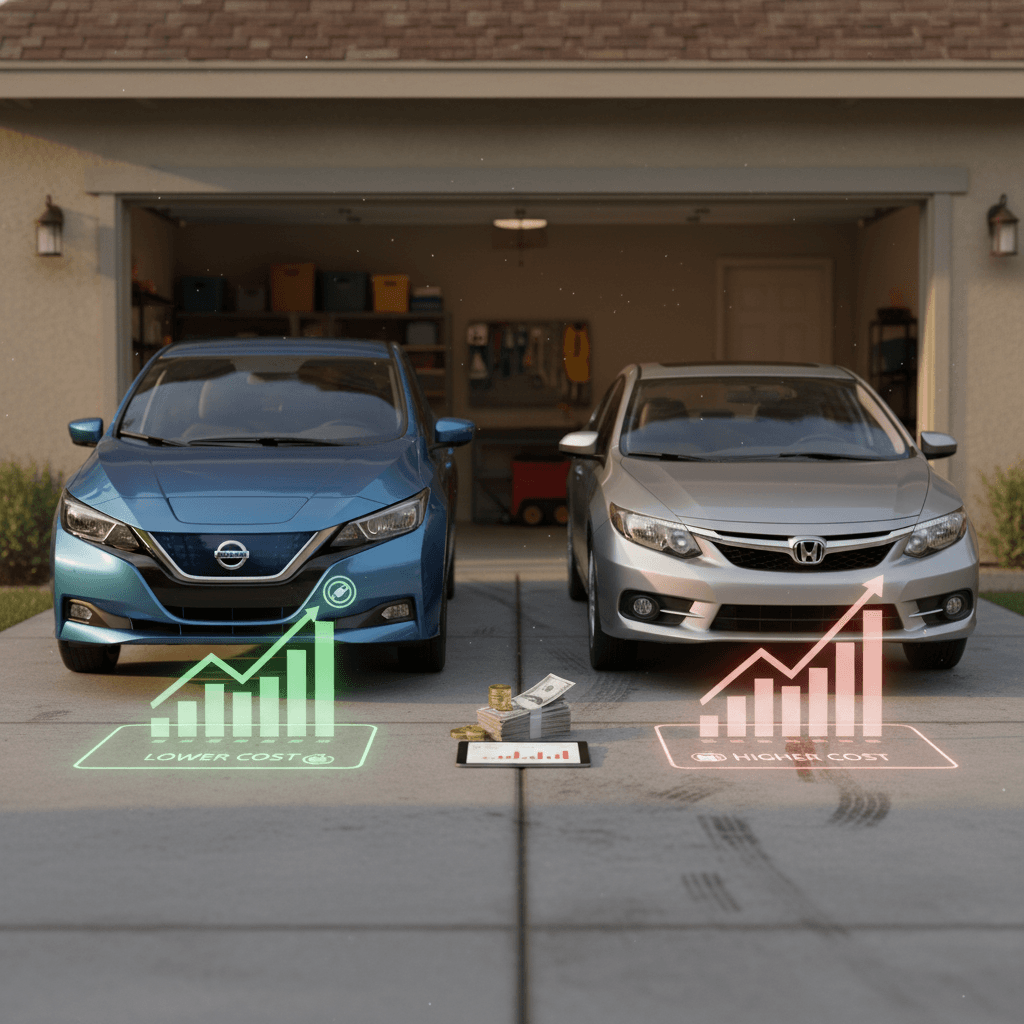
If you’re comparing EV maintenance cost vs gas, you’re really asking one thing: “Once I get this car home, which one is going to keep raiding my checking account?” The good news is that, in 2025, most electric vehicles are simply cheaper to keep on the road than comparable gas cars, especially on maintenance and routine repairs.
Key takeaway
EV maintenance cost vs gas: the short version
EV vs gas maintenance at a glance
Put simply, EVs usually win on routine maintenance. No oil changes, far fewer moving parts, and less brake wear thanks to regenerative braking all add up. Gas cars fight back with cheaper insurance and simpler body and collision repairs, but when you isolate maintenance and mechanical repair, EVs come out ahead in most real‑world budgets.
A quick rule of thumb
How EV maintenance actually differs from gas cars
What gas cars need regularly
- Oil and filter changes every 5,000–10,000 miles.
- Spark plugs and ignition components roughly every 60,000–100,000 miles.
- Transmission service and, eventually, transmission repairs.
- Belts, hoses, exhaust, emissions gear that age out over time.
- More frequent brake jobs in stop‑and‑go driving.
What EVs need instead
- Tire rotations and replacements (EVs are heavier and can wear tires faster).
- Brake fluid changes every few years, but brake pads can last a very long time.
- Coolant service for the battery and power electronics at longer intervals.
- Cabin air filters and standard wear items like wiper blades.
- Occasional software updates, often done over‑the‑air at no visit cost.
Don’t confuse maintenance with repairs
EV vs gas maintenance costs by the numbers
Let’s translate cents‑per‑mile into something you can actually use when you’re shopping.
Illustrative annual maintenance costs (15,000 miles/year)
Using representative 2024–2025 cost‑per‑mile figures for typical compact or midsize vehicles. Your exact model and driving style will vary.
| Powertrain | Assumed maintenance cost per mile | Estimated annual maintenance (15,000 miles) | What drives the cost |
|---|---|---|---|
| Battery‑electric EV | $0.03–$0.06 | $450–$900 | Tires, brake fluid, coolant, filters; far fewer engine‑like components. |
| Hybrid / plug‑in hybrid | $0.05–$0.08 | $750–$1,200 | Has both an engine and an electric system; still needs oil changes. |
| Conventional gas (ICE) | $0.06–$0.10 | $900–$1,500 | Oil and filters, plugs, belts, transmission service, more frequent brake work. |
Approximate averages for mainstream vehicles, not luxury or high‑performance models.
Real‑world studies back this up
Example: same driver, EV vs gas sedan
15,000 miles per year, kept for 8 years
Gas sedan
Maintenance only
- Cost per mile: about $0.08
- Annual miles: 15,000
- Annual maintenance: ≈ $1,200
- 8‑year total: ≈ $9,600
Electric sedan
Maintenance only
- Cost per mile: about $0.04
- Annual miles: 15,000
- Annual maintenance: ≈ $600
- 8‑year total: ≈ $4,800
Estimated maintenance savings: about $4,800 over 8 years, before we even talk about fuel.
Add fuel and the gap widens
What happens over 5–10 years of ownership
Where EVs really stretch their legs is over time. The longer you keep the car, and the more miles you pile on, the more those lower per‑mile maintenance costs matter.
- Short‑term (first 3 years): Maintenance differences are relatively small for new cars. You’ll skip oil changes in an EV, but most new gas cars don’t need big services yet either.
- Medium‑term (years 4–7): Gas cars begin needing bigger jobs, plugs, belts, transmission service, more frequent brakes, while many EVs are still on tires, filters, and inspections.
- Long‑term (8+ years): A well‑maintained gas car can keep going, but repairs stack up. An EV that’s cared for can still be relatively simple to maintain, assuming the battery pack remains healthy.
Maintenance milestones: EV vs gas over 10 years
Typical gas compact SUV
Year 1–3: Oil changes, tire rotations, maybe first brake job in heavy city use.
Year 4–6: Spark plugs, more brake work, transmission fluid service, accessories and belt replacements start to show up.
Year 7–10: Higher odds of bigger repairs, exhaust, transmission, engine seals, emissions hardware. Bills get spikier.
Typical battery‑electric SUV
Year 1–3: Tire rotations, cabin filter, basic inspections. Software updates handled in the background.
Year 4–6: Brake fluid service, tires, maybe the first real out‑of‑warranty repair, but far fewer components to fail.
Year 7–10: Similar tire and fluid work, plus whatever age‑related items crop up. Battery and motor are usually still under or recently out of warranty.
Repairs and “big bills”: batteries, engines, and more
Whenever you mention cheap EV maintenance, someone will ask, “Yeah, but what about the battery?” That’s fair. A replacement pack can be a big number. But it’s not the automatic budget killer social media makes it out to be.
Big‑ticket items: what’s realistically on the table?
What you should actually budget for, by powertrain
Gas engine & transmission
- Major engine repair or replacement can easily run four figures.
- Automatic transmission rebuilds are also expensive.
- These failures are rare but not unheard‑of on higher‑mileage cars.
EV traction battery
- Most modern EVs carry 8–10 year / 100k+ mile battery warranties.
- Outside warranty, a full pack can be expensive, but replacement rates are still low.
- Partial repairs, module replacements, and dropping battery prices are helping.
Shared risks: accidents & electronics
- Collision damage can be pricey for any modern vehicle with sensors and cameras.
- Electronics and infotainment issues show up in both EVs and gas cars.
- Good insurance and a proper pre‑purchase inspection are your best defense.
Don’t skip the pre‑purchase inspection
Used EVs: where maintenance savings really shine
If you’re shopping on a budget, the used EV market has become especially interesting. Prices on many used electric models fell sharply in 2024–2025, in some cases landing right in line with similar used gas cars. That means you can get the lower maintenance and fueling costs of an EV without paying a new‑car premium.
Why used EVs can be a bargain
- Steep early depreciation is your gain as a second owner.
- You still benefit from remaining battery warranty on many 3–7‑year‑old EVs.
- Most early expensive bugs have been fixed under the first owner’s warranty.
- Lower maintenance and fueling costs kick in from day one.
What to check before you buy
- Battery health: capacity loss and any prior battery‑related repairs.
- Service history: look for regular tire, brake, and fluid maintenance.
- Charging history: home vs DC fast charging, which can affect battery aging.
- Software status: make sure the vehicle is up to date and supported.
Buying through a platform like Recharged gives you a verified Recharged Score Report with battery diagnostics and fair‑market pricing baked in.
Checklist: minimizing maintenance risk on a used EV
1. Start with vehicles that still have battery warranty
An 8–10 year battery warranty can cover you for much or all of your ownership. Check in‑service date, mileage limits, and whether the warranty transfers.
2. Review the Recharged Score or equivalent report
Look for clear, quantified battery health data, open recall status, and major repair history. Avoid listings that can’t document this information.
3. Compare expected maintenance to your current gas car
Estimate your current annual maintenance and fuel spend. Then compare it to an EV’s likely maintenance plus electricity at your local rates. The gap can be wide.
4. Get a shop comfortable with EVs
Identify a local dealer or independent shop that knows high‑voltage systems. Even with fewer services, you want the right expertise nearby.
Beyond maintenance: the rest of the ownership cost story
Focusing on EV maintenance cost vs gas is smart, but you shouldn’t ignore the rest of the financial picture. Maintenance is just one piece of the total cost of ownership puzzle.
Other cost factors where EVs and gas cars trade punches
Maintenance is not the only line on the spreadsheet
Fuel vs electricity
EV advantage. Even with rising electricity prices, the average cost per mile for charging is typically 2–3× lower than gasoline, especially if you can charge at home on a normal residential rate.
Insurance
Gas advantage (for now). On average, EVs often carry higher insurance premiums because of pricier parts and fewer repair shops. As more EV‑qualified shops open, this gap is slowly narrowing.
Depreciation & resale
Mixed. Some EVs have depreciated faster than gas cars, which hurts first owners but makes used EVs unusually affordable. Gas models have more predictable resale patterns, but that gap is changing as EVs go mainstream.
Think in total cost, not just the payment
How to estimate your own EV vs gas maintenance costs
You don’t need a Ph.D. in spreadsheets to get a handle on this. A few quick assumptions will get you close enough to make a good decision.
DIY: 10‑minute EV vs gas cost comparison
1. Pull your current maintenance records
Look at what you’ve spent on oil changes, brakes, and other services over the last 12–24 months. Divide by your miles to get a rough per‑mile figure for your gas car.
2. Estimate EV maintenance per mile
For a mainstream EV, using <strong>$0.04 per mile</strong> is a reasonable starting point. Multiply by your annual miles to get an annual estimate.
3. Plug in local energy prices
Check your electric rate on your utility bill and a realistic home‑charging efficiency (often 3–4 miles per kWh). Compare that to your local gas price and your typical MPG.
4. Project out 5–8 years
Multiply your annual fuel and maintenance estimates by the number of years you expect to keep the car. The total savings is often easier to appreciate than arguing about pennies per mile.
5. Add a repair cushion
For both EVs and gas cars, set aside a small yearly amount, say $300–$500, as a cushion for unexpected repairs. That way a surprise bill doesn’t derail the math or your budget.
FAQ: EV maintenance cost vs gas
Frequently asked questions about EV vs gas maintenance
Bottom line: when an EV makes financial sense
When you cut through the noise, the pattern is clear: if you drive a typical number of miles and plan to keep the car for at least a few years, EV maintenance cost vs gas tilts strongly toward the EV. Lower routine service bills, fewer mechanical parts, and cheaper energy add up quietly in the background, month after month.
That doesn’t mean every EV is the right buy. Insurance, purchase price, and your access to home charging all matter. But if you can plug in where you live and you’re open to buying used, you can stack the deck heavily in your favor. A well‑chosen used EV with verified battery health can deliver thousands of dollars in real‑world savings compared with a similar gas model.
Make the numbers work for you
Ready to find your next EV?
Browse Vehicles