If you’re shopping for an electric car in 2026, you’ve probably heard conflicting stories: “The federal EV credit is gone,” “Maryland ran out of money,” “There are still rebates if you know where to look.” This guide to EV incentives in Maryland for 2026 cuts through that noise so you can see what’s actually available when you buy or own an EV today.
Key 2026 reality
Overview: EV incentives in Maryland for 2026
What’s essentially gone in 2026
- Federal new clean vehicle credit (30D) – Ended for vehicles acquired after September 30, 2025, under the One Big Beautiful Bill Act.
- Federal used clean vehicle credit (25E) – Also ended for vehicles acquired after the same date.
- Most Maryland EV excise-tax credits – FY 2026 funding is reported as depleted, and earlier applications have priority.
What’s still helping Maryland EV drivers
- Utility rebates for Level 2 home chargers and some public charging installations (BGE EVsmart, Pepco, and others).
- Lower fueling and maintenance costs versus gas vehicles, which matter more now that purchase tax credits are scarce.
- Used EV price drops after the federal credits sunset, which can narrow the gap even without a tax credit.
EV costs and incentives heading into 2026
Federal EV tax credits in 2026: What actually changed
For years, the federal government carried much of the EV-incentive load. That changed abruptly. The Inflation Reduction Act’s new clean vehicle (30D) and used clean vehicle (25E) credits originally ran through 2032, but the One Big Beautiful Bill Act (OBBBA), signed in mid-2025, shut them down early. As of 2026:
- You generally cannot claim a federal clean vehicle credit for a car you acquire after September 30, 2025.
- If you ordered and legally “acquired” a qualifying EV on or before September 30, 2025, but take delivery in 2026, you may still be able to claim the old credit rules on your 2025 return.
- The point-of-sale transfer feature (credit applied as an instant rebate at the dealer) still has to be reconciled on your tax return if you used it before the cutoff date.
- The separate federal credit for charging equipment (30C) survives into 2026 but is scheduled to end for new installations after June 30, 2026. That matters if you’re installing higher-cost charging at a business or multi-unit property.
Not tax advice
Maryland state EV excise-tax credit status in 2026
Maryland has been one of the more EV-friendly states, offering an excise-tax credit for plug-in electric and fuel cell vehicles that ran from January 1, 2023 through June 30, 2026. The credit amount depended on battery size and vehicle price caps, and it was limited by annual funding.
Here’s where that stands as of early 2026:
Maryland plug-in EV excise-tax credit snapshot for 2026
Summary of how Maryland’s state-level EV purchase credit looks heading into FY 2026.
| Item | Details for 2026 |
|---|---|
| Program window | Statutory dates January 1, 2023 – June 30, 2026 for qualifying plug-in and fuel cell vehicles. |
| Funding status | Maryland’s DOT/MVA has announced that funding for the FY 2026 credit is exhausted, with prior-year applications taking up remaining funds. |
| Practical effect for 2026 buyers | If you buy an EV in calendar-year 2026, you should assume no Maryland excise-tax credit is available unless the legislature adds new funding or creates a new program. |
| What if you applied earlier? | If you bought an eligible EV when funds were still available and submitted a timely application, your credit depends on when your claim was queued, not on your 2026 purchase plans. |
| Future outlook | Lawmakers could revive or redesign the program in a later session, but nothing new is guaranteed yet. |
Funding, dates, and what a shopper in 2026 needs to know.
How to double-check the state credit
Maryland EV charging equipment rebates and programs
Even with purchase credits drying up, Maryland residents can still tap into EVSE (Electric Vehicle Supply Equipment) incentives, that is, rebates to help pay for a home or workplace Level 2 charger. These aren’t tax credits, but they directly cut your out-of-pocket costs.
Key EV charging incentives affecting Maryland drivers
Most of these run through the Maryland Energy Administration (MEA) or your local utility.
MEA residential EVSE rebates
Historically, the Maryland Energy Administration has offered limited-time rebates for installing qualified Level 2 chargers at homes, subject to annual funding caps.
These programs have opened and closed as funds are renewed, so if you’re planning a home install in 2026, check MEA’s current EVSE program page before you buy equipment.
Multifamily & workplace EVSE support
Maryland has supported Level 2 chargers in multifamily buildings and workplaces, often with per-port rebates that reduce install costs for property owners.
Renters can benefit when a landlord participates, even though you don’t receive the rebate yourself.
Federal 30C commercial credit (through mid-2026)
For businesses and certain multi-unit properties, the federal alternative fuel infrastructure credit (30C) can still apply to qualifying charging projects started before mid-2026.
If your employer or building owner is adding chargers, this can stack with Maryland or utility funds.
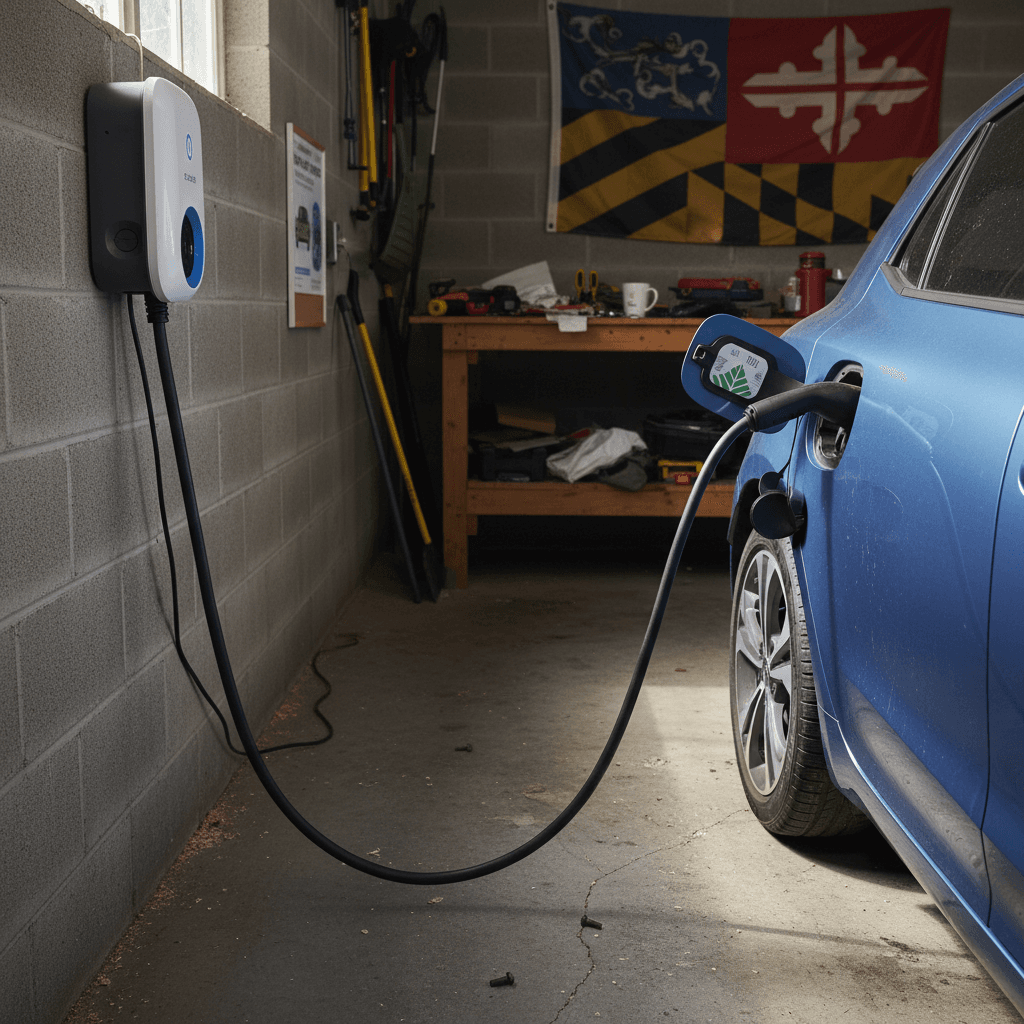
Local utility EV incentives: BGE, Pepco, SMECO and others
Some of the most valuable 2026 savings are hyper-local. Maryland utilities are using EV programs to manage load growth, meet state climate goals, and improve grid planning. In return, they offer EV drivers rebates and special rates. Exact details change regularly, but here’s how the landscape looks in 2026.
Examples of Maryland utility EV incentives in 2026
Utility offerings and how they typically benefit EV drivers. Always confirm current terms with your own utility.
| Utility (examples) | Incentive type | What it can mean for you |
|---|---|---|
| BGE (Baltimore Gas & Electric) | EVsmart residential rebates, charger referral program, public-charging initiatives | Rebates toward the purchase and installation of a Level 2 home charger; some support for multifamily and workplace charging. |
| Pepco (Central Maryland & D.C. suburbs) | Home charger rebates and off-peak rate options | Cash back or bill credits if you install a qualified charger and enroll it, plus lower off-peak energy prices in some rate plans. |
| SMECO & other co-ops | Rebates plus time-of-use or EV-only rates | Regional cooperatives may offer installation rebates or special EV rates to encourage nighttime charging. |
| Municipal utilities | Smaller programs or pilot projects | In certain cities, you may see limited-time pilots with free or discounted public charging or small home-charger rebates. |
Programs vary by service territory, but many Maryland drivers can save on home charging.
Call your utility before you install
How much can a Maryland driver still save?
Without the big federal and state purchase credits, EV shopping in 2026 feels very different than it did just a year or two ago. But when you add up utility programs, lower fueling costs, and a buyer-friendly used-EV market, the total savings can still be meaningful.
Example 1: Home Level 2 charger in Maryland
- Hardware and basic installation: $700–$1,500 for many homes.
- Typical utility rebate: $300–$1,000+, depending on program and year.
- Net cost: Often $400–$800 out of pocket after rebates.
- Convenience gain: Full overnight charging at off-peak rates, less reliance on pricey DC fast charging.
Example 2: Fuel savings vs. a gas car
- Many Maryland drivers pay the equivalent of $1–$1.50 per gallon when charging at home, depending on their rate and efficiency.
- Over 10,000–12,000 miles a year, that can mean $600–$1,000+ in annual fuel savings vs. a 25–30 mpg gas car.
- Maintenance, no oil changes, fewer brake jobs, can add a few hundred dollars a year in savings.
Where used EVs shine in 2026
Strategies to maximize savings with used EVs in 2026
If you can’t lean on big federal or state purchase credits, the way you shop matters more. For many Marylanders, a used EV is now the most cost-effective route into electric driving, especially if you’re careful about battery health and total ownership costs.
Smart 2026 strategies for Maryland used-EV shoppers
Focus on value, battery health, and real-world running costs.
Prioritize verified battery health
A used EV’s battery is its single most expensive component. Look for independent battery diagnostics rather than guessing from the dashboard range estimate.
Every used EV sold through Recharged includes a Recharged Score Report with verified battery health, so you know what you’re buying before you sign.
Shop transparent pricing
Without tax credits to cushion the blow, fair upfront pricing matters. Compare market values for similar EVs, mileage, and options.
Recharged benchmarks each vehicle against the broader used-EV market and shows where it lands, so you can spot over‑ or under‑priced cars at a glance.
Match range to real driving
Don’t overpay for range you’ll never use. If you mostly commute around Baltimore or the D.C. suburbs, a used EV with 180–220 miles of real-world range might be plenty.
If you road trip frequently, consider a longer-range EV and budget for occasional DC fast charging.
Leverage digital-first buying
Step-by-step checklist before you buy an EV in Maryland
Maryland EV buyer checklist for 2026
1. Confirm what incentives still exist for you
Start by checking the latest info on (a) federal charging-equipment credits if you’re installing more complex infrastructure, (b) the Maryland Energy Administration’s EVSE rebates, and (c) your local utility’s EV programs.
2. Call your utility before buying a charger
Ask whether they offer a rebate, which Level 2 chargers qualify, and whether you must enroll the device in a specific program or rate plan to receive benefits.
3. Decide whether new or used makes more sense
With big federal and state credits gone, run the numbers. A late-model used EV with healthy battery life and verified history may undercut a new EV’s lifetime cost by thousands.
4. Get battery health data, not just a test drive
Schedule a pre-purchase battery health check or choose a marketplace that includes it. The Recharged Score Report, for example, tests real battery capacity so you can compare vehicles apples-to-apples.
5. Estimate your at-home charging costs
Look at your current kWh rate, ask about time-of-use or EV rates, and estimate your annual miles. This helps you compare fuel savings against a similar gas vehicle realistically.
6. Plan your home charging installation
Line up a licensed electrician, verify your panel can handle a Level 2 circuit, and collect any documents your rebate program requires before and after installation (photos, permit copies, invoices).
7. Explore EV‑friendly financing
With incentives thinner, your loan structure matters. Recharged offers EV‑specific financing and trade‑in options that can reduce your monthly payment without relying on disappearing tax credits.
FAQ: EV incentives in Maryland for 2026
Frequently asked questions about Maryland EV incentives in 2026
Bottom line for Maryland EV incentives in 2026
EV incentives in Maryland for 2026 don’t look like the headlines from a few years ago. The marquee federal purchase credits have effectively ended, and Maryland’s excise-tax funding has been spoken for. But that doesn’t mean the window has closed on smart, affordable EV ownership.
Your biggest levers now are choosing the right vehicle at the right price, taking full advantage of utility and charging rebates, and keeping your running costs low with efficient at-home charging. For many drivers, that points squarely toward a carefully chosen used EV.
If you want help navigating that landscape, Recharged was built for exactly this moment. Every used EV comes with a Recharged Score battery-health report, transparent fair-market pricing, expert EV support, and a digital-first process that fits your schedule. With incentives changing fast, the most dependable savings in 2026 come from choosing the right car, and the right partner, up front.