If you’re shopping for an electric vehicle in 2026, you’ve probably heard the bad news: the big federal EV tax credit for most buyers ended for vehicles placed in service after September 30, 2025. But that doesn’t mean the deals are gone. Today, the real savings come from a patchwork of EV incentives in 2026 by state, plus utility rebates, charger credits, and aggressive pricing on new and used EVs.
Why 2026 feels confusing
EV incentives in 2026: the new landscape
What EV incentives look like in early 2026
Instead of one big federal check, 2026 is about stitching together smaller but still meaningful programs. Some states, like New Jersey, Colorado, Oregon, and Vermont, still offer robust point-of-sale rebates or state tax credits. Others may not give you cash up front but help through reduced registration fees, HOV lane access, or utility bill credits for charging at home.
How EV incentives work (and what changed after 2025)
Before October 1, 2025
- Up to $7,500 federal Clean Vehicle Credit for many new EVs, often claimed at tax time.
- Up to $4,000 for qualifying used EVs under the Used Clean Vehicle Credit.
- Point-of-sale options at some dealers where the credit reduced your price immediately.
- Separate 30% federal tax credit for home charging equipment, scheduled to run through June 30, 2026.
After September 30, 2025
- The main federal tax credit for most new and used EV purchases ended for vehicles placed in service after that date.
- The home charger credit is still available for qualifying equipment installed through June 30, 2026.
- State and utility programs play a much bigger role, many are income-capped or vehicle-price capped.
- Manufacturers and dealers have responded with steeper discounts, especially on EVs that lost federal eligibility.
Watch those dates
The best EV incentive states in 2026
States that still stand out for EV incentives in 2026
Exact amounts change often, but these programs are worth a very close look.
New Jersey
Charge Up New Jersey remains one of the strongest state programs in 2026, offering a point-of-sale rebate of up to several thousand dollars on eligible new EVs below a set MSRP cap. Combine that with the state’s longstanding sales tax exemption on qualifying EVs, and New Jersey buyers can cut a big chunk off their out-the-door price.
Colorado
Colorado has leaned hard into EVs with a state income-tax credit on new EV purchases and additional support through the Vehicle Exchange Colorado (VXC) program. VXC boosts point-of-sale rebates when lower-income drivers trade older, higher-emitting vehicles for new or used EVs, funding that extends into the 2026 fiscal year.
Oregon & Vermont
Oregon continues to offer generous Clean Vehicle and Charge Ahead rebates, which can reach several thousand dollars for income-qualified buyers, and in some cases include used EVs. Vermont layers a statewide EV incentive on top of extra money for lower-income and rural residents, plus occasional bonus rebates from regional utilities.
Other notable states
Massachusetts still funds its MOR-EV rebate program. Illinois plans to continue offering EV purchase rebates, though statewide amounts step down in 2026 compared with earlier years. Texas has reloaded its light‑duty EV rebate for up to a few thousand dollars on eligible purchases or leases, subject to funding windows and in‑state use requirements.
Follow the money, not the headlines
Regional snapshot: EV incentives by state in 2026
A true fifty‑state chart would be out of date the moment it’s printed. Instead, use this as a directional guide to what different regions tend to offer in 2026, and then confirm the latest details using the tools we’ll share below.
Typical EV incentives by U.S. region in 2026
Representative examples only. Actual eligibility, amounts, and timelines vary by state and program funding.
| Region / Sample States | Common 2026 EV Purchase Incentives | Used EV Support | Other Perks |
|---|---|---|---|
| Northeast (NJ, MA, NY, VT) | Point-of-sale rebates (often $1,500–$4,000+) on new EVs; some programs add bonuses for income-qualified buyers | New York and Vermont offer extra used-EV help through state or regional programs | Sales tax breaks in some states, HOV lane access, reduced registration fees |
| Mid-Atlantic & South (VA, NC, GA, TX) | Fewer direct state rebates, but select states like Texas offer time-limited purchase rebates funded through air-quality programs | Occasional pilot rebates or local grants for used EVs in select cities or counties | Utility bill credits for off-peak charging; discounted tolls or HOV access in limited corridors |
| Midwest (IL, MI, MN) | State rebates or tax credits in places like Illinois (though amounts may step down in 2026); some states emphasize fleet and rural EV funding | Emerging used-EV rebates in a few states; more common as part of vehicle-replacement or low-income programs | Discounted registration, emissions-test exemptions, or grants for charging infrastructure |
| Mountain West (CO, UT) | State tax credits and trade‑in programs (for example, Colorado’s income‑based Vehicle Exchange rebates) can stack with dealer discounts | Some funds earmarked for lower‑income buyers replacing older vehicles with used EVs | Robust public‑charging build‑out and time‑of‑use utility rates for home charging |
| West Coast (CA, OR, WA) | California’s big CVRP rebate has closed, but Oregon keeps strong purchase rebates alive; Washington leans more on sales‑tax breaks than cash rebates | Oregon provides significant used‑EV rebates for income‑qualified households; local programs in California and Washington fill gaps | HOV lane access, utility rebates, and large public‑charging investments are common |
| Alaska, Hawaii & smaller states | Fewer large statewide rebates, but a surprising number of utility and city-level programs offer smaller credits or charger rebates | Occasional pilot rebates for used EVs or carshare programs | Parking discounts, ferry or toll breaks, and local charging grants in select jurisdictions |
Use this table as a starting point, then verify details with state program websites or the DOE’s Alternative Fuels Data Center and similar databases.

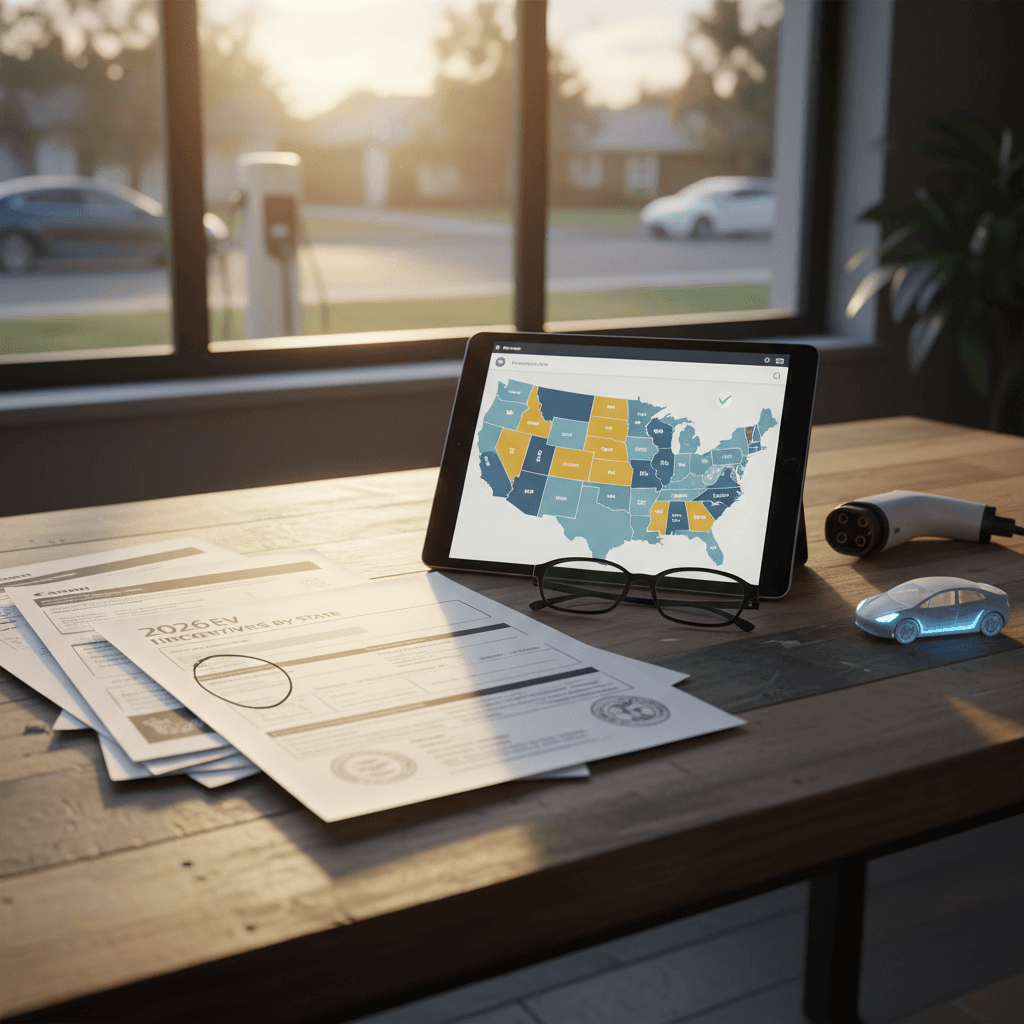
Use a live incentive map
Don’t skip utility and local EV rebates
If there’s a hidden treasure chest in the 2026 incentive world, it’s your electric utility. Even in states without big statewide rebates, utilities often offer $250–$1,000 or more for buying an EV, installing a home charger, or charging during off‑peak hours. Cities and air‑quality districts sometimes add their own small incentives on top.
Common utility-led EV incentives in 2026
These programs usually live on your power company’s website, under “electric transportation” or “EV programs.”
Vehicle purchase rebates
Some utilities offer a straightforward cash rebate, often a few hundred dollars, for customers who register a newly purchased EV with them. The paperwork is usually simple: proof of purchase, VIN, and a copy of your electric bill.
Home charger rebates or free equipment
Many utilities will pay part of the cost of a Level 2 home charger or even supply a basic unit at low or no cost. Others credit you for electrical panel upgrades if they’re needed to support EV charging.
Off‑peak charging rewards
Time-of-use rates and managed charging programs reward you for charging overnight. Some utilities send bill credits or prepaid cards if you enroll your EV in an app that automatically shifts most charging to low-demand hours.
Where to look first
Used EV incentives and why they matter in 2026
With many federal credits gone, the used EV market is where a lot of value has migrated. Prices on three‑ to six‑year‑old EVs have come down sharply compared with their new counterparts, and several state and local programs now target used vehicles specifically, especially for income‑qualified households.
- States like Oregon and Vermont earmark extra rebate dollars for used EVs, often with higher amounts for lower-income buyers.
- Vehicle “exchange” programs, such as Colorado’s VXC, encourage owners of older, higher‑emitting vehicles to swap into cleaner used EVs with generous point‑of‑sale support.
- Some city and regional air-quality districts (especially in California and the Northeast) fund used-EV pilots separate from statewide programs, with limited funding windows.
- Even without a formal used‑EV incentive, the gap between used and new EV pricing in 2026 can easily dwarf the value of the old federal tax credit.
How Recharged fits in
Ready to find your next EV?
Browse VehiclesHome charger incentives through June 30, 2026
One major federal incentive that still matters in 2026 is the Alternative Fuel Refueling Property Credit for home charging equipment. Thanks to recent legislation, this credit now runs only through June 30, 2026 for most households, so there’s a clear deadline on the calendar.
Key facts about the 2026 home EV charger credit
High-level overview of the federal credit for residential charging equipment and how it interacts with other programs.
| Item | Summary (2026 rules) |
|---|---|
| Credit percentage | Typically 30% of the cost of qualifying home charging equipment, including installation labor, subject to IRS limits. |
| Maximum benefit | Commonly capped at $1,000 per return for residential taxpayers in 2026. |
| Deadline | Applies to eligible charging equipment placed in service on or before June 30, 2026 under current law. |
| Stacking with state/utility programs | You may be able to combine the federal credit with state or utility rebates, but some programs reduce the eligible amount by other subsidies, read the fine print. |
| What qualifies | Generally Level 2 charging equipment installed at your primary residence; specialized requirements apply for commercial or multi‑family properties. |
Check current IRS instructions and Form 8911 (or its successor) when you file; this table is a simplified summary, not tax advice.
Don’t wait on panel work
How to stack incentives on a real-world EV purchase
Let’s put all of this into a single, realistic scenario. Imagine you’re buying a used electric crossover in early 2026 and plan to keep it for at least five years. You want to trim both the upfront price and your charging costs.
1. Choose the right state
You live in New Jersey, so you’re eligible for the Charge Up New Jersey program on certain new EVs or plug‑in hybrids under a price cap. If you decide new isn’t in the budget, you still benefit from the state’s sales‑tax treatment and any local grants for used EVs or chargers.
2. Shop smart for the car
You find a 3‑year‑old EV on Recharged with a strong Recharged Score and verified battery health. The seller is competitive because 2026 buyers aren’t chasing tax credits the way they were in 2024–2025. You negotiate a price that already bakes in some of the market’s shift away from over‑MSRP EVs.
3. Layer charger + utility perks
You install a Level 2 charger in your garage for $1,500 including labor. Between a 30% federal credit (up to $1,000), a $500 utility rebate, and enrollment in your utility’s off‑peak charging plan, you cut both the upfront and monthly costs of fueling your EV.
The net effect
Checklist: How to find your EV incentives by state
Your step‑by‑step guide to EV incentives in 2026
1. Confirm where the car will be registered
Incentives usually follow the state where you register the vehicle, not where you happen to buy it. If you’re moving or have multiple residences, figure that out first.
2. Use a national incentive finder
Go to a national incentive database (for example, the DOE’s Alternative Fuels Data Center) and filter by your state, technology (battery electric or plug‑in hybrid), and whether you’re buying new or used.
3. Check your state’s official EV page
Search for “<strong>[your state] electric vehicle rebate</strong>” or visit the state energy or transportation department site. Look for program names like “Drive Clean,” “Charge Up,” “Exchange,” or “Clean Vehicle Rebate.”
4. Dive into utility and local programs
Visit your electric utility’s website and search “EV program” or “electric vehicle.” Then check your city or county for additional air‑quality or climate incentives that might apply.
5. Note every deadline and cap
Write down purchase windows, application deadlines, income limits, vehicle price caps, and any funding caps (for example, “rebates available for first 2,000 applicants”). These details can make or break your eligibility.
6. Talk to your dealer or marketplace early
If you’re buying through a dealer or a digital marketplace like <strong>Recharged</strong>, ask upfront which incentives they see other customers successfully claiming in your state, and whether paperwork support is available.
7. Plan financing with incentives in mind
Because many 2026 incentives are rebates or credits you receive after purchase, make sure your budget and loan terms still work without counting that money on day one.
FAQ: EV incentives by state in 2026
Frequently asked questions about 2026 EV incentives
Bringing it all together: using incentives to buy smarter
The era of simple, one‑size‑fits‑all federal EV tax credits is over, for now. But if you zoom in on EV incentives in 2026 by state, a more interesting picture appears. In the best‑supported states, you can still stack thousands of dollars in state, utility, and charger incentives on top of a softer EV market. Even in states without big headline rebates, home‑charging credits and local programs can quietly chip away at your total cost of ownership.
The key is to treat incentives as part of the shopping process, not an afterthought. Start with your state and utility, map out every program you realistically qualify for, and then shop for the right EV, new or used, with that plan in hand. If you’re browsing used EVs on Recharged, our battery‑health reports, fair pricing, and expert guidance make it easier to line up the right car with the right incentives, so you spend less time decoding acronyms and more time just enjoying the drive.