If you’re ready to move on from your electric vehicle, you’ll quickly run into the question of EV consignment vs dealer trade-in. Both promise a simpler experience than selling privately, but they work very differently, and in today’s softer used EV market, choosing the wrong path can cost you thousands of dollars.
Today’s used EV reality
Why EV sellers face a different decision than gas-car owners
With gas cars, the choice between consignment and dealer trade-in is mostly about convenience vs squeezing out a bit more value. With EVs, there’s an extra layer: battery health, fast-moving technology, and incentives all have an outsized impact on what your car is worth and how quickly it will sell.
What makes selling an EV different?
Three factors that don’t show up on a standard trade-in sheet
Battery health
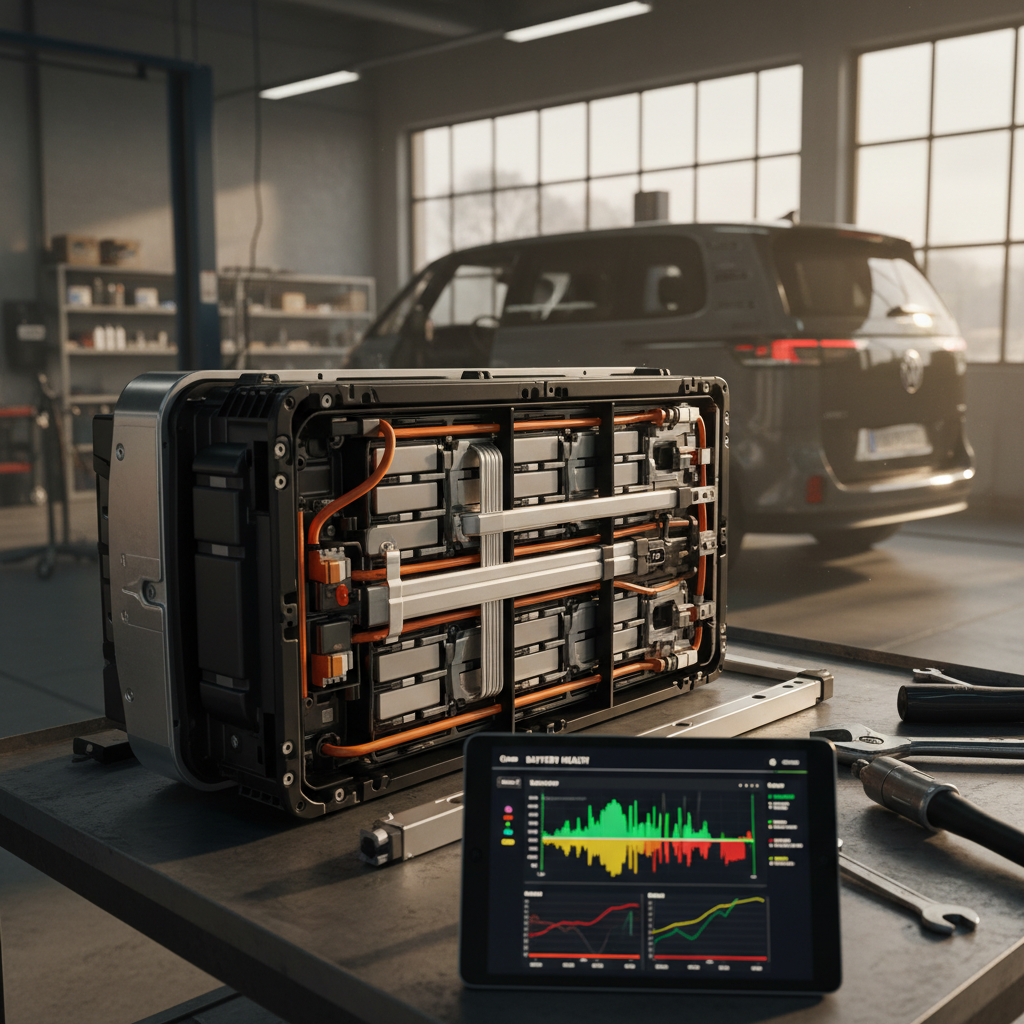
Two identical EVs with different State of Health (SOH) can have very different values. A buyer who understands batteries is often willing to pay more.
Tech changes fast
Price cuts and longer-range new models can drag down older EV prices quickly. Timing and pricing strategy matter more than with most gas cars.
Charging & features
Things like DC fast-charging support, NACS/CCS compatibility, and software options can sway value, if they’re explained well to buyers.
Why this matters for your choice
How EV consignment works
In a consignment sale, you still own the EV until it sells. You partner with a dealer or marketplace that markets and sells the car on your behalf in exchange for a fee or commission. Think of it as hiring a professional salesperson and showroom for your vehicle instead of selling it yourself.
- You agree on an asking (or minimum) price and the consignment term (often 30–90 days).
- The consignment partner inspects, photographs, and lists your EV on their site and major marketplaces.
- They handle test drives, buyer questions, financing, and paperwork.
- When the EV sells, they collect the buyer’s payment, deduct fees or their commission, and send you the balance.
Look closely at fee structures
Pros and cons of EV consignment
Higher upside, but not always the right fit
Pros
- Higher potential payout than a trade-in if your EV is in demand.
- Professional photos, listings, and buyer screening.
- No strangers coming to your home or meeting in parking lots.
- Access to buyers who want financing, warranties, and trade-ins.
Cons
- Not instant, you wait for the car to sell.
- Fees or commissions reduce the final amount you pocket.
- Some contracts lock you in for a set time.
- Limited control over how aggressively it’s discounted to move.
How dealer trade-ins work for EVs
A trade-in is the simplest route: you hand your EV to a dealer and they apply its value toward your next purchase. The dealer takes on the job of reconditioning and reselling it. For EVs, the basic process is the same as with gas vehicles, but how accurately they value an EV can vary widely by store and brand.
- Dealer appraises your EV, often leaning on auction data and generic book values.
- They make an offer, usually conservative enough to protect against price drops and reconditioning surprises.
- You accept the offer and the trade-in amount reduces your sales tax burden in many states.
- The dealer owns the car outright and decides whether to retail it or send it to auction.
Biggest strength of a trade-in
Pros and cons of dealer trade-ins for EVs
Fast and simple, but often less money
Pros
- Fastest way to dispose of your EV and get into another car.
- One transaction, one set of paperwork.
- Potential sales-tax savings on the trade difference, depending on your state.
- No need to worry about advertising, test drives, or post-sale issues.
Cons
- Lower offers, especially from dealers who don’t specialize in EVs.
- Appraisals may not reflect strong battery health or desirable EV options.
- Limited negotiating power if you’re focused on the monthly payment, not the trade value.
EV consignment vs dealer trade-in: key differences
EV consignment vs dealer trade-in at a glance
How the two options compare on the factors that matter most to EV owners
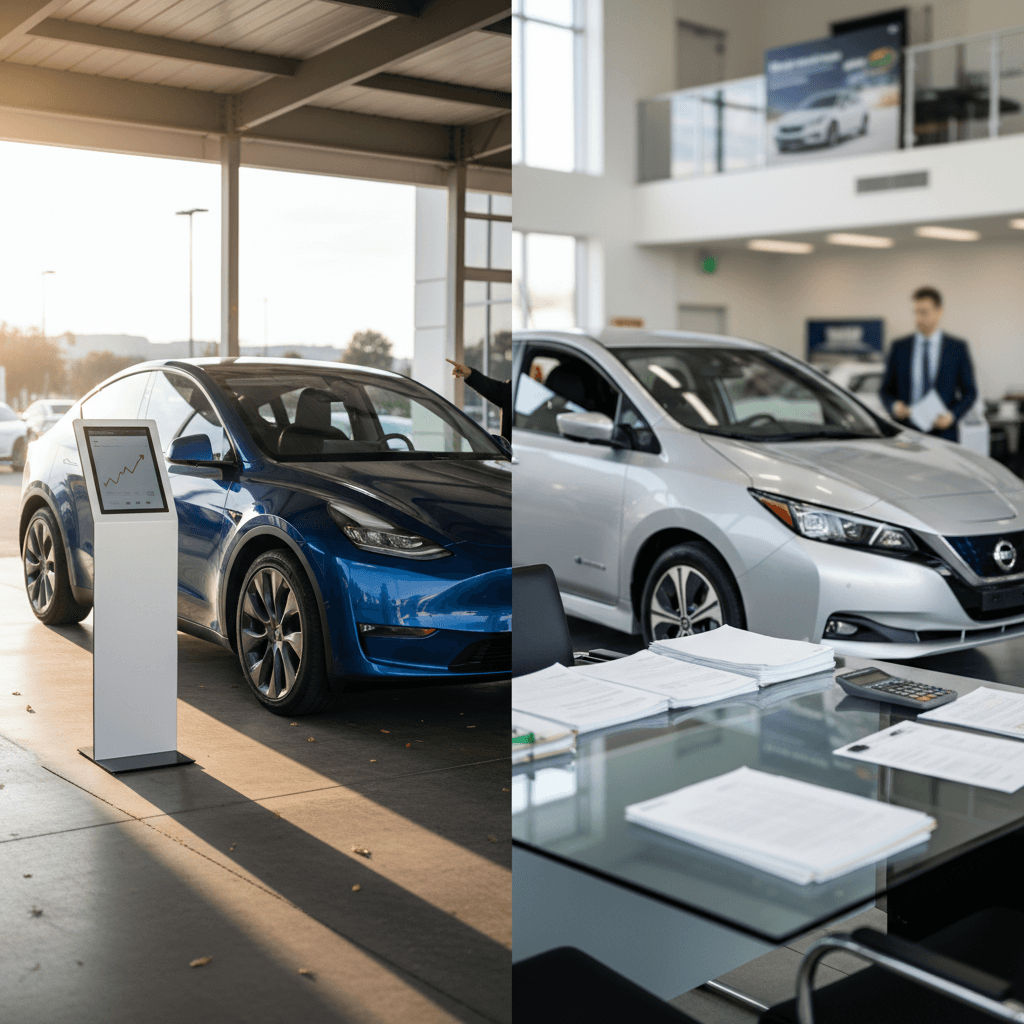
| Factor | EV consignment | Dealer trade-in |
|---|---|---|
| Payout potential | Higher, especially for clean EVs with strong battery health | Lower, dealer needs margin and cushions against price risk |
| Speed | Days to weeks, depending on demand | Same day in most cases |
| Risk of further EV price drops | You still own the vehicle until it sells | Dealer carries the price risk after trade |
| Effort | Low, partner handles marketing and showings | Very low, just the appraisal visit |
| Fees | Commission or fixed fee reduces sale price | No explicit fee, but offer is lower |
| Best fit for | Popular EVs, strong battery, flexible timing | Negative equity, quick switch, complex transactions |
Remember that actual dollars depend on your specific EV, mileage, battery health, and local market.
Why dealers are cautious with EV trade-ins
The hidden trade-in discount
Running the numbers: what you actually net
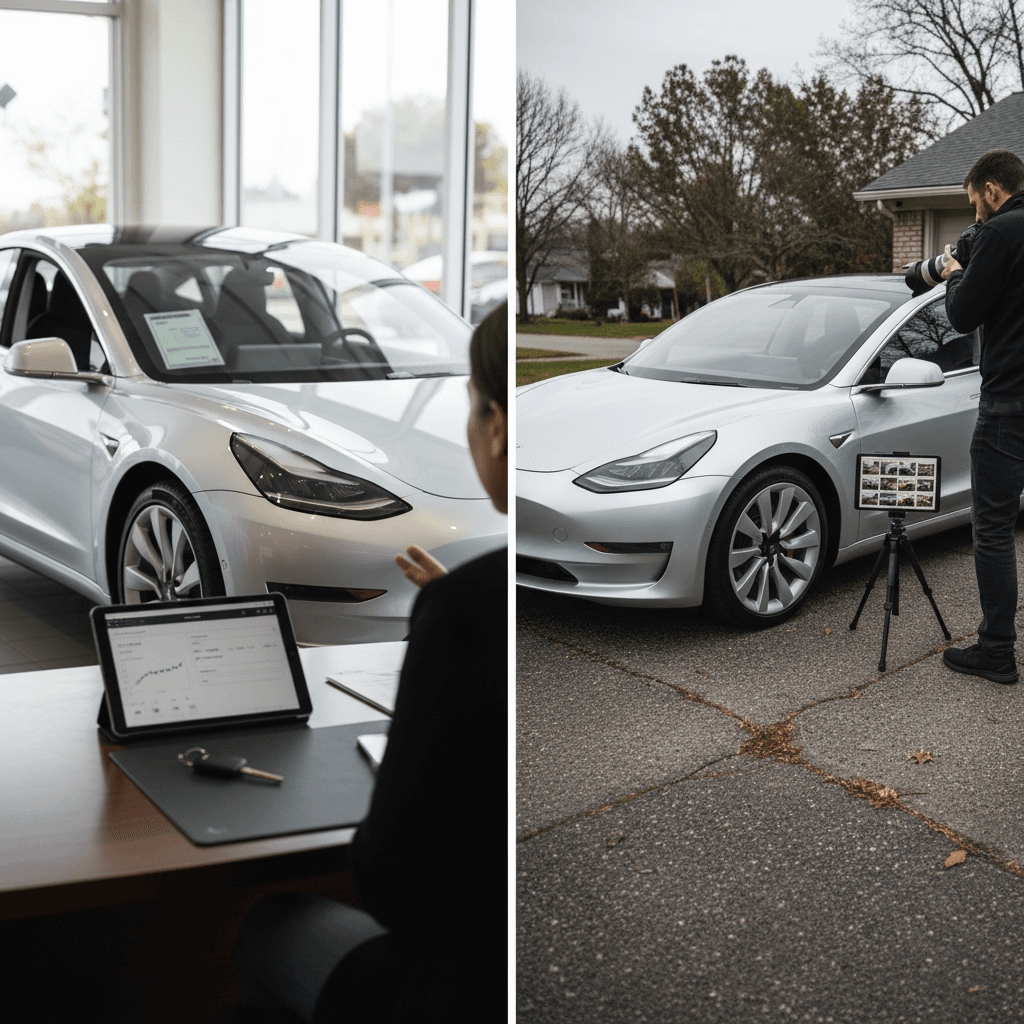
To decide between EV consignment vs dealer trade-in, you need to look past headline prices and focus on net proceeds, what ends up in your bank account after commissions, fees, and taxes.
Scenario 1: Strong used EV, no rush
Say your EV could realistically retail for $30,000 in today’s market.
- Dealer trade-in: Offer of $24,000 to allow for reconditioning, margin, and price risk.
- Consignment: Listed at $30,000, sells for $28,500 after some negotiation.
- Consignment fee of 7% (~$2,000).
Your net: ~$26,500 with consignment vs $24,000 trade-in. You waited a few weeks but gained roughly $2,500.
Scenario 2: Need to get out quickly
Same EV, but you’re relocating next week and can’t keep the car.
- Dealer trade-in: $24,000 and you’re done.
- Consignment: Realistically may not sell in time; you still own and insure it until it does.
Your net: Speed and certainty from the trade-in may be worth more than the extra money you could make with time and patience.
Always ask for both numbers
When EV consignment makes the most sense
Consignment leans toward value maximization. It’s usually the better fit if you’re more concerned with your bottom line than with being out of the car tomorrow.
You’re a strong candidate for EV consignment if…
Your EV is in great shape
Low mileage, clean history, and documented service make your car easier to market and justify at a higher price.
Battery health is verified and strong
You can provide a recent battery State of Health readout or a report like the Recharged Score, showing 80%+ SOH.
You’re flexible on timing
You can wait a few weeks for the right buyer, instead of needing everything wrapped up in a single day.
You want help telling the EV story
You’d rather let EV-savvy pros explain fast charging, software, and battery history than do it yourself with private buyers.
You’re not buried in negative equity
If your loan balance is close to or below your EV’s market value, consignment can usually be structured cleanly.
Where EV-focused consignment shines
When a dealer trade-in is the better move
EV consignment isn’t always the right answer. There are plenty of situations where a traditional trade-in, sometimes even at a non-EV-specialist store, solves real problems quickly.
- You’re upside down on your current EV loan and need help rolling negative equity into the next deal.
- You’re trading into a new car that has strong incentives, and the dealer can structure the whole package favorably.
- You’re moving, losing parking, or can’t easily store the EV while it’s being marketed.
- You have an older, limited-range EV that’s harder to retail and might be headed to auction anyway.
- You simply value speed and simplicity more than squeezing out every last dollar.
Trade-in tip for EVs
Special factors that shape used EV values
Before you choose EV consignment vs dealer trade-in, it helps to understand what’s really moving used EV prices in 2025–2026. Many of these factors aren’t obvious on a standard appraisal form, but they matter a lot to informed buyers.
Four levers that move your EV’s price
Where a specialist can add real money to your sale
Battery SOH
Real-world range
Charging standard
Software & options
Why documentation matters
How Recharged fits into your EV selling options
Recharged was built specifically around used EVs, with tools and services designed to surface the value that generic appraisals often miss. Instead of treating your car like just another used vehicle, Recharged starts with its battery and works outward.
What you get when you sell with Recharged
An EV-focused alternative to generic consignment or trade-ins
Recharged Score battery diagnostics
Multiple selling paths
Nationwide reach & delivery
Ready to find your next EV?
Browse VehiclesYou also get EV-specialist support to help you decide whether a faster instant offer, a consignment-style sale, or a trade-in tied to another purchase makes the most sense for your situation, and your bottom line.
Want to talk through your options?
Step-by-step checklist: consignment vs trade-in
Use this checklist before you sign anything
1. Get a realistic market value range
Use multiple sources, online valuations, marketplace listings for similar EVs, and EV-focused tools, to understand what your car is actually worth today.
2. Document battery health
Pull a recent battery State of Health report or request diagnostics (for example, via a Recharged Score) so buyers can clearly see pack condition.
3. Ask for a trade-in quote
Get written trade-in numbers from at least one dealer that sells your brand, and note any tax benefits that apply in your state.
4. Get a consignment or instant-offer estimate
Talk with an EV-focused consignment partner or marketplace. Ask what they expect to list it for, their fees, and typical time-to-sale for your model.
5. Compare net, not gross
Stack the options side by side: expected selling price minus fees vs trade-in offer plus tax savings. Decide how much premium you’d need to justify waiting.
6. Factor in timing and risk
Be honest about how quickly you need the deal done, and how comfortable you are holding the EV if prices soften further.
FAQ: EV consignment vs dealer trade-in
Frequently asked questions
Bottom line: which should you choose?
When you weigh EV consignment vs dealer trade-in, you’re really balancing three things: how much money you want to net, how fast you need the deal done, and how much pricing risk you’re willing to carry in a changing EV market.
If your EV has strong battery health, clean history, and you have some time, consignment or a marketplace like Recharged can often surface more value than a one-size-fits-all trade offer. If you’re on a tight timeline, dealing with negative equity, or simply want the cleanest path into your next vehicle, a dealer trade-in, ideally informed by solid EV-specific data, may be the smarter move.
Either way, take the time to understand your EV’s real market value, document its battery health, and compare net proceeds across options. A bit of homework now can easily be worth a four-figure difference in your check later, and that’s money you can roll straight into your next electric drive.