Driving an electric car in Minneapolis is getting easier every month, but the charging landscape can still feel like a moving target. Search for EV charging stations in Minneapolis, MN today and you’ll see everything from downtown parking ramps to DC fast chargers clustered along the interstates, and a mix of different networks, speeds, and prices. This guide pulls it together so you know where to plug in, what it will cost, and how to plan your life (and your road trips) around the chargers that already exist and the ones on the way.
Why this guide is different
Minneapolis EV charging at a glance
Minnesota & Minneapolis EV charging snapshot (early 2026)
Map data vs. reality
Where are EV charging stations in Minneapolis?
Most EV charging stations in Minneapolis fall into a few predictable buckets: downtown parking ramps, university and health‑care campuses, grocery stores and retail corridors, city facilities, and a growing number of DC fast sites near major highways. The Twin Cities also have the Evie Carshare network and some curbside chargers sprinkled through neighborhoods, but as a day‑to‑day owner you’ll lean heavily on Level 2 at home or work plus public DC fast charging when you’re in a hurry.
Typical places you’ll find chargers in Minneapolis
Think about where you already park, then layer in charging rather than driving just for electrons.
Downtown ramps & garages
Minneapolis has dozens of Level 2 ports in city‑owned ramps and private garages, especially around Target Field, the Warehouse District, and the central business district.
Ideal if you already commute or attend events downtown.
Hospitals, campuses & workplaces
Major employers, University of Minnesota facilities, and health‑care campuses often host Level 2 stations for staff and visitors.
These are great for “park all day” top‑ups.
Retail, groceries & hotels
Chains like Hy‑Vee, Target, some grocery stores, and newer hotels often host either networked Level 2 or DC fast chargers in their lots.
Useful for errands and overnight stays.
If you’re just getting familiar with the city’s EV ecosystem, start with a multi‑network app like PlugShare, A Better Routeplanner, or your car’s built‑in navigation. Once you see which networks you actually use, ChargePoint in a downtown ramp, say, or Electrify America along I‑94, install those specific apps and make accounts so you’re not downloading software in a freezing parking lot at midnight.
Downtown ramps and workplace charging
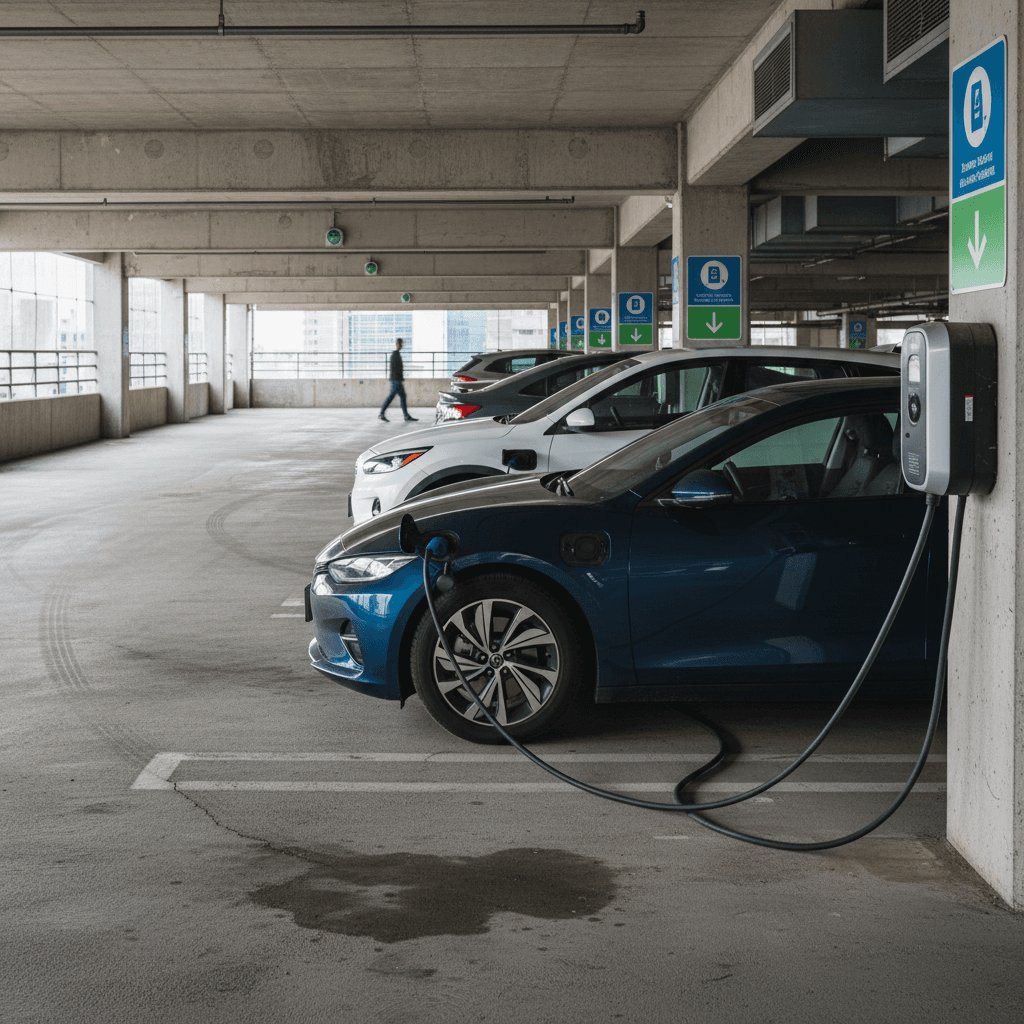
For a lot of Minneapolis EV drivers, downtown ramps are the backbone of public charging. The city and MPLS Parking have steadily added Level 2 stations to the ABC Ramps, Hawthorne Transportation Center, and other garages right where people already park for work and events.
Key downtown Minneapolis EV‑friendly ramps
Exact stall counts move around as equipment is added or upgraded, but these ramps are reliable starting points if you need electrons downtown.
| Ramp / Facility | Typical Charging Type | Network / Access | What to Know |
|---|---|---|---|
| ABC Ramps (A, B, C) | Level 2, some DC fast nearby | ChargePoint via MPLS Parking | Large downtown ramps serving I‑394 and North Loop; you’ll need a ChargePoint account to activate most stations. |
| Hawthorne Transportation Center | Level 2 | ChargePoint (often bundled with contract parking) | Popular with contract parkers. Check whether charging is included with your monthly parking or billed separately. |
| Leamington & Jerry Haaf | Level 2 | ChargePoint | Serve the central business district and U.S. Bank Stadium area, handy for events if you arrive early. |
| City & county buildings | Level 2 workplace focus | Mixed networks | Many city facilities have workplace chargers that may or may not be open to the public; signage on‑site usually spells it out. |
Always check the ramp operator or ChargePoint app for current availability and any fees before you roll in.
Pro tip for ramp charging
DC fast charging in and around Minneapolis
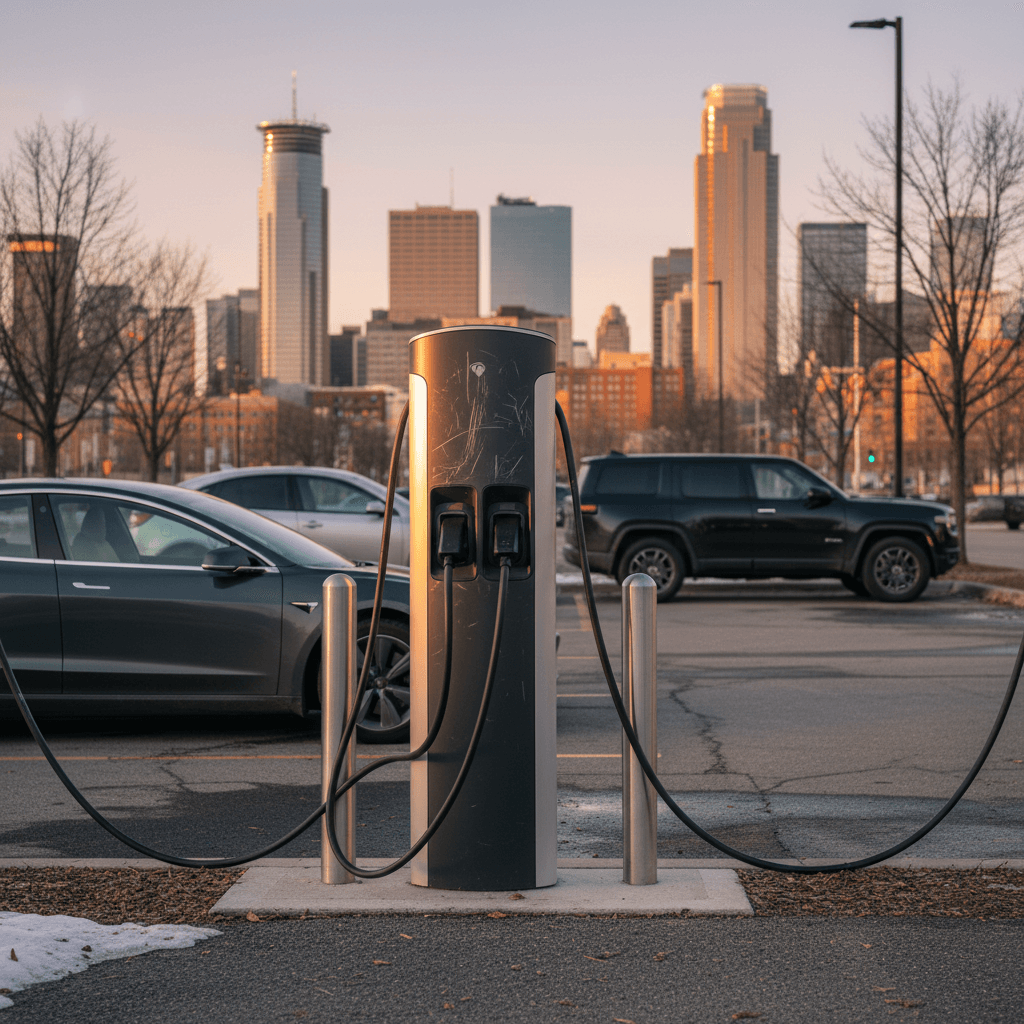
When you’re low on range or trying to cover ground quickly, you’ll skip the slower Level 2 chargers and hunt for DC fast charging instead. The greater Minneapolis area now has dozens of DC fast sites, with new locations opening along I‑94, I‑35, and key state highways as Minnesota taps federal NEVI funds and private investment.
- Electrify America: Large multi‑stall sites at select big‑box retail and travel hubs around the metro. Most stalls run 150 kW, with some 350 kW units for newer EVs.
- EVgo and ChargePoint DC: Smaller but growing fast‑charge footprints, especially in urban parking lots and near shopping centers.
- Tesla Supercharger (NACS): Several Twin Cities Supercharger sites now show up in more EV nav systems as non‑Tesla access rolls out. If your car supports NACS or you have the right adapter, they can be the most reliable option.
- Regional co‑op and municipal utilities: A scattering of two‑to‑four‑stall fast sites at co‑op offices, city halls, and highway crossroads around the metro.
Don’t rely on a single fast charger
When DC fast charging makes sense
- Road trips where you’re trying to cover several hundred miles in a day.
- Emergency top‑ups when you misjudge range or the weather turns.
- Apartment living without reliable overnight charging.
When to stick with Level 2
- Daily commuting and errands in the Twin Cities.
- Overnight hotel stays or all‑day parking downtown.
- Keeping battery health happy, frequent DC fast sessions at high states of charge aren’t ideal long term.
Airport and travel charging options
If your flying life and your EV life overlap, Minneapolis–Saint Paul International Airport (MSP) is a key piece of your charging puzzle. The airport has dozens of Level 1 and Level 2 spots in the parking ramps, particularly the Silver Ramp at Terminal 1, so you can come home to a car that’s ready to drive, not a nail‑biter limp to the nearest DC fast charger.
Using MSP airport charging without the stress
1. Choose the right ramp
The Silver Ramp at Terminal 1 historically has the largest cluster of EV spots, with smaller pockets in Red and Blue. Check MSP’s parking page shortly before your trip for updated counts.
2. Build in a few extra minutes
EV stalls can fill during peak travel periods. Aim to arrive a bit early so you’re not circling levels when you should be heading to security.
3. Expect Level 1 or Level 2 speeds
Airport charging is about time, not speed. An overnight or multi‑day stay on Level 1 can still add a surprising number of miles by the time you fly back.
4. Note any fees
Sometimes you pay only the normal parking rate; sometimes there’s an additional per‑kWh or per‑session fee. Signs and the station’s app will spell it out.
5. Don’t leave your charging cable behind
If you plug into a basic outlet with your portable Level 1 cord, put something on your steering wheel or phone as a reminder so it doesn’t become a very expensive lost‑and‑found item.
What does EV charging cost in Minneapolis?
The cost of charging in Minneapolis depends on two big variables: where you plug in and when you draw power. Xcel Energy’s standard residential rates are still below the national average, but off‑peak EV programs can make home charging dramatically cheaper than most public options. Public charging, meanwhile, is all over the map, some workplace and city chargers are still free, while DC fast can rival or even beat the cost of gasoline per mile, depending on rates and your car’s efficiency.
Typical EV charging costs for Minneapolis drivers (illustrative only)
These ranges are based on recent Minnesota utility and network pricing patterns. Always check your own rate plan and the charger’s posted price before you plug in.
| Charging type | Where | How it’s usually billed | Approx. cost per kWh | Approx. cost per 100 miles |
|---|---|---|---|---|
| Home Level 2 (standard rate) | House or duplex in Xcel territory | ¢/kWh on normal residential rate | $0.11–$0.16 | $3.70–$5.30 |
| Home Level 2 (off‑peak EV program) | Home with dedicated EV or TOU rate | Lower off‑peak ¢/kWh overnight | $0.05–$0.10 | $1.70–$3.30 |
| Workplace / city Level 2 | Downtown ramps, city buildings, employers | Free to modest per‑kWh or hourly fee | Free–$0.25 | $0–$8.30 |
| Public DC fast | Electrify America, EVgo, Tesla, etc. | Per‑kWh or per‑minute, sometimes idle fees | $0.30–$0.55+ | $10–$18+ |
Assumes an EV that averages ~3 mi/kWh in moderate weather. Winter efficiency can drop notably, raising cost per mile.
Gas vs. electrons in Minneapolis
Xcel Energy EV programs for Twin Cities drivers
If you live in Minneapolis proper, there’s a good chance Xcel Energy is your electric utility. They’ve rolled out a small alphabet soup of EV‑focused programs in Minnesota over the last few years, some that provide discounted overnight rates, some that bundle the hardware itself, and others that simply nudge you to let their software manage when your car charges.
Common Xcel Energy EV options in Minnesota
Program names and details evolve, but the basic patterns are consistent: cheaper overnight power in exchange for some rules.
Time‑of‑day & separate‑meter rates
These plans give you cheaper overnight electricity if you’re willing to move most EV charging into off‑peak windows. Some require a dedicated EV meter and wiring, which can add installation cost but sharply lower your fueling bill.
“EV Accelerate At Home”‑style bundles
Xcel has offered programs that bundle a Level 2 charger, installation, and maintenance into a fixed monthly fee. In exchange, they can monitor usage and ensure most charging happens overnight.
Optimize‑Your‑Charge app programs
Newer app‑based options offer modest bill credits if you let Xcel nudge charging into low‑demand hours. Instead of extra hardware, the utility talks directly to either your car or your smart charger.
Read the fine print before you enroll
If you’re shopping for a used EV, ask the seller how they charge at home today and whether they’re already on an EV rate. When you buy through Recharged, our team can help you interpret Xcel’s current menu of EV programs, estimate your monthly charging costs, and decide whether a separate EV meter, a bundled charger plan, or a simple Level 2 on your existing panel makes the most sense for your household.
Planning a road trip from Minneapolis
Minnesotans are used to thinking in long distances, Duluth for the weekend, the North Shore, Fargo, Madison, even the Dakotas. The good news is that fast charging coverage along major corridors is finally catching up to those instincts, with MnDOT steering NEVI funding toward I‑94 and I‑90 while private networks fill in gaps on I‑35 and U.S. highways.
Pre‑trip EV checklist leaving Minneapolis
1. Map your route with an EV‑savvy planner
Use A Better Routeplanner, your vehicle’s native trip planner, or the PlugShare route tool. Aim for stop spacing that leaves you 15–20% battery if your next fast charger is offline.
2. Prioritize multi‑stall fast sites
Look for four‑stall‑and‑up locations on major networks. Redundancy matters; you don’t want your entire day hinging on a single 50‑kW unit behind a closed diner.
3. Account for winter penalty
In a cold snap, don’t assume your usual summer efficiency. Plan for 25–40% less range at highway speeds, especially if it’s below freezing and you’re running the heat.
4. Precondition the battery
If your car supports it, start DC fast sessions with a warm battery by using pre‑conditioning in the nav. You’ll spend less time at the charger and more time on the road.
5. Carry a backup charging plan
Know where slower Level 2 chargers live near your fast‑charge stops, libraries, hotels, city halls, so you have a Plan B if the wires refuse to cooperate.
Home vs. public charging in a cold climate
If you own a home with off‑street parking, a 240‑volt Level 2 charger in the garage or driveway is the single biggest quality‑of‑life upgrade you can buy as an EV driver in Minneapolis. It lets you skip a lot of winter drama: you leave every morning with a warm battery, a full charge, and a windshield that de‑ices quickly. Public chargers become backup and road‑trip infrastructure, not a daily chore.
Strengths of home charging
- Convenience: Plug in once you’re home; forget about it.
- Cost: Lowest per‑kWh price, especially on EV or time‑of‑day rates.
- Battery comfort: Easy to schedule charging so the pack is warm and ready when you are.
Strengths of public charging
- Flexibility: Critical if you rent or don’t have dedicated parking.
- Speed: DC fast cuts road‑trip downtime dramatically.
- Redundancy: A safety net when home power is out or your panel is maxed.
Cold‑weather charging habits that pay off
How Recharged helps Minneapolis EV drivers
Finding a place to plug in is only half the story. The other half is choosing an EV whose battery, range, and charging speed actually fit your life in Minnesota, snowstorms, cabin weekends, MSP runs and all. That’s where Recharged comes in.
Why shop for a used EV with Recharged if you live in Minneapolis
We help you match the right car to the right charging reality, before you sign anything.
Verified battery health with the Recharged Score
Every EV on Recharged comes with a Recharged Score Report that shows real battery health, not guesswork. That matters when winter range can already drop vs. EPA numbers.
Range & route planning baked in
Our EV specialists talk through your actual routes, commutes, cabin trips, kids’ activities, and help you understand whether you’ll be living mostly on home Level 2, downtown ramps, or frequent DC fast charging.
Financing, trade‑in & delivery
Recharged offers financing, trade‑in or consignment options, and nationwide delivery right to your driveway in the Minneapolis area. You can complete the whole process online or visit our Experience Center in Richmond, VA if you’re traveling.
Ready to find your next EV?
Browse VehiclesIf you’re in an apartment today but planning for a house in the suburbs, or you’re adding a second EV to the family fleet, our team can walk you through how that changes your charging mix and long‑term costs. The goal is simple: no surprises after the first polar vortex hits.
EV charging in Minneapolis: FAQ
Common questions about EV charging in Minneapolis, MN
Minneapolis isn’t yet the EV utopia you see in glossy ads, but it’s well past the early‑adopter phase. Downtown ramps, workplace chargers, airport stalls, and a steadily growing mesh of DC fast stations mean you can realistically daily‑drive an electric car here, through winter, to the cabin, and back again, if you understand how the local charging puzzle fits together. Use public stations for what they do best, lean on home or workplace Level 2 whenever you can, and choose an EV whose range and charging speed match your life. If you’d like help sorting through the options, Recharged is built for exactly that: clear battery health, transparent pricing, and EV‑savvy support from your first test drive all the way to your first January cold snap in an electric car.