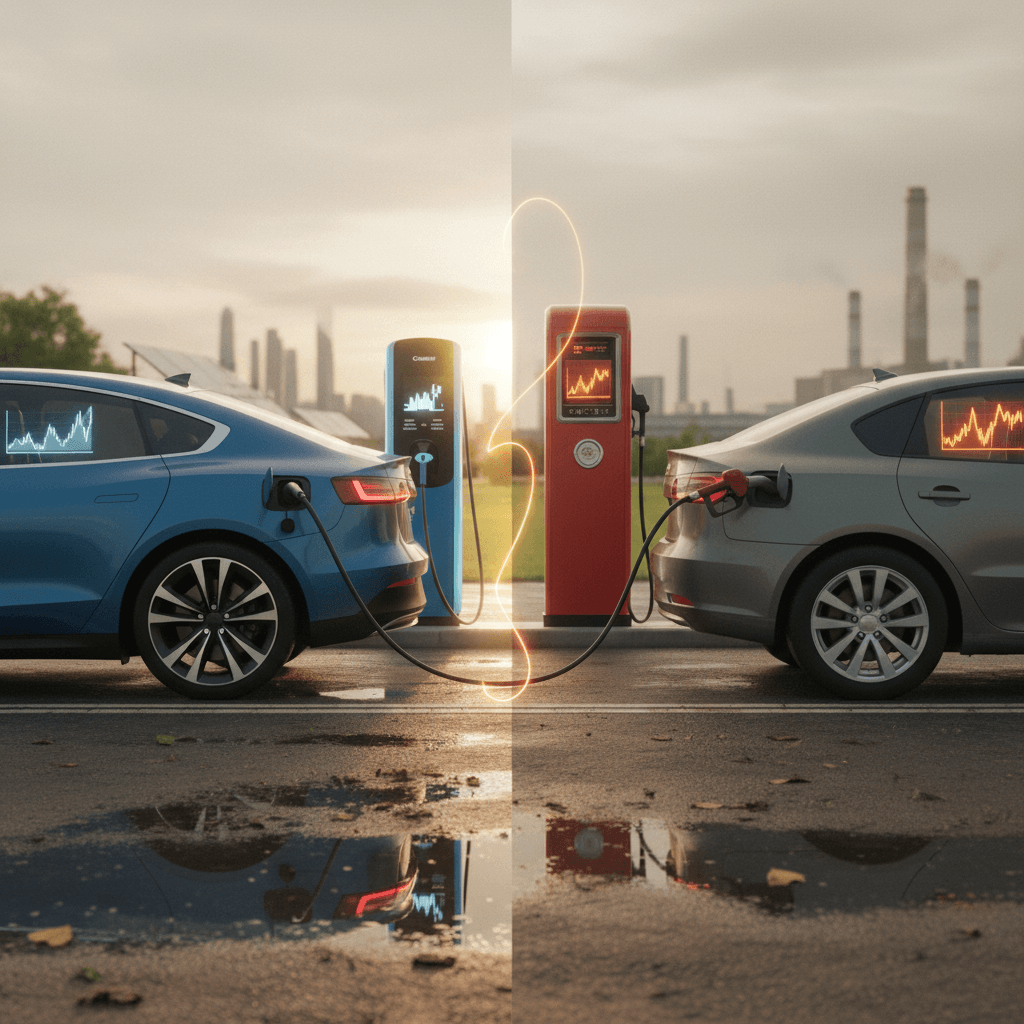
You hear it all the time: charging an EV is cheaper than buying gas. But electricity prices are up in many parts of the U.S., gas prices have eased from 2022 highs, and fast charging isn’t exactly cheap. In 2025, the EV charging cost vs gas comparison is more nuanced, and it depends heavily on where you live, how you charge, and what you drive.
Key takeaway in one line
EV charging cost vs gas: 2025 overview
Headline numbers for 2025 (U.S. averages)
On fuel alone, EVs still beat gas cars most of the time. The average U.S. household is now paying around the high‑teens cents per kWh for electricity, while gasoline has settled in the low‑$3 range per gallon. That usually translates to EVs costing roughly one‑third to one‑half as much per mile to “fuel” as a similar gas vehicle, again, assuming mostly home charging.
But averages can mislead
How to compare EV vs gas cost per mile
To make a fair comparison, ignore monthly bills and focus on cost per mile. Here’s the simple math you can run on any EV or gas car:
EV cost per mile
Use the EPA efficiency rating in kWh per 100 miles from the window sticker or fueleconomy.gov.
Formula:
Cost per mile = (kWh per 100 miles × electricity price per kWh) ÷ 100
Example: 28 kWh/100 mi × $0.18 ÷ 100 = $0.0504 per mile (about 5.0¢/mi).
Gas car cost per mile
Use the combined EPA fuel economy rating in miles per gallon (mpg).
Formula:
Cost per mile = gas price per gallon ÷ mpg
Example: $3.10 ÷ 30 mpg = $0.103 per mile (about 10.3¢/mi).
Use your actual bills and receipts
2025 realities: electricity and gas prices
The EV vs gas equation only makes sense if you anchor it to current energy prices. Here’s where things stand heading into late 2025 in the United States.
What you’re really paying for energy in 2025
National averages hide big state‑by‑state swings
Electricity: ≈17–19¢/kWh
Federal data and recent analyses put the average residential electricity rate around the high teens cents per kWh in 2025. Some states with cheap power are closer to 12¢; high‑cost states like California, Hawaii and parts of New England are 30–40+¢.
Gasoline: ≈$3.00–$3.30/gal
After the 2022 spike, regular gas averaged about $3.30/gal in 2024, and has hovered roughly around or just above $3 in 2025 so far, with seasonal bumps in spring and summer.
What that means for you
If your electricity is near the U.S. average and you charge at home, you’re probably paying the equivalent of $1.00–$1.50 per “gallon” of energy in an EV. In high‑cost power markets, that equivalent can creep closer to $2–$2.50, still often cheaper than gas, but less dramatic.
Watch for rising electricity rates
Real-world cost-per-mile examples
Let’s plug in some realistic numbers for three common scenarios: a compact EV, a midsize SUV EV, and a typical gas crossover. These are illustrative, not tied to a single model, but they’re in the ballpark of popular vehicles you’ll see on the road or shopping on Recharged.
Approximate fuel cost per mile (U.S. averages, 2025)
Assumes $0.18/kWh home electricity, $0.35/kWh DC fast charging, and $3.10/gal gasoline.
| Vehicle type & use case | Energy use assumption | Energy price assumption | Estimated cost per mile |
|---|---|---|---|
| Efficient compact EV (home charging) | 26 kWh/100 mi (3.8 mi/kWh) | $0.18/kWh (home) | ≈$0.047/mi (4.7¢) |
| Midsize SUV EV (home charging) | 32 kWh/100 mi (3.1 mi/kWh) | $0.18/kWh (home) | ≈$0.058/mi (5.8¢) |
| Midsize SUV EV (mostly DC fast) | 32 kWh/100 mi | $0.35/kWh (DC fast) | ≈$0.112/mi (11.2¢) |
| Efficient gas compact (35 mpg) | , | $3.10/gal | ≈$0.089/mi (8.9¢) |
| Gas crossover (28 mpg) | , | $3.10/gal | ≈$0.111/mi (11.1¢) |
| Full‑size SUV (20 mpg) | , | $3.10/gal | ≈$0.155/mi (15.5¢) |
Fuel-only cost per mile; does not include purchase price, insurance, or maintenance.
Where EVs clearly win
Where the gap narrows
Home charging vs public charging vs DC fast charging
Not all kWh are priced the same. To understand EV charging cost vs gas, you need to separate home charging, Level 2 public charging, and DC fast charging, they each have different economics.
How different charging options price out
Same EV, very different cost per mile depending on where you plug in
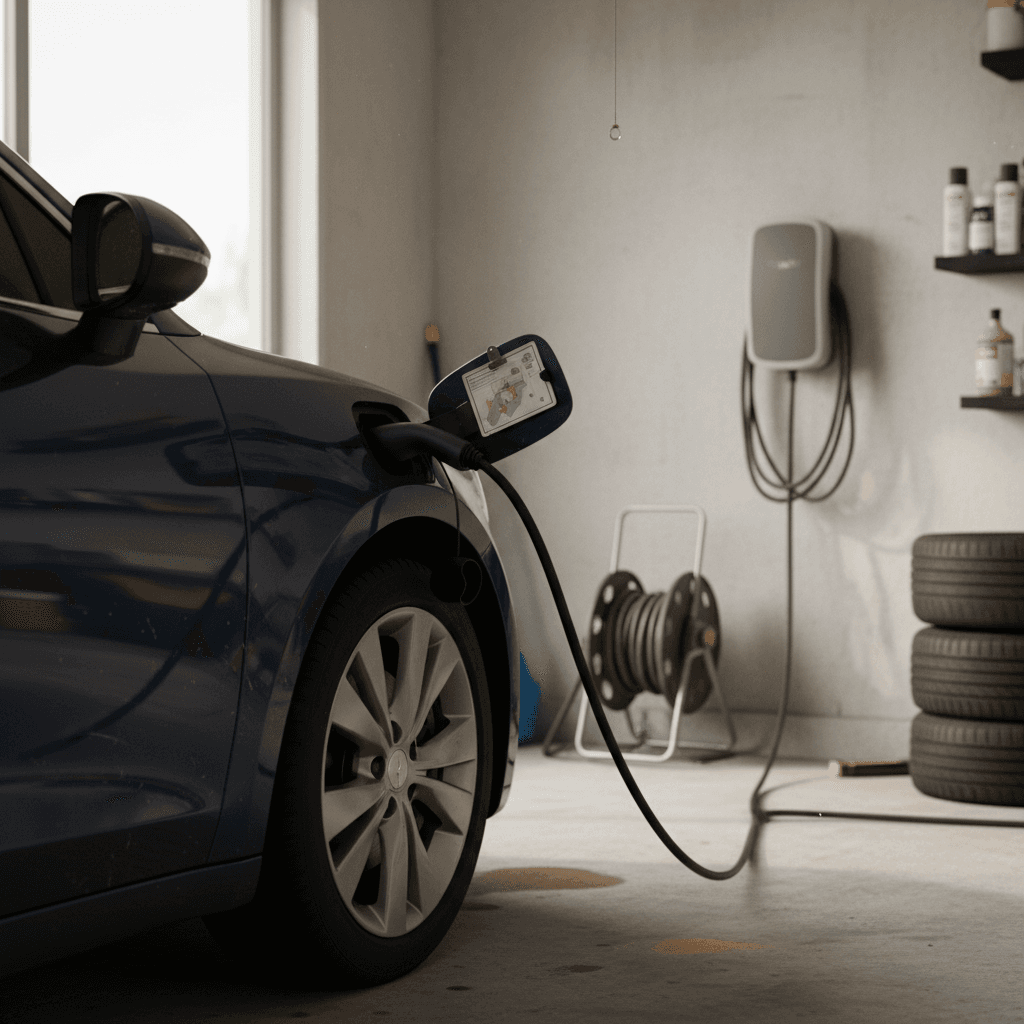
Home Level 2
Best economics. You’re paying your local residential rate, often 12–20¢/kWh.
- Great for overnight charging
- Cheap cost per mile
- Works even on older used EVs
Public Level 2
Moderate cost. Many stations are free at workplaces, hotels, or retailers, but pay-to-use sites may charge a flat fee or higher per‑kWh rates.
- Good supplement to home charging
- Plan around time limits
DC fast charging
Fast but pricey. 30–45¢/kWh is common, and some corridors are higher.
- Great for road trips
- Use sparingly for daily needs
- Can be as costly per mile as gas
Leverage off-peak and EV rates
Other costs that change the EV vs gas equation
Fuel isn’t the only line item in your budget. When you compare EV charging cost vs gas, you should also consider maintenance, purchase price, depreciation, and incentives. Recent ownership‑cost studies still find that EVs tend to have higher total ownership cost than comparable gas vehicles mainly because of higher purchase prices and depreciation, even as they save on fuel and maintenance.
Where EVs save you money
- Maintenance: No oil changes, fewer moving parts, and regenerative braking can mean fewer brake jobs.
- Fuel: Home charging usually cuts per‑mile energy cost 40–70% versus gas.
- Urban driving: Stop‑and‑go traffic hits gas mpg hard, but EV efficiency barely budges.
Where EVs can cost more
- Purchase price: New EVs typically cost more up front than comparable gas cars, though used EV pricing has become very competitive.
- Depreciation: Rapid tech changes and incentives can push used values down faster for some models.
- Insurance & fees: Higher vehicle value and repair costs can raise insurance and registration in some states.
Total cost of ownership matters
Why used EVs and battery health matter
This is where the used market, and companies like Recharged, change the equation. A used EV lets you capture most of the fuel and maintenance savings without paying the new‑car premium or absorbing the steepest early‑years depreciation.
How a used EV reshapes cost vs gas
Fuel savings plus a lower purchase price is a powerful combo
Battery health transparency
With a used EV, the real question is battery health. A strong pack means you keep the advertised efficiency and range, which preserves your low cost per mile.
Every vehicle on Recharged includes a Recharged Score Report with verified battery diagnostics, so you’re not guessing.
Lower depreciation hit
The first owner typically absorbs the steepest depreciation. Buying used can mean a price that better reflects current incentives, tech, and demand, making your total cost of ownership more attractive.
Predictable running costs
Pair a healthy‑battery used EV with home charging and you’ve locked in relatively stable energy costs versus the volatility you see at the pump.
Where Recharged fits in
Ready to find your next EV?
Browse VehiclesChecklist: How to run your own numbers
Rather than rely on generic averages, use this checklist to calculate EV charging cost vs gas for your exact situation.
DIY EV vs gas cost comparison
1. Grab your utility bill
Find your <strong>all‑in electricity rate</strong> in cents per kWh. If your bill lists supply and delivery separately, add them together and divide the total bill by total kWh used to get the real rate.
2. Check for EV or off‑peak rates
Call or visit your utility’s website to see if there’s a special EV or time‑of‑use plan. Plug that lower overnight rate into your EV cost‑per‑mile calculation.
3. Look up EV efficiency
On fueleconomy.gov or the window sticker, find the EV’s <strong>kWh/100 miles</strong> number. For used EVs on Recharged, your specialist can walk you through real‑world efficiency expectations based on battery health.
4. Look up your gas car’s real mpg
Use the trip computer’s long‑term average or track a few tanks to find your actual mpg. City driving or lots of idling often makes this lower than the EPA rating.
5. Use current local gas prices
Check your regular gas price today, not last year. Prices move quickly; using stale numbers can exaggerate the EV advantage or make it look smaller than it is.
6. Run a 5‑year, 75,000‑mile scenario
Multiply your cost per mile for each vehicle by 75,000 miles. Then layer in realistic estimates for maintenance, insurance, and any monthly payment differences. That’s your true comparison.
Need help with the math?
EV charging cost vs gas: FAQ
Frequently asked questions about EV charging cost vs gas
Bottom line: when an EV saves you money
When you cut through the noise, the picture in 2025 is clear: EVs still have a strong fuel‑cost advantage over gas cars, especially if you can charge at home, take advantage of off‑peak rates, and choose an efficient model. That advantage shrinks if your electricity is very expensive or you use DC fast charging as your primary fuel source, and the higher purchase price of many new EVs can offset some of the fuel savings.
If you want the best of both worlds, lower cost per mile without the new‑car price tag, a used EV with verified battery health is a compelling option. That’s exactly what Recharged is built for: transparent battery diagnostics, fair market pricing, EV‑savvy financing, trade‑in support, and nationwide delivery, all wrapped in a digital experience that makes doing the math, and making the switch, much easier.