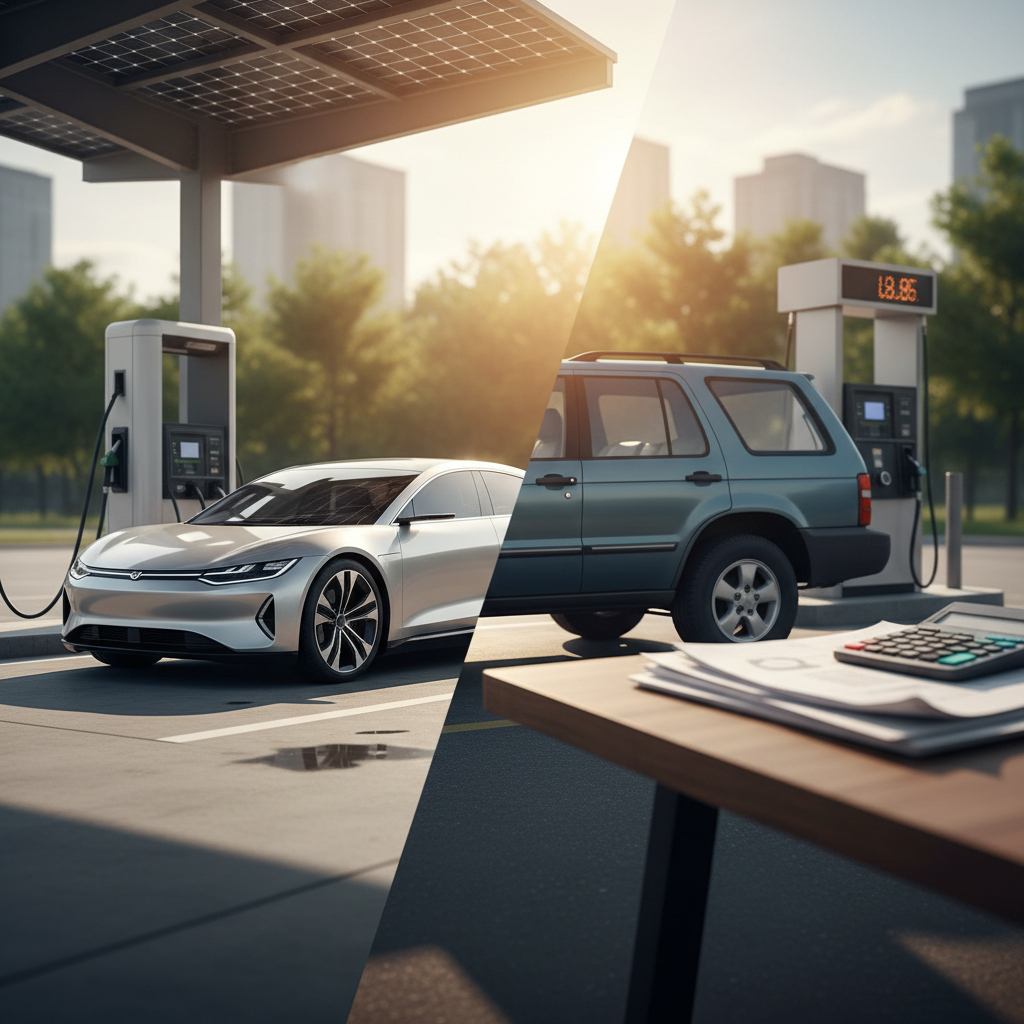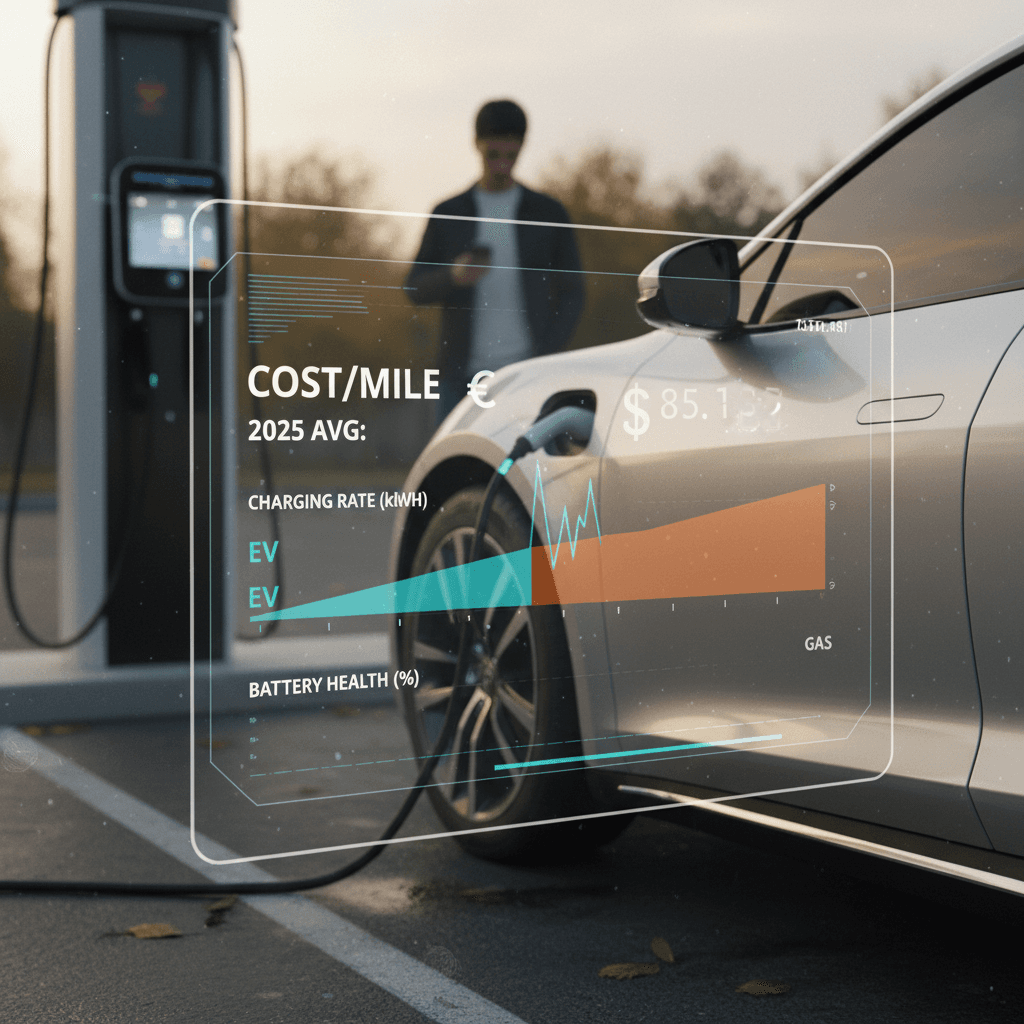
If you’re trying to decide between a gasoline car and an electric vehicle, "EV charging cost vs gas cost per mile" is the number that really cuts through the noise. Forget tank sizes and battery packs for a minute, what matters to your wallet is how much you actually pay to move the car one mile.
Key idea
Why EV vs gas cost per mile matters
Monthly payments and sticker prices are obvious, but running costs quietly add up over years of ownership. Fuel (or electricity) is usually the biggest day‑to‑day expense, especially if you drive a lot. That’s why cost per mile is such a useful comparison: it normalizes different cars, driving patterns, and fuel types into one simple number.
- It lets high‑mileage drivers quickly see how much they’ll save by switching to an EV.
- It exposes how much inefficient gas SUVs and trucks really cost to run.
- It helps you compare two used cars (one EV, one gas) on more than just price and mileage.
- It shows how much your local electricity and gas prices affect the math.
At Recharged, we focus on used EVs, so we spend a lot of time with buyers walking through this exact calculation, often it’s the moment they realize an EV that looks pricier up front could actually be cheaper to own over five or seven years.
Quick answer: EV vs gas cost per mile today
Typical U.S. cost per mile in 2026
Nationally, as of early 2026, regular gasoline averages around $2.90 per gallon, while U.S. residential electricity averages roughly 17¢ per kWh. Most modern EVs use around 27–33 kWh per 100 miles, and many mainstream gas cars fall near 25–30 mpg. All of that math lines up with the rough ranges in the stats above.
Rule of thumb
How to calculate EV charging cost per mile
The EV side of "EV charging cost vs gas cost per mile" comes down to two inputs: your electricity price and your EV’s efficiency.
- Find your electricity rate in ¢/kWh on your utility bill (for example, 17¢ per kWh).
- Look up your EV’s efficiency on the EPA label or window sticker: it’s usually shown as kWh/100 miles or MPGe.
- Use a simple formula to convert to cost per mile.
Formula if you have kWh/100 miles
Most EV spec sheets or EPA labels show kWh per 100 miles.
Cost per mile = (Electricity price per kWh × kWh per 100 miles) ÷ 100
Example: 30 kWh/100 mi and 17¢/kWh:
Cost per mile = (0.17 × 30) ÷ 100 = $0.051 per mile (about 5.1¢)
Formula if you have MPGe
Sometimes you only see MPGe. The EPA defines 33.7 kWh as equal to one gallon of gas.
Cost per mile = (Electricity price per kWh × 33.7) ÷ MPGe
Example: 120 MPGe and 17¢/kWh:
Cost per mile = (0.17 × 33.7) ÷ 120 ≈ $0.048 per mile (about 4.8¢)
Don’t forget charging losses
You can also flip the formula around to see miles per dollar. If your EV costs 5¢ per mile, you travel 20 miles for every dollar of electricity. That’s an easy benchmark to compare with gas.
How to calculate gas cost per mile
Gas math is even simpler. You only need your local gas price and your car’s average mpg.
- Grab your average price for regular gas per gallon (for example, $2.90).
- Find your car’s combined mpg (window sticker, trip computer, or FuelEconomy.gov).
- Use the basic formula below.
Gas cost per mile formula
Cost per mile = Gas price per gallon ÷ Miles per gallon
Example: $2.90/gal gas and 28 mpg:
Cost per mile = 2.90 ÷ 28 ≈ $0.104 per mile (about 10.4¢)
Miles per dollar
If your car costs 10.4¢ per mile to fuel, that’s 9.6 miles per dollar.
Compare that to a typical EV at 5¢ per mile, which gives you 20 miles per dollar of energy, more than double the distance for the same money.
Important nuance
Real-world examples: popular EVs vs similar gas cars
Let’s plug realistic 2026 energy prices into the formulas. We’ll use $2.90/gal for gas and 17¢/kWh for residential electricity, and assume mostly home charging.
EV vs gas cost per mile: example matchups
Approximate costs using national‑average 2026 energy prices and EPA‑style efficiency figures. Your exact numbers will vary with driving style, climate, and local prices.
| Vehicle type | Example EV (efficiency) | Example gas car (efficiency) | Energy price assumptions | EV cost per mile | Gas cost per mile |
|---|---|---|---|---|---|
| Compact sedan | EV: ~28 kWh/100 mi (~120 MPGe) | Gas: ~30 mpg | 17¢/kWh, $2.90/gal | (0.17×28)÷100 ≈ $0.048 | 2.90÷30 ≈ $0.097 |
| Small SUV/crossover | EV: ~32 kWh/100 mi (~105 MPGe) | Gas: ~27 mpg | 17¢/kWh, $2.90/gal | (0.17×32)÷100 ≈ $0.054 | 2.90÷27 ≈ $0.107 |
| Large SUV / pickup | EV: ~45 kWh/100 mi (~75 MPGe) | Gas: ~18 mpg | 17¢/kWh, $2.90/gal | (0.17×45)÷100 ≈ $0.077 | 2.90÷18 ≈ $0.161 |
EVs generally undercut similar gas cars on a cost‑per‑mile basis, especially when charged at home.
What these examples show
If you drive 12,000 miles per year, going from 10¢ to 5¢ per mile is a difference of about $600 per year in energy costs. Over five years, that’s roughly $3,000 saved before you factor in maintenance, which is usually lower on EVs as well.
Home charging vs public charging costs
The big caveat in any "EV charging cost vs gas cost per mile" comparison is where you charge. Home charging with residential rates is generally the cheapest. Public fast charging is more convenient on road trips, but it’s usually priced more like gas, sometimes higher on a per‑mile basis.
How charging location changes your EV cost per mile
Same EV, different electricity prices, very different cost per mile.
1. Home charging
Typical price: ~17¢/kWh (U.S. average, will vary by state)
Example EV: 30 kWh/100 mi
Cost per mile: (0.17×30)÷100 ≈ 5.1¢
Often 2–3x cheaper per mile than gas, especially if you can use off‑peak rates.
2. Workplace / slow public Level 2
Typical price: Sometimes free, often 20–30¢/kWh
Example EV: 30 kWh/100 mi
Cost per mile at 25¢: (0.25×30)÷100 ≈ 7.5¢
Still competitive with gas; free workplace charging can drop your cost per mile close to zero on commuting days.
3. DC fast charging
Typical price: ~35–55¢/kWh depending on network and region
Example EV: 30 kWh/100 mi
Cost per mile at 45¢: (0.45×30)÷100 ≈ 13.5¢
At higher fast‑charge prices, your cost per mile can equal or exceed a decent gas car, though you still avoid oil changes and other engine maintenance.
If you rely almost entirely on fast charging
What really moves your cost per mile
Cost‑per‑mile comparisons aren’t static. A few variables swing the math in either direction for both EVs and gas cars.
Key factors that change your EV vs gas cost per mile
Same driver, same distance, very different fuel bills depending on these levers.
Energy prices
- Electricity: States like Idaho and Nebraska sit near ~11–12¢/kWh; California and Hawaii can exceed 30–40¢/kWh on standard residential rates.
- Gas: Gulf Coast and southern states often see gas in the mid‑$2s; coastal states and the Northeast can be well over $3.50.
- When electricity is cheap and gas is high, EVs win by a landslide. When the reverse is true, the advantage shrinks but often doesn’t disappear.
Vehicle efficiency
- EVs: Many mainstream models sit around 27–33 kWh/100 mi; the best small sedans are in the low 20s, while heavy trucks can use 45+ kWh/100 mi.
- Gas: New compact cars can hit 30+ mpg, but large SUVs and pickups may see real‑world mpg in the mid‑teens.
- Because energy cost is multiplied by efficiency, an inefficient truck, gas or electric, will always cost more per mile than a thrifty sedan.
Driving style & speed
Hard acceleration, high cruising speeds, and stop‑and‑go traffic hurt efficiency for both EVs and gas cars.
- EVs shine in city driving thanks to regenerative braking.
- Gas cars often do relatively better on steady‑speed highway stretches.
- Either way, smoother driving and proper tire pressure lower your cost per mile.
Weather & climate control
Extreme cold or heat can noticeably increase energy use.
- EVs may lose 10–30% efficiency in winter due to cabin heating and cold batteries.
- Gas cars also burn extra fuel to warm up and run defrosters.
- Remote pre‑conditioning while plugged in can soften the hit for EV drivers.
Think in ranges, not one number
Used EV battery health and your cost per mile
With a new EV, cost per mile is mostly about prices and efficiency. With a used EV, battery health adds another dimension. A healthy battery doesn’t dramatically change your cost per mile in dollars, but it does determine how convenient and predictable your cost is.
- A degraded battery gives you less range per charge, so you may need to plug in more often.
- If you rely on fast charging, more frequent sessions could mean more time at higher per‑kWh prices.
- On the flip side, if you charge at home overnight, your energy cost per mile stays roughly the same, your "fuel tank" is just smaller.
Where Recharged fits in
When you shop used EVs, ask for third‑party battery diagnostics, not just an in‑dash state‑of‑charge screenshot. A detailed report helps you estimate how much range you’ll really see from each charge over the next several years.
Checklist: figure out your own cost per mile
Calculate EV charging cost vs gas cost per mile for your situation
1. Gather your energy prices
Pull your latest utility bill for your <strong>¢/kWh rate</strong> (include fees if they’re tied to usage), and check a local gas app or sign for today’s <strong>$ per gallon</strong> price.
2. Look up your vehicle efficiency
For your current gas car, find the combined mpg. For an EV you own, or are considering, find <strong>kWh/100 mi</strong> or <strong>MPGe</strong> on the window sticker or FuelEconomy.gov.
3. Run the EV formulas
Use either the kWh/100 mi formula or the MPGe‑based one to get your EV <strong>cost per mile</strong>. If you’ll fast charge a lot, also run a second version using your local fast‑charging price per kWh.
4. Run the gas formula
Divide your gas price per gallon by your actual mpg (from your trip computer if possible). That gives you a realistic gas <strong>cost per mile</strong>, not an idealized sticker value.
5. Compare annual fuel costs
Multiply each cost‑per‑mile figure by your annual miles (for example, 12,000). The difference between EV and gas is your <strong>yearly fuel savings (or cost)</strong>.
6. Layer in purchase price and financing
If an EV is more expensive up front, compare that extra payment to your annual energy savings. With <a href="/financing">EV‑friendly financing options</a>, many Recharged customers find that lower running costs largely offset the monthly payment difference.
Don’t forget installation and access
FAQ: EV charging cost vs gas per mile
Frequently asked questions
Bottom line: when an EV saves you money
When you break things down to EV charging cost vs gas cost per mile, the picture gets much clearer. With typical 2026 U.S. energy prices, an efficient EV charged mostly at home often delivers roughly double the miles per dollar compared with a similar gas car. Even if you lean on public charging, you may still come out ahead, especially if you’re replacing a thirsty SUV or pickup.
The real key is to run the numbers for your situation: your energy prices, your commute, your ability to charge at home or work, and the specific vehicles you’re comparing. That’s exactly the kind of analysis Recharged does every day for used‑EV shoppers, combining verified Recharged Score battery reports with transparent pricing and EV‑savvy financing options.
If you’re ready to put actual dollars to your decision, explore used EVs on Recharged, talk to an EV specialist, and see how a switch to electric could change your cost per mile, and your total cost of ownership, over the next few years.