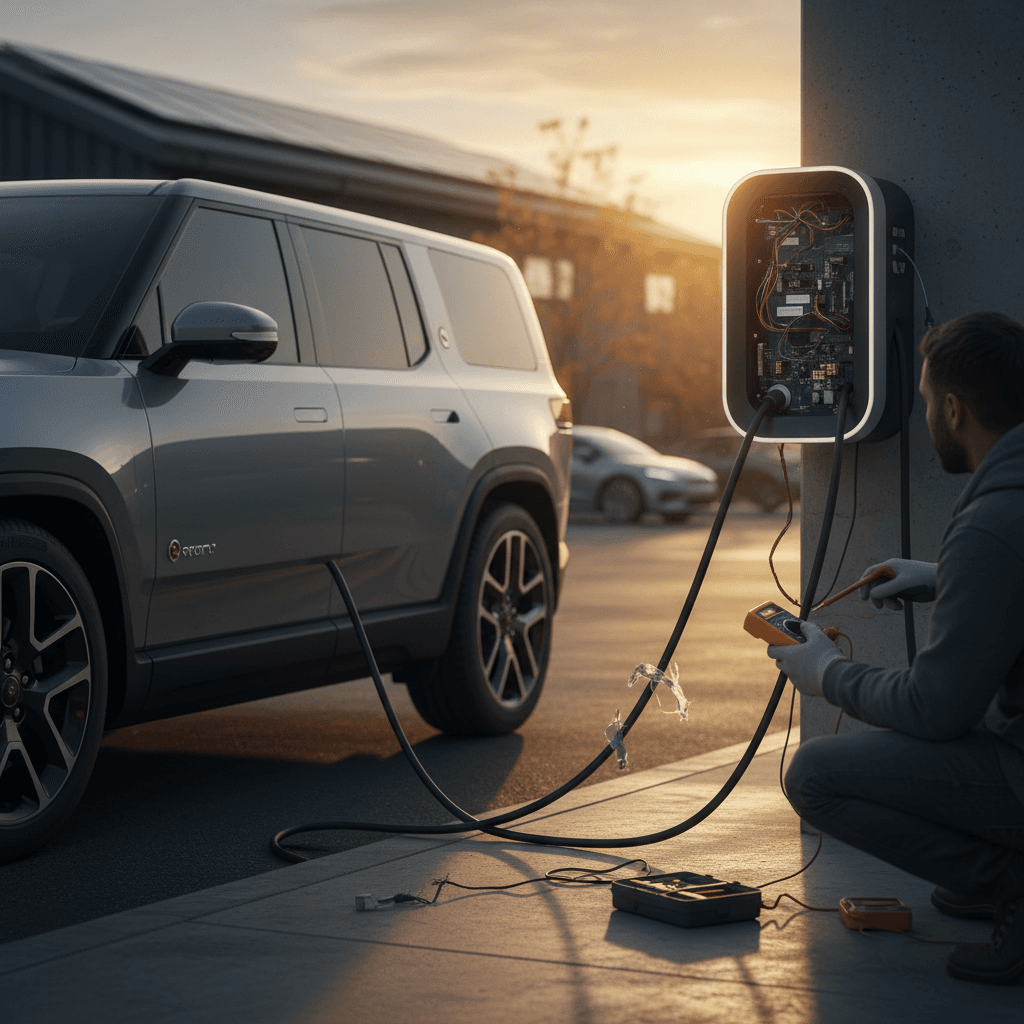
Your EV charger is the unsung hero of ownership, until the day you plug in, the lights don’t come on, and your range for tomorrow’s commute is suddenly in doubt. This guide walks you through EV charger repair from a practical, safety-first angle: what you can check yourself, what a pro needs to handle, how much repairs usually cost in 2025, and when it’s smarter to replace the unit or even upgrade your EV altogether.
Good news
Why EV chargers fail (and what usually breaks)
When you talk about EV charger repair at home, you’re almost always talking about the EVSE, the wall box or portable Level 2 unit, not the big DC fast chargers you see on the highway. These home units are pretty robust, but they live tough lives in garages, driveways, and carports, dealing with heat, cold, dust, and the occasional bumper tap.
Home EV charger realities in 2025
- Weather and moisture – Outdoor units take direct sun, rain, and temperature swings. Compromised seals can lead to condensation and corrosion inside the case.
- Mechanical abuse – Cables used as clotheslines, handles used as doorstops, or cars driven over cords can damage insulation and strain internal connections.
- Electrical wear – Contactors, relays, and circuit boards switch high current for years. Eventually they can pit, overheat, or just fail.
- Installation issues – Undersized wire, loose terminals, or overloaded panels can cause nuisance tripping and premature component failure.
- Firmware and connectivity glitches – Smart chargers sometimes have software bugs, Wi‑Fi dropouts, or app issues that look like hardware failures.
Indoor vs. outdoor ratings matter
Quick checks before you call for EV charger repair
1. Start with the basics
- Check the outlet or breaker: Make sure the breaker is ON and hasn’t tripped. For NEMA 14‑50 outlets, look for discoloration or melted plastic, if you see any, stop using it and call an electrician.
- Verify power at the charger: Is the charger’s power light on? If the unit is totally dead, power may not be reaching it.
- Try another device: If you have a portable charger, try it on the same outlet. If both fail, the wiring or breaker is suspect, not the EVSE.
2. Rule out the car and cable
- Check your EV’s settings: Many cars let you schedule charging or limit current. A midnight schedule will make a 5 PM plug‑in look like a dead charger.
- Try another station: If your car charges fine at public Level 2 stations, the problem is likely your home unit or wiring.
- Inspect the connector: Look for bent pins, debris in the port, or a damaged latch. Don’t poke metal tools into the connector, use a soft brush or compressed air.
5 DIY checks that won’t void your warranty
1. Power cycle the charger
Unplug a portable charger or switch off the breaker for a hardwired unit, wait 60 seconds, then restore power. Many “frozen” smart chargers recover after a clean reboot.
2. Reset Wi‑Fi and app connections
If your smart EVSE only misbehaves when using the app, log out and back in, or re‑pair the charger to your home network. App glitches are far more common than dead hardware.
3. Check for error codes or LEDs
Most modern chargers use colored LEDs or codes. Note the pattern and look it up in the manual or brand’s support site, often it points straight to ground faults, over‑temp, or bad wiring.
4. Try a lower amperage setting
If your 48‑amp charger repeatedly trips the breaker, temporarily drop it to 32 amps in the app or car. If it suddenly behaves, your circuit may be overloaded or undersized.
5. Inspect the cable and strain relief
Run your hand along the cable (when it’s unplugged) feeling for kinks, flat spots, or cuts. Damage near the handle or wall box is a common failure point and a safety concern.
Keep your documentation handy
Safety first: what you should never try yourself
This is the part where we draw the line. A home EV charger may look as harmless as a toaster, but it’s sitting on a 240‑volt, high‑amperage circuit that can do serious damage if you guess wrong. Past a certain point, EV charger repair is a job for a licensed electrician or an authorized service tech.
- Opening the charger housing and probing internal circuits while it’s connected
- Replacing contactors, relays, or circuit boards yourself
- Upsizing breakers or wiring without recalculating load and complying with electrical code
- Bypassing ground‑fault protection after repeated trips
- Attempting DIY repairs on melted outlets, connectors, or obviously burned components
High‑voltage warning
Common EV charger issues and likely fixes
Typical symptoms and who should fix them
Use this as a starting point, not a substitute for a professional inspection.
| Symptom | Likely cause | DIY or Pro? | Next best step |
|---|---|---|---|
| Charger totally dead, no lights | Tripped breaker, bad outlet, or failed power supply | Start DIY | Check breaker, then call electrician if it trips again |
| Charging starts then stops repeatedly | Overheating plug, loose wiring, or bad contactor | Pro | Stop using, schedule inspection and thermal check |
| Breaker trips every time you plug in | Overloaded circuit or short in EVSE | Pro | Have electrician measure load and inspect wiring |
| EV won’t charge at home but works in public | Home EVSE, wiring, or settings issue | DIY then Pro | Double‑check schedules and try reboot, then call installer |
| GFCI or ground‑fault error | Moisture intrusion, damaged cable, or wiring fault | Pro | Do not bypass; schedule repair or replacement |
| Wi‑Fi works, app works, but car charges slowly | Vehicle‑limited charging rate or low current setting | DIY | Raise amperage (within limits) or accept vehicle’s max rate |
If in doubt, err on the side of calling a licensed electrician or the charger manufacturer.
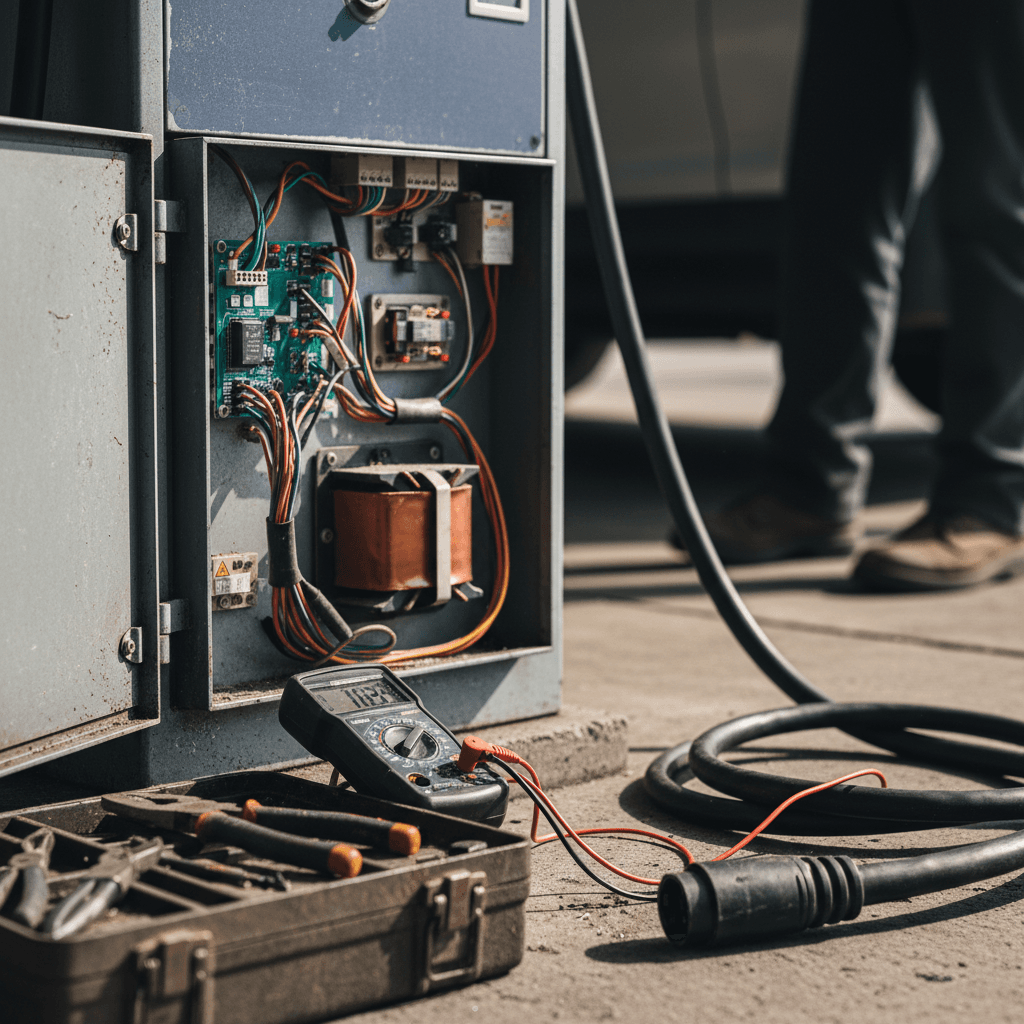
EV charger repair costs vs. replacement
At some point you have to decide whether to nurse an older charger along or replace it with a newer, smarter, often faster unit. With Level 2 installation in the U.S. typically totaling $800–$2,500 for hardware plus professional labor in 2025, the math matters.
Repair or replace? How to think about the dollars
These aren’t hard rules, but they’ll get you in the right ballpark.
When repair makes sense
- The charger is under 5 years old and otherwise in good shape.
- The quote is under $400–$500 for a clear, fixable issue (like a failed relay or board swap).
- You’re not planning to move or change vehicles soon.
- The work is done by an authorized tech, keeping your warranty intact.
When replacement is smarter
- The unit is 7–10+ years old or no longer supported by the manufacturer.
- Repairs push past 40–50% of the cost of a modern smart charger.
- You’ve had repeated failures or nuisance trips despite inspections.
- You want new features like Wi‑Fi, better load management, or NACS compatibility.
Think total cost of ownership
Remember to factor in incentives. Many U.S. households can still claim a federal tax credit of up to 30% of total cost (hardware + installation), capped at $1,000 for home charging equipment, plus state or utility rebates in some areas. That can tilt the decision toward a new unit instead of sinking money into an older one.
When your home charger is fine but charging is still slow
Plenty of drivers call for EV charger repair only to learn there’s nothing wrong with the charger at all. The bottleneck is the car's onboard charger, the AC‑to‑DC hardware inside the vehicle, or the settings you’ve chosen.
Vehicle limits you can’t change
- If your EV only accepts 7.2 kW (32 amps) on AC, buying an 11.5 kW wall box won’t speed things up.
- Some plug‑in hybrids cap AC charging even lower, so “slow” is simply normal.
- Cold‑soaked batteries in winter deliberately limit charge rates to protect longevity.
Settings you can adjust
- Turn off any temporary charge limits you set for a road trip or a previous outlet.
- Check your utility’s time‑of‑use plan; your car may be waiting for cheaper off‑peak hours before charging at full tilt.
- If you own multiple EVs, confirm you haven’t set a conservative load‑sharing limit in the charger’s app.
How to sanity‑check charging speed
Simple EV charger maintenance checklist
You don’t need a service contract for every home charger, but a little routine attention goes a long way toward avoiding repairs altogether. Think of it as the EV version of changing oil, without the oil.
Once‑ or twice‑a‑year EVSE maintenance
Inspect cable, connector, and strain relief
Look for cuts, flattened sections, or cracked plastic. The point where the cable enters the wall box or plug should be snug, not wobbly.
Check outlet and plug temperature
After a 30–60 minute charge, gently touch the outlet or wall box. Warm is fine; hot, discolored, or soft plastic is a red flag.
Clean the connector and holster
Use a dry cloth and, if needed, compressed air to remove dust and cobwebs. Keep liquids and harsh cleaners away from contacts.
Test GFCI and safety features
If your charger or circuit has a test button, press it periodically to confirm it trips and resets properly. This confirms ground‑fault protection is alive and well.
Verify firmware and app updates
Open the charger app every few months. Install updates that improve reliability, security, or load management.
Look for water intrusion
Check outdoor units after heavy storms. Streaks inside the lens, rusted screws, or pooled water in a cable holster are early warnings.
What about commercial stations?
EV charger repair and buying a used EV
If you’re shopping for a used EV, the health of the battery and the quality of the charging setup are just as important as miles on the odometer. A car with a strong battery paired to a tired, unreliable home charger is still going to be a headache to live with.
What to look for when a charger comes with the car
- Ask how old the home or portable charger is, and whether it’s still under warranty.
- Inspect the cable and connector for wear, discoloration, and DIY tape repairs.
- Check that the installation looks professional: proper conduit, secure mounting, and labeled breaker.
- If possible, plug in and observe a full session, watch for error codes or breaker trips.
How Recharged helps simplify the picture
Every vehicle listed with Recharged includes a Recharged Score Report with verified battery health and fair market pricing. That report tells you how much real‑world range you can expect, which directly affects how demanding you’ll be on your home charger.
If you’re upgrading into a used EV through Recharged and your current charger is giving you trouble, our EV specialists can help you evaluate repair vs. replacement and talk through home‑charging options that match your new car and driving habits.
EV charger repair FAQ
Frequently asked questions about EV charger repair
Wrap-up: Fix it, upgrade it, or move on?
When your EV charger acts up, you’re not just dealing with a gadget, you’re negotiating with your daily routine. Start with safe, simple checks: power, settings, cables, and error codes. From there, let professionals handle anything involving high‑voltage wiring or internal components. Weigh the cost of EV charger repair against the price of a modern replacement, including the tax credits and rebates still available in 2025.
If you’re also thinking about your next EV, remember that charger health and battery health go hand in hand. A used EV with a strong battery and a reliable charging setup is a joy to live with; a tired pair is a constant compromise. At Recharged, every car comes with battery diagnostics, transparent pricing, and expert support so you can match the right car, and the right charging plan, to the way you actually drive.