
If you’re shopping for a more efficient car in 2025, you’re probably stuck on the choice between a fully electric car and a plug‑in hybrid (PHEV). Both promise lower fuel bills and fewer emissions than a traditional gas car, but the trade‑offs around price, range, charging, and long‑term value are very different, especially now that federal EV tax credits have expired and the market is recalibrating.
Where the market sits in 2025
How electric cars and plug‑in hybrids differ in 2025
Battery‑electric vehicles (BEVs)
- Power source: Large battery pack only; no gasoline engine.
- Energy use: You plug in at home or public chargers; energy measured in kWh.
- Typical range (2025): 220–320 miles for mainstream models, more for some long‑range trims.
- Maintenance: Fewer moving parts; no oil changes, exhaust, or transmission service.
- Driving feel: Instant torque, quiet operation, strong one‑pedal driving in many models.
Plug‑in hybrid electric vehicles (PHEVs)
- Power source: Smaller battery plus gasoline engine.
- Electric range: Commonly 25–50 miles of EPA‑rated electric range in 2025.
- Operation: Short trips can be all‑electric; engine takes over or assists on longer drives.
- Fueling: You can plug in and use gas stations, which lowers range anxiety.
- Complexity: Two powertrains in one car, more parts than either a pure EV or a pure ICE vehicle.
Think in terms of miles, not labels
Electrification snapshot: U.S. 2023–2025
Market trends in 2025: Are buyers choosing EV or plug‑in hybrid?
The story of electric car vs plug‑in hybrid in 2025 is really a story about a market in transition. Battery‑electric vehicles still make up the majority of plug‑in sales, but growth has cooled as early adopters have largely bought in and mainstream buyers wrestle with price, charging access, and headlines about resale values. Automakers, seeing this hesitation, have poured more effort into hybrids and PHEVs as a lower‑risk bridge technology.
Plug‑in hybrids have quietly benefitted from this shift. They let automakers hit fleet emissions targets without betting everything on BEVs, and they let buyers test‑drive electric commuting without giving up the ability to refuel anywhere. At the same time, they’re still built on a gas‑car foundation, so they don’t fully deliver the simplicity and long‑term operating‑cost upside of a pure EV.
Don’t confuse PHEVs with regular hybrids
Cost comparison 2025: Purchase price and total ownership
Sticker price still favors gasoline and some hybrids, but the real question is five‑year cost of ownership: depreciation, fuel or electricity, maintenance, insurance, and financing. AAA’s 2025 “Your Driving Costs” analysis pegs average new‑vehicle ownership at about $11,577 per year, with EVs still above that average largely because of higher upfront prices and steeper early‑years depreciation.
Where EVs and PHEVs win or lose on cost
Look beyond MSRP to understand your real 2025 costs
Purchase price & depreciation
EVs: Still pricier than comparable gas cars even after recent price cuts, and 2025 has seen aggressive discounting that hurts early‑year resale but helps new buyers.
PHEVs: Usually cost more than their non‑plug hybrid equivalents. Depreciation can be similar to regular hybrids if demand stays strong, but there’s less data and fewer buyers shopping specifically for used PHEVs.
Fuel & electricity
EVs: Lowest per‑mile energy cost if you can charge at home, especially on off‑peak rates. Public DC fast charging narrows or eliminates the fuel‑cost advantage.
PHEVs: Best‑case is charging daily and using gas only on longer trips. Worst‑case is never plugging in and lugging around a heavy battery for hybrid‑like efficiency.
Maintenance & repairs
EVs: No oil changes, spark plugs, or exhaust system. Regenerative braking extends brake life. Fewer moving parts usually mean fewer failures.
PHEVs: You still have an engine plus the full hybrid system, so maintenance is closer to a regular car. Over 10 years, that complexity can show up in repair bills.
Typical 5‑year cost patterns in 2025 (high level)
Generalized comparison assuming 12,000 miles per year. Actual numbers will depend on specific model, incentives, and energy prices in your area.
| New Gas Car | New Plug‑In Hybrid | New Electric Car | Used Electric Car (2–4 yrs old) | |
|---|---|---|---|---|
| Purchase price | Lowest | Medium | Highest | Often similar to new PHEV |
| Fuel / energy cost | Highest | Low if plugged in; medium if not | Lowest with home charging | Lowest with home charging |
| Maintenance | Highest | Medium‑high | Lowest | Low–medium |
| Depreciation | Medium | Medium (uncertain long term) | High early, then levels off | Already absorbed most early depreciation |
| Incentives (post‑2025) | Limited | Limited state/local only | Limited state/utility; federal tax credits ended Sept 2025 | Some state/utility used‑EV rebates still exist |
Use this as a directional guide, not a quote for any specific vehicle.
How to quickly compare real costs
Range, commuting, and road‑trip behavior
Range anxiety still dominates the EV conversation, but for most U.S. drivers it’s more psychological than practical. The average American drives well under 50 miles per day. That means a typical 2025 BEV with 250+ miles of range can easily cover several days of commuting between charges, and a PHEV’s 25–50 miles of electric range can cover the entire workweek if you plug in diligently.
When a full EV fits best
- You mainly do short‑to‑medium daily trips (0–80 miles).
- You’re comfortable planning charging stops for the handful of long road trips you take each year.
- You like the idea of never visiting gas stations, and you have a clear home‑charging plan.
- You live in or near metro areas with robust public charging networks.
When a plug‑in hybrid fits best
- You take frequent multi‑state road trips and don’t want to bet on charger availability.
- You live in a region with sparser charging infrastructure or harsh winters that can cut EV range.
- Your household has only one car and you need it to handle edge‑case trips on short notice.
- You’re still uneasy about battery resale values and want a familiar gas backup.
Cold‑weather caveat
Charging access, home setup, and your living situation
Once you strip away marketing, the most important difference between an electric car and a plug‑in hybrid in 2025 is this: EVs assume you can plug in easily; PHEVs are designed to cope when you can’t. That’s why your home, workplace, and neighborhood infrastructure matter as much as the car’s spec sheet.
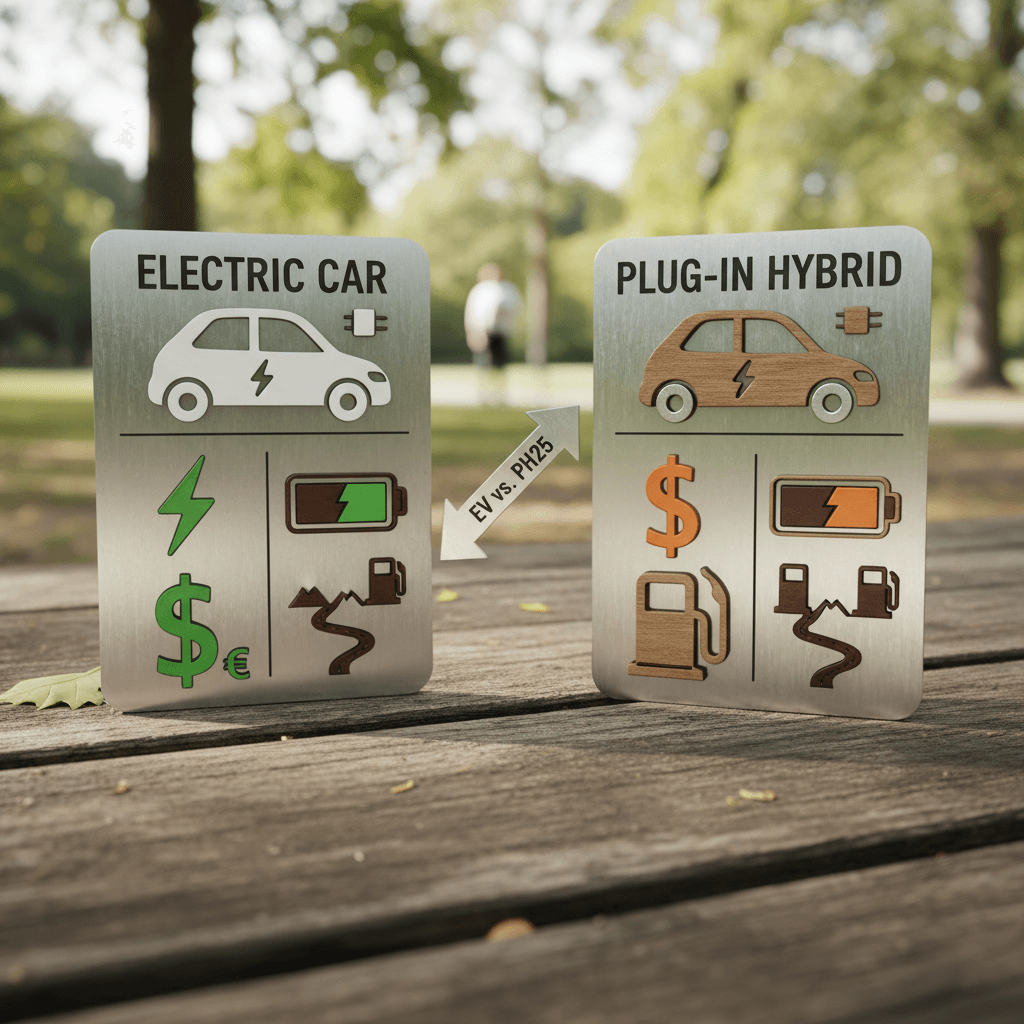
How your living situation shapes the EV vs PHEV choice
Match your driveway, or lack of one, to the right drivetrain
Dedicated driveway or garage
If you can install a Level 2 charger (240V), a full EV is usually the most convenient and cost‑effective choice. You "refuel" while you sleep, and you rarely need public charging.
Recharged can help you understand how different used EVs will fit your charging setup, and how battery health impacts real‑world range.
Apartment or street parking
If you rely mostly on public charging, a PHEV often makes more sense today. You get meaningful electric miles when chargers are available but keep the ability to use gas for everything else.
In dense urban areas with strong public infrastructure, a small‑battery EV can still work, but you’ll want to sanity‑check your local charger reliability first.
Workplace charging
If your employer offers reliable workplace charging, that can substitute for home charging. A BEV you top up at work may be the sweet spot, especially for commuters.
Without that, occasional access at grocery stores or big‑box retailers is a nice bonus, but shouldn’t be the foundation of your charging plan.
Don’t skip the electrical quote
Environmental impact and policy shifts after 2025 credits
From a climate perspective, battery‑electric vehicles have the cleanest tailpipe story: zero local emissions. Even when you factor in battery production and electricity generation, most credible lifecycle analyses still show BEVs producing far fewer emissions than comparable gas vehicles over their lifetime once you’ve driven around 15,000 miles or so.
Plug‑in hybrids can deliver big reductions too, if you actually plug them in. A PHEV driven mostly on electricity can cut fuel use dramatically. But a PHEV that never sees a charging cable is basically a heavier, more complex hybrid that burns more fuel than it needs to. Policymakers in Europe have already started tightening PHEV rules and benefits in response to this behavior; over the next few years you should expect more scrutiny on how these vehicles are used, not just how they’re sold.
What changed after the federal tax credit expired?
Used electric car vs new plug‑in hybrid: The sleeper value play
One wrinkle that most “electric car vs plug‑in hybrid 2025” comparisons miss is the used market. New EVs have seen heavy discounting and rapid technology updates, which has pushed down used prices. That can be painful for first owners, but it’s a gift for second owners who understand battery health and don’t need the absolute latest range number.
Why a used EV can beat a new PHEV
- Early‑years depreciation is already baked into the price.
- You can often buy a 2–4‑year‑old BEV with similar payments to a brand‑new PHEV.
- Energy and maintenance costs are still EV‑low, especially with home charging.
- If you choose carefully, remaining range is more than enough for daily use.
What you need to watch
- Battery health: Capacity loss varies by model, climate, and how the car was used.
- Warranty coverage: Many EVs carry 8‑year/100,000‑mile battery warranties, but terms differ.
- Charging standard: NACS versus CCS support and adapter availability matter more every year.
Recharged’s Recharged Score Report tackles these directly with verified battery‑health diagnostics, pricing against the used‑EV market, and expert guidance on whether a specific car still fits your range needs.
Where Recharged helps you de‑risk a used EV
Ready to find your next EV?
Browse VehiclesWho should choose an electric car in 2025?
- You can reliably install or access Level 2 charging at home or work.
- Your typical daily driving is under ~100 miles, even if you occasionally road‑trip.
- You’re looking at the vehicle as a 5–10 year keeper and prioritize lower long‑term fuel and maintenance costs over rock‑solid short‑term resale.
- You value a quieter, simpler driving experience and don’t mind using apps to plan the few long trips you take.
- You’re open to considering a used EV with verified battery health to stretch your budget.
Who should choose a plug‑in hybrid in 2025?
- Home charging is uncertain or impossible in the next few years (for example, you rent in a building without parking or charger access).
- Your household has one car that must handle everything from school runs to 800‑mile weekends, and you don’t want to depend on public charging for those edge cases.
- You like the idea of cutting gasoline use but aren’t ready to fully commit to a charging‑centric lifestyle.
- You’re comparing against a traditional gas SUV or pickup and the plug‑in version gives you all‑electric commuting with towing or off‑road capability when needed.
- You’re able and willing to plug in at least a few times per week; otherwise a regular hybrid is often a better choice than a PHEV.
Checklist: Electric car vs plug‑in hybrid decision guide
Walk through these questions before you decide
1. How many miles do you actually drive each day?
Look at a few months of odometer readings or smartphone tracking rather than guessing. If you’re consistently under 60–80 miles per day, a reasonably ranged EV or a short‑range PHEV can both cover your needs.
2. Where will your car sleep for the next 5–8 years?
If it will be in the same driveway or garage, plan around installing a Level 2 charger. If your situation is more transient, renting, frequent moves, a PHEV or a used EV with lower payments might be safer.
3. Can your electrical panel comfortably support Level 2?
Before committing to a full EV on the assumption of home charging, get a quote for a 240V outlet or wallbox. If upgrades are expensive or impossible, weight shifts toward PHEVs or small‑battery EVs supported by workplace charging.
4. How often do you take road trips over 250 miles?
If the answer is “a few times a year,” either a BEV plus some planning or occasional rental of a gas car is reasonable. If it’s “twice a month,” a PHEV may better match your lifestyle until ultra‑fast charging is more ubiquitous.
5. Are you buying new or used?
In 2025, a <strong>used EV with a healthy battery</strong> can often undercut a new PHEV on total cost while delivering a better electric experience. If you’re shopping used, prioritize vehicles with transparent battery‑health data like the Recharged Score provides.
6. How long do you intend to keep the car?
Short 2–3‑year horizons favor whatever has the strongest current incentives and resale, which can be PHEVs in some markets. Longer horizons skew the math toward BEVs because fuel and maintenance savings compound over time.
FAQ: Electric car vs plug‑in hybrid in 2025
Frequently asked questions about EVs and plug‑in hybrids
Bottom line: How to decide in 2025 and where Recharged fits
In 2025, the electric car vs plug‑in hybrid decision isn’t about choosing a “right” technology in the abstract, it’s about matching your real driving, your charging reality, and your time horizon to the right tool. If you can anchor your life around home or workplace charging and you’re thinking in 5‑ to 10‑year terms, a full EV, especially a carefully chosen used one, usually delivers the best combination of cost, simplicity, and environmental impact. If you can’t count on plugging in and you need one vehicle to do everything with minimal planning, a plug‑in hybrid remains a pragmatic step away from gasoline without forcing you into today’s charging gaps.
Where Recharged comes in is on the used‑EV side of that choice. By combining a Recharged Score battery‑health report, transparent fair‑market pricing, financing, trade‑in options, and nationwide delivery, Recharged makes it far easier to compare a specific used EV against the new plug‑in hybrid on your local lot. Instead of betting on technology headlines or worst‑case anecdotes, you can look at actual battery state‑of‑health, real‑world range, and 5‑year ownership costs, and pick the electrified path that truly fits how you live.