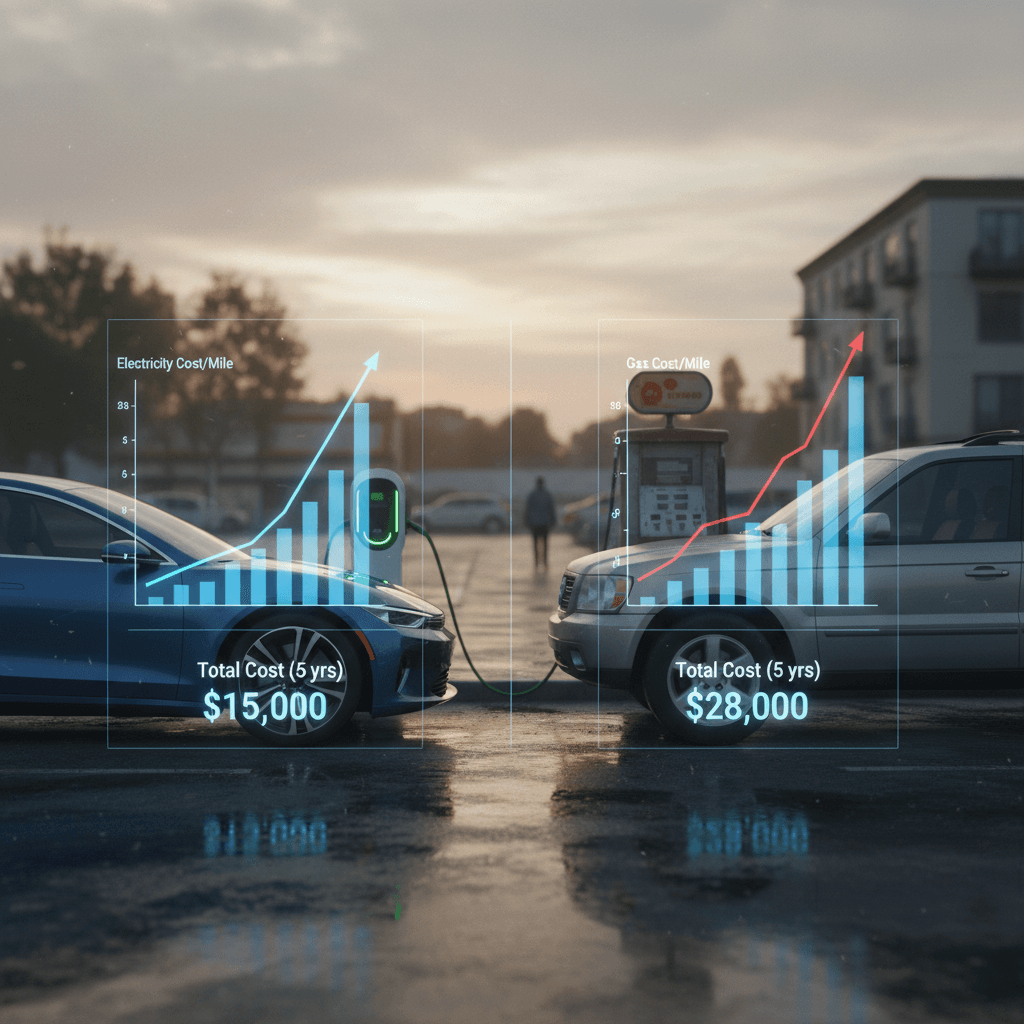
If you’re trying to decide between an electric vehicle and a gas car, the real question isn’t just mpg or MPGe – it’s cost per mile. In 2025, with U.S. electricity averaging around 17 cents per kWh and gasoline around $3.10 per gallon, the gap between EV vs gas cost per mile is big for some drivers and surprisingly small for others. This guide walks through the math in plain English so you can see what you would actually pay.
What this guide covers
Why cost per mile matters more than mpg
Manufacturers advertise mpg for gas cars and MPGe or kWh/100 mi for EVs. Both are just efficiency metrics. What you actually feel in your budget is how many cents you spend every time you drive a mile. That cost per mile determines your monthly "fuel" bill, your road-trip budget, and how quickly a more efficient or electric vehicle pays back a higher purchase price.
Efficiency numbers vs real-world dollars
How to read the labels on the window sticker
MPG (gas)
Measures how many miles you drive per gallon of gasoline. More is better. But it only tells you about volume, not price.
MPGe (EV)
"Miles per gallon equivalent" – a way to compare EVs to gas cars using an energy equivalent. Helpful, but still abstract.
Cost per mile
Translates efficiency and fuel price into what you actually pay. This is the number that should guide your decision.
Key idea
Quick answer: EV vs gas cost per mile in 2025
Typical U.S. cost per mile in 2025
Those are national averages, not promises. If you live in a high‑electricity‑cost state and drive an ultra‑efficient hybrid, your gas car might be competitive per mile. If you live where power is cheap or you have time‑of‑use rates, an efficient EV can undercut gas costs dramatically. That’s why it’s important to plug in your own numbers.
How to calculate EV cost per mile (step by step)
EV cost per mile is usually simpler than it looks. You only need two things: your EV’s efficiency and your electricity price. Efficiency is often given in kWh per 100 miles or MPGe on the window sticker or in the EPA listing.
- Find your EV’s kWh/100 mi rating (for many newer EVs, it’s around 25–30 kWh/100 mi).
- Grab your all‑in electricity price per kWh from your utility bill (delivery + supply + fees).
- Convert kWh/100 mi into kWh per mile by dividing by 100.
- Multiply kWh per mile by your price per kWh to get dollars per mile.
- Multiply by 100 to see cents per mile, which is easier to compare to a gas car.
Formula: EV cost per mile
How to calculate gas car cost per mile
Gas cost per mile is even more familiar, but the industry tends to talk in mpg instead of cost per mile. The math is straightforward once you stop thinking in gallons and start thinking in miles per dollar.
- Find your car’s real‑world mpg (your trip computer average is usually more honest than the EPA sticker).
- Note the current price per gallon you’re actually paying in your area.
- Divide the price per gallon by your mpg to get cost per mile.
- Again, multiply by 100 to get cost per 100 miles or by 1,000 to see cost per thousand miles.
Formula: gas cost per mile
Real-world examples: compact, SUV and road-trip driving
Let’s plug in some realistic 2025 numbers so you can see how the cost per mile EV vs gas comparison plays out for different types of vehicles and driving. These are illustrative, but they’re grounded in the kind of efficiency and price data we see every day.
Scenario 1: 30‑mile daily commute (compact cars)
Comparing a typical compact EV and compact gas car for a suburban commuter driving ~9,000 miles per year.
| Vehicle | Efficiency | Energy price | Cost per mile | Annual "fuel" cost (9,000 mi) |
|---|---|---|---|---|
| Compact EV (home charging) | 27 kWh/100 mi | $0.17/kWh | ≈ 4.6¢ | ≈ $414 |
| Compact gas car | 32 mpg | $3.10/gal | ≈ 9.7¢ | ≈ $873 |
Assumes average U.S. electricity rates and gasoline around $3.10/gal.
In this common commuter scenario, the EV’s energy cost per mile is less than half the gas car’s. Over a standard 3‑year ownership period at 9,000 miles/year, you’re looking at roughly $1,400–$1,500 in fuel savings before you factor in maintenance differences.
Scenario 2: Family SUV, mixed driving
Comparing a midsize electric SUV to a similar gas SUV for a family driving ~12,000 miles/year.
| Vehicle | Efficiency | Energy price (blended) | Cost per mile | Annual "fuel" cost (12,000 mi) |
|---|---|---|---|---|
| Electric SUV (70% home, 30% fast) | 32 kWh/100 mi | ≈$0.20/kWh blended | ≈ 6.4¢ | ≈ $768 |
| Gas SUV | 24 mpg | $3.10/gal | ≈ 12.9¢ | ≈ $1,548 |
Assumes mostly home charging for the EV, occasional fast charging on trips.
Here the EV still enjoys a clear cost‑per‑mile advantage, roughly 6 cents per mile vs almost 13 cents, even with a meaningful share of higher‑priced DC fast charging. The more you can shift charging back to your home or workplace, the bigger that gap gets.
Scenario 3: Road‑trip heavy driver, high electricity prices
Comparing an EV and gas car for a driver who road‑trips often, uses lots of public fast charging, and lives in a high‑electricity‑cost area.
| Vehicle | Efficiency | Energy price | Cost per mile | Annual "fuel" cost (15,000 mi) |
|---|---|---|---|---|
| EV (mostly fast charging) | 30 kWh/100 mi | ≈$0.40/kWh at many DC fast chargers | ≈ 12.0¢ | ≈ $1,800 |
| Efficient hybrid | 45 mpg | $3.10/gal | ≈ 6.9¢ | ≈ $1,035 |
This is the scenario where gas can come close, or occasionally win, on energy cost per mile.
Why this third scenario matters
Beyond fuel: insurance, maintenance and battery health
Maintenance and repairs
From an energy perspective, EVs often win on cost per mile. But that’s only half the story. Over time, maintenance can matter just as much.
- EVs: No oil changes, fewer moving parts, no exhaust or transmission service. Tire wear can be higher on heavy, torquey EVs.
- Gas cars: Regular oil changes, spark plugs, belts, exhaust, and more complex transmissions add up.
For many drivers, the lower scheduled maintenance of an EV is roughly equivalent to dropping another 1–2¢ per mile compared with a traditional gas car.
Insurance and depreciation
Insurance and depreciation don’t directly affect energy cost per mile, but they absolutely affect your total cost per mile.
- Some EVs cost more to insure; others are now competitive with similar gas models.
- Used EV prices came down sharply after 2022, which is good news if you’re buying now but less great if you paid new‑car prices at the peak.
If you’re shopping used, starting with fair market pricing and transparent history, like the Recharged Score Report, is key to making sure fuel savings aren’t eaten up by overpaying upfront.
Why battery health matters for cost per mile
Recharged data
Used EV battery health
94%
avg remaining capacity
From Recharged battery inspections, not manufacturer estimates.
- Lowest
- 70%
- Median
- 95%
- Highest
- 100%
- Est. range
- 266 mi avg
- Cell balance pass
- 100%
- Quick charges
- 18 avg
- Slow charges
- 61 avg
Average cell imbalance: 7.8 mV
Based on vehicles Recharged tested as of Jul 23, 2026
Recharged data
Recent EV sold prices
$25,997
median sold price
What buyers actually paid through Recharged, not list price.
- Lowest
- $4,527
- Average
- $28,433
- Highest
- $129,998
Monthly median sold price
Based on Recharged sales in the last 12 months as of Jul 23, 2026
Ready to find your next EV?
Browse VehiclesHome charging vs DC fast charging: why your mix matters
When people talk about cost per mile EV vs gas, they often forget that EV "fuel" pricing is highly location‑dependent. The difference between home charging at 12–20¢/kWh and DC fast charging at 35–55¢/kWh is enormous. Your personal blend between the two is one of the biggest drivers of how cheap or expensive your EV actually is to run.
Three common charging profiles
Same EV, very different cost per mile
1. Mostly home charging
Profile: Single‑family home, overnight Level 2 charging, occasional road trips.
Typical cost: ~4–6¢/mi for many EVs.
Takeaway: This is where EVs shine financially.
2. Mixed home + workplace/public
Profile: Apartment with some workplace charging, occasional public Level 2 or fast charging.
Typical cost: ~6–9¢/mi, depending on rates.
Takeaway: Still often cheaper than gas, but you need to pay attention to posted prices.
3. Mostly DC fast charging
Profile: No home charging, frequent long trips, reliance on highway fast‑charge networks.
Typical cost: ~9–15¢/mi.
Takeaway: In this edge case, an efficient hybrid may win on fuel cost per mile.
Planning around your real life
When a gas car can still be cheaper per mile
Despite the hype, EVs are not automatically cheaper per mile for everyone. There are realistic situations where a gas or hybrid vehicle can win on energy cost per mile, even in 2025.
Situations where gas or hybrid can come out ahead
You live where electricity is very expensive
In a handful of states, all‑in residential electricity can be 30–40¢/kWh or more. At those prices, an EV’s home‑charging cost per mile can creep toward 8–10¢, especially for less efficient, heavy models.
You can’t charge at home
If you rely entirely on DC fast charging priced at 40–55¢/kWh, you may end up paying 12–18¢ per mile in energy, which is higher than many efficient hybrids at today’s gas prices.
You drive an ultra‑efficient hybrid
A hybrid that reliably returns 45–50 mpg at $3.10/gal gas is in the 6–7¢/mi range, competitive with, or better than, an EV that’s fed mostly on fast charging.
Your driving is mostly long‑distance highway
EVs are often most efficient around city speeds. Meanwhile, a good hybrid can deliver excellent highway mpg, especially if you drive steady, long distances.
You have special gas discounts but no EV rate plan
Company fuel cards, big‑box gas discounts, or fleet pricing can pull your effective gas price down. If your utility doesn’t offer off‑peak EV rates, that advantage may matter.
Don’t ignore total cost of ownership
How to estimate your own cost per mile in 5 minutes
Rules of thumb are useful, but the real power comes when you plug in your own numbers. Here’s a quick, back‑of‑the‑envelope process you can use for any EV or gas car you’re considering, new or used.
5‑minute DIY cost‑per‑mile calculator
1. Grab your electricity rate and gas price
Look at your latest utility bill for your all‑in price per kWh and check a recent fill‑up for your local gas price per gallon. Write both numbers down.
2. Note vehicle efficiency
For an EV, use kWh/100 mi from the EPA label or manufacturer site. For a gas car, use your real‑world mpg (or a realistic estimate based on similar driving).
3. Calculate EV cost per mile
Use the formula: (kWh/100 mi ÷ 100) × price per kWh. If you’ll mix home and fast charging, estimate a blended kWh price based on your best guess of each share.
4. Calculate gas cost per mile
Divide price per gallon by real‑world mpg. Check how that changes at different gas prices, say $2.75, $3.25, and $3.75 per gallon, to see your sensitivity.
5. Compare over your annual mileage
Multiply each cost per mile by your annual miles. The difference is your yearly "fuel" savings (or penalty) for choosing one powertrain over the other.
6. Layer in maintenance and purchase price
Once you see fuel savings, add an estimate for maintenance (EVs usually win) and consider how much more or less you’re paying upfront. That’s the kind of holistic analysis Recharged helps buyers work through when they’re choosing a used EV.
FAQ: EV vs gas cost per mile
Frequently asked questions about cost per mile
Bottom line: what most drivers actually pay
If you zoom out from the marketing and focus strictly on cost per mile, most U.S. drivers who can charge at home will find that an EV is cheaper to "fuel" than a comparable gas car, often by 30–50%. The exceptions tend to be drivers with no access to home charging, extremely high electricity prices, or unusually efficient hybrids. That’s why the smartest move is to run your own numbers rather than relying on blanket statements about EVs always or never saving money.
When you’re ready to explore specific cars, Recharged makes this analysis concrete. Every used EV on the platform comes with a Recharged Score Report that includes verified battery health, transparent pricing, and expert support, so you can understand not just the sticker price but the true cost per mile of owning that car. From there, it’s much easier to decide whether your next 100,000 miles should be powered by electrons, gasoline, or something in between.