If you’re trying to make sense of the electric car US market right now, you’re not alone. Between headlines about record EV sales, charging gaps, shifting incentives, and steep discounts on some models, it can be hard to tell what’s signal and what’s noise. This guide pulls the big picture together and then zooms in on what actually matters if you’re thinking about driving, or buying, a new or used electric car in the United States.
Why this matters now
Electric cars in the US in 2025: the snapshot
US electric car market at a glance
A decade ago, electric cars in the US were a rounding error; today they account for nearly one in ten new vehicles sold, and one in four new vehicles is expected to be electrified (including hybrids) in 2025. At the same time, price cuts, dealer inventory build‑ups, and policy uncertainty have cooled some of the early euphoria. That tension, between structural growth and short‑term volatility, is exactly what you need to understand as a consumer.
Growth doesn’t mean every model wins
How fast are electric cars growing in the US?
From 2011 to 2023, US plug‑in market share climbed from essentially zero to 9.1% of new‑vehicle sales, with 1.4 million plug‑ins sold in 2023 alone. In 2024, the US crossed roughly 1.5 million new EVs sold in a single year, and major forecasters expect pure EVs to reach about 10% of new sales in 2025, with hybrids and plug‑in hybrids adding roughly another 15%.
- EV adoption is concentrated in coastal and metro markets, California still leads, but states like Texas, Florida, New York, and Washington are growing quickly.
- Crossover and SUV EVs dominate sales, reflecting broader US buying habits.
- Fleet and corporate adoption (delivery vans, company cars, ride‑hail) is becoming a meaningful share of new EV registrations.
What this momentum means for you
Is the US charging network keeping up?
Charging infrastructure is where the electric car US story gets more complicated. The good news: the US ended 2024 with roughly 200,000 public charging points, and public DC fast‑charging stalls alone topped 65,000 by late 2025. Growth has been running at about 20–25% per year, with federal funding and private investment both pushing deployment forward.
The US charging landscape in plain English
What you’ll actually see as a driver
Level 2 public chargers
These are the "workhorse" chargers you’ll find at workplaces, parking garages, grocery stores, and hotels.
- Power: typically 6–19 kW
- Great for top‑ups while you park for 1–4 hours
- Often discounted or free at workplaces
DC fast chargers
These provide rapid charging on highways and major corridors.
- Power: 50–350 kW+
- Ideal for road trips or quick turnarounds
- Pricing can vary widely, always check in‑app
Home charging
Still the backbone of EV ownership in the US.
- Level 1 (120V) for overnight trickle charging
- Level 2 (240V) for full overnight charges
- Most US EV miles are powered from home outlets
Coverage is improving, but not even
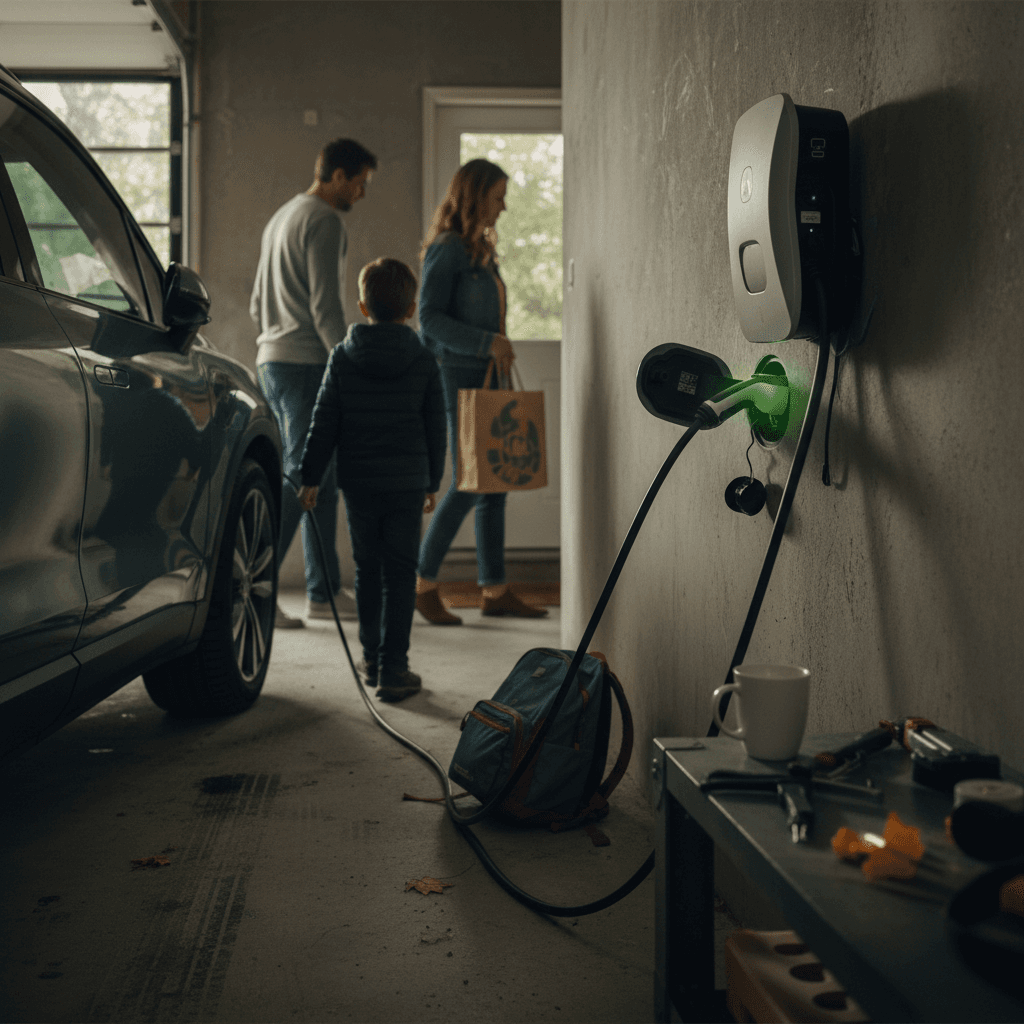
Typical charging options for US EV drivers
Where American EV drivers actually plug in, and what each option is best for.
| Charging type | Where you’ll see it | Best for | Rough time from 10–80%* |
|---|---|---|---|
| Level 1 (120V) | Older homes, apartments, standard outlets | Low daily miles, emergency use | Overnight to 24+ hours |
| Level 2 home (240V) | Garages, driveways with dedicated circuit | Daily commuting, full overnight charge | 6–10 hours |
| Public Level 2 | Workplaces, destination parking | Top‑ups while you’re busy | 2–6 hours |
| DC fast (50–150 kW) | Highways, big box retailers, travel hubs | Road trips, long drives | 30–60 minutes |
| High‑power DC (200–350 kW) | Major interstates, flagship sites | Fastest possible road‑trip stops | 15–30 minutes |
Think of public charging as a supplement; home charging does the heavy lifting for most owners.
Don’t buy purely on maximum charging speed
Incentives and policy shaping US EV adoption
Policy is one reason the electric car US market has scaled so quickly, and also why it can feel confusing. Federal rules have shifted from simple purchase rebates to a more complex mix of domestic content requirements and income caps, while state and utility programs layer on top.
Federal incentives in 2025
The federal Clean Vehicle Credit still offers up to $7,500 on qualifying new EVs, but eligibility now depends on:
- Where the vehicle is assembled
- Battery component and critical mineral sourcing
- Your income and the vehicle’s MSRP cap
A separate credit is available for some used EVs sold under specific price and income thresholds. Always verify eligibility for a specific VIN before you sign.
State & local sweeteners
States and utilities can stack additional value on top of federal programs:
- Rebates for home Level 2 charger installation
- Reduced registration fees or carpool lane access
- Time‑of‑use electricity rates that make off‑peak charging much cheaper
This patchwork is one reason EV economics can look radically different in, say, California versus the Southeast.
How to sanity‑check incentives
What it’s actually like to live with an electric car in the US
Day‑to‑day, the US electric car experience is less about kilowatts and policy acronyms and more about convenience, range, and charging habits. Owners who can plug in at home typically report that living with an EV is easier than they expected: you start each day with a “full tank” and mostly stop thinking about gas stations.
Everyday realities of US EV ownership
The trade‑offs most drivers actually notice
Driving feel
Most electric cars feel quicker and smoother than their gas equivalents around town. Instant torque and one‑pedal driving change how you think about city traffic.
Weather & range
Cold winters and high‑speed highway driving can noticeably reduce range, sometimes by 20–30%. Planning a buffer on road trips is wise, especially in colder states.
Running costs
Electricity is usually cheaper per mile than gasoline, and maintenance (no oil changes, fewer moving parts) tends to be lower, but insurance and purchase price can be higher.
Apartment and street‑parking challenges
Buying a used electric car in the US
Here’s where the current electric car US moment is especially interesting. As early EV adopters upgrade and more models enter the market, used EV supply is rising, and prices on many models have corrected from pandemic highs. That creates opportunities, provided you can confidently evaluate battery health and total cost of ownership.
Used EV buying checklist for US shoppers
1. Start with your daily driving reality
Estimate your real daily mileage, climate, and access to home or workplace charging. A 200‑mile EPA range means something different in Phoenix than in Minneapolis in January.
2. Look beyond the badge price
Factor in potential tax credits on used EVs, state rebates, electricity rates, insurance, and expected maintenance. A slightly more expensive car with a healthier battery can be the cheaper option over 5–7 years.
3. Demand verified battery health
Battery capacity and fast‑charging history matter more than odometer miles. Ask for a <strong>formal battery health report</strong>, not just a generic “passed inspection” claim.
4. Check fast‑charging compatibility
Make sure the car’s connector standard (CCS, NACS/Tesla, or CHAdeMO on older models) matches the fast‑charging networks that are actually dense along your regular routes.
5. Inspect software and warranty status
Some EVs bundle critical functions behind software updates or subscriptions. Confirm that software is up to date and that any remaining battery and powertrain warranty transfers to you.
6. Test‑drive with charging in mind
On the test drive, watch how the car predicts range, how driver‑assist systems behave on the highway, and how easy it is to find and navigate to chargers from the infotainment system.
Don’t skip the battery report
How Recharged simplifies buying a used EV in the US
Traditional dealership processes weren’t built for the realities of EVs. Pricing often doesn’t reflect battery condition, sales staff may not understand things like charging curves or connector standards, and test drives rarely tell you what you need to know. That’s exactly the gap Recharged was built to fill.
What you get when you buy a used EV through Recharged
Designed specifically around electric cars in the US
Recharged Score battery diagnostics
Every vehicle on Recharged includes a Recharged Score Report with verified battery health. You see objective data on capacity, fast‑charging behavior, and thermal performance, so you’re not guessing about the most expensive part of the car.
Transparent pricing & financing
Recharged benchmarks each EV against fair market pricing and its actual battery health. You can finance online, pre‑qualify with no impact to your credit, and even structure deals that factor in potential tax credits.
Nationwide, digital‑first experience
Browse, finance, and complete your purchase fully online, with nationwide delivery and the option to visit the Recharged Experience Center in Richmond, VA if you prefer an in‑person walkthrough.
Ready to find your next EV?
Browse VehiclesTrade‑in and instant offers
If you’re moving from a gasoline car, or an older EV, Recharged can provide an instant offer or help you consign your vehicle to maximize value. Because the platform is EV‑specialized, it can more accurately price plug‑ins than many traditional dealers.
Expert EV support
From connector standards to home‑charging questions, Recharged pairs you with EV‑specialist support throughout the process. That matters when you’re comparing, for example, a CCS‑equipped crossover to a NACS‑equipped sedan and trying to understand how that plays out at real charging stations near you.
Why a dedicated EV retailer matters
Frequently asked questions about electric cars in the US
US electric car FAQs
The bottom line on electric cars in the US
The electric car US story in 2025 is neither unbridled hype nor backlash, it’s a big, structural shift going through a messy middle phase. Adoption is climbing, charging is expanding quickly but unevenly, and incentives are evolving from blunt instruments into more targeted policies. For you as a driver, that translates into growing choice, better product, and a used market that finally has enough volume to reward careful shoppers.
If you take away one thing, make it this: your experience with an EV will be defined less by the logo on the hood and more by where you charge, what your real‑world range needs are, and how healthy the battery is. Spend your effort understanding those three things, and you’ll be positioned to take advantage of this market’s upside rather than getting caught in its noise. And if you’d rather not decode all that alone, a specialized retailer like Recharged, with verified battery diagnostics, transparent pricing, EV‑savvy support, and nationwide delivery, can dramatically lower the friction of making the switch.