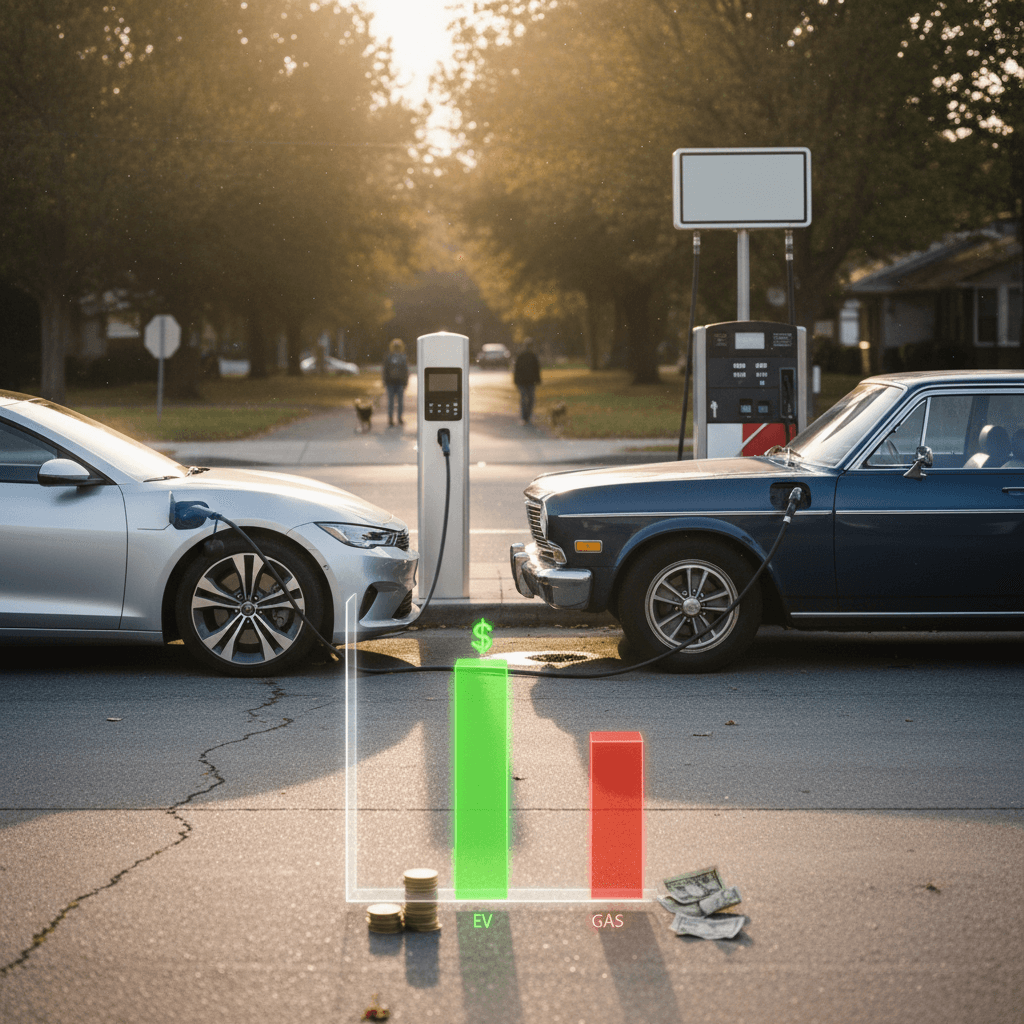
If you’re comparing an electric car to a gas car, you’ll quickly run into a confusing mix of MPG, MPGe, kWh, and “efficiency” claims. You’ll also see bold headlines about rising electricity prices and cheaper gas. To make a smart decision, especially on a used EV, you need to understand how electric car efficiency vs gas really stacks up in 2025, in terms of energy use, cost per mile, and emissions.
Key takeaway upfront
Why electric vs gas efficiency matters in 2025
Efficiency isn’t just an engineering curiosity, it’s a direct line to your monthly costs and the car’s climate impact. In 2025, U.S. electricity prices have climbed into the high‑teens cents per kWh on average, while gasoline prices have cooled from their early‑2020s peaks. That makes the EV vs gas efficiency comparison more nuanced than the “EVs are always cheaper” headlines from a few years ago, but the basic physics haven’t changed: wasting less energy still pays.
EV vs gas at a glance (typical 2025 numbers)
Context matters
How efficiency is measured: MPG, MPGe and kWh
Gasoline cars are rated in miles per gallon (MPG). Electric cars use kilowatt‑hours (kWh) of electricity instead of gallons of fuel, so a more natural metric is miles per kWh. For regulatory purposes, the EPA also publishes MPGe (miles per gallon equivalent), which says: “If a gallon of gasoline contains 33.7 kWh of energy, how many miles would this EV go on that much energy?”
- Typical modern compact or midsize gas car: 30–35 mpg highway, high‑20s mpg combined.
- Typical modern battery‑electric: 3.0–4.0 miles per kWh (roughly 100–135 MPGe).
- EPA’s energy content conversion: 33.7 kWh = 1 gallon of gasoline.
Quick rule of thumb
Pure energy efficiency: electric vs gas powertrains
Gasoline car: where the energy goes
- Only about 20–30% of the chemical energy in gasoline reaches the wheels.
- The rest is lost as engine heat, exhaust, and friction inside the transmission and driveline.
- Stop‑and‑go driving is especially punishing: every time you brake, you throw away energy as heat.
Electric car: fewer losses, more recovery
- Electric motors are typically 85–95% efficient in converting electrical energy to mechanical power.
- Inverters, batteries, and driveline components add some losses, so you end up with ~70–85% overall efficiency from plug to wheels.
- Regenerative braking recovers a chunk of energy that a gas car throws away as heat.
That fundamental difference is why an EV can post triple‑digit MPGe while a similar‑size gas sedan struggles to crack 40 mpg. Even when electricity prices rise, you’re starting from a much more efficient machine.
Real‑world cost per mile: electricity vs gasoline
People usually care less about thermodynamic elegance and more about “what does it cost me to drive 1 mile?” Let’s run the numbers using broadly representative U.S. prices in late 2025 and a realistic EV efficiency figure.
Cost per mile: sample EV vs gas scenarios
These are simplified examples to illustrate how efficiency plays with local energy prices.
Scenario 1: Average‑cost state, home charging
Assumptions
- Electricity: $0.18/kWh (roughly U.S. residential average in 2025)
- EV efficiency: 3.5 mi/kWh
- Gas: $3.25/gal
- Gas car efficiency: 32 mpg
Results
- EV: about $0.05/mile
- Gas: about $0.10/mile
You save roughly 5 cents per mile with the EV, about $750 over 15,000 miles a year.
Scenario 2: High‑cost electricity, mostly DC fast charging
Assumptions
- Public DC fast charging: $0.45/kWh
- EV efficiency: 3.0 mi/kWh (less efficient at highway speeds)
- Gas: $3.25/gal
- Gas car: 32 mpg
Results
- EV: about $0.15/mile
- Gas: about $0.10/mile
If you rely heavily on expensive fast chargers, the gas car can actually be cheaper to fuel per mile.
Scenario 3: Low‑cost electricity, time‑of‑use rates
Assumptions
- Off‑peak home charging: $0.10/kWh
- EV efficiency: 4.0 mi/kWh (efficient compact EV)
- Gas: $3.50/gal
- Gas car: 30 mpg
Results
- EV: about $0.025/mile
- Gas: about $0.12/mile
Here the EV costs about one‑fifth as much per mile to run as the gas car.
How to estimate your own cost per mile
Emissions and “well‑to‑wheel” efficiency
Energy efficiency and climate impact are related but not identical. A gas car burns fossil fuel in the vehicle, so its tailpipe CO₂ emissions are straightforward to measure. An EV has no tailpipe, but the electricity it uses may come from natural gas, coal, renewables, or a mix. To compare apples to apples, analysts use a “well‑to‑wheel” or “life‑cycle” framework.
- Gas car: well‑to‑wheel emissions depend on oil extraction, refining, transport, and tailpipe burning.
- EV: well‑to‑wheel emissions depend on power plant mix, transmission losses, charging, and use in the car.
- Both: manufacturing emissions (especially battery production for EVs) matter when you zoom out to full life cycle.
What most studies find
As the grid adds more solar, wind, and storage, each kWh you put into an EV gets cleaner over time. The gas car, by contrast, is locked into burning fossil fuel at roughly the same CO₂ per gallon for its entire life.
Efficiency over time: battery health vs engine wear
A brand‑new car is one thing; the real question is how efficiency holds up after 5–10 years. This is where used‑EV shoppers understandably worry about battery degradation, while used‑gas shoppers worry about repairs and worsening fuel economy.
Gas cars as they age
- Fuel economy often declines slightly over time due to engine wear, clogged injectors, and transmission issues.
- Owners tend to defer maintenance as cars age, which can further hurt efficiency.
- Mechanical issues (timing components, exhaust, sensors) can keep the car from operating at its original efficiency even if it still drives fine.
EVs as they age
- Batteries lose some capacity over time, which reduces range, but the motor and inverter generally remain very efficient.
- Real‑world data suggest many modern EVs retain the majority of their usable capacity, often around 80–90% after 8–10 years, depending on model and usage.
- That means your cost per mile may barely change; you just have fewer miles per full charge than when the car was new.
How Recharged tackles the battery question
When a gas car can seem more efficient (and when it isn’t)
It’s absolutely possible to find scenarios where a gas car looks better on a narrow metric, usually short‑term cost per mile, but the underlying energy efficiency story doesn’t change. Here are a few edge cases and how to think about them.
Edge cases where gas can compete on cost
1. You road‑trip constantly and live on fast charging
If 90% of your miles are highway road trips and you’re paying premium DC fast‑charge rates, fuel costs in an efficient gas hybrid can undercut a less‑efficient EV. You’re paying a big per‑kWh markup for convenience.
2. You live where electricity is very expensive
In parts of California or the Northeast, residential rates can run above $0.30–$0.40/kWh. If you can’t access off‑peak rates or workplace charging, the EV’s cost advantage shrinks and sometimes flips for high‑efficiency gas cars.
3. You drive very little
If you only drive a few thousand miles a year, fuel isn’t your main cost, <strong>depreciation and insurance</strong> are. In that case, an EV’s efficiency advantage matters less than getting the right vehicle at the right price.
4. You can’t install home charging
Apartment and condo living can make it hard to tap cheap, predictable home electricity. If public charging is your only option and prices are high or unreliable, a gas car’s refueling convenience becomes a larger part of the equation.
Don’t confuse fuel cost with total cost
What this means if you’re shopping for a used EV
If you’re in the market for a used vehicle, the efficiency math is one core reason people move from gas to electric, but the details of the specific car and your local energy prices matter just as much. Here’s how to turn “EVs are more efficient” into a concrete buying strategy.
Turning efficiency into a smart used‑EV purchase
Four practical steps you can take before you sign anything.
Know your own driving pattern
- Estimate your annual miles and how many are highway vs city.
- City‑heavy driving favors EVs even more because of regenerative braking.
- If you mostly do short trips, even a smaller‑battery EV can work great.
Run the numbers for your local rates
- Pull a recent utility bill and note your actual $/kWh.
- Use the EPA’s rated kWh/100 miles for the EVs you’re considering.
- Compare against your current gas car’s real mpg at current fuel prices.
Check battery health, not just range on paper
- Two identical EVs on paper can have very different real‑world range.
- A verified battery health report (like the Recharged Score) shows how much capacity is left.
- That directly affects how many miles you get out of each kWh you buy.
Look at total monthly cost, not just fuel
- Factor in purchase price, financing, insurance, maintenance, and fuel/charging.
- Used EVs often shine on maintenance: no oil changes, fewer moving parts, and less brake wear.
- On Recharged, you can also explore financing and trade‑in options to see the full monthly picture.
How Recharged can help
FAQ: electric car efficiency vs gas
Frequently asked questions about EV vs gas efficiency
Bottom line: how much more efficient are EVs than gas cars?
Strip away the hype and the politics, and the core story is simple: electric drivetrains waste far less energy than internal‑combustion engines. That shows up as higher MPGe, lower typical cost per mile when you can access reasonably priced electricity, and lower emissions over the life of the vehicle in most of the U.S., especially as the grid gets cleaner.
Where things get nuanced is how that efficiency interacts with your local electricity and fuel prices, your ability to charge at home, and the specific vehicle you choose. A carefully chosen used EV, with verified battery health and a good match to your driving pattern, can give you the best of both worlds: dramatically higher energy efficiency than a gas car, and a total monthly cost that’s competitive with, or better than, a comparable gasoline vehicle.
If you’re ready to run the numbers on a real car instead of a hypothetical, explore used EVs on Recharged, look through each car’s Recharged Score Report, and see how electric car efficiency vs gas plays out for your budget, your commute, and your long‑term plans.