Under the sleek floor of an electric car, the most important component isn’t the motor, the screen, or the badge on the hood. It’s a giant, densely packed lithium‑ion battery that really, really cares about temperature. Electric car cooling is the quiet, invisible system that keeps that battery, the motor, and you at exactly the right degree of happiness.
The EV “Goldilocks zone”
Why electric car cooling matters more than you think
In a gasoline car, the engine wastes so much heat that designers mostly worry about getting rid of it; the cabin heat is basically a free side hustle. In an EV, almost all the energy goes into motion, not waste heat, so engineers have to build an entire thermal management system from scratch. That system decides how far you can drive on a winter morning, how quickly you can DC fast charge in August, and how long your battery stays healthy.
Electric car cooling by the numbers
This isn’t academic. Poor cooling is exactly why some early air‑cooled EVs saw visible battery degradation in hot climates, while newer liquid‑cooled packs from Tesla, Hyundai/Kia, Ford, and others stay healthier for far longer. When you buy a used EV, you’re also buying the history of how well its cooling system has done its job.

How EV battery cooling works
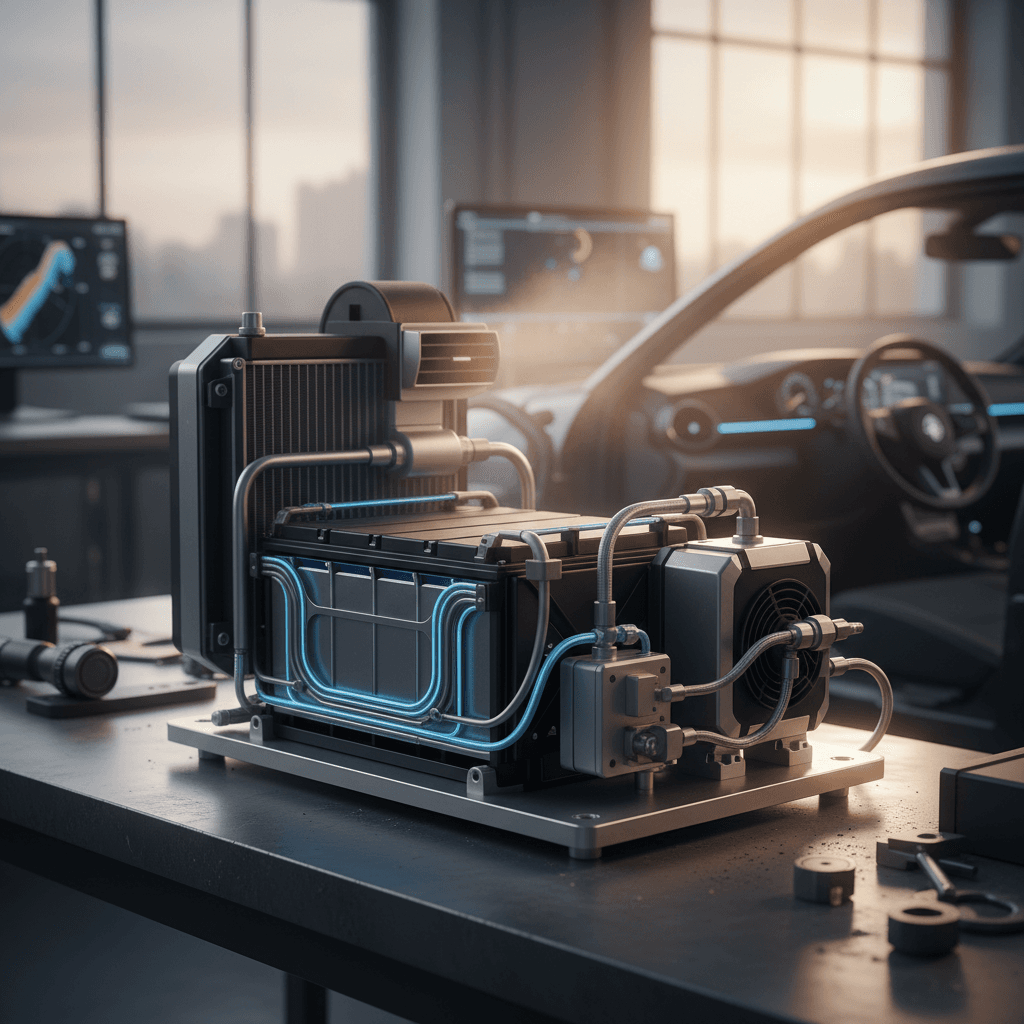
Think of an EV battery pack as a small apartment building made of hundreds or thousands of cells. Every time you accelerate hard or fast‑charge, those cells dump heat into the walls. Electric car cooling is the plumbing built into those walls that carries heat away before anything overheats or ages prematurely.
Core pieces of an EV battery thermal management system
Different badges, same basic architecture under the floorpan
Battery pack & sensors
The pack is filled with modules or cell blocks. Temperature sensors are embedded throughout to catch hot spots, and software continuously watches for cells that run hotter than the rest.
Cooling plates & channels
Most modern EVs sandwich thin aluminum plates or channels between cells. A coolant (often a water–glycol mix) flows through these plates, picking up heat directly from the battery.
Pumps, valves & radiators
Electric pumps push coolant through radiators at the nose of the car. Valves route flow between battery, motor, power electronics, and sometimes the cabin HVAC to reuse or dump heat as needed.
From the driver’s seat, all of this is invisible. What you notice is the effect: stable range on long highway runs, DC fast‑charging that doesn’t immediately throttle, and an EV that doesn’t panic when the thermometer looks like a Phoenix real‑estate chart.
Think of it as a shared spine
Liquid vs air cooling in electric cars
If you want to start an argument at an EV engineering conference, ask whether air cooling was ever a good idea. Early, low‑range EVs sometimes relied on simple fans and ducts. Almost every serious electric car today uses some form of liquid battery cooling instead.
Air cooling vs liquid cooling in EV batteries
Why most modern EVs have moved away from purely air‑cooled packs.
| Feature | Air‑cooled pack | Liquid‑cooled pack |
|---|---|---|
| Heat removal | Limited: depends heavily on ambient air | High: coolant can absorb and move heat efficiently |
| Temperature uniformity | Hot spots common, especially in big packs | Very uniform across cells, crucial for longevity |
| Fast‑charging | Often restricted or slower in hot weather | Supports high charge rates with less throttling |
| Complexity & cost | Simpler, cheaper, fewer parts | More components: pumps, plates, hoses, valves |
| Use cases today | Older EVs, low‑range city cars | Most modern long‑range and performance EVs |
Liquid cooling wins on control and fast‑charging, while air cooling wins on cost and simplicity.
To put it in everyday terms: air cooling is a box fan; liquid cooling is a full HVAC system with ductwork in every room. When you’re charging a 70–100 kWh pack at 150 kW on a summer road trip, you want the HVAC system, not the box fan.
Why this matters for used EVs
Cabin heating and cooling in EVs
Gas cars have it easy: the engine throws off absurd amounts of waste heat, so warming the cabin is as simple as piping that heat through a small radiator. EVs don’t have that luxury. Every watt of cabin heating or cooling comes straight out of the battery, which is why electric car cooling and heating are tightly integrated with the rest of the thermal system.
Resistive heaters: the simple option
Many early and budget EVs use resistive heaters, essentially giant versions of the coils in a hair dryer. They’re simple and reliable, but also energy‑hungry. In sub‑freezing weather, a resistive heater can eat a big chunk of your usable range just keeping the glass defrosted and your toes unfrozen.
That’s why owners of some older EVs see dramatic winter range drops when they run the heater hard.
Heat pumps: the efficient upgrade
A heat pump is more like a reversible air‑conditioner. Instead of making heat from electricity, it moves heat from one place to another. That’s far more efficient, especially around freezing temperatures.
Modern EVs with heat pumps, such as many Teslas, Hyundai Ioniq 5/6, Kia EV6, Mustang Mach‑E and others, tend to lose less range in winter because the car isn’t wasting as much energy on cabin heating.
Cooling the cabin vs cooling the battery
Electric car cooling in extreme heat and cold
Thermal management is at its most interesting, and most important, right when you’re most uncomfortable: heat waves and cold snaps. The car is trying to keep itself alive while also keeping you happy, and the battery would frankly prefer you picked one.
What your EV is doing behind the scenes
Same hardware, very different jobs in July vs January
In extreme heat
- Battery coolant flow ramps up to keep cells below roughly 40°C.
- Fans pull air through front radiators, just like a gas car.
- DC fast charging may slow if pack temperature creeps too high.
- Cabin A/C and battery cooling share capacity; heavy cabin use can reduce charging speed or power briefly.
In deep cold
- The car may pre‑heat the battery before fast‑charging to avoid lithium plating and damage.
- Cabin heating relies on a heat pump or resistive elements, both drawing directly from the battery.
- Regen braking can be limited until the pack warms, which changes the way the car feels off‑throttle.
- Range drops largely because you’re heating a big glass box with electric power.
Let the car precondition
Ownership tips to protect your EV’s cooling system
You don’t control the hardware, but you do control how hard your thermal management system has to work. A few small habits make a noticeable difference in both day‑to‑day range and long‑term battery health.
Six practical habits that help your EV keep its cool
1. Favor shade and covered parking
High cabin temperatures force the A/C and battery cooling circuits to work overtime. Parking in a garage or under shade means less energy spent dragging the car back down to a reasonable temperature.
2. Precondition while plugged in
Use your car’s app or in‑car scheduler to heat or cool the cabin before you unplug. That way the grid, not your battery, pays the big climate‑control bill.
3. Don’t ignore software updates
Automakers routinely tweak thermal management logic with over‑the‑air updates: when pumps kick on, how hard fans run, how fast you can charge. Keeping software current can literally improve battery comfort.
4. Watch DC fast‑charging behavior
Repeated, back‑to‑back DC fast‑charging in very hot weather can tax the cooling system. If your EV is clearly throttling and the pack feels hot, build in longer breaks or alternate with slower AC charging when possible.
5. Use seat and wheel heaters first
In winter, seat and steering‑wheel heaters use much less energy than blasting hot air. You stay comfortable while the battery cooling/heating system doesn’t have to work as hard.
6. Don’t dismiss odd fan or pump noises
Extended, loud cooling fans or gurgling noises at odd times can be early warning signs. If you’re buying used, ask the seller about any history of coolant leaks or thermal faults.
Thermal warnings are not optional
Used EV shopping: What to know about cooling systems
When you’re buying a used electric car, you’re not just looking at mileage and tire tread. You’re buying the history of its electric car cooling: how many hot summers it sat baking, how often it fast‑charged, how well the pack stayed in its comfort zone.
Questions to ask about thermal history
- Air‑ or liquid‑cooled? Know which design you’re dealing with; air‑cooled packs deserve extra scrutiny in hot‑weather states.
- Climate & usage pattern? A commuter that lived in coastal Oregon is a different thermal story than a rideshare car in Phoenix.
- Any cooling‑system repairs? Radiator, pump, valve or coolant‑leak repairs are not deal‑breakers, but you want documentation.
How Recharged helps you read between the lines
Every vehicle sold through Recharged comes with a Recharged Score Report that goes beyond cosmetic condition. Our diagnostics look at battery health and fast‑charging behavior, both closely tied to how the cooling system has performed over time.
Pair that with expert EV‑specialist support, transparent pricing, financing, and nationwide delivery, and you’re not guessing whether the car has been thermally abused, you’re making an informed decision.
Buying with confidence
Ready to find your next EV?
Browse VehiclesFAQ: Electric car cooling & thermal management
Frequently asked questions about electric car cooling
Key takeaways for EV owners and shoppers
- EVs live or die by temperature. Keeping the battery in its comfort zone is the single biggest job of electric car cooling systems.
- Liquid‑cooled packs with smart thermal management age more gracefully, charge faster, and hold range better than older air‑cooled designs.
- Heat pumps, preconditioning, and smart use of seat heaters are your allies against winter range loss.
- Simple habits, parking in shade, updating software, respecting thermal warnings, meaningfully reduce stress on your EV’s cooling hardware.
- When buying used, don’t just ask about miles; ask about climate, charging habits, and get a proper battery health report that reflects the car’s thermal history.
If you think of your EV as a rolling smartphone on 19‑inch wheels, the cooling system is the part that keeps the battery from living on the thermal edge. Understand it and work with it, and you get the quiet, instant torque and low running costs you signed up for, without the nagging worry about what summer and winter are doing to the chemistry under your feet. And if you’d rather have experts read the thermal tea leaves for you, Recharged is built exactly for that job.