
If you’re selling an electric vehicle, you’ve probably asked yourself, “Do I need to disclose battery health when selling my EV?” Buyers know the battery is the most expensive component in the car, and they’ll treat it like the engine in a gas vehicle. Whether you’re listing your car privately, trading it in, or using an EV marketplace, how you handle battery health disclosure can affect your sale price, time to sell, and even your legal risk.
Short answer
Why battery health matters when you sell an EV
- The battery is typically the single most valuable component in an EV.
- Battery degradation directly affects range, performance, and charging behavior.
- Replacement or major repair can run into the thousands or even tens of thousands of dollars.
- Unlike mileage on a gas car, EV odometers don’t tell the whole story, a 90,000‑mile car with a healthy pack can be more valuable than a 50,000‑mile car that’s been fast‑charged aggressively.
From the buyer’s point of view, battery health is the difference between a great deal and a ticking time bomb. From your perspective as the seller, being intentional and transparent about battery condition is the easiest way to build trust, reduce back‑and‑forth haggling, and avoid post‑sale disputes.
Do you legally have to disclose EV battery health?
In the U.S., there’s no federal law that says, “You must show a battery state‑of‑health percentage to sell an EV.” Instead, the legal framework is built around truthful representation, consumer protection, and state‑level used‑car rules. That means the answer depends on where you sell, how you sell, and what you already know about the car.
How disclosure rules differ by selling scenario
Your obligations look different as a private seller vs a dealer.
Private party sale
You usually aren’t held to the same standards as a licensed dealer, but you still can’t lie about or hide known defects. If you know the pack is weak and you say it’s “perfect,” that’s a problem.
Dealer or wholesaler
Dealers operate under state dealer laws and consumer‑protection rules. Many states expect written disclosure of major known defects, and regulators can step in if vehicles are misrepresented.
Marketplace & consignment
Marketplaces focused on EVs (like Recharged) build battery health checks and transparency into their process, often going beyond the minimum legal requirements to protect both sides.
Important nuance
What counts as misrepresentation or fraud when selling an EV?
Courts and regulators look less at whether you printed out a fancy report and more at whether you were honest about what you knew. With EVs, that usually comes down to a handful of specific behaviors.
Common ways sellers get into trouble
Examples of risky behavior when selling an EV and how to avoid them.
| Scenario | Risk level | Safer approach |
|---|---|---|
| You know the range has dropped by ~30% vs new but advertise “full factory range.” | High | Quote the actual typical range you see in daily driving and share any battery reports or screenshots. |
| You reset the trip computer before a test drive to hide recent poor efficiency. | Medium–High | Let buyers see normal energy‑use history and be available to answer questions about your driving pattern. |
| You ignore a recurring battery or charging error message and tell the buyer there are “no issues at all.” | High | Mention recurring warnings, share service records, and price the car accordingly. |
| You genuinely don’t know the exact state of health and say, “I haven’t had it tested.” | Low | Be transparent about what you do and don’t know; offer to get a battery health check. |
When in doubt, disclose more than you legally have to, especially around battery performance.
Clear red lines
Best practices for disclosing battery health to buyers
Even if the law in your state doesn’t spell out exactly how to disclose EV battery health, the market increasingly expects it. Transparent sellers are rewarded with more interest and less skepticism. Here’s a practical playbook you can follow.
Practical disclosure checklist for EV battery health
1. Gather what your car already tells you
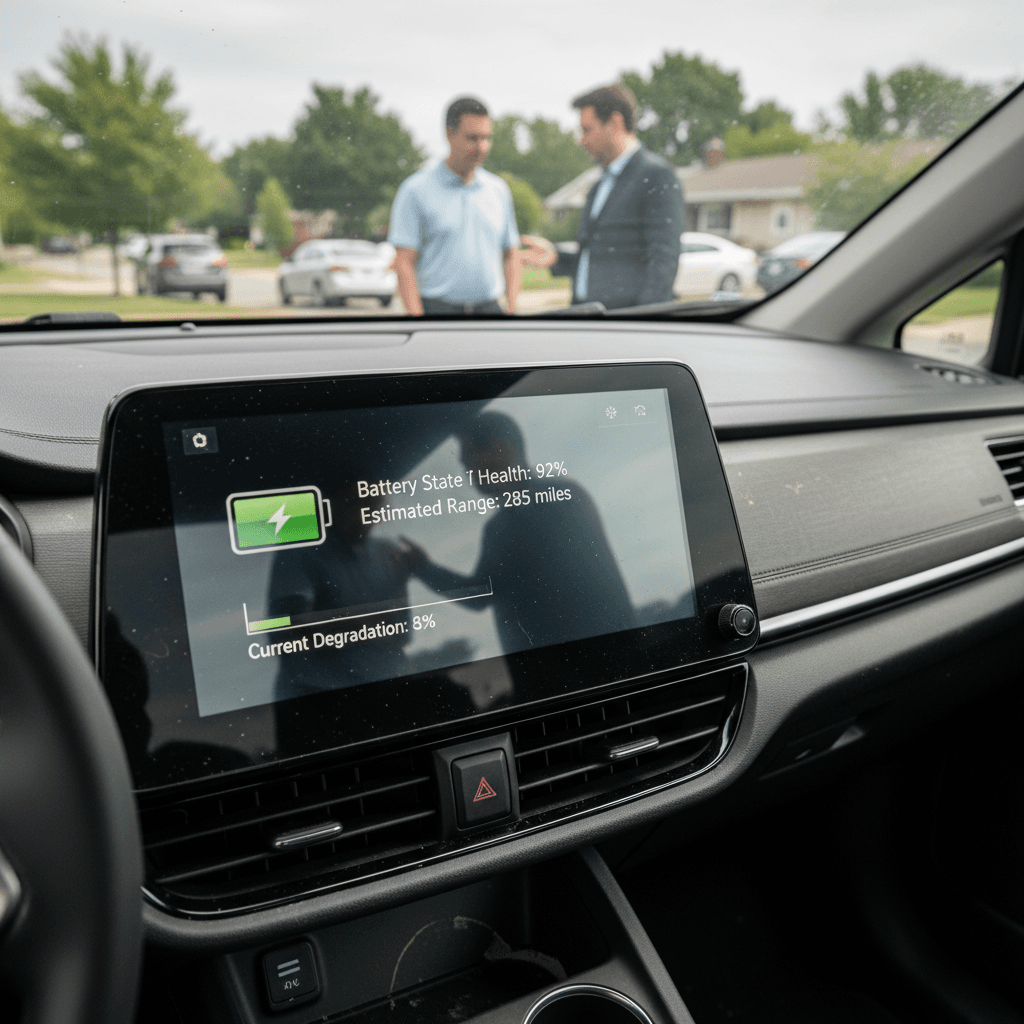
Most EVs show estimated range and sometimes an internal battery health or “rated range at 100%” figure. Take clear photos or screenshots of these screens at full charge and typical charge levels.
2. Pull service and warranty records
If the battery has been serviced, replaced, or evaluated by a dealer, collect those records. They’re powerful evidence if a buyer worries about pack condition or remaining warranty coverage.
3. Get an independent battery health test
Where possible, use a third‑party or marketplace battery diagnostic, like the <strong>Recharged Score battery health evaluation</strong>, so you’re not asking buyers to take your word for it.
4. Be specific in your listing
Instead of vague claims (“great range!”), include real‑world figures: typical highway range, your normal charge limit, and any degradation you’re aware of. Specific numbers build trust.
5. Disclose recurring issues before the test drive
If you’ve seen charging problems, unexpected drops in range, or dashboard warnings, mention them upfront. Surprises during a test drive erode buyer confidence fast.
6. Reflect battery health in your pricing
A car with above‑average battery health can justify a stronger asking price; a car with noticeable degradation should be <strong>priced honestly</strong> rather than glossed over.
Use disclosure as a sales tool
How to get a reliable battery health report
Unlike a compression test on an engine, EV battery diagnostics aren’t yet standardized across automakers. But the landscape is improving quickly, and you have a few realistic options as a seller.
Common ways to check EV battery health
Choose the option that fits your car, location, and budget.
Dealer diagnostic
Some brands can run a state‑of‑health (SoH) test through factory tools. You’ll usually pay a diagnostic fee, and the output can be technical, but it carries OEM credibility.
App‑based scan
For certain models, third‑party apps and OBD dongles can estimate battery health by reading live data. Results can vary, but they’re often more detailed than the dash display.
Marketplace battery report
EV‑focused marketplaces like Recharged include a Recharged Score battery health report with each vehicle, using specialized diagnostics so buyers see an objective view, not just a seller’s claim.
Where Recharged fits in
How battery health actually affects your EV’s resale value
Battery health is more than a technical curiosity; it’s one of the biggest levers on your EV’s resale price. Buyers don’t pay for what the car did when it was new, they pay for the range and performance they’ll get in their own daily use.
Key value drivers linked to battery health
The takeaway: Good battery documentation doesn’t scare buyers away; poor or missing information does. Even if your pack shows some expected degradation, being upfront allows you to anchor the price on facts instead of speculation.
Private sale vs trade‑in vs EV marketplace: who handles disclosure?
Private party sale
You control everything: the listing, the conversations, the paperwork. That also means you own the disclosure strategy. If you don’t provide a battery health story, shoppers will assume the worst or walk away. On the upside, a strong battery with documentation can help you net more than a typical trade‑in.
Downside: you’re responsible for answering tough questions, organizing tests, and protecting yourself legally.
Trade‑in or instant offer
When you bring your EV to a dealer or offer service, they’ll appraise the car and price in their own view of battery risk, whether they share those details with you or not. You typically accept a lower but simpler outcome: less hassle, less direct negotiation with an end buyer.
With Recharged, that instant offer is backed by EV‑specific expertise and a transparent condition report, including battery health, so the valuation isn’t just a guess.
A third route, consignment or selling through an EV marketplace, essentially lets a specialist handle the transparency and buyer education for you. Recharged, for example, combines battery diagnostics, fair market pricing, and expert‑guided support so neither side is flying blind.
Who disclosure really helps
Ready to find your next EV?
Browse VehiclesHow to protect yourself as a seller
Transparency isn’t just about being nice, it’s also about protecting yourself if a buyer later claims you hid something. Here are practical ways to reduce your risk while still getting a fair outcome.
Seller protection checklist for EV battery disclosure
Put key facts in writing
Summarize what you know about battery health in the bill of sale or sales agreement: typical range, any tests performed, and known issues. Written clarity is your best defense if memories differ later.
Avoid absolute guarantees
Instead of saying “battery is perfect,” describe what you’ve observed: “At 80% charge, I typically see about X miles of range in mixed driving.” Don’t promise future performance you can’t control.
Share documents, not just opinions
Provide copies of battery reports, service invoices, and recall work. Documents are harder to dispute than verbal assurances made in a driveway.
Capture buyer acknowledgment
For private sales, have both parties sign that they’ve <strong>reviewed the documents and understand the car is sold as‑is</strong>, subject to any remaining factory warranty.
Use a reputable intermediary when in doubt
If you’re uncomfortable handling battery questions or paperwork, consider selling through a marketplace like <strong>Recharged</strong> that builds disclosure and documentation into the process.
This isn’t legal advice
FAQ: Battery health and selling your EV
Frequently asked questions
Key takeaways for selling an EV with confidence
- You’re rarely forced by law to provide a formal battery report, but you must be truthful about what you know.
- Battery health is a core value driver for your EV, so treating it like a black box only hurts your position.
- Clear documentation, screenshots, service records, third‑party tests, or a Recharged Score, turns disclosure from a risk into a selling point.
- Putting key facts in writing and avoiding absolute guarantees helps protect you if disputes arise later.
- Selling through an EV‑focused marketplace like Recharged can offload the hard parts: battery diagnostics, pricing, buyer education, and paperwork.
So, do you need to disclose battery health when selling an EV? Strictly speaking, not always. But if you want to maximize value, minimize hassle, and sleep well after the sale, the smartest move is to treat battery transparency as non‑negotiable. Whether you sell privately or let Recharged handle the heavy lifting, a clear, honest story about your battery is the foundation of a smooth EV sale.