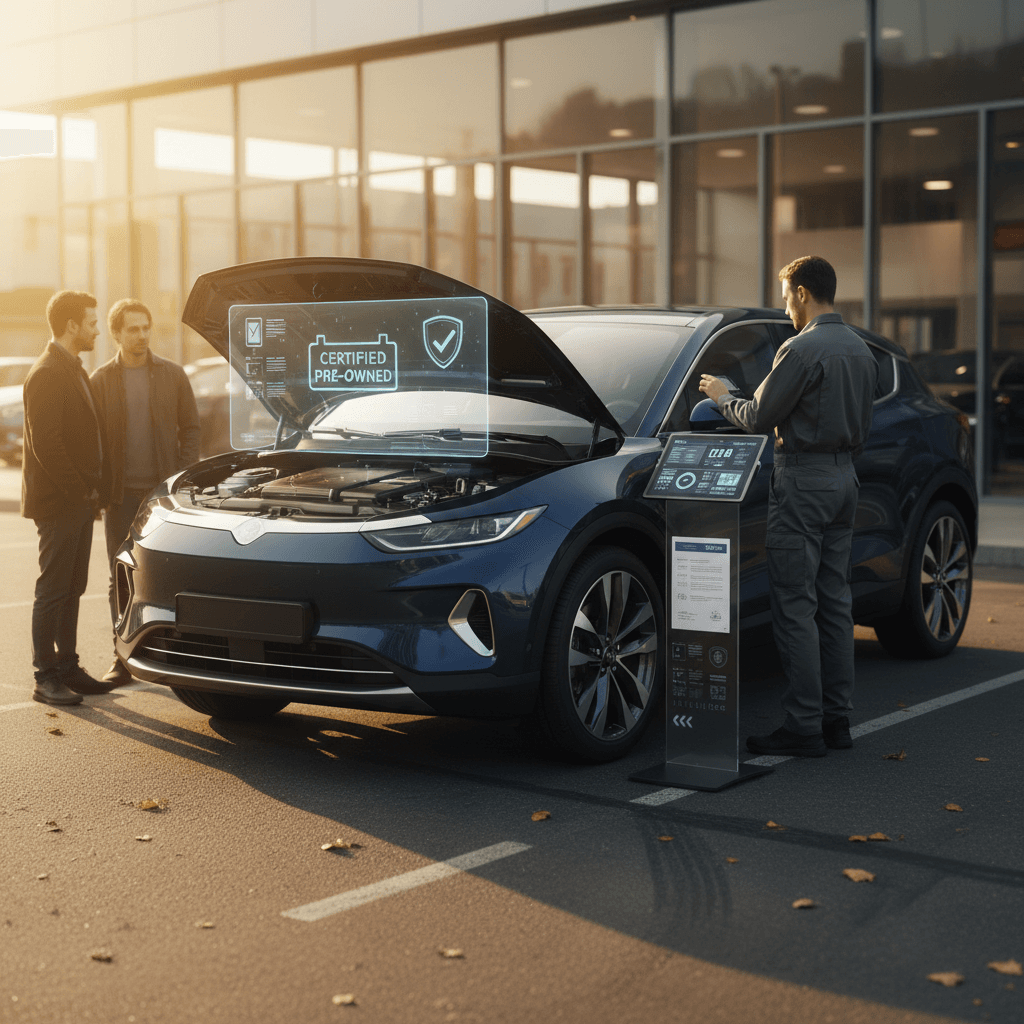
Walk onto almost any franchise lot today and you’ll see banners shouting "CERTIFIED PRE‑OWNED" over rows of used cars. A CPO car dealer promises extra peace of mind: factory‑backed inspections, better warranties, and cars that have been “cherry‑picked” from the used market. But what does that really mean, especially if you’re shopping for a used electric vehicle?
Quick definition
What is a CPO car dealer, really?
A CPO car dealer is usually a new‑car franchise that also sells used vehicles under the manufacturer’s certified pre‑owned program. The automaker sets the ground rules, age and mileage limits, inspection standards, and warranty coverage, but the dealer decides which cars to certify and how aggressively to price them.
- Affiliated with a specific brand (Toyota, BMW, Hyundai, etc.)
- Has access to that brand’s official CPO program and marketing
- Can enroll qualifying used cars as "certified" for an extra fee
- Represents the factory on warranty repairs and recalls
Think of CPO as a bundle
Why CPO has become such a big deal
How CPO certification works at the dealer level
CPO programs sound simple in ads, but inside a dealership they’re a tug‑of‑war between marketing, service, and the used‑car department. Understanding that tug‑of‑war helps you negotiate smarter.
What actually happens before a car becomes CPO
Behind the scenes at a CPO car dealer
1. Eligibility check
Dealer screens age, mileage, and history:
- Usually under 5–7 model years old
- Mileage caps vary by brand, often under 60–80k
- Clean title; certain accidents or mods can disqualify
2. Multi‑point inspection
Brand‑specific checklist, often 100–180 items covering:
- Brakes, tires, suspension
- Fluids, filters, lights
- On EVs: high‑voltage system checks
3. Certification & warranty
Dealer pays a fee to the automaker to enroll the car as CPO, unlocking:
- Extended limited warranty
- Roadside assistance
- Marketing on brand’s CPO website
Important nuance
Who’s responsible for what in a CPO sale?
Understanding the roles of the automaker vs. the local CPO car dealer.
| Area | Automaker (Brand) | Local CPO Car Dealer |
|---|---|---|
| Program rules | Sets age, mileage, and inspection standards | Must follow rules to call a car CPO |
| Inspection checklist | Creates official multi‑point checklist | Pays techs to perform inspection |
| Warranty | Backs CPO limited warranty and battery coverage | Handles warranty paperwork; gets reimbursed |
| Pricing | No direct control over retail price | Sets selling price and CPO premium |
| Reconditioning | May set minimum standards | Chooses how far to go beyond the minimums |
CPO works because the factory and dealer share responsibility, but they don’t share it evenly.
CPO car dealer vs regular used car dealer
If you’re cross‑shopping a CPO car dealer with an independent lot, it helps to strip away the marketing and compare the basics: price, warranty, inspection, and who stands behind you if something goes wrong.
What a CPO car dealer typically offers
- Factory‑backed limited warranty beyond any original coverage.
- Brand‑specific multi‑point inspection, sometimes 150+ items.
- Roadside assistance, trip‑interruption coverage, and sometimes free maintenance.
- Access to OEM technical support and recall work.
Luxury brands often pitch CPO as a low‑risk way to get into a higher‑end model with lower monthly payments than new.
What a non‑CPO used car dealer offers
- Lower asking price in many cases.
- State‑required inspection plus whatever the dealer chooses to do.
- Dealer or third‑party warranty, if offered, with more fine print.
- Less consistent reconditioning standards from car to car.
A good independent dealer can absolutely deliver a solid car, but you need to probe harder on inspection reports and warranty coverage.
Where Recharged fits in
Ready to find your next EV?
Browse Vehicles
CPO and electric vehicles: what’s different?
For electric vehicles, the word "certified" can lull buyers into assuming the battery has been thoroughly evaluated and protected for the long haul. Sometimes that’s true. Sometimes, it’s wishful thinking. You need to dig into the EV‑specific details at any CPO car dealer.
Key EV differences at a CPO car dealer
What you should expect to be different from gas CPO
Battery warranty transfer
Most EVs ship with 8–10 year/100,000‑mile battery warranties that transfer to subsequent owners. CPO rarely extends the battery warranty itself, it adds coverage for everything around the battery.
Capacity & health checks
Some brands require a minimum state‑of‑health (for example, Nissan LEAF CPO requires a certain number of capacity bars). Others simply verify no warning lights are on. Always ask how battery health was measured.
High‑voltage inspection
Quality CPO programs include checks of the high‑voltage cables, charge port, onboard charger, and cooling system. You want proof that a trained EV tech actually did this, not just a line item on a checklist.
Example: mainstream EV CPO benefits
Don’t confuse "no warning lights" with a battery health report
When a CPO car is (and isn’t) worth the premium
CPO isn’t automatically a good deal. Sometimes the premium buys you meaningful coverage and saves you thousands later. Other times, you’re paying thousands for benefits you don’t really need. The trick is matching the car and your risk tolerance to the program on the table.
Situations where a CPO car dealer can be worth it
1. You’re buying an expensive or complex vehicle
High‑end EVs and luxury models pack advanced tech and pricey components. A strong CPO warranty can be cheap insurance against a big repair during your ownership window.
2. You want a simple, one‑stop solution
If you’d rather not juggle third‑party warranty quotes or independent inspections, a CPO program can bundle inspection, warranty, and roadside coverage into one transaction.
3. You’re financing and keeping the car for years
If you’re planning a 5–6 year relationship with this car, an extra year or two of warranty coverage can help you budget and keep surprises to a minimum.
4. The CPO premium is modest vs. coverage value
If the CPO version is a few hundred dollars more than an equivalent non‑certified car, but adds genuine warranty coverage, it’s often worth the bump.
Red flags: when CPO may not pencil out
How to shop a CPO car dealer like a pro
Whether you’re eyeing a certified SUV or a used EV, walking into a CPO car dealer with a game plan changes the entire conversation. Here’s how to tilt the playing field back in your favor.
Step‑by‑step game plan at any CPO car dealer
1. Start with the VIN, not the badge
Look up the specific car’s history (accidents, title status, mileage) using tools like Carfax or AutoCheck. Confirm that the VIN on the CPO listing matches the VIN on the car and all paperwork.
2. Ask for the actual CPO inspection report
Don’t settle for “it’s been inspected.” Ask for a printed or digital copy of the completed multi‑point checklist, with technician signatures and dates.
3. Clarify every warranty in writing
Have the dealer spell out CPO coverage, any remaining factory warranties, and any dealer‑installed or third‑party coverage. Note start and end dates, mileage caps, and deductibles.
4. Dig into EV‑specific checks
For EVs and plug‑in hybrids, ask how battery health was measured, what minimum capacity is required, and what high‑voltage components were inspected or replaced.
5. Compare CPO vs. non‑CPO pricing
Look for similar non‑certified cars locally and online. If the CPO premium is big, ask the dealer to justify it, or sharpen their pencil.
6. Don’t skip an independent inspection
Even a "certified" car can benefit from an independent pre‑purchase inspection, especially if you’re traveling or buying sight‑unseen.
Leverage competition
Alternatives to traditional CPO car dealers
If you like the idea of a vetted car and strong warranty support but don’t love the dealer dance, you’re not stuck. There are realistic alternatives that can deliver CPO‑like assurance, sometimes with better EV‑specific information.
Popular alternatives to the traditional CPO route
Different paths to peace of mind
Brand‑adjacent used programs
Some big national used‑car retailers pair thorough inspections with their own in‑house warranties and return policies. You don’t necessarily get a factory label, but you do get structure and predictability.
Online‑first marketplaces
Digital retailers, including EV‑focused platforms like Recharged, emphasize transparency: detailed photos, battery‑health reporting, home delivery, and try‑at‑home periods so you can avoid the showroom shuffle.
DIY + independent shop
If you’re comfortable doing homework, you can buy from a non‑CPO dealer or private seller and invest in a thorough independent inspection and a carefully chosen warranty, if desired.
How Recharged handles "certification" for EVs
Common pitfalls at CPO car dealers
Most people who end up disappointed with a CPO purchase are tripped up not by sneaky fine print, but by assumptions. Here are the traps to avoid.
- Assuming every car on a franchise lot is CPO (many are just used).
- Believing online listings that label a car as CPO when it hasn’t actually been certified yet.
- Thinking CPO guarantees "like new" condition, reconditioning standards vary.
- Assuming the battery is "good" because the car is certified, without any numeric health data.
- Letting the CPO badge distract you from basic things like tire wear, brakes, and prior crash damage.
Watch for "certified" shell games
"Certified pre‑owned can be a great tool for buyers, but it’s not a magic wand. The label doesn’t matter nearly as much as the inspection behind it and the warranty in front of it."
FAQ: CPO car dealers and EVs
Frequently asked questions about CPO car dealers
Bottom line: choosing the right path to a used EV
A CPO car dealer can be a solid option, especially if you’re eyeing a pricey or complex EV and the certification comes with truly meaningful warranty coverage. But the badge itself isn’t the prize. The prize is a car whose condition you understand, a battery whose health you can verify, and terms that fit your budget and risk tolerance.
If a local CPO program gives you that clarity at a fair price, it’s worth serious consideration. If it doesn’t, you have options: independent dealers, careful DIY shopping, or EV‑specialist marketplaces like Recharged that put battery health and transparency at the center of the experience. Whichever path you choose, slow the process down, ask for documentation, and make the car, and the data, earn your trust before you sign.