When you’re comparing the cost of gas vs electric per month, headline MPG ratings don’t tell you what really matters: how much money leaves your bank account. Let’s walk through current U.S. prices and realistic examples so you can see, in dollars, what a gas car and an EV actually cost to “fuel” every month.
Quick answer
Why monthly costs matter more than MPG
Automakers and dealers love to talk about MPG or EPA range because those numbers look impressive on a window sticker. But when you’re deciding between gas and electric, the question you care about is much simpler: how big is the monthly hit to my budget? That’s especially true if you’re also taking on a car payment, insurance, and maybe a home-charger installation.
- Gas vehicles turn miles into dollars through gallons × price per gallon.
- EVs turn miles into dollars through kilowatt-hours (kWh) × price per kWh.
- Both are strongly affected by how and where you drive, city vs highway, climate, and how heavy your right foot is.
Don’t forget local prices
Key numbers behind gas vs electric costs
To compare the cost of gas vs electric per month in the U.S. right now, we’ll use recent nationwide averages and middle‑of‑the‑road vehicles. You can plug in your own numbers later.
Typical 2025–2026 U.S. cost assumptions
Use conservative, not best-case, numbers
Example 1: commuter driving 1,000 miles per month
Let’s start with a common scenario: you commute and run errands, adding up to about 1,000 miles per month. We’ll compare a typical gas crossover to a mainstream EV.
Monthly gas vs electric cost at 1,000 miles
Assumes 28 mpg gas car, 3 mi/kWh EV, $3.10/gal gasoline, 17.3¢/kWh home electricity, and 90% of EV charging done at home.
| Scenario | Key assumptions | Energy used per month | Monthly fuel or electricity cost |
|---|---|---|---|
| Gas car – typical | 28 mpg, $3.10/gal | 1,000 ÷ 28 ≈ 36 gal | 36 × $3.10 ≈ $112 |
| Gas car – larger SUV | 22 mpg, $3.10/gal | 1,000 ÷ 22 ≈ 45 gal | 45 × $3.10 ≈ $140 |
| EV – mostly home charging | 3 mi/kWh, 17.3¢/kWh, 90% home, 10% fast charge | 1,000 ÷ 3 ≈ 333 kWh total | Home: 300×$0.173 ≈ $52 Fast: 33×$0.35 ≈ $12 Total ≈ $64 |
| EV – home only (no fast charging) | 3 mi/kWh, 17.3¢/kWh, 100% home | 1,000 ÷ 3 ≈ 333 kWh | 333 × $0.173 ≈ $58 |
In this baseline scenario, the EV’s energy cost is roughly one‑third to one‑half that of the gas vehicle.
Takeaway at 1,000 miles

Example 2: road warrior at 1,500 miles per month
If you drive for work, love road trips, or just rack up miles, the difference grows. Let’s look at 1,500 miles per month, roughly 18,000 miles per year.
Monthly costs at 1,500 miles
Same efficiency and price assumptions as before, but 1,500 miles/month. Fast‑charging share increased for the EV to reflect more road trips.
| Scenario | Energy used per month | Monthly cost (fuel or electricity) |
|---|---|---|
| Gas car – 28 mpg | 1,500 ÷ 28 ≈ 54 gal | 54 × $3.10 ≈ $167 |
| Gas car – 22 mpg SUV/truck | 1,500 ÷ 22 ≈ 68 gal | 68 × $3.10 ≈ $211 |
| EV – 70% home / 30% fast charge | 1,500 ÷ 3 ≈ 500 kWh total | Home: 350×$0.173 ≈ $61 Fast: 150×$0.35 ≈ $53 Total ≈ $114 |
| EV – mostly home (85% / 15%) | Same total 500 kWh | Home: 425×$0.173 ≈ $74 Fast: 75×$0.35 ≈ $26 Total ≈ $100 |
High‑mileage drivers see the biggest absolute dollar savings from switching to electric.
Road-trip reality check
Example 3: low-mileage driver at 500 miles per month
What if you’re retired, work from home, or live in a walkable neighborhood, and you only drive about 500 miles per month? The absolute savings are smaller, but the pattern is the same.
Monthly costs at 500 miles
500 miles/month with the same representative vehicles and prices.
| Scenario | Energy used per month | Monthly cost |
|---|---|---|
| Gas car – 28 mpg | 500 ÷ 28 ≈ 18 gal | 18 × $3.10 ≈ $56 |
| Gas car – 22 mpg SUV/truck | 500 ÷ 22 ≈ 23 gal | 23 × $3.10 ≈ $71 |
| EV – home charging | 500 ÷ 3 ≈ 167 kWh | 167 × $0.173 ≈ $29 |
| EV – 80% home / 20% fast | Same 167 kWh total | Home: 134×$0.173 ≈ $23 Fast: 33×$0.35 ≈ $12 Total ≈ $35 |
At low mileage, fuel savings alone are modest, but EVs still usually come out ahead on energy and maintenance.
Watch the purchase price
How home vs public charging changes your bill
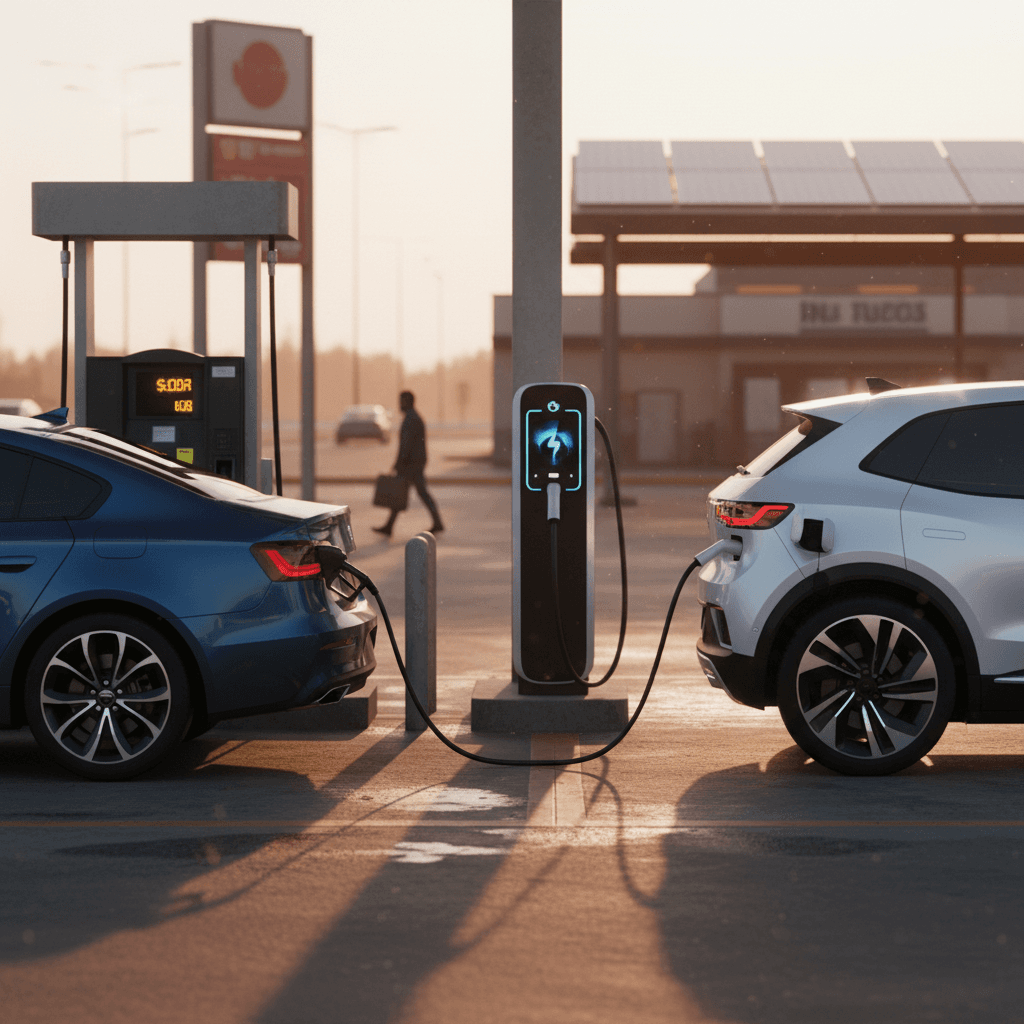
For EV owners, where you charge matters as much as what you drive. Home charging is typically the cheapest, while public DC fast charging can approach, or sometimes exceed, the per‑mile cost of gasoline in certain markets.
Typical cost ranges by charging location
Think of EV charging like choosing between cooking at home and eating out.
Home charging
Best for: Daily commuting, regular use.
- Uses your residential rate (often 12–25¢/kWh depending on state).
- Smart chargers or EV rate plans can be cheaper off‑peak.
- Convenient: plug in overnight.
Workplace / free chargers
Best for: Extra savings if available.
- Some employers, apartments, or retail locations offer free or subsidized charging.
- Can reduce your home electricity bill significantly.
Public DC fast charging
Best for: Road trips, emergency top‑ups.
- Often 30–50¢/kWh in the U.S., sometimes more at peak.
- Per‑mile cost can approach efficient gas cars if heavily used.
Look for off-peak EV rates
Other monthly costs people forget
Fuel or electricity is just one line item in your monthly car budget. When comparing gas vs electric, you should also consider how much you’ll spend (or save) on maintenance, repairs, and other recurring costs.
Big ownership costs beyond fuel
1. Routine maintenance
EVs don’t need oil changes, spark plugs, or timing belts. Over a year, that can add up to several hundred dollars of avoided service visits, which works out to meaningful monthly savings vs a gas car, especially as vehicles age.
2. Brakes and tires
Because EVs use regenerative braking, brake pads often last longer, but heavier EVs can wear tires faster if you drive aggressively. For most drivers, the overall cost difference is modest but worth factoring in.
3. Unexpected repairs
Gas cars have complex engines, exhaust systems, and transmissions that can fail expensively out of warranty. EVs trade those for battery packs, inverters, and electric motors, which tend to need less frequent repair but can be costly if they do.
4. Insurance
Insurance can be higher for some EVs due to repair costs and vehicle value, but it varies widely by model and ZIP code. Always get quotes for the specific VINs you’re considering, gas and electric.
5. Depreciation
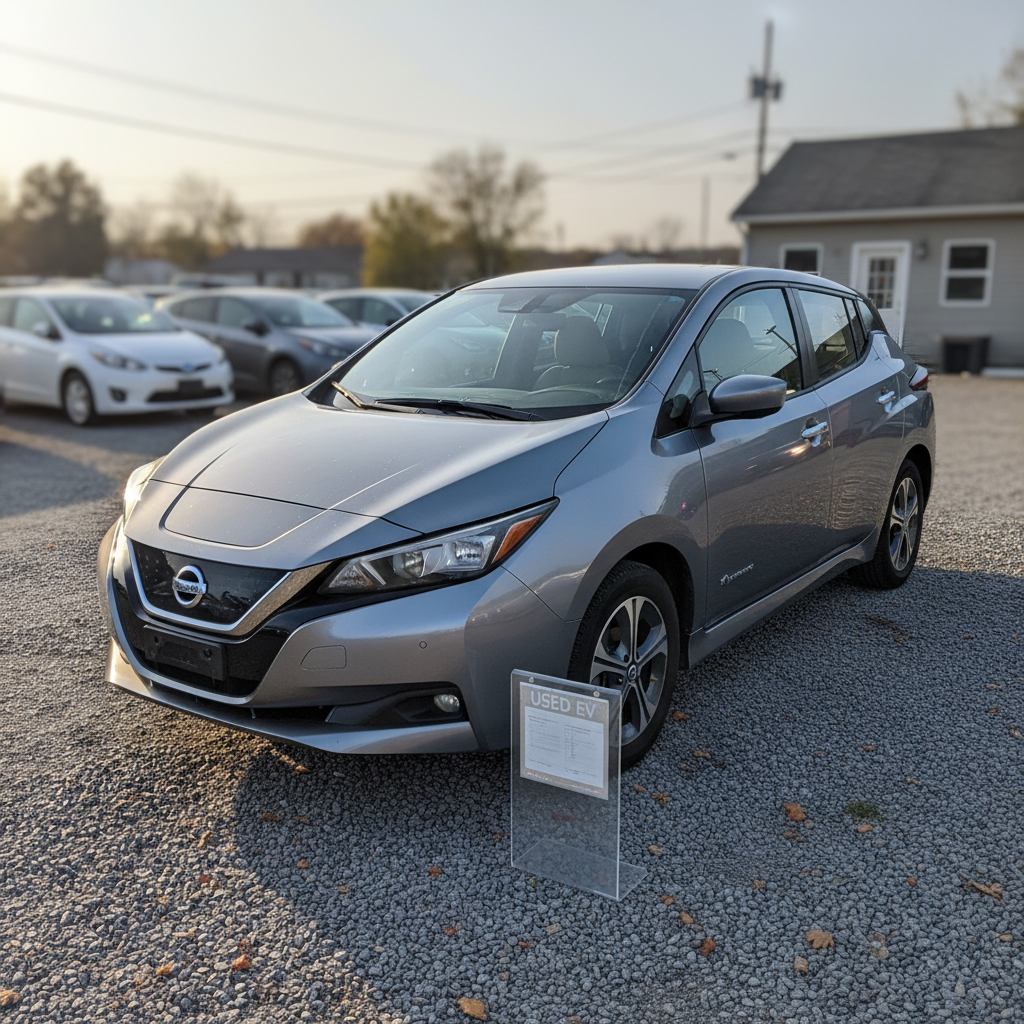
How fast your vehicle loses value is a big hidden “cost per month.” The used EV market is maturing quickly; buying a <strong>late‑model used EV</strong> can let you skip the steepest part of the depreciation curve.
Total cost of ownership vs monthly cash flow
How to estimate your own monthly EV cost
The examples above are helpful benchmarks, but nothing beats using your own commute, your local prices, and a specific vehicle. Here’s a simple way to calculate the monthly cost of gas vs electric for your situation.
DIY monthly gas vs electric cost calculator
1. Estimate your monthly miles
Look at your odometer now and again in a month, or check mileage from your current fuel receipts. If you’re shopping for your first car in a while, 800–1,200 miles per month is common for U.S. drivers.
2. Find local gas and electricity prices
Use a gas-price app or the sign at your local station for regular unleaded. Check your utility bill for your <strong>$/kWh</strong> rate, or its website for EV or off‑peak rates.
3. Check vehicle efficiency
For gas, note the combined <strong>mpg</strong> on the window sticker (then mentally shave a few mpg for real‑world driving). For EVs, look for the combined <strong>kWh/100 miles</strong> or miles per kWh number.
4. Do two quick calculations
Gas: <strong>monthly miles ÷ mpg × gas price</strong>.<br>EV: <strong>(monthly miles ÷ miles per kWh) × electricity price</strong>. If you expect to use fast chargers, assume some portion (10–30%) at a higher rate, like 35–45¢/kWh.
5. Add in realistic maintenance and fees
Spread big recurring expenses over 12 months. For example, if you expect to spend $600/year on oil changes and routine maintenance in a gas car vs $200/year in an EV, that’s an extra <strong>$33/month</strong> in the gas column.
What the math usually shows
When you run those numbers carefully, you’ll usually find that:
- The monthly energy cost (fuel or electricity) for an EV is significantly lower than for a comparable gas vehicle at the same mileage.
- Maintenance and repair costs tend to be more predictable and often lower for EVs, especially as gas vehicles age beyond their powertrain warranty.
Where gas can still look better
Gas vehicles can look cheaper month‑to‑month if:
- You find a much lower purchase price or better financing on a specific gas model.
- Your local electricity is very expensive and you have no good way to charge off‑peak or at home.
- You drive very few miles per year, so fuel savings are small compared with price differences.
Where used EVs fit into the cost picture
New EVs grab headlines, but for most households the decision is really between a used gas car and a used electric vehicle. That’s where the monthly cost story can get especially compelling.
Why a used EV can dramatically cut your monthly costs
Lower payment + lower fueling often beats a cheaper gas car on total monthly outlay.
Lower monthly payment
Battery health transparency
Predictable ownership costs
How Recharged can help
FAQ: cost of gas vs electric per month
Frequently asked questions
Bottom line: what you’ll actually pay each month
When you boil all the math down, the story is remarkably consistent: at today’s U.S. prices, an electric vehicle usually costs substantially less per month to power than a comparable gas car, especially if you drive a normal or high annual mileage and can charge at home.
For a typical driver covering about 1,000 miles per month, gasoline often runs $110–$150 per month depending on vehicle and local prices, while an EV charged mostly at home typically lands closer to $40–$70 per month. Layer in lower routine maintenance, and the monthly budget advantage of an EV gets even stronger over a few years of ownership.
If you’re ready to see how those numbers look for a specific vehicle, a specific payment, and your driving pattern, that’s exactly what Recharged is built for. Every used EV we list comes with a Recharged Score Report so you can understand battery health, range, and fair market pricing up front, and our EV specialists can help you compare gas vs electric on total monthly cost, not just on stickers and specs.
From there, it’s about finding the right car and the right deal. Whether you want to trade in, get an instant offer, consign your current car, or finance a used EV with nationwide delivery, you can put real numbers to the cost of gas vs electric per month and choose the path that makes the most sense for your wallet.