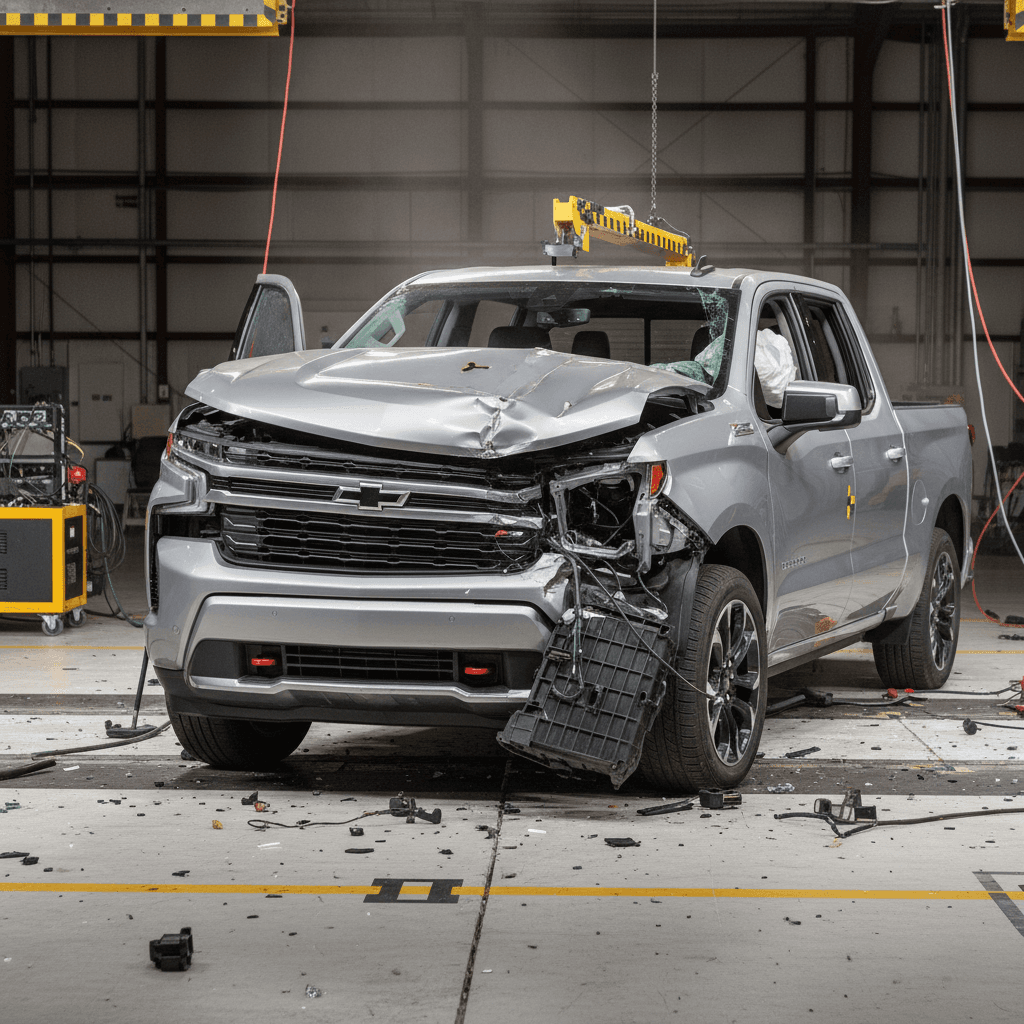
If you’re looking at a Chevy Silverado EV, you’re not just shopping for range and towing numbers, you want to know how this big electric truck will protect you and your family. Yet when you search for the Chevy Silverado EV safety rating and crash test results, the answers can feel strangely thin. That’s because, as of early 2026, the Silverado EV is still a relative newcomer in the lab-coat world of federal and insurance crash testing.
Quick takeaway
Chevy Silverado EV safety overview
The Chevrolet Silverado EV is a full-size battery-electric pickup that went into production in 2023 for fleet Work Truck (WT) trims, followed by consumer-oriented RST and Trail Boss models. GM has been loud about range and capability, 400+ miles of range, five-digit tow ratings, wild fast-charging speeds, but quieter on formal crash-test results. That silence doesn’t mean the truck is unsafe, only that the independent lab verdicts are still catching up to the product rollout.
Silverado EV safety context at a glance
New EV, evolving data
Has the Chevy Silverado EV been crash-tested yet?
Here’s the straight answer: as of February 2026, there is no full, widely published crash-test rating set specifically for the Chevy Silverado EV from either the Insurance Institute for Highway Safety (IIHS) or the National Highway Traffic Safety Administration (NHTSA). You may see references to Chevrolet Silverado 1500 crash results online, but those typically refer to the gasoline Silverado, not the electric truck.
Who rates the Silverado EV’s safety?
Two agencies, different test philosophies
NHTSA 5-Star Ratings
NHTSA runs frontal, side, and rollover tests on new vehicles and gives them a 1–5 star overall rating. For 2026, NHTSA has listed the Chevrolet Silverado 1500 crew cab among the pickup trucks selected for testing. The EV variant is built on a different platform, so expect its results to be listed separately when available.
IIHS Crashworthiness & Crash Avoidance
IIHS focuses on crashworthiness (how well the structure and restraints protect you) and crash-avoidance tech. They run small-overlap front impacts, side impacts, roof strength, head restraint tests, and increasingly tough evaluations for automatic emergency braking and headlights.
Why you see ‘Silverado’ but not ‘Silverado EV’
So for now, you’re essentially in a waiting room: regulators are lining up Silverados for testing, and the EV will eventually have its own scorecard. Until then, shoppers have to read between the lines, looking at the gas truck’s history, GM’s EV engineering approach, and early real-world safety signals like recalls and crash reports.
What we can (and can’t) infer from gas Silverado crash tests
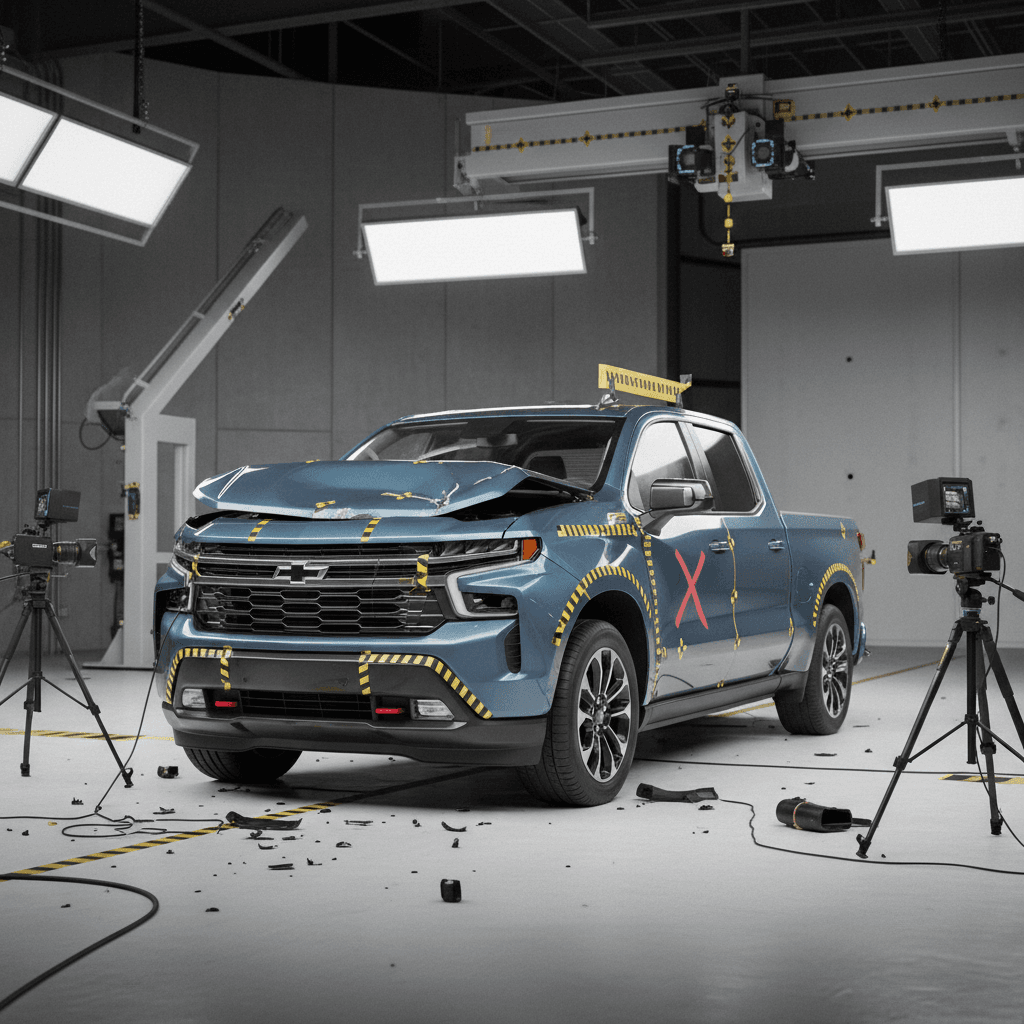
If you look up crash data today, you’ll find detailed IIHS results for the conventional Silverado 1500 crew cab. Recent generations generally score well on major crashworthiness tests, “Good” in moderate overlap frontal and the original side-impact test, though smaller-overlap and headlight performance have been more mixed. Those results tell you something about GM’s ability to engineer a safe big pickup, but not everything about the EV.
Where the EV is likely similar
- Cab structure & crumple zones: GM knows how to engineer full-size truck cabins that hold up in big frontal and side crashes.
- Airbag coverage: Expect front, side-impact, and side-curtain airbags comparable to or better than recent gas trucks.
- Seat design: Head-restraint geometry and seat frames follow the same modern playbook.
Where the EV is meaningfully different
- Mass and weight distribution: The floor-mounted Ultium pack makes the Silverado EV very heavy, with a lower center of gravity than a gas truck.
- Battery protection: Crash structures must protect a large, high-voltage pack from intrusion and puncture.
- Front structure: No big V8 up front means different load paths in a frontal crash, sometimes an advantage, sometimes a new challenge.
How to compare safely
Key safety and driver-assistance features on the Silverado EV
Independent ratings are only half the story. The other half is what Chevy actually bolts onto the truck. The Silverado EV arrives with the kind of feature list you’d expect from a modern flagship pickup, some standard, some optional, and some trim-dependent.
Core Silverado EV safety & assist systems
What’s working for you before, during, and after a crash
Passive safety
- Front, side, and side-curtain airbags
- Three-point belts in all seating positions
- Rigid passenger cell with engineered crumple zones
- Battery enclosure designed to resist intrusion
Active safety & ADAS
- Automatic emergency braking with pedestrian detection
- Forward collision warning & lane-keep assist
- Blind-spot and rear cross-traffic alerts (trim-dependent)
- Surround-view cameras and parking assist on higher trims
Hands-free Super Cruise (select trims)
- Hands-free driving on mapped highways
- Lane-centering with adaptive cruise
- Automatic lane changes in some configurations
- Towing support on certain Silverado EV trims
Super Cruise ≠ autopilot
One safety nuance of the Silverado EV is its sheer mass. In a multi-vehicle crash, weight tends to favor the occupants of the heavier vehicle. That’s cold comfort if you’re the one in the smaller crossover it hits. From a public-safety standpoint, the Silverado EV is part of the same big-truck arms race that’s driven up American fatality statistics. As a driver, though, it means you’re likely to walk away from impacts that would have been uglier in a lighter vehicle, assuming the structure and restraints do their jobs.
Recalls and known safety issues on the Silverado EV
Because formal crash ratings for the Silverado EV are limited, early recalls and defect investigations become important clues about how the truck behaves in the real world. They also tell you how GM responds when something isn’t right.
Notable Chevy Silverado EV safety-related recalls so far
This is not an exhaustive list, always run a VIN check, but these issues have direct safety implications.
| Issue | Model years affected (approx.) | What could happen | Remedy |
|---|---|---|---|
| Seatbelt bezel / load path concern | Early 2024 Silverado EV WT | Under heavy frontal loads with a large occupant, an incorrect trim piece could interfere with how the belt behaves, potentially increasing injury risk. | Dealers replace the bezel with a version that releases as designed under crash loads. |
| Stability-control warning light logic | Select 2026 Silverado EV and GMC Sierra EV | If stability control malfunctions, the warning light may only illuminate once and not re-illuminate after a key cycle, leaving drivers unaware of an ongoing issue. | Software update to correct the instrument-cluster logic, applied via over-the-air update or at a dealer. |
Recall information can change quickly. Check your truck’s VIN on the NHTSA recall site or Chevy’s owner portal for the latest status.
Don’t ignore recall mail
Beyond these officially documented items, remember that software-heavy EVs evolve constantly. OTA updates can quietly improve braking behavior, refine alerts, and tweak stability-control tuning. That’s good for safety, but it also means two trucks built six months apart may feel subtly different on the road unless both are fully up to date.
How Silverado EV safety compares with other electric trucks
When you ask whether the Chevy Silverado EV safety rating and crash-test performance are “good,” what you really mean is: compared to what? The relevant peers are other electric pickups, Ford F-150 Lightning, Rivian R1T, GMC Hummer EV, and the upcoming Ram and Tesla trucks, plus the safer end of full-size gas pickups.
Where the Silverado EV likely stacks up well
- Crash-structure know‑how: GM has decades of experience building big trucks that meet tough U.S. standards.
- Battery safety engineering: The Ultium platform is shared with Hummer EV and Cadillac’s electric flagships, which pushes GM to engineer strong underfloor protection.
- Active safety feature set: On paper, its ADAS suite is competitive with Ford’s BlueCruise and Rivian’s Driver+ in function, if not in marketing buzz.
Where questions remain
- Verified crash scores: Unlike some rivals, the Silverado EV doesn’t yet flaunt an IIHS Top Safety Pick or NHTSA 5-star headline.
- Pedestrian & cyclist safety: Massive front ends and tall hoods are a structural disadvantage in urban crashes, EV or not.
- Repairability after a crash: With a big battery and complex bodywork, even moderate hits can mean long, expensive repairs.
Smart comparison shopping
Buying a used Silverado EV? Safety checklist
The Silverado EV’s combination of range and capability makes it attractive on the used market, especially for fleets flipping early Work Trucks. But with incomplete crash-test data and a young platform, you can’t afford to be casual about safety due diligence.
7 safety checks before you buy a used Chevy Silverado EV
1. Pull a full VIN-based recall report
Use the NHTSA recall lookup or Chevrolet’s owner site to see every open and completed campaign. Walk away from any seller who won’t fix open safety recalls as a condition of sale.
2. Verify crash and repair history
Order a vehicle-history report and ask for body-shop invoices. High-voltage battery or heavy structural repairs after a major crash deserve extra scrutiny and, ideally, an independent inspection.
3. Confirm software and firmware are current
Ask the seller to show that all over-the-air updates are installed, or have a Chevy dealer scan the truck. Out-of-date software can undermine stability control, driver-assistance systems, and charging behavior.
4. Inspect tires, brakes, and suspension carefully
The Silverado EV is heavy; under-spec or worn tires and brakes are a safety issue, not just an expense. Check for correct load rating, even wear, and no evidence of cheap replacements.
5. Test every driver-assistance feature on a road drive
On your test drive, deliberately try forward collision alerts, lane-keep assist, adaptive cruise, cameras, and parking sensors. Any warning lights or erratic behavior should be resolved before purchase.
6. Look for signs of non-professional modifications
Aftermarket lifts, oversized wheels, or tampered air-suspension components can upset stability and braking. They also complicate any future safety-related warranty work.
7. Get an EV-savvy inspection and battery health report
A shop or marketplace that specializes in EVs can evaluate the battery, high-voltage safety systems, and charging hardware, things a traditional mechanic may not fully understand.
Where Recharged fits in
FAQ: Chevy Silverado EV safety & crash tests
Frequently asked questions about Silverado EV safety
Bottom line: Is the Chevy Silverado EV a safe truck to buy?
Big picture, the Chevy Silverado EV looks like a modern, thoughtfully engineered electric truck with the safety tech you expect: strong structure, comprehensive airbags, serious electronic driver aids, and the option for hands‑free highway driving. What it doesn’t have yet is the neat little box on the window sticker that says “5 stars overall” or “IIHS Top Safety Pick+,” and if that box matters more to you than anything else, you may want to favor trucks with complete scorecards today.
If you’re comfortable living slightly ahead of the testing curve, the Silverado EV’s early recall record is manageable, its platform is shared with GM’s flagship EVs, and its feature set is fully competitive. The key is to control the variables you can: verify recall completion, check for crash damage, insist on current software, and get an EV‑savvy inspection, especially when buying used.
That’s exactly the gap Recharged is built to fill. With a Recharged Score battery-health report, fair-market pricing, and EV specialists who live in the details, you can evaluate a used Silverado EV (or any other electric truck) with far more confidence than a traditional test drive and a shrug. Until the lab tests catch up, that kind of transparency is the closest thing to a guaranteed safety rating you can get.