If you want maximum electric range for the money, a used Chevy Bolt EV is hard to beat. But between the well‑publicized battery recall, multiple model years, and fast‑changing EV incentives, you don’t want to go in blind. This Chevy Bolt EV buying checklist walks you step‑by‑step through what to inspect before you buy, so you end up with a great car, not a science project.
Who this checklist is for
Why the Chevy Bolt EV is such a strong used buy
The original Chevy Bolt EV helped prove that a relatively affordable EV could deliver real‑world, 200+ mile range years before many competitors. That early lead, combined with aggressive new‑car discounts before the 2023 discontinuation, means Bolts have already taken a big depreciation hit, making them standout values on the used market today.
Chevy Bolt EV at a glance
Why the recall can be a positive
Chevy Bolt EV model years cheat sheet
Before you can evaluate a particular car, you need to know what you’re looking at. Here’s a quick rundown of how the used Bolt EV market breaks down by model year.
Bolt EV model year highlights
Key differences that matter to used buyers. Exact specs and features vary by trim and option package.
| Model year | Approx. EPA range | Notable changes | Fast charging |
|---|---|---|---|
| 2017–2019 | 238 mi | Launch years, simpler interior, early infotainment. All subject to battery recall. | 55 kW CCS optional on most trims. |
| 2020 | 259 mi | Efficiency tweaks add range; largely similar look/feel to early cars. | 55 kW CCS available; check option list. |
| 2021 | 259 mi | Last pre‑refresh hatch; some trims include DC fast charge as standard. | Premier trim gets DC fast charge standard. |
| 2022–2023 | 259 mi | Major interior/exterior refresh, lower MSRP, improved ride and seats. | CCS DC fast charge standard; up to 55 kW. |
Use this as a high‑level guide, then verify specific features on the individual VIN.
Don’t confuse past and future Bolts
Step 1: Verify recall and battery module replacement
Every 2017–2022 Bolt EV was subject to a high‑profile battery fire recall, and 2022 Bolt EUVs were included as well. GM’s final remedy was replacement of affected battery modules plus an extended battery warranty. You want a car that has had this work fully completed and documented.
Recall and battery checklist
1. Run the VIN through GM’s recall tool
Ask the seller for the VIN, then check open recalls through Chevrolet’s official website or the NHTSA recall lookup. You’re looking for confirmation that the battery recall is marked as <strong>completed</strong>.
2. Ask for battery recall service records
Request a detailed service invoice from a Chevrolet dealer showing <strong>which modules were replaced and when</strong>. The document should reference the official recall campaign number.
3. Confirm updated battery warranty coverage
When the recall remedy is performed, GM applies an updated <strong>8‑year/100,000‑mile</strong> warranty (from original in‑service date) on the new or refurbished modules. Make sure the paperwork clearly indicates the in‑service date and that you’re still within that window.
4. Check for recall behavior limits in the past
Many cars had temporary software limits (for example, capped state‑of‑charge or range). Ask the seller whether they experienced these limits and whether the final remedy fully removed them.
5. Avoid cars with incomplete recall work
If the seller can’t prove the recall has been completed, factor in the time and logistics of getting the work done, or simply walk away and look for a better‑documented example.
Hard pass: cars with DIY battery history
Step 2: Check real battery health and range
With the recall handled, your next priority is understanding the car’s actual usable range in your climate and driving pattern. Unlike gas cars, battery health, software behavior, and previous charging habits all affect how far your Bolt will go on a charge.
Battery health signals to check
Use the car’s own screens plus a structured test to gauge real‑world range.
Full‑charge estimate
Charge the car to 100% and note the predicted range on the main display.
- A healthy pack in mild weather should show a number reasonably close to the original EPA rating.
- Huge gaps can point to heavy degradation or an aggressive driving history.
Recent efficiency
On the energy screens, check mi/kWh over the last 50–100 miles:
- Typical mixed driving often lands around 3.5–4.0 mi/kWh.
- Very low numbers may just reflect cold weather or fast driving, ask about conditions.
Climate and terrain
Ask the seller about their typical use:
- Frequent highway trips at 75+ mph, steep hills, or very cold winters all reduce range.
- That doesn’t mean the battery is bad, but it affects what you should realistically expect.
Simple on‑road battery health test
1. Start near full charge
Begin your test drive with the Bolt EV at or near 100% state of charge so you can easily track energy use.
2. Drive a known loop
Take a 15–20 mile loop with a mix of city and highway speeds. Note the starting and ending state of charge and the distance driven.
3. Calculate implied range
If you used 10% of the battery to go 20 miles, that implies roughly 200 miles of full range at those conditions. Compare this to the EPA rating and your expectations.
4. Listen for pack cooling and watch temps
Hard driving or fast charging can heat the pack. Watch for warning lights or unusual behavior; you shouldn’t see temperature‑related power limits in normal driving.
5. Consider professional diagnostics
If you want deeper insight without guesswork, look for a used Bolt that includes a <strong>third‑party battery health report</strong>, for example, Recharged provides a Recharged Score battery diagnostic on every vehicle.
Step 3: Inspect charging hardware and DC fast charging
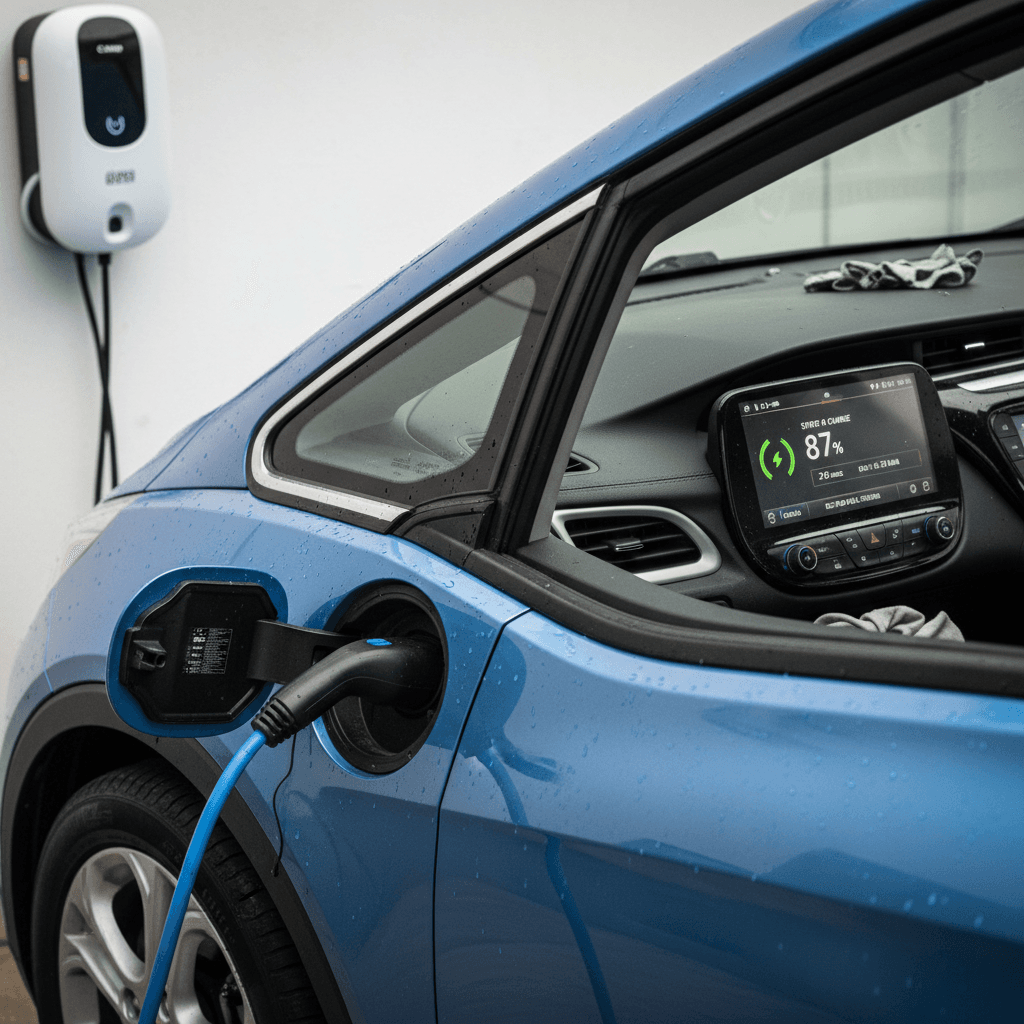
Every Bolt EV comes ready for Level 1 and Level 2 AC charging using the J1772 inlet. DC fast charging, using the CCS connector, was optional on many early cars and standard on later ones. For road‑trip flexibility and resale value, you almost certainly want a car with CCS DC fast‑charge capability.
What to check on the car
- Charge port hardware: Open the charge door and look for the two large DC fast‑charge pins below the J1772 opening. If they’re missing, the car doesn’t support CCS.
- Port condition: Inspect pins and seals for corrosion, bent contacts, or broken plastic.
- Charge door operation: Make sure the charge door opens, closes, and latches smoothly.
- On‑board charger rating: On 2022–2023 cars, the AC charger was upgraded to around 11.5 kW. That means faster home Level 2 charging if your circuit supports it.
What to check in the glovebox and trunk
- Included portable EVSE: Early Bolts shipped with a 120 V Level 1 charger; some owners later upgraded to 240 V‑capable units.
- Cable and plug condition: Look for nicks, abrasions, or heat discoloration on plugs and connectors.
- Adapters: If the seller includes NEMA or other adapters, verify they’re properly rated and labeled, not generic no‑name parts.
- Home charging history: Ask where and how the car was typically charged (garage circuit, shared parking, public stations).
Bring your own adapter
Step 4: Look for common Chevy Bolt EV issues
Overall, the Bolt EV has proven mechanically simple and generally reliable, but like any car it has patterns. A smart inspection looks for these known trouble spots so you’re not surprised later.
Common problem areas on used Bolt EVs
None of these are automatic deal‑breakers, but they should factor into your negotiation.
Interior wear and seat comfort
Early owners often complained about firm front seats. Later models improved padding slightly, but comfort is subjective.
- Check for sagging cushions, torn seat covers, or broken adjusters.
- Spend extra time in the driver’s seat; if it doesn’t work for you on the test drive, it won’t improve later.
Suspension squeaks and clunks
Over rough pavement, listen for knocks from the front suspension or hatch area.
- Low‑mileage city cars can wear bushings just from age and potholes.
- Budget for basic suspension refresh on higher‑mileage examples.
DC fast‑charging behavior
The Bolt’s DC fast‑charge peak is around 55 kW, and it tapers fairly quickly.
- That’s normal, but watch for very low power (under 20 kW) on a warm battery at low state of charge, it could indicate an issue.
Warning lights and software glitches
Cycle the car on and off a few times during the visit.
- Look for persistent battery, charging, or airbag lights.
- Test all windows, locks, cameras, and infotainment features.
Get a pre‑purchase inspection on older or high‑mileage Bolts
Step 5: Review software, safety and driver-assistance features
The Bolt EV’s hardware tells only half the story. Software updates, safety tech, and driver‑assistance options vary by model year and trim, and they meaningfully affect day‑to‑day livability.
- Confirm that all software updates are current. Ask the seller for service records or have a Chevrolet dealer pull the history.
- Test the rear‑view camera, rear cross‑traffic alert, blind‑spot monitoring, and parking sensors in a safe area.
- Check whether the car has adaptive cruise control or only standard cruise; many Bolts lack advanced lane‑centering systems.
- Explore the energy, charging, and trip menus on the infotainment system so you’re comfortable using them.
- Pair your phone and test maps, Bluetooth calls, and audio. Some newer EVs have lost phone‑projection features; know exactly what your Bolt supports.
EV‑specific safety advantage
Step 6: Price check, financing and total cost
Used Bolts have already seen significant depreciation, especially early model years, while newer 2022–2023 cars tend to hold value better thanks to lower original MSRPs and the recall battery refresh. Your goal isn’t just to find the cheapest car, but to find the best‑value car once you factor in condition, warranty, and your financing.
Typical used Chevy Bolt EV price patterns
Illustrative relationship between age and retained value; exact numbers vary by mileage, trim, and market conditions.
| Model year | Original MSRP (approx.) | Typical used price band | Approx. value retained |
|---|---|---|---|
| 2017–2018 | $36,500 | Low teens to mid‑teens | ~30–35% |
| 2019–2020 | $36,500 | Mid‑teens to high‑teens | ~35–40% |
| 2021 | $36,500 | High‑teens | ~40–45% |
| 2022–2023 | $26,500–$31,500 | High‑teens to low‑20s | ~60–70% |
Use this to sanity‑check asking prices relative to original MSRP.
Questions to ask about price
- How does this price compare to similar year/mileage Bolts in your area?
- Is the seller pricing in recall completion, new tires, or fresh brakes, or are those still future costs for you?
- Is there evidence of prior accidents or paintwork that should lower the price?
Financing and ownership costs
- Check current EV loan rates and terms; some lenders offer better rates for green vehicles.
- Estimate your monthly electricity cost vs. gasoline; even at higher power prices, a Bolt usually beats a comparable gas car.
- Factor in insurance, registration, and home charging upgrades (like a 240 V circuit) in your budget.
If you buy through Recharged, you can see transparent pricing, compare financing offers online, and have the vehicle delivered to your door.
Leverage the Bolt’s reputation for value
Step 7: Your test-drive and final walkthrough checklist
By the time you get behind the wheel, you should already know the basics: recall status, features, rough pricing. The test drive is about confirming that this specific Bolt EV drives, charges, and feels the way you expect.
On‑site Chevy Bolt EV inspection
1. Exterior and wheels
Walk the car slowly. Look for mismatched paint, panel gaps, cracked glass, curb‑rashed wheels, and unusually worn tires (which can hint at alignment issues).
2. Interior ergonomics and tech
Adjust the seat and wheel, test all seat adjustments, and make sure you’re comfortable. Try the infotainment system, HVAC, heated seats/steering wheel (if equipped), and all window and lock switches.
3. Around‑town driving feel
In city driving, check for smooth acceleration, natural brake feel as regenerative braking hands off to friction brakes, and any clunks over bumps.
4. Highway stability and wind noise
Take the car to highway speed. It should track straight with the wheel centered and no unusual vibrations. Wind and road noise should be consistent with the car’s age and mileage, not excessive.
5. Regenerative braking modes
Try both Drive and Low modes to feel different regen levels. Test one‑pedal driving if available and make sure it engages smoothly without jolts or warning lights.
6. Quick charge test if possible
If the seller agrees and a DC fast charger is nearby, plug in briefly to confirm the car initiates a CCS fast‑charge session and ramps up to a reasonable power level for its state of charge.
7. Final paperwork review
Before you sign, review the title status, recall and service history, battery warranty details, and any third‑party inspection or <strong>Recharged Score</strong> battery report. Make sure all verbal promises are in writing.
Chevy Bolt EV buying checklist: quick reference
Need the essentials in one place? Here’s a condensed Chevy Bolt EV buying checklist you can screenshot or print out and take with you.
- Confirm model year and trim, and whether it has CCS DC fast charging (look for the two extra DC pins).
- Run the VIN through GM and NHTSA recall tools; verify the battery recall shows as completed.
- Get dealer service records showing battery module replacement and updated warranty coverage.
- Charge to 100% and note the estimated range and mi/kWh from the energy screens.
- Inspect the charge port, cables, and included EVSE for damage or overheating signs.
- Check for warning lights, test all cameras and safety features, and confirm software updates are current.
- Drive a meaningful route that includes city and highway, checking ride quality, noise, and steering feel.
- Inspect tires, brakes, and suspension for uneven wear, noises, or leaks.
- Compare the asking price to similar listings and depreciation norms for that year and mileage.
- Have an EV‑savvy inspection or buy from a seller who provides a professional battery health report, such as the Recharged Score.
Chevy Bolt EV buying FAQ
Frequently asked questions about buying a used Chevy Bolt EV
A used Chevy Bolt EV can deliver a lot of modern EV capability, usable highway range, nimble city manners, and simple daily charging, for a fraction of the price of many newer models. The key is being disciplined: verify recall work and battery health, insist on documentation, and test how the car fits your real life, not just your spreadsheet. Whether you buy through a private seller or a specialized marketplace like Recharged, using this Chevy Bolt EV buying checklist will put you in a far better position to spot the right car, and walk away from the wrong one.