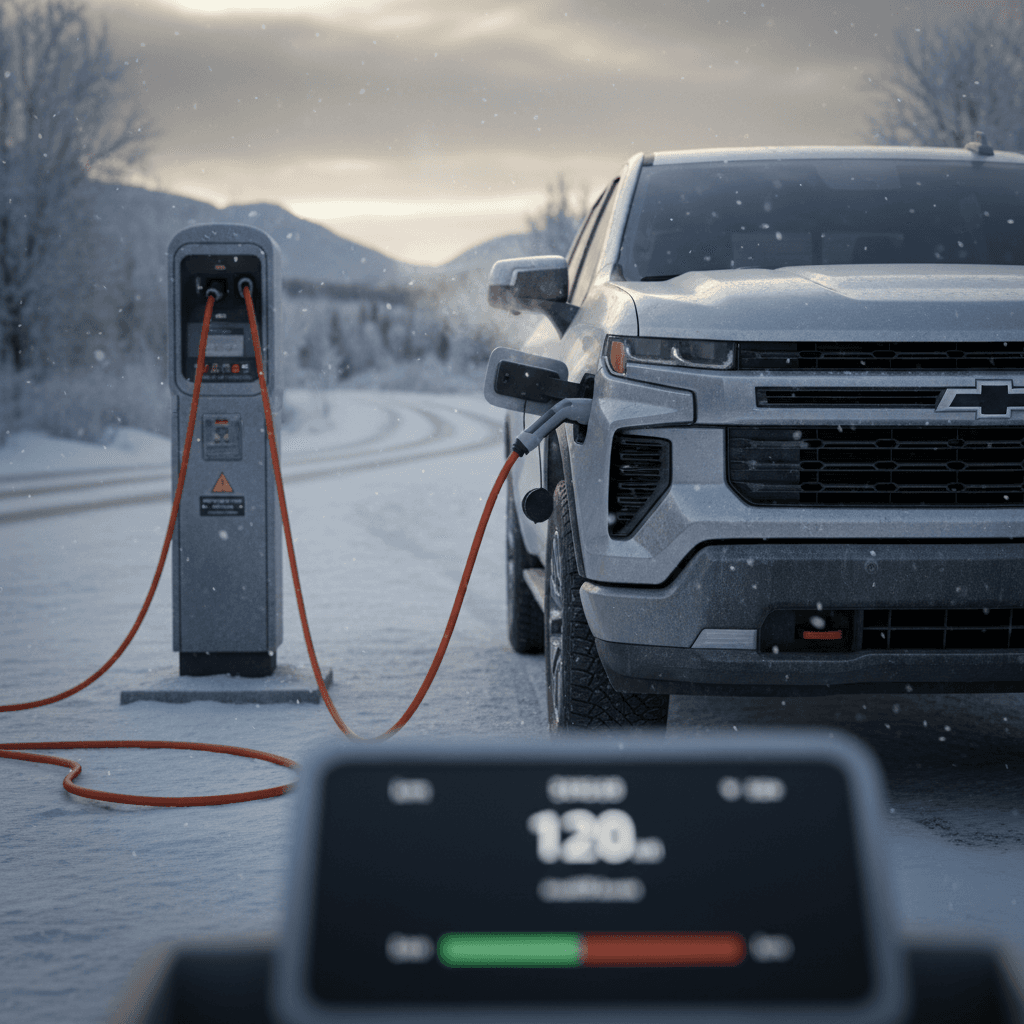
If you’re considering a Chevrolet Silverado EV and you live where winters are real, think snow, ice, and weeks below freezing, the big question isn’t just the headline EPA number. You want to know the Chevrolet Silverado EV range in cold weather: how far it really goes on a January morning with the heat blasting, maybe with a trailer in tow.
Why winter range matters more in a truck
Silverado EV winter range overview
Chevrolet’s official EPA estimates for the Silverado EV look impressive on paper. Depending on trim and battery, you’re looking at roughly 282 to just under 500 miles of rated range on a full charge in mild conditions. That’s best-case: moderate temperatures, no trailer, and gentle driving.
Silverado EV range: paper vs winter reality
That means a Silverado EV rated near 450 miles might feel more like 300–380 miles on the highway in typical winter conditions, and significantly less if you’re towing a heavy trailer at interstate speeds. The good news: with some planning and a few habits, you can keep the hit closer to the low end of that range loss.
EPA range vs real-world winter driving
Chevrolet’s Silverado EV range figures come from standard EPA procedures run in controlled, moderate temperatures. That’s useful for comparing one truck to another, but it doesn’t tell you what happens at 20°F with slush on the road and the defroster on high.
- EPA tests are done in lab-like, moderate conditions with no cargo or trailer.
- They assume smooth acceleration and steady speeds at legal limits.
- Cabin climate control is used, but not like you would on a bitterly cold commute.
- There’s no allowance for preconditioning at home or sitting outside all day at work.
Independent testing across many EVs has consistently found average winter range loss of around 20–30% in real driving at or below freezing, with some models doing better and others worse. At very low temps (single digits or below) and on short, stop‑and‑go trips, range loss can climb closer to 40% because the truck spends so much energy repeatedly heating a cold battery and cabin.
Don’t panic about the worst-case numbers
How cold affects Ultium batteries and range
The Silverado EV rides on GM’s Ultium battery platform. It’s a modern, liquid‑cooled lithium‑ion pack with active thermal management, similar to what you’ll find in other current EVs. That means it’s engineered to survive extreme temperatures, but physics still wins in the cold.
Why your Silverado EV loses range in cold weather
Same chemistry as other modern EVs, just in truck-sized form
Slower battery chemistry
More energy for heat
Heavier rolling losses
Use shore power to warm, not drive
Chevrolet Silverado EV winter range by trim
Exact winter numbers will vary by driver and conditions, but we can translate EPA ratings into reasonable cold‑weather expectations by applying typical winter‑loss percentages to Chevy’s published estimates.
Estimated Silverado EV range in cold weather
Approximate real‑world winter range based on typical 20–30% loss in freezing conditions with light cargo and mixed driving.
| Trim / Battery | EPA-rated range (approx.) | Mild-winter realistic (15% loss) | Cold-winter realistic (25% loss) |
|---|---|---|---|
| WT Standard Range (work truck) | ~280 mi | ~240 mi | ~210 mi |
| WT Extended Range | ~350 mi | ~300 mi | ~260 mi |
| LT / LT Extended Range | ~400 mi | ~340 mi | ~300 mi |
| RST / top-range trims | ~440–450+ mi | ~375–385 mi | ~330–340 mi |
These are directional estimates, not guarantees. Actual range will depend on temperature, speed, load, terrain, and driving style.
Think of those “cold-winter realistic” numbers as conservative planning targets at or below freezing: light cargo, no trailer, mostly highway, cabin set to a comfortable temperature. In milder shoulder‑season weather, say 35–45°F, you’ll often see better results, especially if you precondition regularly and avoid short hops.
Towing with a Silverado EV in cold weather
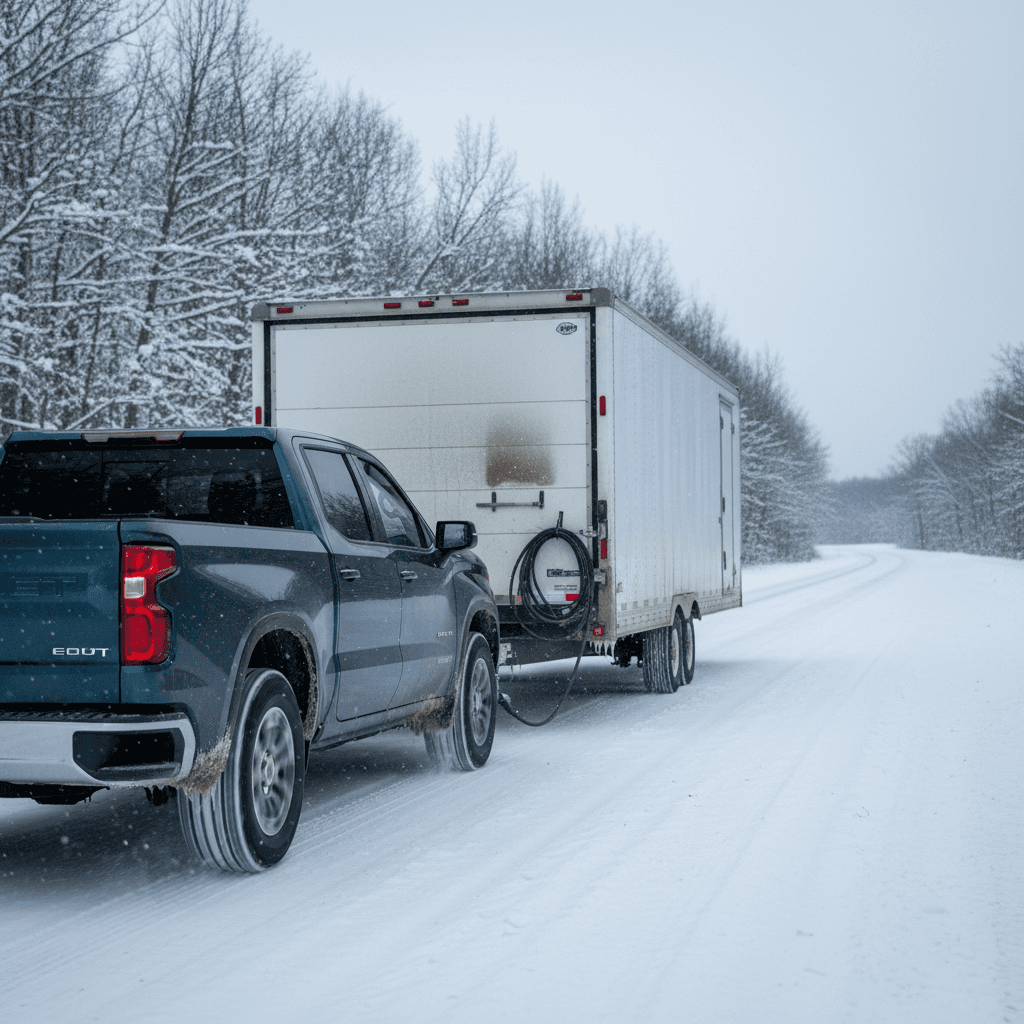
If you’re buying a Silverado EV to tow, winter planning needs to be especially conservative. Even in perfect temperatures, towing a large enclosed trailer or heavy equipment can cut range by 40–50% compared with driving unloaded. Add freezing temps, snow, and a strong headwind, and you can easily see total range reductions north of 60%.
Example: Light open trailer at 25°F
Let’s say you have an LT extended‑range truck with roughly 400 miles EPA range.
- Normal mild‑weather highway towing hit: −40% → ~240 miles
- Winter cold‑weather penalty: another ~15% → ~200 miles
Plan around 180–200 miles between DC fast charges in steady conditions.
Example: Tall enclosed trailer at 10°F
Same truck, but now you’re pulling a big enclosed cargo trailer in single‑digit temps.
- Aerodynamic and weight hit: −50–55%
- Deep‑cold penalty with strong cabin heat: another 20–25%
Now you’re realistically looking at 140–170 miles per charge before you want to stop and fast‑charge.
Give yourself a big buffer when towing in winter
Driving habits that hurt or help winter range
Your Silverado EV’s software works hard behind the scenes to manage the battery in the cold, but your habits matter just as much. Two drivers in identical trucks on the same route can see very different winter results.
Habits that protect your Silverado EV’s winter range
1. Precondition while plugged in
Use the myChevrolet app or in‑truck scheduling so the cabin and battery are warmed before you unplug. This moves a big chunk of heating load off the battery and onto the grid.
2. Use seat and steering-wheel heaters first
Heated seats and wheel use far less energy than blasting the cabin heat. Start with those and then nudge cabin temperature just high enough to stay safe and comfortable.
3. Avoid repeated short trips from cold
Dozens of 5–10 minute drives from a stone‑cold truck are a range killer. When possible, group errands so the battery and cabin stay warm for longer stretches.
4. Moderate your highway speed
Aerodynamic drag climbs fast above 65 mph, especially in cold, dense air. Dropping from 75 to 65 mph can meaningfully improve winter range, particularly if you’re towing.
5. Keep tires properly inflated
Cold air drops tire pressure, increasing rolling resistance and energy use. Check tire pressures regularly and keep them at the door‑sticker spec for best efficiency and safety.
6. Clear ice and snow from the truck
Snow‑caked wheel wells, ice on the bed, or a roof buried under slush all hurt aerodynamics and add weight. Take a few minutes to clear off the truck before hitting the highway.
The upside of winter EV driving
Winter range planning: daily use vs road trips
A key part of understanding the Chevrolet Silverado EV range in cold weather is separating everyday duty from long‑distance travel. The calculus is very different when you can charge at home every night versus depending on public DC fast charging.
Daily driving in winter
For most owners with home Level 2 charging, winter is less about absolute range and more about predictability.
- Commutes under 80–120 miles round‑trip are generally easy in any Silverado EV trim, even on cold days.
- You leave home every morning with a full (or mostly full) battery and can plug in again at night.
- If you work outdoors or on job sites, using scheduled preconditioning and a conservative climate setting will go a long way.
Road trips and work routes in winter
Longer routes and regional hauling need more planning:
- Map DC fast chargers along your route and assume shorter legs between stops in winter, especially when towing.
- Plan charging stops where you can combine charging with meals or rest breaks.
- At very low temps, expect fast‑charging to start slower until the pack warms up, so don’t arrive at 0% if you can avoid it.
Use multiple apps to plan winter routes
Shopping for a used Silverado EV if you live in the cold
If you’re eyeing a used Chevrolet Silverado EV, winter performance should be on your checklist right alongside price and options. The truck’s huge battery can mask some degradation, but you still want to know how much usable capacity remains, especially if you’ll be driving in northern states or at altitude.
Cold-climate questions to ask about a used Silverado EV
These help you translate specs into real winter usability
1. What’s the battery health?
2. Which range package is it?
3. How will you charge?
Every used EV listed on Recharged includes a detailed Recharged Score battery health report that quantifies remaining capacity and expected range. That’s particularly valuable if you’re in places like the Upper Midwest or New England, where you might be driving days on end at or below freezing.
How Recharged can help
FAQ: Chevrolet Silverado EV range in cold weather
Frequently asked questions about Silverado EV winter range
Bottom line on Silverado EV winter range
The Chevrolet Silverado EV starts with some of the highest EPA range numbers in the electric‑truck world. In true winter weather, you should mentally dial those numbers back by roughly 20–30% for normal driving and even more if you’re towing or spending your day on short, cold starts. That still leaves plenty of usable range for most owners, especially if you can charge at home overnight.
If you live in a cold‑climate state and you’re shopping for a used Silverado EV, think beyond the brochure numbers. Look at battery health, your real daily mileage, how often you tow, and what charging you can install where you live. At Recharged, every used EV comes with a Recharged Score battery report and EV‑specialist guidance, so you can match the right Silverado EV to your winter reality, not just the test cycle. That’s how you turn a promising spec sheet into a truck that works for you all year long.