If you’re eyeing a Chevrolet Silverado EV, you’re probably wondering what its **depreciation curve over 5 years** will look like. Early lease deals show extremely high residuals on paper, but real‑world data from other electric pickups suggests a much steeper drop in value than a gas Silverado. The truth is somewhere in the middle, and getting clear on that can save you thousands whether you’re buying new, leasing, or shopping used.
Important context
Silverado EV depreciation overview (and why it’s tricky)
Depreciation is simply how much value your truck loses over time. For a new **Chevrolet Silverado EV**, that curve will be shaped by three overlapping forces: aggressive lease residuals from GM Financial, the way other electric pickups have actually depreciated, and the broader EV market finding its footing after a few choppy years.
Big‑picture EV depreciation trends
Those are averages across the EV market, not Silverado‑specific. What’s unique about Silverado EV is that GM is currently **pricing leases with extremely high residuals**, implying very slow depreciation on paper. But history suggests the actual used‑market curve will be steeper than GM’s lease models imply, especially in the early years.
How electric trucks have depreciated so far
Because the Silverado EV doesn’t yet have a 5‑year track record, the best clues come from other electric pickups that have a few years under their belts, most notably the **Ford F‑150 Lightning** and **Rivian R1T**.
What rival electric trucks tell us
These real‑world examples help frame a realistic Silverado EV depreciation curve.
Rivian R1T
Used pricing data shows several R1T configurations down roughly 30–40% from original MSRP within about three years, depending on trim and mileage.
Ford F‑150 Lightning
Recent analyses peg 3‑year Lightning value retention near 50–55% of MSRP, weaker than many gas half‑ton pickups, which often stay above 60% at 3 years.
EV vs gas pickups
Gas half‑tons like a Silverado 1500 or F‑150 historically retain 55–65% after 5 years. Early EV pickups are tracking a bit worse, especially high‑MSRP trims.
Don’t confuse lease math with real depreciation
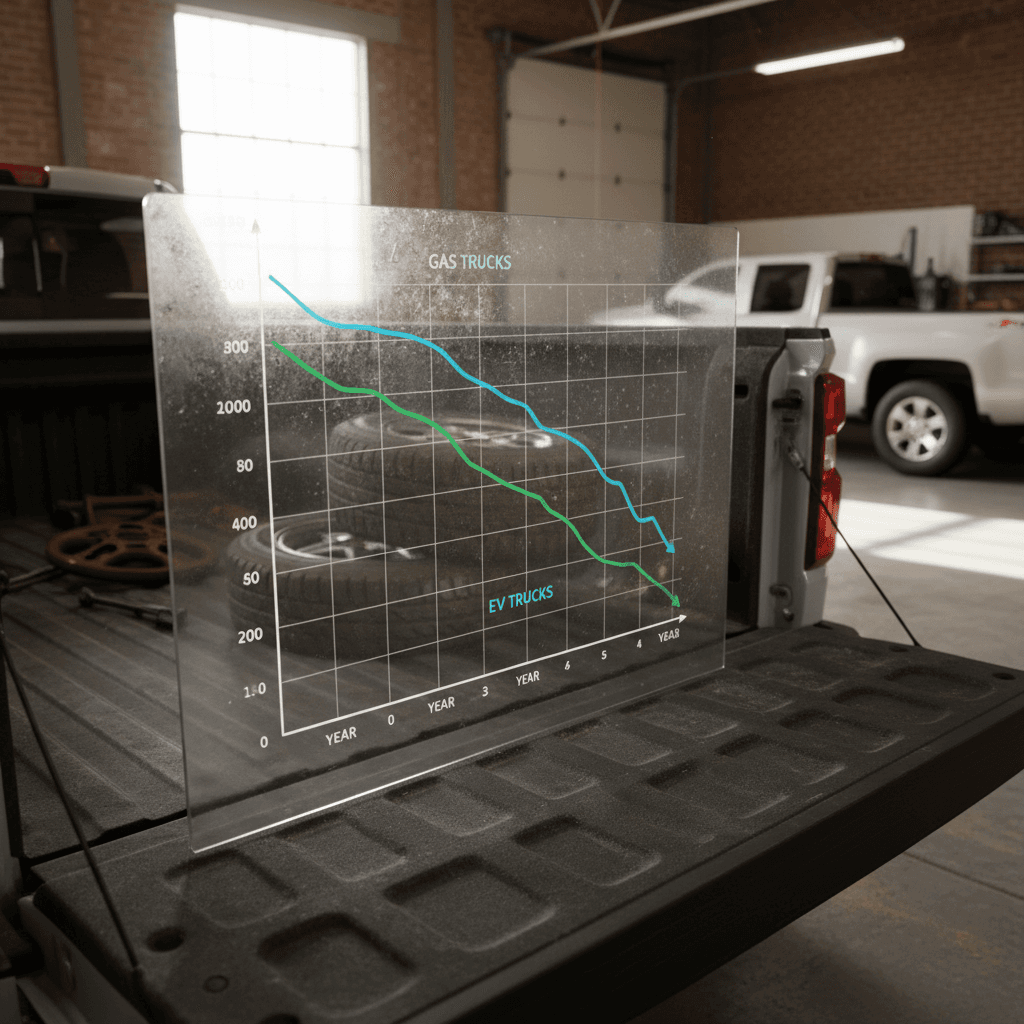
Projected 5‑year Chevrolet Silverado EV depreciation curve
Let’s pull this together into a realistic, **ballpark 5‑year depreciation curve** for a Silverado EV bought new in the U.S. in 2024–2026. To keep things grounded, assume a well‑equipped LT or RST in the $75,000–$85,000 range, driven about 12,000 miles per year, with no major accidents and normal wear.
Illustrative 5‑year Silverado EV depreciation curve
Approximate resale value as a percentage of original MSRP, assuming typical use and market conditions similar to other EV pickups.
| Year in service | Approx. miles | Estimated value vs. original MSRP | What’s happening in the market |
|---|---|---|---|
| Year 1 | ~12,000 | 75–80% | Initial drop as incentives change and early‑adopter demand cools. High‑MSRP trucks feel the hit first. |
| Year 2 | ~24,000 | 65–72% | More used inventory appears; buyers compare against new incentives and fresh trims. EV pickup prices normalize. |
| Year 3 | ~36,000 | 55–65% | This is where many EV trucks land today. Stronger battery health and desirable trims stay toward the top of the range. |
| Year 4 | ~48,000 | 48–58% | Market separates well‑cared‑for trucks with documented battery health from beat‑up workhorses. |
| Year 5 | ~60,000 | 40–52% | Mature used‑EV market. Trucks with healthy packs, towing history, and clean titles command the premium. Others sink toward the bottom of the range. |
These ranges are estimates based on current EV truck behavior, not guarantees. Individual trucks can do better or worse.
These ranges reflect what you might expect if the Silverado EV tracks somewhere between the Rivian R1T and F‑150 Lightning, with a modest boost from Chevrolet’s broad dealer network and brand familiarity. A five‑year‑old truck in good shape could reasonably still be worth **40–50% of its original MSRP**, while stellar examples might do a little better.
How to use these numbers
Lease residuals vs. real‑world resale
Part of the confusion around the **Chevrolet Silverado EV depreciation curve** comes from how aggressive GM Financial has been on lease residuals. Early dealer guides have shown **36‑month residuals in the low‑ to mid‑80% range** on some work‑truck trims at low mileage allowances, numbers that would be unheard of on most gas pickups.
What residuals are telling you
- GM is confident enough in the truck’s future value to keep lease payments attractive without massive discounts.
- Residuals are sometimes boosted by passing along federal EV incentives inside the lease structure.
- Shorter leases (24–27 months) often carry especially high residuals.
Why market value may differ
- Used‑market prices respond to interest rates, fuel prices, and rival truck incentives, none of which GM can control.
- EV technology is evolving fast; new models with better range or charging can push older trucks down faster.
- If EV demand softens, banks and captives may eat losses on residuals rather than update numbers every month.
Watch the buyout number
5 factors that will shape Silverado EV resale value
Key depreciation drivers for the Silverado EV
1. Battery health & fast‑charging history
On a heavy electric truck, the battery pack is a huge chunk of the vehicle’s value. Frequent DC fast charging, high mileage towing, and hot‑climate use can all affect long‑term health. A Silverado EV with **verified strong battery diagnostics** will always command more money than one with unknown history.
2. Trim, MSRP and options
High‑MSRP, launch‑edition trucks tend to depreciate harder in dollars and sometimes percentages. Work Truck (WT) and mainstream LT trims will likely hold value better than six‑figure RST builds with every option checked.
3. Charging speed and range vs newer trucks
If newer model years add significantly more range or much faster charging, earlier trucks can see accelerated depreciation. If updates are modest, depreciation may track closer to a conventional gas truck’s curve.
4. Incentives and interest rates
Large factory rebates on new EV trucks, or a drop in interest rates, can put pressure on used prices. Conversely, if incentives shrink or rates stay high, clean used trucks look more attractive and can retain more value.
5. Brand and dealer support
Chevrolet’s nationwide dealer footprint is actually a plus here. Buyers tend to pay more for used EV trucks when they trust that warranty work, software updates, and repairs are accessible through familiar dealers.
How Silverado EV depreciation compares to F‑150 Lightning & Rivian R1T
To understand if the Silverado EV is likely to be a depreciation outlier, it helps to stack it against the electric trucks that already have resale history. Here’s a simplified comparison for a similar $80,000‑ish build in each lineup.
Illustrative 5‑year value comparison: electric pickups
Approximate value retention based on current behavior of F‑150 Lightning and Rivian R1T, plus a forecast for Silverado EV.
| Model | 3‑year value vs MSRP (est.) | 5‑year value vs MSRP (est.) | Depreciation notes |
|---|---|---|---|
| Chevrolet Silverado EV | 55–65% | 40–52% | Still early. Brand familiarity and dealer network could support values slightly better than the segment average, especially on mainstream trims. |
| Ford F‑150 Lightning | 50–55% | 38–48% | First‑wave demand cooled quickly after launch; heavy incentives on new units have pressured used prices. |
| Rivian R1T | 55–60% | 40–50% | Strong enthusiast following, but high MSRPs and rapid model updates have led to big dollar depreciation in the first 3–4 years. |
Percentages are illustrative only and assume similar original MSRPs, equipment levels, and mileage.
Upside for Silverado EV owners
Buying a used Silverado EV: Smart strategies
If you’re shopping a Silverado EV three to five years from new, depreciation is your friend, you’re letting someone else take the steepest part of the curve. The trick is to buy the **right truck, at the right price, with the right data** in front of you.
How to evaluate a used Silverado EV
Focus on battery data, pricing realism, and how you’ll actually use the truck.
1. Get battery health in writing
Ask for a recent, third‑party battery health report or OEM diagnostic. On Recharged, every Silverado EV listing comes with a Recharged Score Report that breaks down pack health, range expectations, and charging history, so you aren’t guessing.
2. Compare to new incentives
Before you fall in love with a used price, check what it would cost to lease or finance a new Silverado EV after factory incentives. If new trucks are heavily subsidized, used prices should reflect that.
3. Match truck to your use case
If you tow rarely and drive modest miles, a 3‑ or 4‑year‑old truck with 50–60k miles can be a sweet spot. High‑mileage commercial units might be priced lower but could come with heavier battery and chassis wear.
Where Recharged fits in
Maximizing your Silverado EV’s resale value
If you already own a Silverado EV, or you’re about to take delivery, there’s plenty you can do to stay at the top end of that 5‑year value range. Think of it as “depreciation maintenance”: small decisions over time that keep your truck more desirable when you’re ready to sell or trade.
Practical steps to protect Silverado EV value
1. Be smart about fast charging
Use DC fast charging when you need it, but rely on Level 2 at home or work for most charging. Avoid running the pack to near‑zero or 100% every day. Healthier batteries fetch stronger offers.
2. Keep detailed service and software records
Save invoices, recall notices, and screenshots of software versions. A clean paper trail, including over‑the‑air update history, signals to buyers that the truck has been cared for and kept current.
3. Protect the interior and bed
EV trucks attract lifestyle buyers as much as work‑truck shoppers. Bed liners, seat covers, and regular detailing can easily be worth a few extra percentage points in resale when it’s time to list the truck.
4. Avoid heavy aftermarket mods
Big lifts, wheel/tire packages, or aggressive tuning might look great to you but narrow the pool of used buyers and can spook banks and extended‑warranty companies. Mild, reversible changes are usually safer.
5. Time your sale strategically
If you see big incentives or a major refresh coming for new Silverados, consider selling a few months earlier. When new‑truck prices drop sharply, used values often follow.
6. Get a pre‑sale battery report
Before you list or trade in, get a fresh battery health report. At Recharged, that data feeds into your **Recharged Score**, helping justify a stronger asking price and giving buyers the confidence to move quickly.
Frequently asked questions about Silverado EV depreciation
Silverado EV depreciation: FAQs
Bottom line: What the 5‑year curve means for you
The **Chevrolet Silverado EV depreciation curve over 5 years** will probably look steeper than a comparable gas Silverado, but broadly similar to other electric pickups once the dust settles. Expect a healthy truck in a mainstream trim to keep roughly 40–50% of its value at the 5‑year mark, with condition, battery health, and timing doing a lot of the fine‑tuning.
If you’re risk‑averse or only plan to keep the truck a few years, a lease can insulate you from worst‑case scenarios. If you’re hunting value, a **3‑ to 5‑year‑old Silverado EV with verified battery health** can be a smart buy, someone else has already eaten the steepest depreciation, and you still get modern capability.
Either way, make your decision with real numbers instead of guesses. Use tools like the **Recharged Score Report**, fair‑market pricing analysis, and EV‑specialist support to see exactly how a specific Silverado EV stacks up, and you’ll navigate the depreciation curve on your own terms, not the other way around.