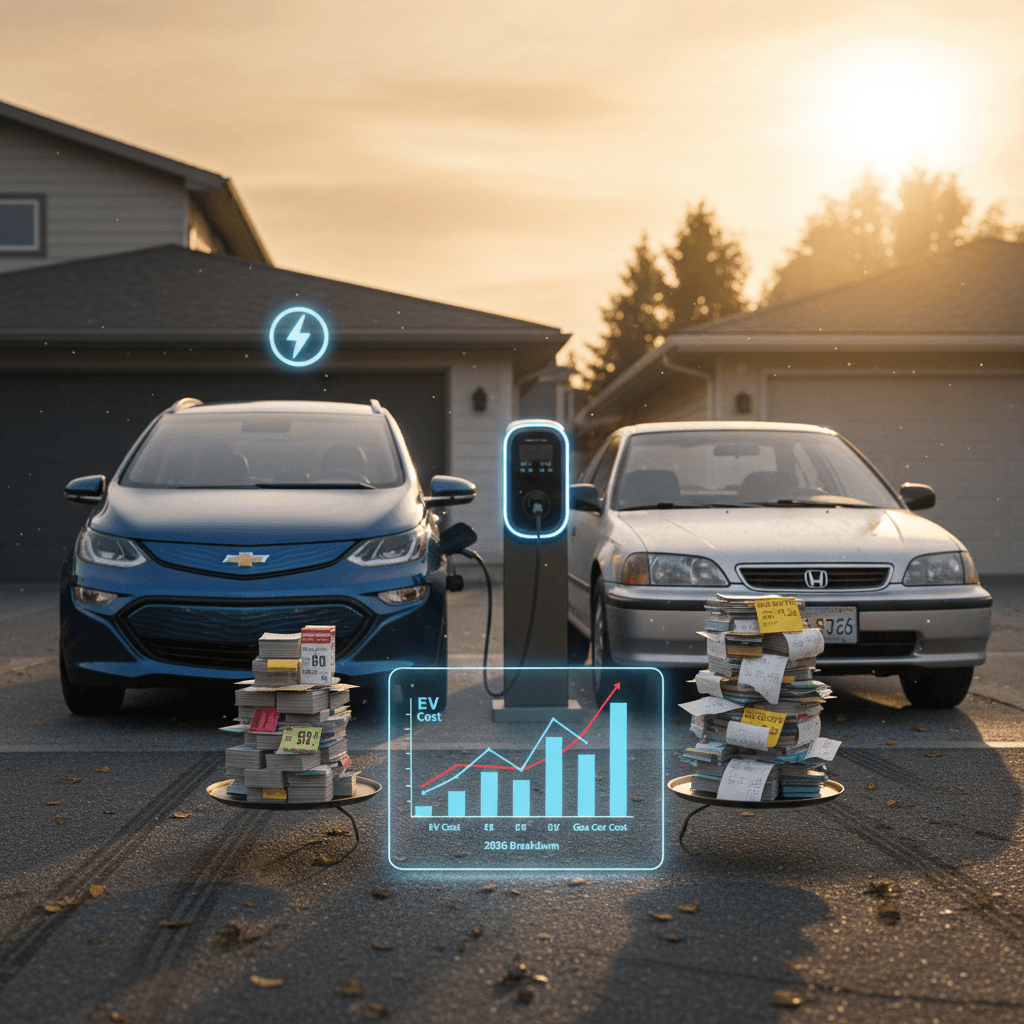
If you’re cross-shopping a Chevrolet Bolt EV against a similarly sized gasoline compact, the sticker price only tells part of the story. The real question is the Chevrolet Bolt EV total cost vs a gas car equivalent once you factor in fuel, maintenance, insurance, and resale over several years.
At-a-glance takeaway
Why compare Chevrolet Bolt EV total cost vs a gas car?
Shoppers looking at a used Chevrolet Bolt EV are usually comparing it to mainstream gasoline compacts like a Toyota Corolla, Honda Civic, Hyundai Elantra, or similar hatchbacks. On paper, those gas cars can look safer: long track records, familiar technology, and no worries about charging. But total cost of ownership tells a more nuanced story, especially as U.S. gasoline hovers near $4 per gallon and average residential electricity lands around 16–17¢ per kWh nationally.
This article walks through a reporter-style, number-driven comparison using realistic 2026 assumptions, then shows you how to plug in your own local fuel and electricity prices. Along the way, we’ll flag where costs can swing sharply, for example, if you rely heavily on DC fast charging, or if you commute in a high-gas-price state like California.
Key assumptions behind this cost comparison
To keep this Chevrolet Bolt EV vs gas compact comparison concrete, we’ll use a set of baseline assumptions that match how many U.S. drivers actually use their cars.
- Ownership period: 5 years
- Annual mileage: 12,000 miles (roughly the U.S. average passenger-vehicle use)
- Use case: Daily commuting plus errands, mostly around town with some highway
- Bolt EV: 2020–2022 Chevrolet Bolt EV, 66 kWh battery, EPA efficiency ~29 kWh/100 miles (about 3.45 miles per kWh)
- Gas equivalent: 2020–2022 compact gas car averaging 32 mpg combined
- Electricity price (home): 16.5¢ per kWh national residential average in late 2024/2025
- Gasoline price: $3.50 per gallon long-run average, with recent spikes around $4
- Charging mix: 90% at home, 10% at public fast chargers for the Bolt EV
- Discount rate, financing, and tax are kept simple to focus on operating costs rather than more complex financial modeling.
Your numbers will vary
Bolt EV vs gas compact: efficiency snapshot
Fuel and energy costs: Bolt EV vs gas compact
Fuel and electricity are where the Chevrolet Bolt EV usually builds its biggest lead over a comparable gas car, but the gap depends heavily on your local rates and how you charge.
Step 1: Annual electricity cost for a Bolt EV
Using the assumptions above, here’s what powering a Bolt EV looks like if you mostly charge at home:
Annual electricity use and cost: Chevrolet Bolt EV
Assumes 12,000 miles/year and 90% home charging.
| Item | Assumption | Result |
|---|---|---|
| Miles driven | 12,000 mi/year | 12,000 mi |
| Efficiency | 3.45 mi per kWh | ~29 kWh/100 mi |
| Total kWh needed | 12,000 ÷ 3.45 | ≈ 3,480 kWh/year |
| Home charging share | 90% home, 10% public fast | 3,132 kWh home, 348 kWh public |
| Home electricity rate | $0.165 per kWh | Home cost ≈ $517/year |
| Public DC rate (estimate) | $0.40 per kWh | Public cost ≈ $139/year |
| Total annual energy cost | Home + public | ≈ $655/year |
Real owners often report 3–4 miles per kWh; we use 3.45 miles per kWh as a middle-of-the-road value.
Lower rates? Bigger savings
Step 2: Annual gasoline cost for a compact car
Now let’s put a realistic gas compact next to the Bolt EV. A late-model Toyota Corolla, Honda Civic, Mazda3 or similar typically posts around 30–35 mpg combined. We’ll use 32 mpg as a middle ground.
Annual gasoline use and cost: compact gas car
Assumes 12,000 miles/year and a long-run average of $3.50 per gallon.
| Item | Assumption | Result |
|---|---|---|
| Miles driven | 12,000 mi/year | 12,000 mi |
| Fuel economy | 32 mpg combined | 32 miles/gallon |
| Gallons used | 12,000 ÷ 32 | 375 gallons/year |
| Average gas price | $3.50 per gallon | Varies by region |
| Total annual fuel cost | 375 × $3.50 | ≈ $1,313/year |
In 2026, national averages bounce around; $3.50/gal is a conservative medium-term assumption.
Annual fuel/energy cost
- Chevrolet Bolt EV: ≈ $650/year (mostly home charging at 16.5¢/kWh, some DC fast)
- Gas compact (32 mpg): ≈ $1,300/year at $3.50/gal
That’s roughly $650 in yearly fuel savings at our baseline prices. At $4/gal gas, the gap widens to close to $800 per year.
Five-year fuel totals
- Bolt EV: ≈ $3,250 in electricity over 5 years
- Gas compact: ≈ $6,565 in gasoline over 5 years (at $3.50/gal)
Under these assumptions, the Bolt EV saves around $3,300 in fuel alone across five years of ownership.
Public fast charging can erase much of the gap
Maintenance and repairs: where EVs quietly win
Fuel is visible; maintenance often isn’t. The Chevrolet Bolt EV doesn’t need oil changes, spark plugs, timing belts, or emissions system repairs. It still requires tires, cabin filters, brake fluid, and occasional software updates, but the service menu is shorter than a gas equivalent.
Typical routine maintenance needs
Bolt EV vs comparable compact gas car over 5 years
Chevrolet Bolt EV
- Tire rotations (likely every 7,500–10,000 miles)
- Cabin air filter replacement
- Brake fluid service (interval‑based)
- Occasional alignment, wiper blades, etc.
- Software updates (often done over-the-air)
Brake wear is usually lighter thanks to regenerative braking.
Gas compact
- Oil and filter changes 2–3 times per year
- Engine air filter, spark plugs, belts
- Transmission fluid service (depending on transmission)
- Exhaust/emissions system repairs as vehicle ages
- Same tire, brake, and suspension items as EV
Over 5 years and 60,000 miles, these add up quickly even on a reliable compact.
Estimated 5‑year routine maintenance costs
Illustrative averages for mainstream vehicles, excluding unexpected major repairs and tires (which both cars need).
| Category | Chevrolet Bolt EV | Gas compact |
|---|---|---|
| Oil changes | N/A | $75 × 3/year × 5 years ≈ $1,125 |
| Engine-specific service (filters, plugs, belts, etc.) | Minimal (≈ $300) | ≈ $500–$700 |
| Brake service (pads/rotors) | Reduced wear; maybe light service ≈ $300 | More frequent wear ≈ $500 |
| Misc. fluids, inspections | ≈ $300–$400 | ≈ $300–$400 |
| Estimated 5‑year maintenance total | ≈ $900–$1,300 | ≈ $2,400–$2,700 |
Real numbers will vary by region, labor rates, and how closely you follow the maintenance schedule.
Realistic maintenance edge
Insurance, taxes, and fees
Insurance can be a wildcard. Some carriers treat EVs like any other compact; others charge slightly more due to higher parts prices or limited repair networks. Meanwhile, some states are introducing additional EV registration fees in lieu of lost gas-tax revenue.
Insurance premiums
- For many drivers, a Bolt EV and a similarly priced compact gas car will quote within ±5–10% of each other.
- Rates swing more based on driver history, ZIP code, and coverage selections than on EV vs gas alone.
- Because used Bolts can be relatively inexpensive to buy, premiums can actually be modest compared with pricier new EVs.
Taxes and registration
- Some states add an annual EV fee ($100–$250) to offset gas-tax revenue.
- Other states still offer EV purchase incentives or reduced registration fees.
- Sales tax is largely a function of purchase price; here a used Bolt EV often matches or undercuts a similar‑age gas car.
When you add it all up, insurance and fees usually don’t make or break the comparison, but EV‑specific fees are worth checking before you buy.
How Recharged helps here
Depreciation and resale value
Depreciation, the difference between what you pay for a car and what you sell it for later, is usually the single biggest ownership cost, EV or gas. Early in their life cycles, Bolt EVs depreciated quickly due to aggressive factory incentives and uncertainty about EV batteries. The used market has since matured: buyers understand the car better, and demand for affordable EVs has climbed.
What used Chevrolet Bolt EV pricing looks like
In 2026, many 2020–2022 Chevrolet Bolt EVs trade in the mid‑ to high‑teens to low‑$20,000s range depending on mileage, trim, and battery health. Meanwhile, a similar‑age Toyota Corolla or Honda Civic often lists in a comparable band, sometimes a bit higher thanks to strong brand loyalty and historically slow depreciation.
Illustrative 5‑year depreciation scenario
Same purchase year, similar age, similar mileage
Chevrolet Bolt EV (used)
- Purchase: 3‑year‑old Bolt EV today at $18,000
- Five years later: vehicle is now 8 years old with ~72,000 additional miles
- Conservative resale: $7,000–$9,000, assuming healthy battery verified by diagnostics
Depreciation over 5 years: roughly $9,000–$11,000.
Gas compact (used)
- Purchase: 3‑year‑old Toyota Corolla/Honda Civic at $20,000
- Five years later: same 8‑year‑old age and added mileage
- Resale estimate: $7,000–$10,000 depending on brand and condition
Depreciation over 5 years: roughly $10,000–$13,000.
Battery health matters for resale
Five-year total cost: Bolt EV vs gas car at a glance
Now let’s put the major cost buckets together for a five‑year, 60,000‑mile ownership window. These aren’t precise forecasts, but they’re grounded enough for a directional view.
Illustrative 5‑year total cost of ownership (60,000 miles)
Assumes used purchase today of a 3‑year‑old vehicle, average U.S. fuel and electricity prices, and mostly home charging for the Bolt EV.
| Cost component | Bolt EV (used) | Gas compact (used) | Comment |
|---|---|---|---|
| Purchase price | $18,000 | $20,000 | Representative examples of mainstream models |
| Fuel / electricity | ≈ $3,250 | ≈ $6,565 | Bolt assumes mostly home charging; gas assumes $3.50/gal & 32 mpg |
| Routine maintenance | ≈ $1,100 | ≈ $2,500 | Both exclude tires; EV avoids oil and most engine service |
| Insurance & fees | ≈ $6,000 | ≈ $5,800 | $1,200/year baseline; some states add EV fees |
| Total cash outlay before resale | ≈ $28,350 | ≈ $34,865 | Sum of above over 5 years |
| Estimated resale value after 5 years | −$8,000 | −$8,500 | 8‑year‑old vehicles in decent condition |
| Net 5‑year cost (approx.) | ≈ $20,350 | ≈ $26,365 | Bolt EV advantage ≈ $6,000 in this scenario |
Numbers rounded for clarity; your local costs and resale values will differ.
Think in ranges, not single numbers
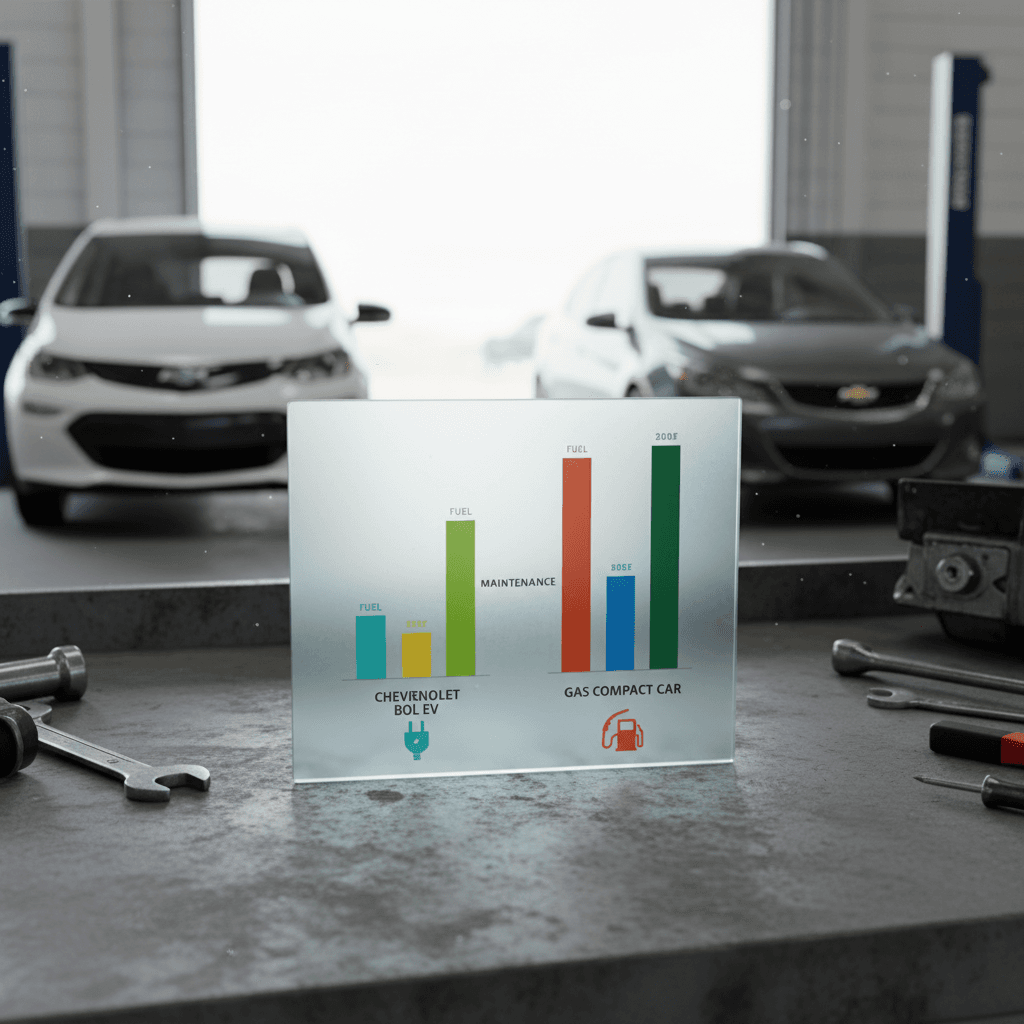
When a Chevrolet Bolt EV saves you the most money
The Bolt EV doesn’t win in every scenario. But there are clear patterns where its total cost advantage over a gas compact becomes very hard to ignore.
Conditions that maximize Bolt EV savings
1. You can charge at home or at work
The biggest savings show up when 80–100% of your driving is powered by relatively inexpensive residential or workplace electricity. That keeps your per‑mile cost far below gasoline.
2. You drive at least 10,000–15,000 miles per year
Higher annual mileage amplifies fuel savings. A commuter who logs 15,000 miles per year might see several hundred dollars more in yearly fuel savings than a low‑mileage driver.
3. Your local gas prices are high
Drivers in states where gas regularly lives above $4 per gallon, California, for example, tilt the math strongly toward EVs, especially efficient ones like the Bolt.
4. You’re shopping used rather than new
Buying a Bolt EV after its steepest early depreciation has already happened lets you capture low operating costs without paying new‑EV prices.
5. You plan to keep the car 5+ years
The longer you own the car, the more time you have for lower fuel and maintenance costs to overpower any extra purchase or insurance cost.
When a gas compact can still compete on cost
Even with today’s energy prices, an efficient gas compact isn’t automatically a bad deal. There are situations where the total ownership cost gap narrows or even tips the other way.
Scenarios where a gas compact may be comparable
Cost isn’t just about fuel; usage patterns matter too.
No reliable charging access
Very low annual mileage
Unique local incentives or fees
Don’t ignore your time cost
How to run your own Bolt EV vs gas math
No national average perfectly matches your life. Fortunately, you don’t need a Ph.D. in economics to compare a Chevrolet Bolt EV’s total cost with a gas compact based on your own commute and local prices.
Four-step DIY total-cost comparison
Step 1: Gather your inputs
Your annual miles (look at prior years’ odometer readings or app data).
Your local gas price per gallon, use a 6‑ to 12‑month average if prices swing.
Your residential electricity rate in cents per kWh (shown on your utility bill).
Whether you’ll charge mostly at home, at work, or at public stations.
Step 2: Estimate fuel and electricity costs
For the gas car: annual gallons = miles ÷ mpg; annual fuel cost = gallons × $/gal.
For the Bolt EV: annual kWh = miles ÷ (mi per kWh); split kWh between home and public charging.
Home charging cost = kWh_home × electricity rate; public charging cost = kWh_public × public rate.
Compare the totals over your expected ownership period (e.g., 5 years).
Step 3: Layer in maintenance and insurance
Ask your shop what routine maintenance for a compact gas car looks like over 60,000 miles.
Review manufacturer guidance on EV maintenance intervals.
Get actual insurance quotes for a Bolt EV and your gas alternative using the same coverage levels.
Add maintenance and insurance to your fuel totals for both vehicles.
Step 4: Consider purchase price and resale
Compare real asking prices for specific model years and mileages rather than list MSRP.
For used EVs, look for independent battery health data, such as a <strong>Recharged Score</strong> report, before assuming a low resale value.
Decide how long you plan to keep the car; spread your net cost over that time to get cost per year or per mile.
Once you’ve done the math, step back and weigh non‑financial factors: noise, driving feel, and where you’ll actually be able to charge.
If you’d rather not build a spreadsheet from scratch, many online total-cost calculators will do the heavy lifting. Pair one of those tools with verified battery and pricing data, like the reports included with every vehicle sold on Recharged, and you’ll have a grounded view of whether a Bolt EV or a gas compact fits your budget better.
FAQ: Chevrolet Bolt EV total cost vs gas equivalent
Frequently asked questions
Bottom line: Is a Chevrolet Bolt EV cheaper than a gas car?
When you zoom out beyond the window sticker, the Chevrolet Bolt EV total cost vs gas car equivalent story is straightforward: in most mainstream U.S. use cases with access to home charging, the Bolt EV quietly wins. Lower energy and maintenance costs, paired with competitive used pricing and maturing resale values, add up to thousands of dollars in potential savings over a five‑year span.
The math isn’t universal, heavy reliance on expensive public fast charging, very low annual mileage, or unusual local fees can level the playing field. But if you drive a normal commute, can plug in at home, and plan to keep the car several years, a used Bolt EV deserves a serious look next to any compact gas car on your list.
If you want to see how this plays out with real cars, pricing, and battery reports, browse used Chevrolet Bolt EV listings on Recharged. Every vehicle comes with a Recharged Score battery health report, fair market pricing analysis, and guidance from EV specialists who can help you compare total ownership costs against your current, or future, gas car.