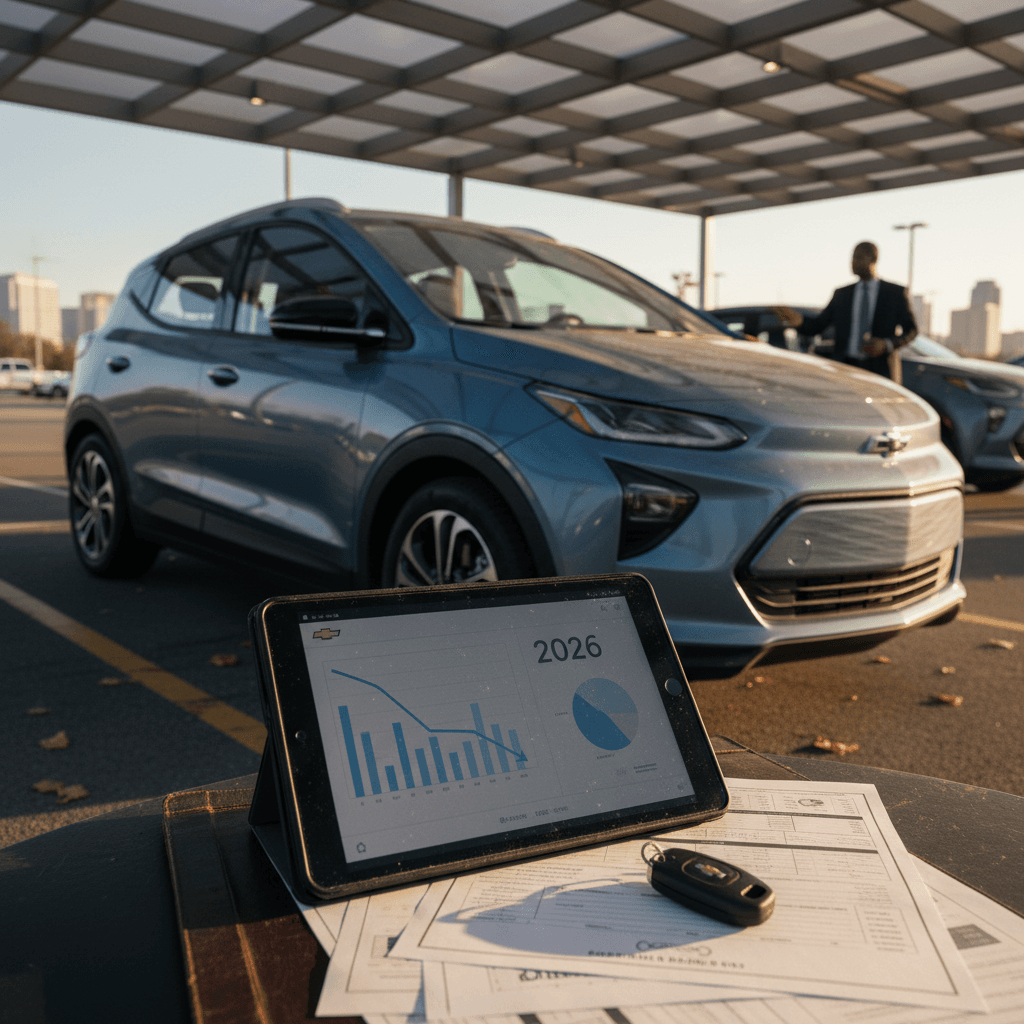
If you’re driving a Chevrolet Bolt EUV in 2026, you’re sitting on one of the most interesting assets in the used-EV market. Trade-in values look brutal on paper, EVs in general depreciate faster than gas cars, but the Bolt EUV also started cheap, benefitted from tax credits, and has become a go-to budget EV. This guide breaks down realistic Chevrolet Bolt EUV trade in value in 2026, what drives those numbers, and how to squeeze the most money out of your sale or trade.
Context: what “2026 values” actually mean
Chevrolet Bolt EUV trade-in value in 2026: big picture
Let’s set expectations. Independent depreciation analyses and Recharged’s own pricing research all point to the same conclusion: the Bolt EUV is a high‑depreciation but high‑value used EV. Most cars lose roughly 45–55% of their value in five years; many EVs lose closer to 60–68%. The Bolt EUV tends to land in that EV band, but because it started with a modest MSRP and deep discounts, the dollar loss is less painful than it looks in percentage terms.
Chevy Bolt EUV value snapshot in 2026 (high‑level)
Because General Motors ended production of this generation of Bolt EV/EUV after the 2023 model year and is preparing a new Ultium‑based Bolt for 2027, you also have the “discontinued but beloved” effect to contend with. For some shoppers, that makes the current Bolt EUV a value play; for others, it raises questions about long‑term parts and support. Both reactions feed back into what your car is worth in 2026.
Typical 2026 Chevrolet Bolt EUV price and trade-in ranges
Exact numbers depend on trim, miles, condition, and region, but it helps to anchor your expectations before you walk into a dealership. Below are ballpark U.S. ranges Recharged sees in early 2026 when we look across auction lanes, listing data, and our own marketplace.
2026 Chevy Bolt EUV value ranges by model year (U.S., typical mileage)
Approximate retail listing and trade-in numbers for a Chevrolet Bolt EUV in good condition with typical miles for its age. Think of this as a sanity‑check guide, not a quote.
| Model year | Age in 2026 | Typical miles | Likely retail asking price | Likely dealer trade-in range |
|---|---|---|---|---|
| 2023 Bolt EUV | 3 years | 25,000–40,000 | $18,000–$22,000 | $14,000–$18,000 |
| 2022 Bolt EUV | 4 years | 35,000–55,000 | $16,000–$20,000 | $12,000–$16,000 |
| 2021 Bolt EUV* | 5 years | 45,000–70,000 | $14,000–$18,000 | $10,000–$14,000 |
| 2020 Bolt EV (not EUV) | 6 years | 60,000–80,000 | $11,000–$15,000 | $8,000–$12,000 |
These are directional ranges based on early‑2026 used‑EV market data; unusual mileage, options, or vehicle history can move your number significantly.
These aren’t appraisal numbers
If you run your Bolt EUV through instant‑offer tools or dealer trade estimators and see numbers far outside these bands, say, a clean 2023 Bolt EUV with 30,000 miles pulling a $9,000 quote, that’s a sign to slow down, gather more bids, or talk to a used‑EV specialist.
Why Bolt EUV depreciation looks steep on paper, but can work in your favor
By 2026, a lot of Bolt EUV owners are comparing a trade‑in offer against their original out‑the‑door price and feeling a bit of whiplash. On the surface, you may be looking at 60%+ depreciation over five or six years. But EV economics, and Bolt economics in particular, are different from the usual playbook.
Three things that distort Bolt EUV depreciation
Understanding these will keep you from over‑ or under‑reacting to a trade-in offer.
1. Huge incentives on new
Many early Bolt EUV buyers stacked factory discounts, dealer markdowns, and federal/state tax credits. Your net cost may have been $7,500–$12,500 lower than MSRP, so a 60% "paper loss" overstates the real hit to your wallet.
2. EV price reset in 2023–2024
Tesla price cuts, Hertz dumping fleets of EVs, and IRA incentives all pushed used EV prices down fast. Bolt EUVs got swept up in that wave, front‑loading a lot of their depreciation into the first 2–3 years.
3. Strong used demand at the bottom
Today, the Bolt EUV is one of the least expensive, most efficient DC‑fast‑chargeable EVs you can buy. That floors values and helps keep older examples from falling off a cliff the way some luxury EVs have.
All of this adds up to an odd profile: the Bolt EUV falls fast from MSRP, then tends to settle into a relatively stable, budget‑EV price band. If you bought new and are trading in after three years, the percentage loss can sting. If you bought used at 2–3 years old, you’re likely missing the worst of the curve and may see gentler depreciation going forward.
Key factors that move your Bolt EUV trade-in value up or down
Two otherwise identical Bolt EUVs can get wildly different offers depending on details most shoppers don’t think about until it’s too late. Here’s what typically matters most when a dealer or used‑EV buyer runs the numbers.
- Mileage: A 2023 Bolt EUV with 15,000 miles is a very different asset from the same car with 65,000 miles. For EVs, many buyers get nervous once they see 80,000+ on the odometer, even if the battery is healthy.
- Battery health: With EVs, usable range is the new compression test. A Bolt EUV that still delivers close to its original EPA range will pull stronger money than one that’s clearly degraded, even if both are technically “within warranty.”
- DC fast charging (DCFC) option: Early Bolts without DCFC are penalized heavily. On the EUV, most cars have it, but if yours doesn’t, expect a noticeable hit.
- Trim and options: Higher trims (Premier) with Super Cruise, upgraded audio, or desirable colors and wheels generally retail better. Dealers will pay extra when they know they can sell the car quickly at a premium.
- Accident and title history: Manufacturer buybacks, accidents with airbag deployment, or a branded/salvage title can knock thousands off a trade-in offer, or make some buyers walk away entirely.
- Charging habits and records: A car that’s been fast‑charged constantly at 100% or stored hot and full doesn’t show well to a buyer who understands batteries. Clean service records and reasonable charging behavior are a plus.
- Region and season: In 2026, Bolts still command more in expensive‑fuel coastal markets and dense metros with good public charging. Winter tends to soften EV prices, spring tax‑refund season usually perks them up.
Why Recharged cares so much about battery data
How dealers actually calculate a Chevy Bolt EUV trade-in offer
When you hand over the keys for an appraisal, the salesperson might talk about “book value,” local demand, or what they saw at auction last week. Underneath the sales patter, most franchise dealers and large independents are doing some version of the same math.
Step 1: Start from wholesale, not retail
Dealers look at sources like auction results, recent trades, and pricing tools derived from those markets. For a 2023 Bolt EUV in average shape, the wholesale number in 2026 might sit around the mid‑teens, even if similar cars are listed retail for $20,000 or more.
They’re thinking: “What could we reasonably buy this car for at auction next week?” Your trade‑in number usually starts there.
Step 2: Work backwards from risk and recon
From that wholesale anchor, they subtract:
- Reconditioning costs (tires, brakes, cosmetic work, detailing)
- Battery risk if they can’t easily document health
- Floorplan and time risk (how long it might sit unsold)
Then they add back a target margin so they can retail the car, cover overhead, and not lose money if the used‑EV market softens further.
This is why a dealership may offer you $14,000 for a Bolt EUV they plan to retail at $19,000. It isn’t always gouging; it’s an artifact of a legacy system that was built around gas cars and is still learning how to price EV‑specific risks, especially batteries.
Watch out for the “over‑allowance” shell game
How to maximize your Bolt EUV trade-in or sale in 2026
You can’t control macro‑level EV depreciation or GM’s product planning, but you can absolutely influence where your individual Bolt EUV lands within the market ranges. Think of it as turning a “$12k–$16k” band into a concrete $16,000–$17,000 outcome.
Practical steps to get more for your Bolt EUV
Clean, detail, and de‑clutter
A spotless interior, clean wheels, and a shiny exterior can move a car from “rough” to “front‑line ready” in a buyer’s eyes. That can be worth hundreds of dollars on an appraisal sheet, especially at dealers who don’t want to invest in reconditioning.
Fix cheap-but-visible problems
If your Bolt EUV needs tires, wipers, or has a cracked windshield, getting those sorted before shopping the car can be cheaper than the deductions dealers will assume. Bigger items like bodywork or infotainment faults are case‑by‑case; sometimes it’s better to disclose than to fix.
Document battery health and range
Take recent photos of the energy screen at a known state of charge and temperature, or better yet, <strong>get a third‑party battery health report</strong>. Recharged’s diagnostic process feeds directly into our Recharged Score so strong‑battery cars don’t get valued like worst‑case unknowns.
Gather service and recall records
A binder, or even a digital folder, showing completed recall work, regular service, and any battery replacements under warranty builds confidence. The Bolt’s fire‑related recall history is well known; demonstrating that your car is up‑to‑date matters.
Get multiple offers within a short window
Used‑EV values move quickly. Try to collect <strong>at least three offers within the same week</strong>: a local dealer trade quote, an instant‑offer site, and a specialist like Recharged. Use the best one as leverage with the others.
Be strategic about timing
If you can, avoid unloading your Bolt EUV right into the teeth of a winter EV slump or during a period when a flood of ex‑rental Bolts is hitting the market. Spring and early summer usually see stronger demand and firmer pricing.
Trade-in vs selling through a used-EV specialist like Recharged
You essentially have three ways to turn your Chevrolet Bolt EUV into cash or equity for your next car in 2026: trade it in at a traditional dealer, sell it yourself, or work with a used‑EV specialist. Each path has different implications for price, effort, and risk.
Comparing your main 2026 options for a Bolt EUV
What you gain and give up with each path.
Traditional dealer trade-in
- Pros: Fast, convenient, lets you roll equity straight into the next deal.
- Cons: Typically the lowest number; many stores still treat EV batteries as a big unknown and hedge accordingly.
Private-party sale
- Pros: Often the highest price if you find a motivated buyer.
- Cons: Time‑consuming, you manage test drives and paperwork, and many private buyers are wary of EV battery risk.
Specialist like Recharged
- Pros: EV‑savvy pricing, battery health diagnostics, nationwide audience, and options like instant offer or consignment.
- Cons: You may wait a bit longer than a same‑day trade if you choose a consignment model to maximize price.
At Recharged, we’re set up specifically for scenarios like yours: an owner sitting on a well‑kept Bolt EUV in a market where generic pricing tools still struggle. Our team can help you understand where your car lands in current data, what your options are (instant offer, trade‑in, or consignment), and whether it makes more sense to hold or sell based on your plans.
2026–2030 outlook: will Chevrolet Bolt EUV values fall or stabilize?
Looking beyond this year’s trade‑in quote, it’s worth thinking about whether you’re unloading your Bolt EUV right before a big slide, or right before values flatten out. Forecasting any used‑EV market is inherently messy, but several forces around the Bolt are reasonably clear.
What points to gentle further depreciation
- New Ultium‑based Bolt is coming: GM has signaled a second‑generation Bolt launching around 2027. When it hits showrooms, older Bolts will look dated on paper, even if they’re still great commuters.
- More cheap used EVs: As early Teslas, Mach‑Es, Ioniq 5s, and others age, Bolt EUVs will no longer be the only compelling low‑teens EV option.
- Battery tech marches on: Longer‑range, faster‑charging mainstream EVs put downward pressure on older 65‑kWh, CCS‑only cars.
What supports a value floor
- Low running costs: The Bolt EUV is still one of the cheapest ways to commute 10,000–15,000 miles per year if you can charge at home.
- Compact crossover form factor: Unlike some quirky early EVs, the Bolt EUV’s shape and packaging still fit what many buyers want.
- Discontinued-but-loved effect: A loyal fanbase and limited supply can keep clean, low‑mile examples in demand.
Put together, that suggests a continued slow glide down rather than a cliff for most Bolt EUV values from 2026 through roughly 2030, with sharper drops likely only when a flood of ex‑fleet cars hits the market or when the new‑generation Bolt launches in volume.
A reasonable rule of thumb
Quick checklist before you trade in your Chevy Bolt EUV in 2026
Chevrolet Bolt EUV 2026 trade-in prep checklist
Confirm your payoff and equity
If you still have a loan, get a current payoff quote from your lender and compare it to realistic trade‑in ranges for your year and miles. Knowing whether you’re in positive or negative equity territory changes how you approach the deal.
Pull instant offers for a baseline
Use at least one or two online instant‑offer tools plus a quote from an EV‑savvy buyer such as Recharged. Ignore the highest and lowest outliers; focus on the cluster in the middle as your true market signal.
Decide whether you’re time‑rich or time‑poor
If you need to be out of the car this weekend, a slightly lower but immediate trade‑in might be worth it. If you can wait a few weeks, consignment or listing through a marketplace can net you more.
Assemble your documentation
Title, registration, recall and service records, both keys, charging cable(s), and any battery health report you’ve had done. A complete package signals to appraisers that the car has been cared for.
Plan your next‑car strategy first
Know what you’re moving into, another EV, a plug‑in hybrid, or a gas car, and your budget before you let a salesperson steer the conversation. Your Bolt EUV’s value is only half of the equation.
Talk to an EV specialist if you’re unsure
If you’re getting wildly different numbers, or a dealer seems to be treating your Bolt like an unknown science experiment, reach out to a used‑EV specialist like Recharged. We live in this data every day and can help you interpret the noise.
Chevrolet Bolt EUV trade-in value 2026: FAQ
Frequently asked questions about 2026 Chevy Bolt EUV trade-in values
The Chevrolet Bolt EUV was never designed to be a collector’s item, and its depreciation curve reflects that: fast early losses, followed by years of quietly cheap, efficient service. In 2026, your job as an owner is to make sure the market sees the full story of your particular car, its battery health, care history, and equipment, not just a VIN in a generic pricing table. Whether you trade it, consign it, or sell it outright, going in with realistic expectations and EV‑specific insight will do more for your bottom line than hunting for a magic number. And if you’d like a second set of eyes on your Bolt EUV’s value, Recharged is built precisely for that moment.