You type “cheapest EV lease” into a search bar and get buried in ads: $189 a month here, $259 a month there, all with tiny asterisks and fine print. In 2025, chasing the rock‑bottom payment can either save you a pile of money, or cost you more than simply buying a solid used EV. Let’s unpack what “cheap” really means now that tax credits and incentives have shifted, and how to make the numbers work in your favor.
2025 landscape has changed
Why “cheapest EV lease” is tricky in 2025
In early 2024, the cheapest EV leases leaned heavily on a $7,500 federal tax credit that lenders could pass through as a discount. By November 2025, that credit is gone, and brands are responding differently. Some, like Ford and GM, are still using their finance arms to mimic that discount on certain leases through year‑end, especially on in‑stock EVs. Others, like Tesla, have raised lease prices noticeably after the credit expired and are experimenting with rentals instead of aggressive leases.
At the same time, regional offers have gotten more extreme. In EV‑heavy markets like California, Oregon, Washington, and Colorado, you still see headline deals under $200 a month on cars like the Hyundai Ioniq 6 or Kia Niro EV, but only if you meet narrow criteria: specific trims, zip codes, short terms, and relatively high cash due at signing.
Headline payment vs. real cost
Current cheap EV lease examples
Exact numbers change every month and vary by region, but as of late 2025, here’s the flavor of deals being advertised in the U.S. These are representative examples, not guarantees, your local offers may differ.
Sample “cheap” EV lease offers in late 2025
Representative nationally advertised or regional low‑payment leases. Always verify with local dealers and the automaker’s website before you shop.
| Model & trim (approx.) | Headline payment | Term & miles | Due at signing | Notable fine print |
|---|---|---|---|---|
| 2025 Hyundai Ioniq 6 SE RWD SR | From $189/mo | 24 months, 12,000 mi/yr | $3,999 | Regional CA metro offer, includes large lease cash; effective cost closer to ~$356/mo. |
| 2025 Kia Niro EV Wind | From $209–259/mo | 24–36 months, 10–12k mi/yr | $3,999 | Available in CA/CO/OR/WA; up to $11,000+ lease cash built in. |
| 2025 Ford Mustang Mach‑E Select | Around $219–287/mo | 24–36 months | $2,000–4,499 | Some deals include 0% APR purchase options or a free home charger instead of extra cash. |
| 2025 Hyundai Ioniq 5 (select trims) | Around $159–269/mo | 24–36 months | $2,000–3,999 | Aggressive short‑term leases earlier in 2025; current offers vary by inventory. |
| 2025 Fiat 500e | Around $159/mo | 24–36 months | Varies by region | Often among the lowest advertised EV payments where available. |
All examples assume excellent credit and may require loyalty or conquest rebates.
How to use these numbers
How to calculate the true monthly cost
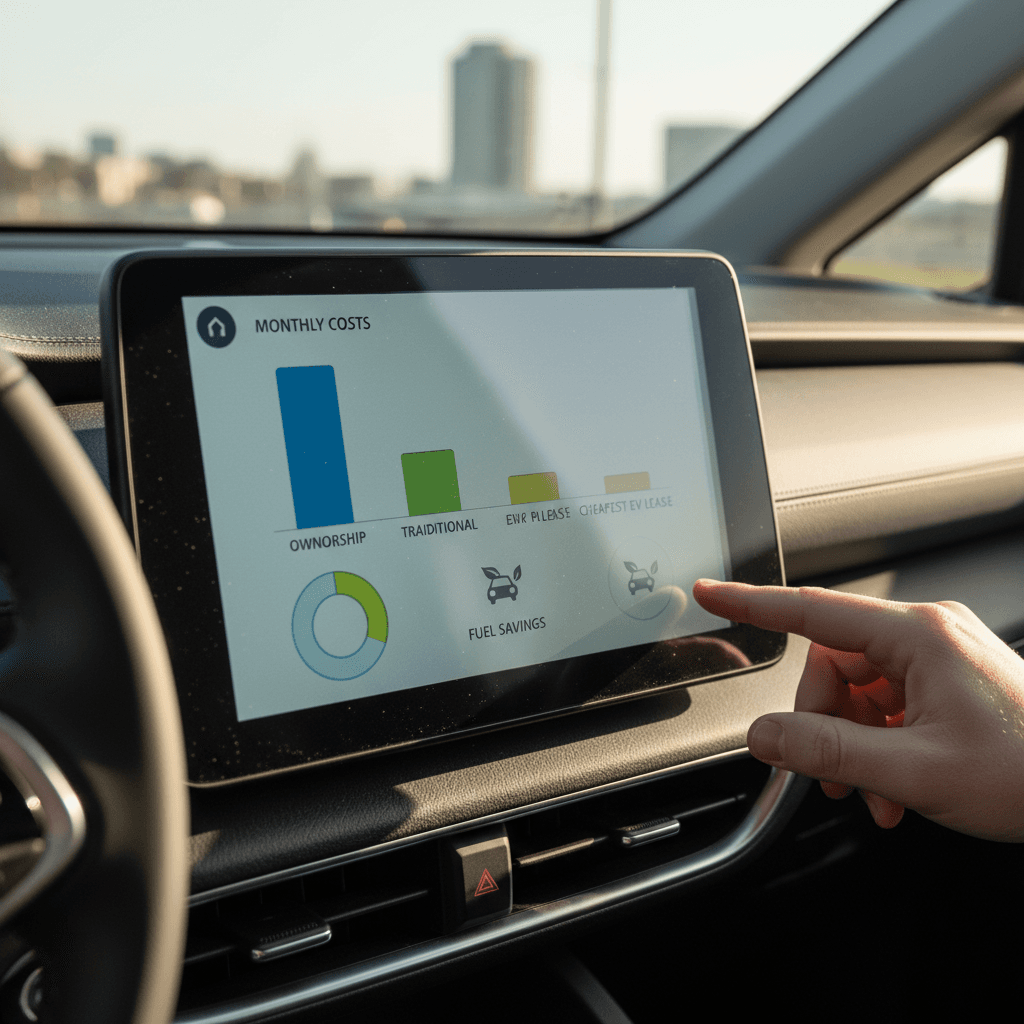
If you only remember one thing from this guide, let it be this: the cheapest EV lease isn’t the lowest monthly payment, it’s the lowest effective monthly cost for a car that actually fits your life. Here’s how to figure that out quickly.
5‑step formula for comparing EV leases
1. Add up everything due at signing
Include down payment (cap cost reduction), acquisition fee, doc fees, first month’s payment, and taxes. This is real cash leaving your bank on day one.
2. Multiply the monthly payment by the term
Payment × number of months. A $219 payment for 24 months is very different from $219 for 39 months.
3. Add signing costs to total payments
Signing costs + total of monthly payments = full out‑of‑pocket cost over the lease term, before wear and mileage charges.
4. Divide by the number of months
Take that total and divide by lease length. The result is your true effective monthly cost, what the car really costs you per month.
5. Adjust for miles and extras
If one deal gives you 10,000 miles a year and another 15,000, or includes a free home charger, mentally add or subtract value. A slightly higher payment with more miles can still be cheaper than overage fees later.
Quick example
Factors that make an EV lease cheap or expensive
What really drives EV lease prices
It’s more than MSRP and money factor, EV‑specific forces are at work.
Residual value
Incentives & lease cash
Regional demand
Range & tech updates
Charging ecosystem
Interest rates & credit tier
Why Tesla leases look different now
Lease vs. buying a used EV: which is cheapest long-term?
Leasing a new EV
- Pros: Latest tech, full warranty, often includes roadside assistance and sometimes free public charging credits.
- Predictable costs: You know your payment for the term, and you can simply hand the car back at the end.
- Great if you like new: Leasing lets you hop into a new EV every 2–3 years as range and charging tech improve.
- Cons: You’re renting. At the end, you either walk away with nothing or pay the buyout price, which might not reflect real market values.
Buying a used EV
- Pros: Depreciation has already done its worst. A 2–4 year‑old EV can cost dramatically less than new, while still feeling modern.
- Equity: You own an asset. If values hold up better than expected, you keep the upside.
- Flexibility: No mileage limits, no wear‑and‑tear inspections, and you can sell or trade whenever you like.
- Cons: You’re on the hook after the factory warranty ends, and you need a clear view of battery health and prior fast‑charging use.
In pure monthly‑payment terms, a heavily subsidized new‑EV lease can beat a loan payment on the same model. But when you compare those payments to a well‑priced used EV, with a sensible term and a healthy battery, the gap shrinks fast. That’s the space where Recharged lives: making used EV ownership predictable by grading battery health and pricing with our Recharged Score, then backing it up with specialist support.
When a used EV from Recharged beats the “cheapest” lease
Why used EVs can undercut new leases
Let’s say you’re comparing two paths for the next three years: - A 2025 Ioniq 6 lease at an effective ~$350–$375 per month, with a 10,000–12,000‑mile annual cap, and you walk away with nothing at the end. - A 2–3 year‑old EV at Recharged for a similar or slightly higher payment, financed over 60–72 months, but you own the car, and you can sell or trade it at any point. If your driving is predictable and you love always having the latest thing, the lease is fine. But if you’re thinking about total cost over five to seven years, a used EV with a verified battery and fair‑market pricing often ends up cheaper. You’re not starting the depreciation curve at the top.
Where Recharged fits in
Ready to find your next EV?
Browse VehiclesHow to shop for the cheapest EV lease, step by step
Practical playbook for finding a cheap EV lease
1. Define your real budget and mileage
Decide what you can comfortably spend in total per month, payment plus insurance, charging, and parking. Then estimate honest annual mileage; 15,000 miles a year on a 10,000‑mile lease is a recipe for ugly penalties.
2. Shortlist 3–5 EVs that fit your life
Don’t start with the deal, start with the car. Compact hatch, small SUV, or pickup? Need all‑wheel drive? Prioritize range, charging speed, and interior space before you ever look at payments.
3. Check national and regional offers
Visit each automaker’s site and filter for lease offers in your ZIP code. Then cross‑check with deal aggregators like TrueCar, CarsDirect, or KBB to see if your region has stronger unpublished specials.
4. Calculate effective monthly cost
Use the 5‑step formula above on every lease that looks promising. Create a quick spreadsheet with term, payment, due at signing, and effective cost so you can compare apples to apples.
5. Compare against a used EV payment
Take a used EV you like, maybe a prior‑generation Ioniq 5, Mustang Mach‑E, or Model 3, from a marketplace like Recharged. Run the payment with realistic terms and see how it stacks up over 3–5 years.
6. Negotiate or walk
If the effective cost on your lease is way above the national benchmarks, ask the dealer what’s driving it. If they can’t or won’t move, say thanks and walk. In today’s EV market, there’s usually another car and another deal.
Common pitfalls with cheap EV leases
Don’t let a “cheap” EV lease surprise you later
These are the gotchas that turn bargains into budget busters.
Ultra‑low mileage caps
Wear‑and‑tear charges
Gap and insurance surprises
Upside‑down buyout
Watch out for prepayment illusions
FAQ: Cheapest EV lease deals
Frequently asked questions about cheap EV leases
Chasing the cheapest EV lease in 2025 isn’t about winning a low‑payment lottery, it’s about understanding how the math works now that the federal credit is gone, and using that knowledge to your advantage. Start with a car that actually fits your life, calculate the effective monthly cost, and then compare it honestly against a solid used EV with known battery health and fair pricing. If a new lease still wins, fantastic, you’ll drive off knowing you didn’t miss a better deal. If a used EV from Recharged comes out ahead, you’ll own your savings instead of giving them back at lease end.