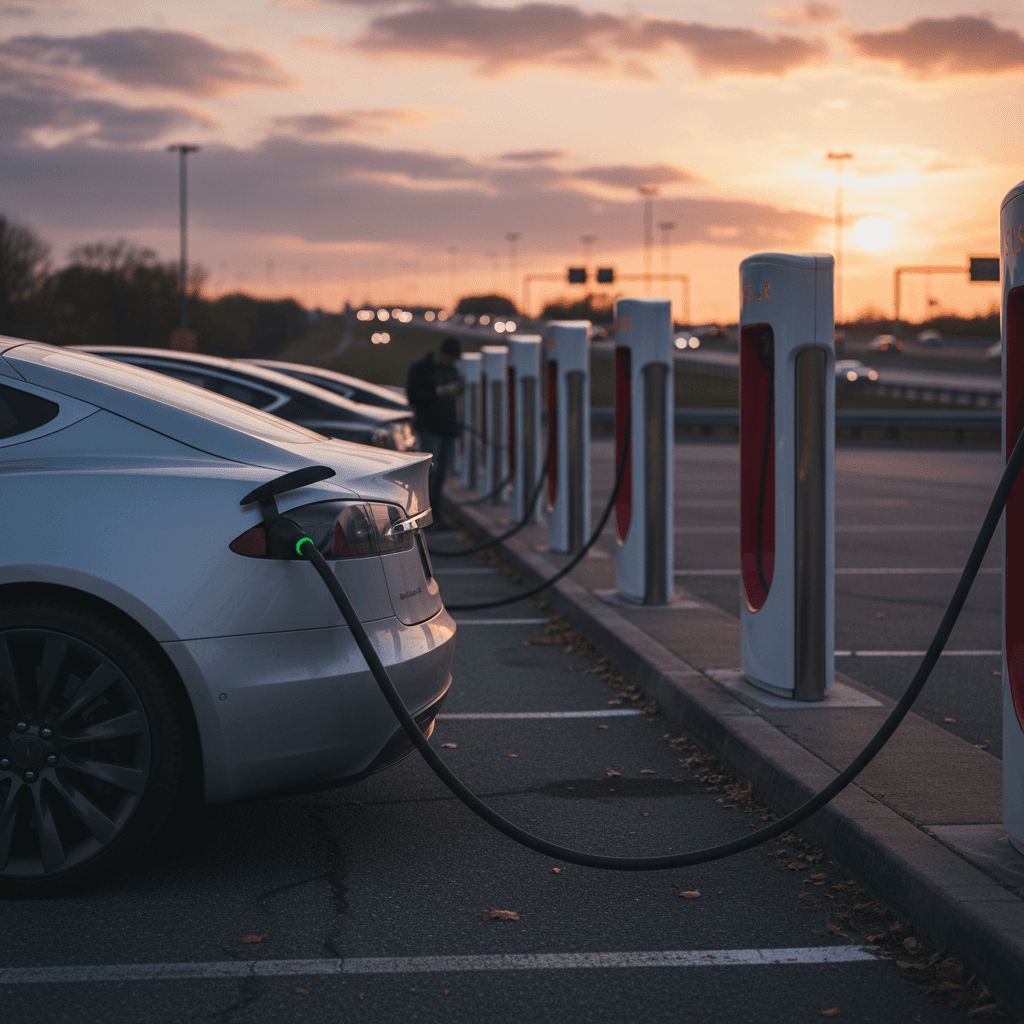
If you’re Googling “car supercharger near me”, you’re probably low on time, low on range, or both. The good news: whether you drive a Tesla or a non-Tesla EV, it’s easier than ever in 2025 to find a fast charger nearby, as long as you know which apps, plugs, and networks to look for.
Quick definition
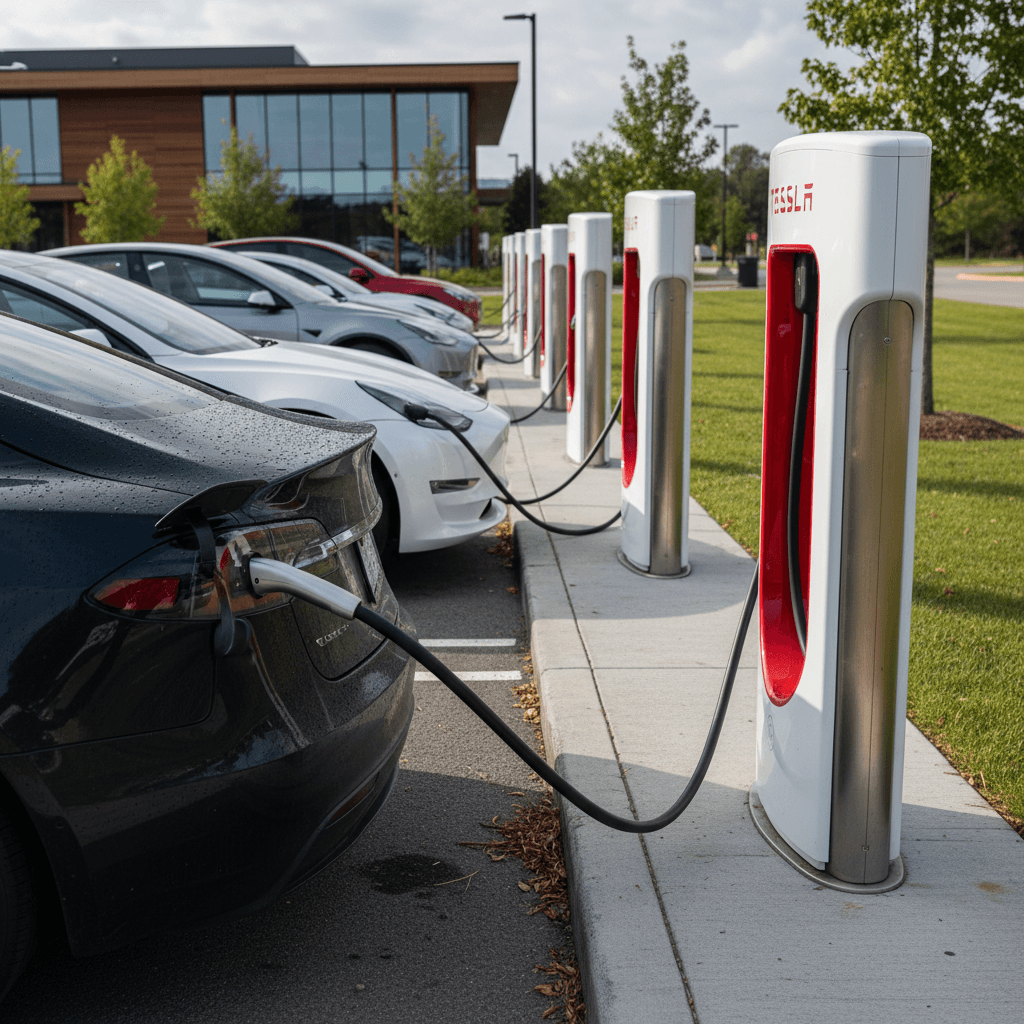
Why you’re searching “car supercharger near me”
Fast charging has gone from niche to normal. Major road corridors now have multi‑stall DC fast‑charging sites every 50–70 miles in many parts of the U.S., and Tesla is steadily opening Superchargers to non‑Tesla brands. At the same time, reliability on some non‑Tesla networks still lags behind, so simply finding a pin on a map isn’t enough, you also care if it works, is compatible with your car, and won’t trap you behind a line of other desperate drivers.
Fast charging in the U.S. at a glance (2025)
Those numbers are moving targets, but the directional story is clear: more locations, more speed, more brands sharing plugs. The challenge is picking the right charger for your specific EV and trip, in real time.
Supercharger vs. DC fast charger: what’s the difference?
Tesla Supercharger (NACS)
- Brand: Owned and operated by Tesla.
- Plug type: NACS connector (now the North American Charging Standard).
- Speed: Typically 120–250 kW, some newer sites higher.
- Access: All Teslas; many non‑Tesla EVs via adapter and app.
- Payment: Tesla app, in‑car integration for some brands.
Other DC fast chargers (CCS & NACS)
- Brands: Electrify America, EVgo, Ionna, ChargePoint, Revel, regional utilities, and more.
- Plug types: CCS, NACS, and sometimes CHAdeMO on older sites.
- Speed: Commonly 50–350 kW, depending on site and stall.
- Access: Any compatible EV; payment via app, RFID card, or credit card reader.
- Experience: Highly variable, some excellent, some frustrating.
When you type “Supercharger near me”, it usually makes sense to widen your search to any reliable DC fast charger. For most road trips, the practical question is: “Where can I add 60–200 miles quickly and with minimal hassle?” The badge on the pylon matters less than uptime, speed, and whether your car can plug in without a bag of adapters.
Shortcut for daily driving
Apps and tools to find a car Supercharger near you
In 2025, the best way to find a car Supercharger near you is to let your phone or car’s infotainment do the heavy lifting. Several apps now pull in live data on stall availability, pricing, and charging speeds so you don’t waste time detouring to a full or broken site.
Best tools to locate fast chargers near you
Use more than one source, crowd data plus official data beats either alone.
Google Maps
Best for: A single map for everything.
- Now shows live Tesla Supercharger availability across North America.
- Filter by fast charging, plug type, and network.
- Great for mixed gas/EV routing on unfamiliar routes.
Tesla app
Best for: Tesla owners and non‑Teslas with Supercharger access.
- Filter to “Superchargers open to non‑Tesla” if you drive another brand.
- Shows real‑time stall counts, pricing, and on‑site amenities.
- Required to start most sessions in non‑Tesla EVs.
Dedicated EV apps
Best for: Seeing all networks at once.
- PlugShare, ChargePoint, A Better Routeplanner, and OEM apps (Ford, Hyundai, Mercedes, Honda, etc.).
- User reviews and photos to spot unreliable sites.
- Route planning that accounts for your car’s range and charging curve.
Watch out for stale data
Can your EV actually use a Tesla Supercharger?
The biggest source of confusion right now is compatibility. Searching “Tesla Supercharger near me” doesn’t mean your EV can automatically plug in. Access depends on three things: your connector (NACS vs CCS), whether your brand has a deal with Tesla, and whether you have the right adapter Always confirm details with your automaker, but this gives a high‑level snapshot for U.S. drivers. Access assumes you’re in the U.S. and have any required adapter/software updates. Look at your charge port or owner’s manual: does your car use NACS (Tesla‑style) or CCS? Newer models increasingly have NACS from the factory. Open your automaker’s app or website to see if they’ve enabled Tesla Supercharger access in your region yet. Use the adapter sold or approved by your automaker. Third‑party adapters may not be supported or safe at full power. Create an account, add a payment method, and link your car if required so you can start a session quickly at the charger. Try a nearby Supercharger with plenty of range remaining. It’s better to discover any issues close to home than on a road trip. Whether you end up at a Tesla site or another brand’s station, the basic flow is similar. The key differences are how you start and pay for the session. Nothing kills confidence like rolling up to a “nearby Supercharger” only to find it offline or dribbling power at 20 kW. You can’t control everything, but you can dramatically improve your odds with a few habits. Use these filters every time you search “car supercharger near me.” Apps like PlugShare and some OEM apps let drivers log successful and failed sessions. Ignore stations with lots of recent 1‑star complaints, even if they’re convenient on the map. All else equal, choose sites with 150–350 kW hardware. Even if your car tops out lower, those sites are usually newer and better maintained. When you plan a stop, note a backup charger 5–15 miles further along the route. If the first site is full or broken, you’re not stranded. On a long drive, charging stops are part of the trip, not a random emergency. The more you plan upfront, the less you’ll be doom‑scrolling “Supercharger near me” on the shoulder of the interstate. If you drive a Tesla or a NACS‑equipped EV with Supercharger access, make Tesla your default and others the backup. If you’re CCS‑only, lean on Ionna, Electrify America, EVgo or your automaker’s preferred partners. Tools like A Better Routeplanner and some OEM nav systems model your <strong>real‑world consumption</strong> and suggest optimal charging stops and state‑of‑charge targets. Cold, heat, headwinds, and mountain grades all eat into range. Add a buffer, especially in winter, rather than trusting ideal‑conditions estimates. Pick chargers near services you actually want to use. 25–35 minutes flies by if you’re eating or walking, and feels endless if you’re stuck in a parking lot with nothing around. Many EVs can pre‑heat or cool the battery before a fast charge if you set the charger as your destination. That can significantly improve initial charging speed. Ready to find your next EV? Aggressively using every Supercharger you can find isn’t free, it costs a bit of long‑term battery health and more money than slower charging. That doesn’t mean you should avoid fast charging; it just means you should use it strategically. When you search for a “car supercharger near me”, you’re really asking, “Where can I get a fast, reliable charge right now?” In 2025, that answer may be a Tesla Supercharger, a brand‑new NACS plaza, or a well‑run CCS site down the street, but only if your car, adapter, and apps are all on the same page. Do those few things consistently and “car supercharger near me” stops being a panic search and becomes just another quick step in planning your day or your next road trip.Quick guide: Can my EV use a Supercharger in 2025?
Brand Status in 2025 (U.S.) What you typically need Notes Tesla Full access Nothing extra Plug and charge at nearly all Superchargers. Ford, GM, Rivian Widespread access Official NACS adapter + Tesla app or in‑car integration Most highway‑corridor sites open; check automaker app for details. Hyundai, Kia, Genesis Rolling out OEM NACS adapter + software update Access expanding through 2025; new models increasingly ship with NACS ports. Mercedes‑Benz, BMW, Volvo, Polestar, Honda/Acura Growing access OEM adapter + app (Tesla or OEM) Most sell or provide adapters so CCS cars can use NACS Superchargers. Others (VW, Nissan, older EVs) Mixed Check with brand Some have announced NACS plans; others still CCS‑only for now. What if my car is CCS‑only?
Compatibility checklist before you drive to a Supercharger
1. Confirm your port type
2. Check your brand’s Supercharger policy
3. Order the official adapter if required
4. Install the Tesla app
5. Test locally before a big trip
Step-by-step: how to charge at a Supercharger or DC fast charger
At a Tesla Supercharger
At a non‑Tesla DC fast charger
How long should you stay?
How to avoid slow or broken fast chargers
Three habits of low‑stress fast charging
Read recent check‑ins
Target higher power sites
Always have a Plan B
Don’t arrive on “battery fumes”
Planning road trips around Superchargers
Road‑trip planning checklist for fast‑charging
Choose your primary network
Use a route planner that knows your car
Account for weather and terrain
Optimize meal and restroom stops
Precondition when possible
How Recharged fits in
Fast charging and battery health: what used-EV shoppers should know
How fast charging affects batteries
Practical rules of thumb
Buying used? Ask about charging history
FAQ: car Supercharger near me
Frequently asked questions about finding a car Supercharger near you
Key takeaways