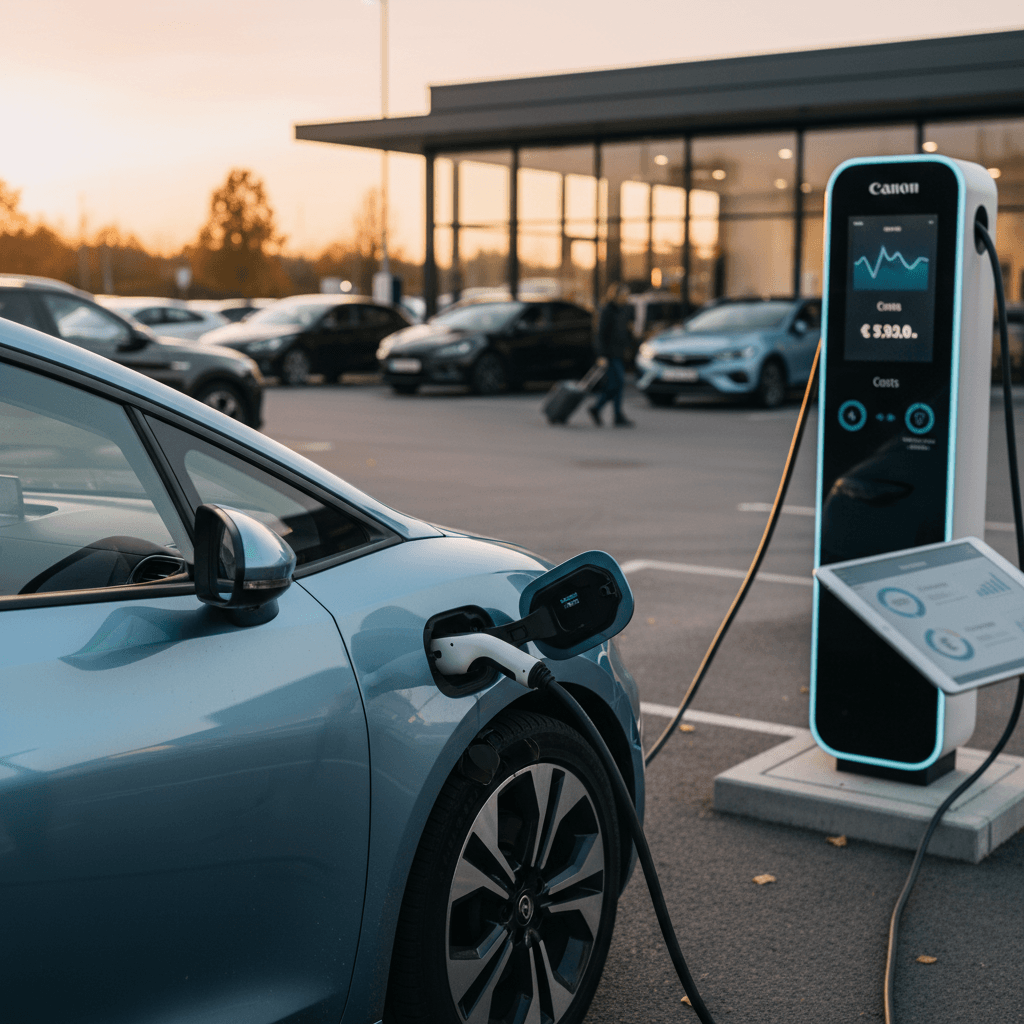
If you search for car rental electric cars in 2025, you’ll see glossy photos of Teslas at airports and promises of “eco-friendly mobility.” But the reality is more nuanced: EVs still make up only a small slice of rental fleets, pricing can be confusing, and charging isn’t always as simple as filling up at the nearest gas station. This guide walks you through how electric car rentals really work, what they cost, how to charge on the road, and when it might be smarter to own a used EV instead of renting repeatedly.
Quick context
Why rent an electric car in 2025?
Top reasons travelers choose electric car rentals
Beyond “feeling green,” there are practical advantages if you know how to use them.
Lower running costs
Electricity is usually cheaper per mile than gasoline, especially if you can tap hotel or workplace charging.
On longer rentals, that can offset a slightly higher daily rate.
Better in cities
EVs shine in stop‑and‑go driving, where regenerative braking recovers energy.
Many cities offer preferred parking or discounted congestion/low‑emission fees for electric vehicles.
Future-proof practice
If you’re considering buying a used EV, a rental is a low‑risk way to live with one for a week, learn the charging realities, and see if it actually fits your lifestyle.
Tip: Treat your rental as an extended test drive
How electric car rental works today
At a high level, renting an electric car works just like renting any other vehicle: you pick a class, choose dates, add insurance, and pick up at a branch or airport. The differences show up in how models are guaranteed, how the car is returned, and how charging is billed.
- Booking: Most large brands (Enterprise, Avis, Sixt, etc.) now have an "electric" or "EV" filter online. Sometimes you’re booking a specific model (e.g., Tesla Model 3); other times you’re choosing a generic "Compact Electric" class.
- Pickup: Staff will usually give a quick orientation, gear selector, charging port, how to open the charge flap, and any brand‑specific quirks. Don’t rush this walkthrough; ask to see how to start a charge session on their recommended networks.
- Charging access: Some rentals include access cards or app logins for major networks, while others expect you to set up your own accounts. Policies vary widely, so read the confirmation email and ask at the counter.
- Return state‑of‑charge: Instead of “full tank,” EV rentals typically require you to return the car at the same state‑of‑charge (SoC) you picked it up. If you don’t, the company may add a “recharging fee” that’s far more expensive than public charging rates.
- Damage and tire policies: EVs tend to be heavier and often quicker than equivalent gas cars. Some rental companies have tightened damage and tire wear policies on performance EVs, so inspect carefully at pickup and return.
Watch the “or similar” fine print
Electric car rental market: What’s actually available?
Electric car rental market in numbers
From a renter’s perspective, those numbers mean two things. First, you can’t assume an EV will be available everywhere, you’ll have better odds in large U.S. metros, West Coast states, and climate‑conscious cities like New York, Boston, Seattle, and Denver. Second, the category is in flux: some firms are scaling back specific models that proved expensive to maintain, even as regulators in Europe push toward all‑electric rental fleets in the 2030s.

What does it cost to rent an electric car?
Pricing for car rental electric cars changes weekly, but some patterns are emerging. In many markets EVs are now priced within shouting distance of comparable gas models, especially outside peak holiday windows. The total you pay comes down to four buckets: daily rate, fees, charging, and insurance.
Typical cost components for electric car rentals
Use this as a framework when comparing EV vs gasoline rentals for the same trip.
| Cost component | What to expect for EVs | How to optimize |
|---|---|---|
| Daily rate | Can be slightly higher than a similar gas compact, but promotions often narrow the gap. | Book mid‑week, avoid airport surcharges where possible, and compare several brands with the EV filter on. |
| Charging cost | Usually lower per mile than gasoline, but depends heavily on where you charge (hotel vs DC fast charging). | Target Level 2 chargers overnight, use fast charging only when you need to, and avoid premium "idle" fees. |
| Recharging fee | If you return under the pickup state‑of‑charge, per‑kWh rates can be 2–4× public charging prices. | Aim to return the car at or slightly above pickup SoC; schedule a charging stop near the rental return. |
| Insurance | Collision and liability similar to other cars; some companies charge higher deductibles on premium EVs. | Check whether your credit card covers EV rentals; for high‑performance models consider extra coverage. |
| Extras | Navigation, connectivity, toll transponders, and mobile app access may incur add‑on fees. | Download required apps over Wi‑Fi before your trip and bring your own phone mount and cable. |
Actual prices vary by city, dates, and demand, but the structure of costs is consistent.
Run your own TCO math
Charging an electric rental car without stress
Charging is where many first‑time EV renters get anxious. The good news is that if you plan ahead, it’s much more manageable than it looks from the outside. Think in three layers: where you’ll charge overnight, how you’ll top up during the day, and how you’ll make sure the car is ready at return.
Three layers of a low‑stress charging plan
Cover these bases before you leave the rental lot.
1. Overnight charging
Check whether your hotel or Airbnb offers EV charging. "EV charger" is now a filter on most booking sites.
If they do, confirm whether it’s free, pay‑per‑kWh, or pay‑per‑session.
2. Daytime top‑ups
Use apps like PlugShare, ChargePoint, or Electrify America to plan stops near your actual activities, coffee shops, malls, restaurants, rather than random highway exits.
3. Return strategy
Before your last day, find a charger within a few miles of the rental location and note opening hours.
Plan a 30–45 minute stop to bring the car back to its required state‑of‑charge.
EV charging checklist for renters
Download 1–2 charging apps in advance
Create accounts and add a payment method for at least one major network (like ChargePoint or Electrify America) plus a community map like PlugShare.
Ask the counter how charging is handled
Some rental brands give you RFID cards or app credentials tied to the car. Ask which networks they support and how you’ll be billed.
Confirm the connector type
Most U.S. rental EVs today use CCS or the J1772 plug for Level 2 and CCS or NACS for DC fast charging. The car’s charge port and the public charger must match or use a compatible adapter.
Know your target state‑of‑charge
Make a note of the battery level at pickup (for example, 80%). Plan to return the car at that level or slightly higher to avoid recharging fees.
Avoid living at 100%
For battery health and charging speed, it’s usually best to charge to 80–90% for daily use and only go to 100% right before a long highway leg.
Good news on charging speeds
City rental vs road trip: Different EV strategies
Using an electric rental in the city
Urban and suburban trips are where EV rentals shine. Distances are shorter, speeds are lower, and there are usually more charging options, from curbside chargers to workplace parking and shopping‑center stations.
- Prioritize compact EVs that are easy to park.
- Look for free or low‑cost charging at hotels and garages.
- Don’t obsess over fast charging; Level 2 overnight is often enough.
Taking an EV rental on a road trip
Longer highway trips are totally doable in an EV, but they demand more planning. You’ll be stringing together DC fast‑charging stops, and your real‑world range will depend heavily on speed, weather, and elevation changes.
- Allow an extra 15–30 minutes per 200 miles for charging.
- Favor cars with at least 250 miles EPA range if you can.
- Plan fast‑charging stops near services, not in the middle of nowhere.
Cold weather changes the math
Common EV rental pitfalls (and how to avoid them)
- Underestimating range at highway speeds: Many renters drive 80 mph with the heater on and assume the car will still hit its rated range. In reality, expect 20–30% less range at higher speeds, especially in cold weather.
- Ignoring the return SoC requirement: Returning a car far below its pickup battery level can trigger steep recharging fees. Treat the final charge stop as part of the trip, not an afterthought.
- Relying on a single fast‑charging network: Chargers can be busy, broken, or offline. Having accounts with at least two networks gives you options.
- Assuming every EV uses the same plug: Connector standards are converging, but we’re still in a transition. Always confirm that your planned chargers match your rental’s port and that any needed adapters are provided.
- Not documenting pre‑existing damage: EVs often have large alloy wheels and low‑profile tires that show curb rash. Do a slow walk‑around with video before leaving the lot and capture close‑ups of any scuffs, chips, or cracks.
Don’t ignore warning lights
Renting an EV vs owning a used EV
If you only drive on occasional trips, renting an electric car can be a smart way to access modern tech without monthly payments. But if you find yourself renting cars several times a year, or if you’re consistently choosing EVs at the counter, it’s worth comparing that spend to the cost of owning a used electric vehicle instead.
When renting an EV wins, and when owning a used EV does
A simple comparison for U.S. drivers debating between repeated rentals and buying a used electric car.
| Scenario | Renting an electric car | Owning a used EV |
|---|---|---|
| You drive fewer than 6,000 miles per year and mostly on trips | Likely cheaper. You avoid insurance, registration, and depreciation between trips. | Probably overkill unless you value having a car available 24/7. |
| You rent more than 3–4 weeks per year | Costs add up quickly; you’re paying a rental margin every time. | A used EV with manageable payments can be cheaper over 3–5 years, especially if you charge at home. |
| You live in a dense city with scarce parking | On‑demand rentals and car‑sharing might make more sense than owning any car, EV or otherwise. | Street parking and limited home charging can make ownership frustrating. |
| You have a driveway and a 240V outlet or can install one | You’ll still need to plan charging and returns each trip. | This is where owning a used EV shines; home charging is cheap, convenient, and available every night. |
| You’re worried about long‑term battery health | You don’t own the asset, so you’re not on the hook for degradation, but you’re also paying every time you need a car. | Today you can evaluate battery health up front and buy only cars with verified pack condition and transparent pricing. |
Use this as a starting point; your own driving pattern and financing options will tilt the answer one way or the other.
What about battery wear from rentals?
How Recharged fits into your decision
If renting electric cars has convinced you that you like EV driving, but not rental counter pricing, this is where Recharged comes in. Instead of paying a premium every time you travel, you can own a used EV with verified battery health, transparent pricing, and expert help from first click to final signature.
Turning rental experience into confident EV ownership
What Recharged offers when you’re ready to move beyond short‑term rentals.
Recharged Score battery report
Every vehicle listed on Recharged comes with a Recharged Score that quantifies battery health, charging performance, and overall vehicle condition.
You’re not guessing about degradation based on model year and mileage.
Flexible ways to switch from renting
Recharged offers financing, trade‑in, and instant offers, so you can move out of your current car, or your pattern of repeated rentals, into a used EV without a high‑pressure dealership visit.
Nationwide delivery & EV‑specialist support
Shop fully online, get expert EV advice when you need it, and have your car delivered to your door. If you’d rather see one in person, you can visit the Recharged Experience Center in Richmond, VA.
From trial to commitment
Ready to find your next EV?
Browse VehiclesFAQ: Car rental electric cars
Frequently asked questions about renting electric cars
The bottom line on car rental electric cars
Electric car rentals in 2025 occupy an awkward but exciting middle ground. EVs are still a small share of rental fleets, and policies around charging, damage, and exact model guarantees are very much in flux. But if you plan ahead, understanding costs, downloading the right apps, and giving yourself a margin on range, renting an electric car can be smoother, quieter, and often cheaper per mile than a gasoline alternative.
If your EV curiosity is limited to the occasional trip, smart use of car rental electric cars will give you a low‑commitment way to build experience. If those rentals leave you wishing you could plug in at home every night, it may be time to compare your rental spend to the total cost of owning a used EV with verified battery health. That’s exactly the gap Recharged is built to fill, helping you move from one‑off experiments to confident, transparent electric ownership on your own terms.