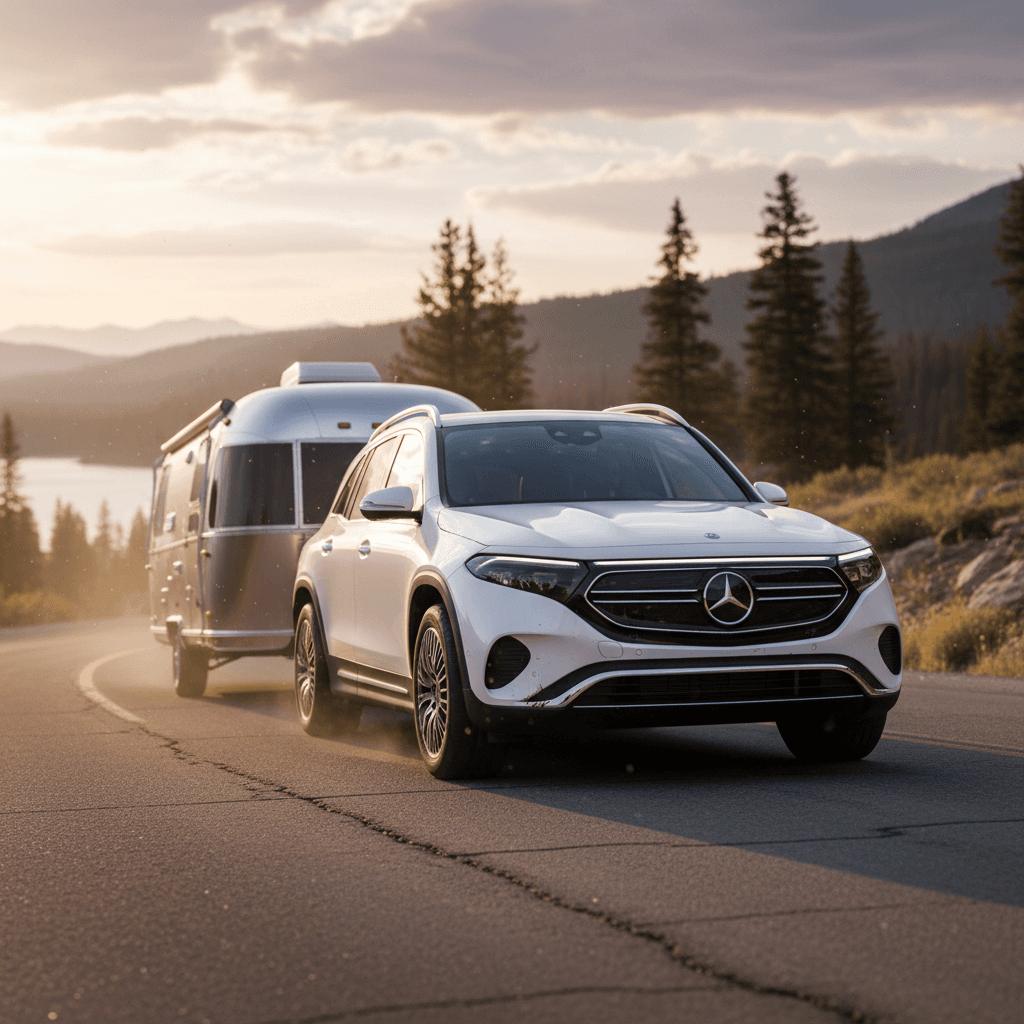
If you’re eyeing a compact luxury EV that can haul kids during the week and a small trailer on the weekend, you’re probably wondering: can the Mercedes EQB tow a trailer at all, and if so, how much? The answer is a cautious “yes”, but the details depend heavily on where the car was sold, how it’s equipped, and how comfortable you are living close to the edge of the ratings.
Quick answer
Can the Mercedes EQB actually tow a trailer?
From a hardware standpoint, the EQB is built on the same basic platform as the gasoline GLB, which in many markets is rated to tow a moderate‑size trailer. With the facelifted EQB introduced for the 2023–2024 model years, Mercedes added an optional factory trailer hitch with ESP trailer stabilization on 5‑seat models, and in Europe they published clear towing limits.
That’s where the confusion starts for U.S. and Canadian shoppers. Some spec sheets and dealer guides for 2024 EQB 300/350 trims in North America list towing as “not recommended,” while European brochures talk openly about towing capacities. As a shopper or owner, you have to separate two questions: 1. Is the EQB structurally and mechanically capable of towing? 2. Is your specific vehicle legally and warranty‑approved to tow?
Always start with your owner’s manual
EQB towing ratings: Europe vs. North America
EQB trailer ratings in markets where towing is approved
In European technical docs for the facelifted EQB, you’ll see a dedicated row for towing capacity. Typical figures are: - EQB 250+ (front‑wheel drive): 750 kg (≈1,650 lb) unbraked / 1,400 kg (≈3,100 lb) braked - EQB 300 4MATIC and EQB 350 4MATIC: 750 kg (≈1,650 lb) unbraked / 1,700 kg (≈3,750 lb) braked Those numbers are enough for a small camping trailer, a pair of ATVs, or a modest boat, on paper.
In North America, the picture is fuzzier. Some dealer towing guides and comparison charts list “towing not recommended” for EQB while giving clear ratings to larger Mercedes SUVs. That doesn’t mean the car would instantly fail if you tow with it; it does mean Mercedes hasn’t chosen to certify and support towing for all configurations here. That has implications for warranty coverage, liability, and resale.
Typical EQB towing data by market (for factory‑equipped vehicles)
Approximate figures based on published specs where available. Always rely on your vehicle’s own documentation first.
| Market | Drivetrain | Unbraked trailer | Braked trailer | Official note |
|---|---|---|---|---|
| Europe/UK | EQB 250+ FWD | ≈750 kg (≈1,650 lb) | ≈1,400 kg (≈3,100 lb) | Factory hitch option on 5‑seat models |
| Europe/UK | EQB 300/350 4MATIC | ≈750 kg (≈1,650 lb) | ≈1,700 kg (≈3,750 lb) | Trailer stabilization ESP available |
| U.S./Canada | EQB 250+/300/350 | Often “N/A” | Often “Not recommended” | Check your manual; many trims not tow‑rated |
| Aftermarket (global) | Any EQB | Limited by hitch & vehicle | Use lowest rated component | May affect warranty/insurance |
If your EQB’s owner’s manual or door‑jamb label disagrees with this table, follow the lower number.
Never “borrow” another market’s tow rating
What kinds of trailers an EQB can safely tow
If your EQB is officially tow‑rated and has the factory or OEM‑approved hitch, it’s designed for light to moderate trailers, not big fifth‑wheels or triple‑axle toy haulers. Think in terms of frontal area (wind resistance) and weight:
- Excellent fits: single‑axle utility trailers, small cargo trailers, lightweight teardrop or micro‑campers, one or two dirt bikes, or a pair of kayaks on a small trailer.
- Borderline but possible (with a braked trailer and careful loading): compact single‑axle travel trailers in the 2,000–3,000‑pound range, low‑profile boat trailers, or a small enclosed moto trailer.
- Not a good idea: tall, boxy trailers with huge frontal area (big travel trailers), multi‑axle campers near the 3,500‑pound mark, or anything that pushes tongue weight beyond what Mercedes specifies.
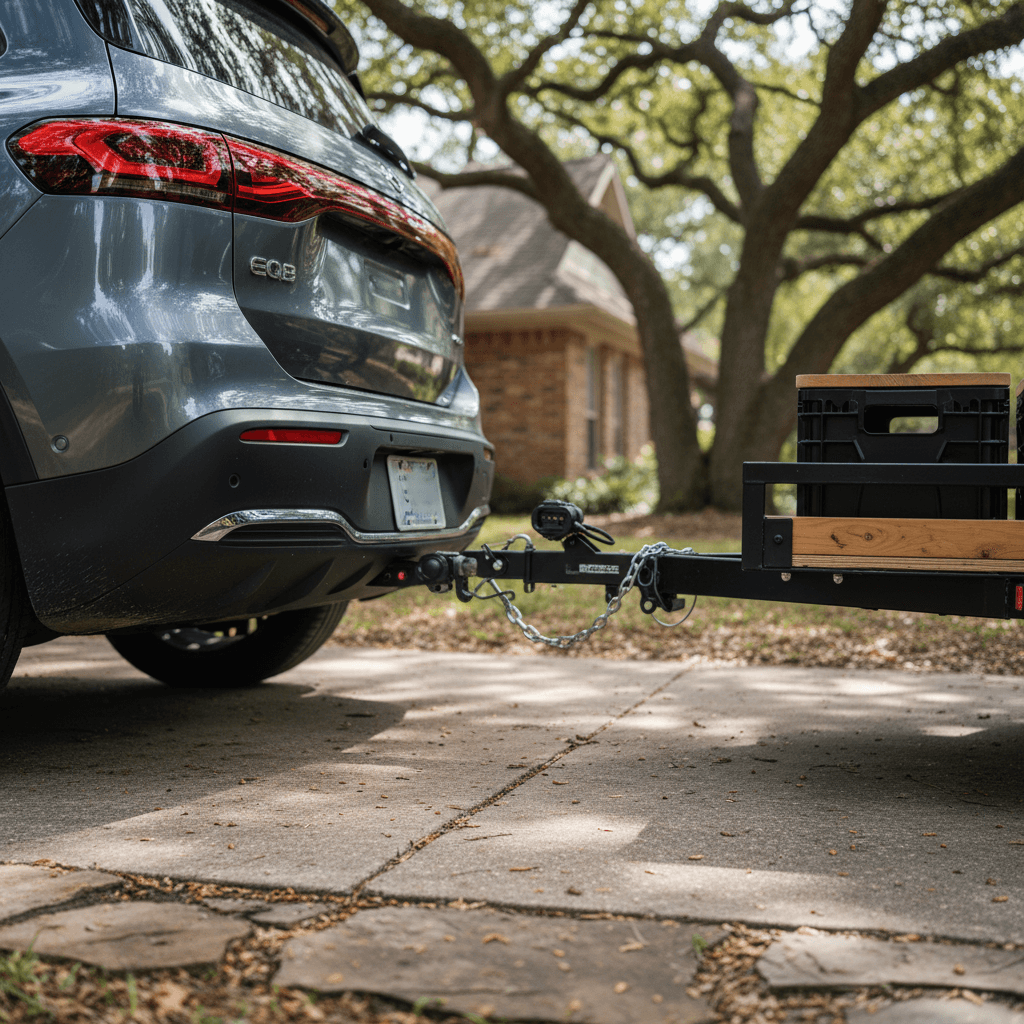
Mind the tongue weight
How towing affects EQB range and performance
Even if your EQB is approved to tow, the more important question for an EV owner is often, “What happens to my range?” The honest answer: it drops, sometimes dramatically.
Typical range impact when towing with an EQB
Rough, real‑world expectations for moderate loads in good weather
Light load, low profile
Example: 800–1,200 lb utility trailer with bikes or gear.
Expect roughly 20–30% range loss at highway speeds if you drive conservatively.
Moderate camper or boat
Example: 1,500–2,500 lb small camper or boat with a tidy shape.
Plan for 30–40% less range and more frequent DC fast‑charging stops.
Tall, blunt trailer
Example: Tall box trailer close to the limit.
Drag dominates. You could see 40–50% or more range reduction at interstate speeds.
The EQB’s battery, roughly 70–74 kWh usable depending on model year, is sized for everyday commuting and family use, not heavy towing. Add the extra weight and aerodynamic drag of a trailer, and the motor has to work harder, especially at 65–75 mph. You’ll feel that in energy consumption and in how often you’re stopping to charge on a road trip.
Braking and stability
Electric SUVs like the EQB have strong regenerative braking, but that doesn’t replace proper trailer brakes on heavier loads. If your trailer is over about 1,500–2,000 pounds, you’ll want it to be braked and wired correctly so it can help slow the rig. Mercedes’ trailer‑stability programming on factory‑equipped EQBs can also help tame sway, but it’s not a cure‑all for poor loading or excessive speed.
Thermal management and power
Towing up long grades or in high summer heat keeps the battery, motors, and inverter working hard. Mercedes engineers design in margin, but sustained, heavy towing can push things close to limits. That’s one reason why some markets are more conservative with official tow ratings on EVs than on their gasoline counterparts.
Watch your speed when towing
Hitches, wiring, and what dealers won’t tell you
Because Mercedes was slow to publish tow ratings for the EQB in North America, you’ll see a mix of advice from dealers and service advisors, everything from “absolutely no towing” to “sure, just add an aftermarket hitch.” The safe path depends on your risk tolerance and how you plan to use the vehicle.
EQB hitch and wiring options, from safest to riskiest
1. Factory‑equipped, tow‑rated EQB
If you live in a market where Mercedes sells the EQB with an official tow rating and a factory hitch (including trailer ESP), this is the gold standard. The vehicle, cooling, and software were certified to tow, and your owner’s manual will spell out exact limits.
2. Dealer‑installed OEM hitch on rated vehicles
Some dealers can add the same hitch hardware and wiring harness that the factory uses, on trims that are already tow‑approved. This may preserve warranty coverage if done to Mercedes’ guidelines, but you still have to follow the lower of the hitch or vehicle ratings.
3. Aftermarket hitch for accessories only
In markets where EQB towing is “not recommended,” reputable hitch makers still offer receivers <strong>just for bike racks or cargo carriers</strong>. These may have their own weight rating, but that doesn’t magically give your EQB a trailer rating.
4. Aftermarket hitch used for “light” towing
Some owners choose to tow small trailers (say 800–1,500 lb) with an aftermarket hitch on non‑rated EQBs. While the car is probably capable from a purely mechanical standpoint, you’re on your own for any warranty, insurance, or legal issues if something goes wrong.
Warranty and insurance fine print matters
Towing safety checklist for EQB owners
If you’ve confirmed that your EQB is legally tow‑approved and you’ve got the right hardware, the remaining job is to tow in a way that keeps you, your passengers, and your battery safe. Use this checklist every time you hitch up.
Pre‑trip checklist for towing with a Mercedes EQB
Confirm your exact ratings
Open the owner’s manual and check any stickers on the driver’s door jamb or hitch. Note the <strong>maximum braked and unbraked trailer weights</strong> and the tongue‑weight limit. Don’t guess, write the numbers down.
Weigh your trailer loaded
A trailer that’s “about 2,000 pounds” can end up much heavier once you add gear, water, and propane. Use a public scale or trailer‑rental facility to verify the actual loaded weight and compare it to your EQB’s limits.
Set proper tongue weight
Aim for roughly 10% of the total trailer weight on the hitch unless your manual specifies otherwise. Too little tongue weight encourages sway; too much can overload the rear axle and hurt steering and braking.
Check brakes, lights, and wiring
If your trailer has brakes, make sure they’re adjusted and that your EQB’s controller (if fitted) is configured correctly. Confirm that all turn signals, brake lights, and running lights work before you leave.
Plan your charging stops
Use route‑planning tools that support trailers or simply add extra buffer into your trip. Expect <strong>shorter legs between stops</strong> and slightly longer sessions on the DC fast charger.
Drive slower and leave space
Keep your speed down, especially in crosswinds. Leave extra following distance for emergency braking and avoid sudden steering inputs. The EQB’s stability systems help, but physics wins every time.
Is the Mercedes EQB a good tow vehicle?
Viewed strictly as a tow rig, the EQB is a light‑duty solution. It offers decent torque, a high seating position, and the refinement you expect from Mercedes, but it doesn’t have the battery size or cooling reserves of larger electric SUVs designed with towing front‑of‑mind.
Pros and cons of towing with an EQB
How the EQB stacks up as a tow vehicle
Where the EQB works well
- Ideal for occasional light towing, small campers, utility trailers, or toys.
- Strong, smooth electric torque makes it easy to pull away from stops.
- Compact size is easier to park and maneuver than a full‑size truck.
- Quiet, refined cabin helps reduce fatigue on long drives.
Where the EQB falls short
- Limited or absent official tow ratings in some markets.
- Range can suffer 30–50% or more with a big trailer at highway speeds.
- Battery and thermal systems aren’t sized for heavy, frequent towing.
- Aftermarket solutions may complicate warranty and resale value.
If you tow often, consider a different EV
Used EQB shoppers: what to look for if you plan to tow
If you’re shopping the used market, and especially if you’re browsing a curated marketplace like Recharged, it pays to be picky about how an EQB was used and equipped. Towing adds stress and heat cycles, so you want to know what you’re getting.
Buying a used EQB you hope to tow with
Look for a factory or OEM‑grade hitch
A cleanly integrated hitch with proper wiring, ideally documented as factory or dealer‑installed, is much more reassuring than a random aftermarket setup with no paperwork.
Verify towing approval for that VIN
Don’t assume all EQBs are the same. Check the original build sheet or window sticker, or ask the seller for documentation that shows whether that specific vehicle was tow‑rated in its market.
Check battery health and service history
Repeated towing at high loads is one more factor in a battery’s life. On Recharged, every vehicle includes a <strong>Recharged Score Report</strong> with verified battery health and expert‑reviewed history, which can give you confidence before you hook up a trailer.
Inspect underbody and rear structure
Look for signs of overloading: sagging rear suspension, damaged hitch mounts, or scuffed underbody panels. These can be subtle clues that a previous owner towed more than the car was designed for.
Test drive with highway speeds
On your test drive, take the EQB to highway speed and pay attention to straight‑line stability, vibration, and any warning messages. You want a solid baseline before adding the complexity of a trailer.
Leverage specialist support
FAQ: Mercedes EQB towing questions answered
Common EQB towing questions
Bottom line on towing with a Mercedes EQB
So, can a Mercedes EQB tow a trailer? In the right configuration and market, yes, within light to moderate weight limits and with realistic expectations about range. The key is not to assume that every EQB shares the same abilities. Your owner’s manual, door‑jamb labels, and factory build sheet are the final authority on what your specific vehicle can legally and safely do.
If you’re shopping used, especially online, take the time to match your towing plans to the right EQB, with proper documentation and a clean bill of health. That’s exactly where a specialist retailer like Recharged shines: verified battery diagnostics, transparent history, fair pricing, and expert guidance on whether a given EV is truly up to the towing tasks you have in mind.