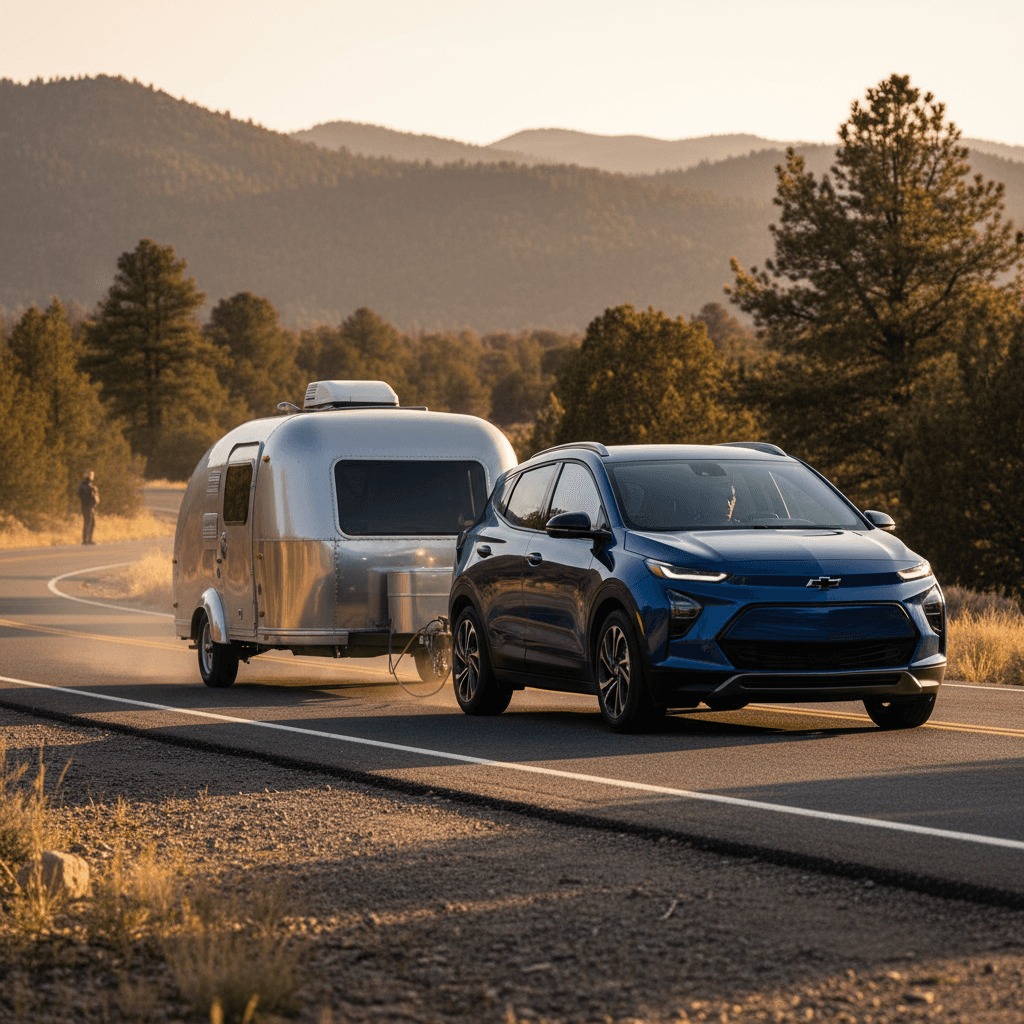
If you own or are shopping for a Chevrolet Bolt EUV, it’s natural to ask: can a Chevrolet Bolt EUV tow a trailer? Chevy markets the EUV as a practical, SUV‑shaped EV, but the towing story is…complicated. This guide breaks down what the manual says, what aftermarket hitches are rated for, how towing hits your range, and what’s realistic in the real world.
Key takeaway up front
Short answer: Can a Chevrolet Bolt EUV tow a trailer?
- Officially (Chevy’s position): The Bolt EUV is not rated to tow and the owner’s manual says it is not intended for trailer towing.
- Practically (what’s possible): With a properly installed aftermarket hitch and wiring, many owners tow very small, light trailers, think utility trailers, cargo boxes, or tiny teardrop campers, while staying well under common hitch ratings.
- Risk trade-off: Because GM doesn’t provide a factory tow rating, you assume responsibility for any issues, and a dealer could push back on related warranty claims.
Important disclaimer
What Chevrolet officially says about Bolt EUV towing
The Bolt EUV was engineered primarily as an urban, efficiency‑focused EV. In U.S. and Canadian owner’s manuals for 2022–2023 model years, Chevrolet states that the vehicle is not designed or intended to tow a trailer. There is no published tow rating (in pounds) the way you’d see on a Silverado or Equinox.
- No factory tow package in North America (hitch, wiring, upgraded cooling, etc.).
- No official maximum trailer weight or tongue weight listed for the Bolt EUV in U.S./Canada specs.
- Manual language that effectively says: don’t tow; the vehicle is not intended for trailer use.
Why this matters
Aftermarket hitches and ratings for the Bolt EUV
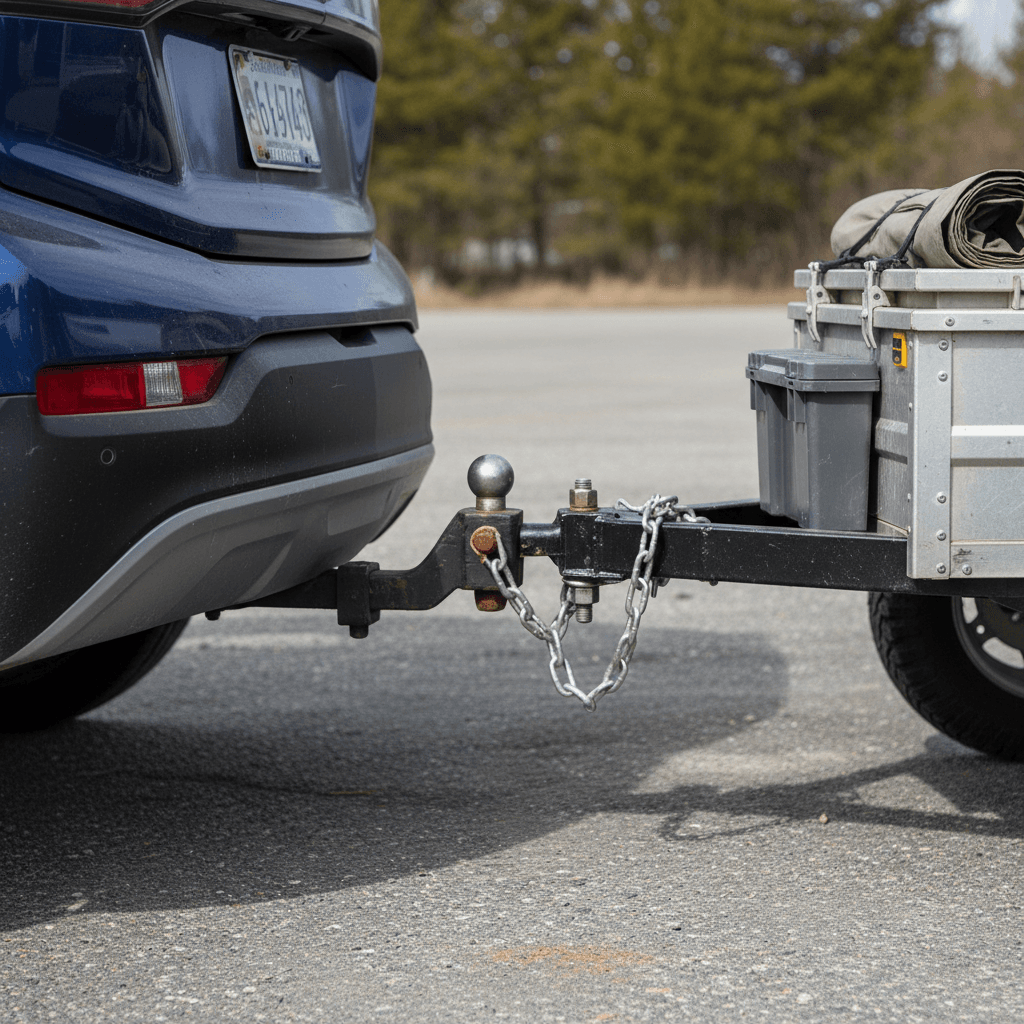
Despite Chevy’s “no towing” stance, several hitch manufacturers sell vehicle‑specific receiver hitches for the Bolt EUV. These are primarily marketed for bike racks and cargo carriers, but they also publish towing and tongue‑weight ratings for the hardware itself.
Common Bolt EUV hitch options and ratings
Typical ratings are for the hitch hardware, not an official vehicle tow rating.
Draw‑Tite Class III (2" receiver)
- Typical rating: ~2,000 lbs gross trailer weight
- Typical tongue weight: ~300 lbs
- Popular for bike racks and small utility trailers
EcoHitch (hidden‑style)
- Advertised ratings around 3,000 lbs GTW
- Tongue weight often ~450 lbs at the ball
- Clean, tucked‑up look; costlier but beefier hardware
Curt / Other Class II–III hitches
- Earlier Curt designs drew mixed reviews from owners
- Ratings often in the 2,000–3,500 lb GTW range
- Check for up‑to‑date fitment specifically labeled for "Bolt EUV"
Hitch rating vs. vehicle capability
What owners are actually towing with the Bolt EUV
In forums and owner groups, Bolt EUV drivers report thousands of miles of towing, again, all outside GM’s official recommendations. Common real‑world use cases look like this:
- Small 4x6 or 5x8 utility trailers loaded with household junk, yard waste, lumber, or moving boxes.
- Compact teardrop or “standy” campers with loaded weights often in the 1,000–1,500 lb range, towed at moderate speeds.
- Lightwatercraft or small toy haulers: single‑axle trailers carrying kayaks, canoes, bikes, or a single lightweight motorcycle.
- Hitch cargo boxes and platform carriers (technically not trailers but impose similar tongue loads).
Real‑world pattern
How towing affects Bolt EUV range and performance
The Bolt EUV’s 65 kWh battery offers EPA‑rated range in the mid‑200‑mile neighborhood when unladen. Hook up a trailer, and that number changes fast. Owner reports and broader EV‑towing data suggest a few consistent patterns:
- Range penalty of ~30–50% is common with a small, low‑profile trailer (think utility trailer no taller than the car).
- Tall, boxy campers can chop range by 50–60% or more, especially at freeway speeds, because aero drag dominates.
- Speed is the single biggest lever: the difference between towing at 60 mph vs. 75 mph can be the difference between a manageable trip and a white‑knuckle crawl to the next charger.
- Regenerative braking helps on descents, but towing adds stress to brakes and tires in emergency stops, no EV magic there.
Very rough range impact examples for a Bolt EUV
Illustrative, not official, assumes a healthy battery and mild weather.
| Setup | Speed | Estimated Practical Range |
|---|---|---|
| No trailer | 70 mph | ~220–240 miles |
| Low, small utility trailer (~1,000 lbs) | 65–70 mph | ~120–160 miles |
| Low utility trailer, keep it slow | 55–60 mph | ~150–190 miles |
| Small teardrop camper (~1,300–1,500 lbs, modest height) | 60–65 mph | ~110–150 miles |
| Boxy, tall camper near hitch limit | 65–70 mph | Often < 120 miles |
Assuming an unladen highway range of ~240 miles at 70 mph.
Plan charging like a hawk
What kind of trailer can a Bolt EUV realistically tow?
If you decide to tow despite the lack of a factory rating, the safest mindset is to treat the Bolt EUV as a light‑duty tow vehicle for occasional, modest tasks, not as a mini pickup or full‑time tow rig.
Realistic trailer use cases for a Bolt EUV
Think small, aerodynamic, and occasional.
Good candidates
- 4x6 or 5x8 open utility trailer with light loads (yard waste, Ikea runs, moving boxes).
- Very compact teardrop trailer with a loaded weight often under ~1,300–1,500 lbs.
- Single‑axle motorcycle or toy trailer with a lightweight bike.
- Kayak, canoe, or bike trailers with low frontal area.
Poor candidates
- Large, tall travel trailers with big flat fronts.
- Loaded dual‑axle trailers near 2,000–3,000 lbs or more.
- Car haulers, livestock trailers, or heavy equipment.
- Anything that pushes tongue weight near the hitch’s rated limit.
Rule of thumb
Safety checklist before you tow with a Bolt EUV
Bolt EUV towing safety checklist
1. Read the manual front to back
Re‑read the towing and cargo sections of your Bolt EUV owner’s manual so you fully understand what Chevy does and does not support.
2. Install a quality hitch professionally
Use a hitch specifically engineered for the Bolt EUV and have it installed by a reputable shop or dealer‑approved upfitter. Confirm torque specs, rust protection, and that nothing critical was cut or bent.
3. Add proper wiring and lights
Use a powered trailer wiring module that doesn’t overload the car’s lighting circuits. Verify that brake lights, turn signals, and running lights on the trailer all work reliably.
4. Measure real weights
Weigh the trailer empty and loaded at a public scale. Measure tongue weight with a tongue scale or at a scale by comparing axle loads with and without the trailer attached.
5. Check tires and pressures
Ensure both the Bolt’s tires and the trailer’s tires are in good condition, properly inflated, and rated for the combined load and speed you plan to run.
6. Practice stops and turns locally
Before any highway trip, practice braking, turning, and backing up with the loaded trailer in a parking lot and low‑speed streets to understand how the combo behaves.
Mind your payload too
Bolt EUV vs. Bolt EV: Any towing differences?
Mechanically, the Bolt EV and Bolt EUV share much of their platform and powertrain. In North America, neither is factory‑rated for towing. Hitch manufacturers sell hardware for both, and owners of each model report similar experiences when towing small loads.
Bolt EUV advantages
- Slightly longer wheelbase can improve stability with a short trailer.
- More rear legroom and cargo space make it easier to carry people plus gear.
- Ride height and stance feel a bit more “SUV‑like,” which some drivers prefer when loaded.
Shared limitations
- No OEM tow rating or factory tow package in U.S./Canada.
- Thermal and brake systems not engineered as heavy‑duty tow components.
- Range loss from aero drag and weight is similar in both models.
When you should not tow with a Bolt EUV
There are situations where it’s smarter to leave the Bolt EUV unhitched and find a different solution, rent a truck for the weekend, borrow a friend’s pickup, or ship the item instead.
- You need to tow heavy, tall, or long trailers regularly (contractor work, full‑size campers, frequent cross‑country towing).
- You can’t stay well under hitch ratings or you’re unsure of trailer weight.
- You drive mostly at 70+ mph in windy or mountainous regions where range and stability margins are slim.
- You’re depending on towing for emergency evacuation or critical, time‑sensitive logistics.
- Your Bolt EUV still has major battery or drive unit warranty coverage and you don’t want to risk any argument with GM about modifications.
Don’t gamble with stability
Towing and resale value: Buying a used Bolt EUV
If you’re shopping for a used Bolt EUV, especially through a marketplace like Recharged where EV history and battery health really matter, towing is one more factor to evaluate. A receiver hitch on the back of an otherwise clean EUV isn’t automatically a red flag, but you should ask questions.
How to assess a used Bolt EUV that has a hitch
Smart questions to ask the seller or dealer.
1. What was it used for?
2. Any documentation?
3. Check battery health
Where Recharged fits in
Ready to find your next EV?
Browse VehiclesFAQ: Chevy Bolt EUV towing questions answered
Chevy Bolt EUV towing FAQ
Bottom line: Is Bolt EUV towing worth it?
So, can a Chevrolet Bolt EUV tow a trailer? Physically, yes, within limits, and plenty of owners do. Officially, Chevy still says the Bolt EUV isn’t intended for towing, which leaves you without a factory rating and puts more responsibility on your shoulders. If you stick to small, light, well‑balanced trailers, keep your speed down, respect hitch and axle limits, and plan for serious range loss, the Bolt EUV can double as a handy utility hauler a few times a year.
If you’re weighing whether a used Bolt EUV is the right fit for light towing and everyday driving, consider working with an EV‑focused retailer like Recharged. Every vehicle includes a Recharged Score battery‑health report, expert guidance, and nationwide delivery, so you can match the right car to your range and towing expectations before you ever plug in a trailer.