If you own or are shopping for a Cadillac Lyriq, you’ve probably heard about **battery state of health**, or noticed the battery capacity readout in the vehicle’s info screens. For an EV where the battery pack is both the fuel tank and most of the car’s value, understanding Cadillac Lyriq state of health (SOH) isn’t optional. It’s how you protect your range, your wallet, and your resale value.
Quick definition
What “state of health” means on a Cadillac Lyriq
All modern EVs track the high‑voltage battery’s **state of health (SOH)**, but Cadillac doesn’t always use that exact phrase on the screen. Instead, Lyriq owners will typically see **“Battery Capacity”** in the Vehicle Status or Vehicle Information app in the center display. That battery capacity is your real‑world state of health.
- 100% battery capacity → The car believes the pack can store essentially as much energy as when new.
- 95–98% → Mild, normal early‑life degradation; you may not notice any range difference.
- 90% and below → Meaningful loss of range; worth digging into if the car is only a few years old.
- 70% or lower → This is the zone where OEM warranties usually step in on EVs; it’s also a red flag on an out‑of‑warranty car.
Think in range, not just percent
Where to see Cadillac Lyriq battery health in the car
Cadillac quietly did something very consumer‑friendly: they surfaced the Lyriq’s battery health right in the infotainment system, instead of hiding it behind dealer tools. You’ll typically find it via the **Vehicle Status** or **Vehicle Information** app on the center display, depending on model year and software version.
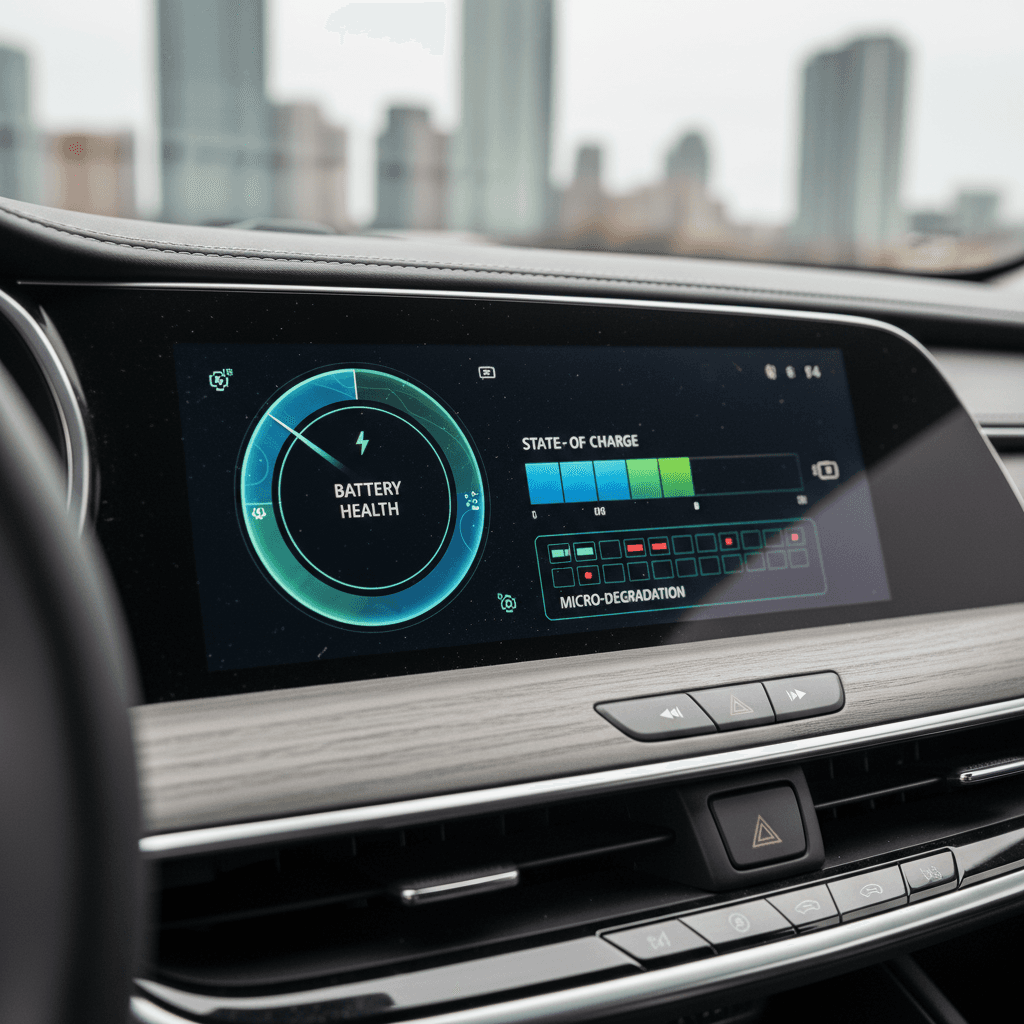
- On the center screen, tap the Vehicle Status or Vehicle Information app icon.
- From the overview screen, look for cards or tiles related to Energy or Battery.
- On some Lyriqs, there’s a section labeled Battery Capacity. This displays the capacity of the high‑voltage battery compared to when it was new, with a “battery capacity at vehicle delivery” value and a current value.
- You may also find efficiency and energy‑usage cards that show consumption over your last trip or last 30 miles, helpful for separating driving style from true battery health.
Naming can vary
How the Lyriq estimates battery state of health
The Lyriq rides on GM’s Ultium platform, and like other modern EVs it constantly monitors the pack through a **battery management system (BMS)**. That BMS is the quiet accountant in the background, tracking electrons in and out and estimating long‑term battery health.
What feeds the Lyriq’s SOH estimate?
You don’t see this math, but it’s happening every time you drive or charge.
Charge & discharge history
Temperature exposure
DC fast vs. AC charging
Crucially, the Lyriq’s SOH number is a **model**, not a lab test. Software updates can refine that model, which is why some owners see their indicated capacity or projected range change after an over‑the‑air update with no real‑world difference in how far the car drives.
Don’t overreact to a single snapshot
What’s normal battery degradation on a Cadillac Lyriq?
The Lyriq uses a large Ultium pack, on the order of 100 kWh usable, so its **per‑mile stress is relatively low** compared with small‑battery city EVs. Early owner data across EVs generally points to single‑digit percent loss over the first few years when the car is treated decently.
Realistic expectations for Lyriq battery health
Every pack ages differently
Habits that hurt or help your Lyriq’s state of health
Habits that quietly damage SOH over time
- Parking at 100% for days – High voltage and heat together are the battery’s enemies.
- Living on DC fast charging – Great for road trips, not as a daily diet.
- Letting it sit near empty – Repeatedly leaving the pack below ~10–15% for long periods isn’t ideal.
- Chronic heat exposure – Hot climate, no shade, no garage; the thermal management can only do so much while parked.
Habits that protect your Lyriq’s SOH
- Daily charge limits – Using the Charging app’s target level (50–80%) for everyday driving.
- Home Level 2 charging – Slower, gentler charging when you’re not in a rush.
- Garaging when possible – Reduces thermal stress in both summer and winter.
- Occasional full cycles – Now and then, letting the car run from low to high SOC helps the BMS recalibrate more accurately.
Set it and forget it
When the numbers look wrong: understanding weird SOH or range readings
Lyriq forums are already full of stories that go like this: a software update lands, the displayed range changes, someone panics, and then… nothing dramatic happens in real life. The car still does the same commute with the same buffer. That tension, between what the screen says and what the car does, is where you need to be a little analytical.
Four common reasons SOH or range readings look “off”
Not every scary number is real degradation.
Cold weather
Recent driving style
Software recalculation
Genuine fault
When to stop guessing and call for service
Buying a used Cadillac Lyriq? Battery SOH checklist
On a used Lyriq, state of health is the single most important hidden variable. The cabin tech, the light show, the chrome, those are distractions. The battery pack is the car. Here’s how to interrogate it politely before you sign anything.
Used Lyriq battery health checklist
1. Capture the in‑car battery capacity reading
Sit in the vehicle, open the Vehicle Status/Information app, and photograph the <strong>Battery Capacity</strong> screen. That’s your starting SOH reference.
2. Compare mileage to SOH
A low‑mileage Lyriq with unusually low battery capacity (for example, below the high‑80s) deserves extra questions. Heavy DC fast‑charging or extreme climates can accelerate wear.
3. Cross‑check with a real‑world drive
On a test drive, note miles driven and battery % consumed. If the car burns, say, 20% to go 25 miles on mixed roads in mild weather, that’s a clue the practical range is below spec, even if the SOH number looks fine.
4. Ask about charging habits
How did the previous owner charge, mostly home Level 2, or public DC fast chargers? Did they leave it at 100% often? Their habits are part of the SOH story.
5. Check for past service visits and campaigns
Ask for service records, especially if there were battery‑related warnings, charging failures, or software reprogramming. Confirm any battery‑related campaigns or fixes have been applied.
6. Verify warranty status and coverage
Look up the in‑service date and mileage to see how much battery warranty remains. On a borderline SOH car, remaining coverage can be the difference between “interesting deal” and “run away.”
How Recharged changes the equation
Warranty, software fixes, and what protects you
EVs live and die by software. The Lyriq is no exception. Early owners have seen everything from 12‑volt battery drain after over‑the‑air updates to high‑voltage system warnings that were ultimately fixed with reprogramming. That’s the messy adolescence of a brand‑new EV platform. The good news: you’re not defenseless.
Key protections for a Cadillac Lyriq’s battery & electronics
Exact terms can vary by model year and market; always confirm for the specific VIN you’re considering.
| Protection | What it typically covers | Why it matters when SOH drops |
|---|---|---|
| High‑voltage battery warranty | Defects in materials or workmanship, often with a minimum capacity guarantee over a set time/mileage. | If your SOH falls below the warranty threshold while you’re still covered, you may qualify for repair or pack replacement. |
| Power electronics & drive unit | Inverter, onboard charger, and related components. | Some “battery” problems are actually power‑electronics issues that affect charging or range; warranty can address those too. |
| Software campaigns & updates | Targeted fixes for known issues like charging behavior or dashboard errors. | A software campaign can change how SOH is calculated or displayed, resolving confusing readings without hardware changes. |
| Customer satisfaction programs | Specific, often time‑limited fixes (e.g., 12‑volt battery drain issues). | These programs quietly solve early‑production problems that could otherwise look like poor battery health. |
Use this table as a conversation starter with a seller or service advisor, not as a substitute for reading the warranty booklet.
Always read the fine print
How Recharged evaluates Cadillac Lyriq battery health
A Lyriq’s state of health deserves more than a casual glance at one dashboard screen. At Recharged, we treat the battery like an independent asset and score it that way. That’s the heart of the **Recharged Score Report** you get with every vehicle.
Inside a Recharged Lyriq battery assessment
What we look at before any Lyriq hits our marketplace.
Vehicle‑reported SOH & history
Performance vs. peers
Transparent pricing & financing
If you’re trading in or selling your own Lyriq, that same rigor works in your favor. A healthy pack documented by a Recharged Score can justify stronger pricing, while a borderline pack is priced realistically instead of being discovered later in a painful negotiation.
Cadillac Lyriq state of health: FAQ
Frequently asked questions about Cadillac Lyriq battery SOH
Key takeaways on Cadillac Lyriq state of health
The Cadillac Lyriq’s state of health story is, in many ways, the story of every modern EV: a big, sophisticated battery pack managed by evolving software, quietly aging in the background while you commute, road‑trip, and occasionally worry. The upside is that Cadillac gives you unusually clear visibility into that aging through its in‑car battery capacity display.
If you treat the pack well, reasonable charge limits, home Level 2 charging, avoiding chronic heat and 100% parking, your Lyriq should deliver years of strong range with only modest, gradual SOH loss. And if you’re shopping used, don’t be shy about asking for screenshots, service records, and a proper battery evaluation. With tools like the Recharged Score Report, financing and trade‑in options, and EV‑specialist support, you can make the Cadillac Lyriq’s state of health a known quantity, not a roll of the dice.