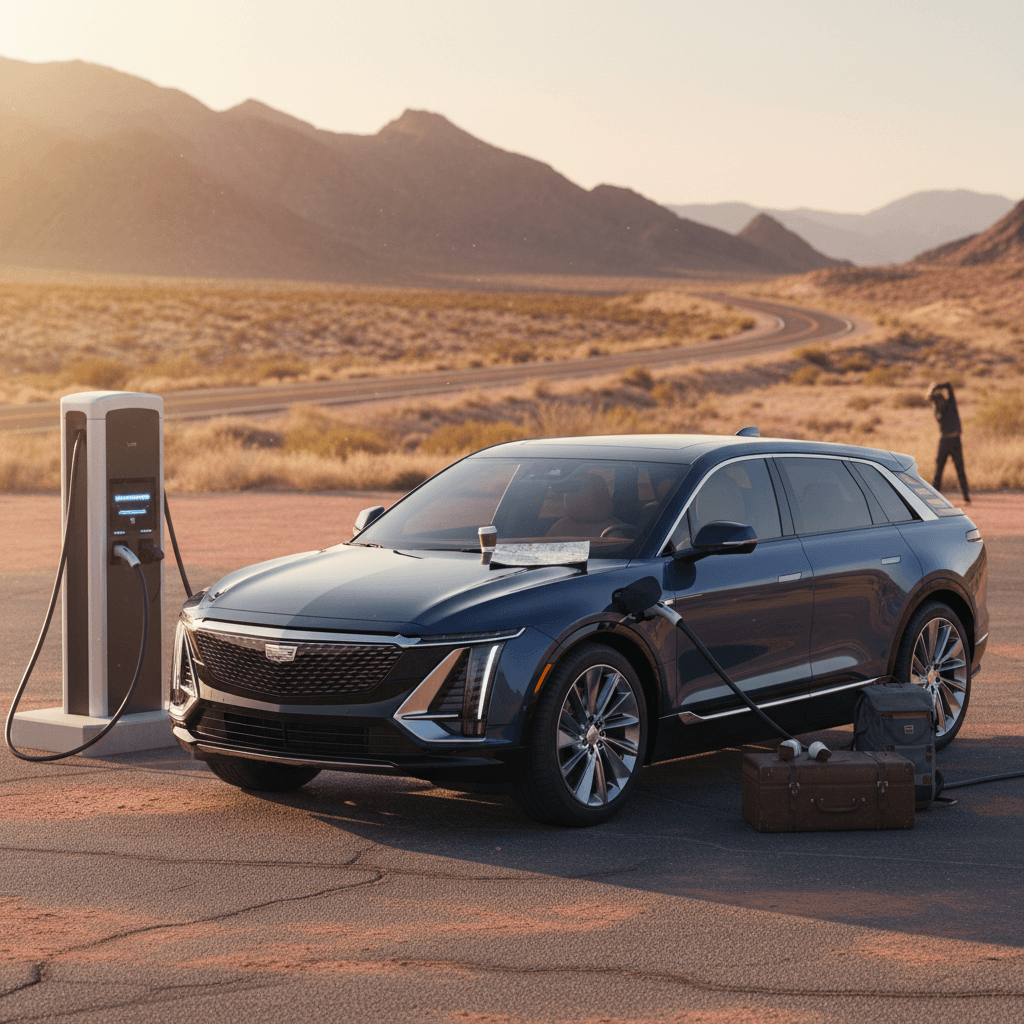
The Cadillac Lyriq looks like it was born for the interstate: long wheelbase, silent power, and a battery the size of a small hydroelectric project. But how does it actually behave when you stop doomscrolling spec sheets and take it on a real Cadillac Lyriq road trip? That’s where the romance of LED light shows collides with the realities of charging curves, rest‑stop food, and the American highway system.
The short version
Cadillac Lyriq on a Road Trip: Big Promise, Big Battery
Every Lyriq sold in the U.S. rides on GM’s Ultium platform with a 102 kWh battery pack and EPA range that, depending on trim and wheels, runs roughly 307–326 miles for 2025–2026 models. Rear‑wheel‑drive “Luxury” trims sit at the top of that range, while dual‑motor AWD and the high‑performance Lyriq‑V give up a few miles in the name of thrust.
Cadillac Lyriq Road Trip Numbers at a Glance
On paper, that’s an easy two‑to‑three hours of interstate driving between meaningful charging stops. On the road, the Lyriq delivers most of what the spec sheet promises, so long as you understand two truths of EV road‑tripping: highway range is always lower than the optimistic city‑heavy EPA cycle, and public fast‑charging is only as good as the station you roll up to.
Real-World Cadillac Lyriq Range on the Highway
What you can realistically expect at 70–75 mph
Cadillac quotes up to 326 miles EPA for a rear‑drive Lyriq with the right wheel and equipment combination, with AWD trims in the low 300s and the Lyriq‑V around the high‑200s. In independent highway range tests and owner reports, you’re usually looking at about 280–310 miles at 70 mph for the efficiency‑oriented trims in good weather, a bit less for the V‑Series or 22‑inch wheel setups.
- Tour or Normal drive modes and smaller wheels (19–20 inches) deliver the best range.
- Expect roughly 2.8–3.2 mi/kWh on a calm‑weather highway run in an RWD Lyriq.
- AWD and Lyriq‑V trims typically land closer to 2.4–2.7 mi/kWh at similar speeds.
- Headwinds, rain, low temperatures, and high speeds will all eat noticeably into your buffer.
Cold‑weather reality check
Tour vs Sport vs Lyriq‑V on the open road
Drive modes in the Lyriq aren’t just decoration on the big 33‑inch screen. Tour softens throttle mapping and leans into regeneration, while Sport and the Lyriq‑V’s Velocity Max and competitive modes unlock more power and burn through electrons faster. If you care about making the next charger with a cushion, Tour is your ally; if you want to annihilate on‑ramps, Sport and the V will happily turn range into acceleration.
Charging the Cadillac Lyriq on a Road Trip
DC fast‑charging: how fast is “fast enough”?
All Lyriq trims support up to 190 kW DC fast‑charging when the conditions are right. In practice, that means a healthy, pre‑conditioned battery arriving near 10–20% state of charge at a 150–350 kW station. Under those circumstances, you’re looking at roughly 10–80% in about 35–40 minutes, adding on the order of 200+ miles of real‑world highway range in the middle of the pack.
- Peak rates around 180–190 kW are achievable at low state of charge on high‑power stations.
- The Lyriq tends to hold 140–170 kW for a useful chunk of the session before tapering.
- Above ~70–80% state of charge, the curve falls off, making it inefficient to charge to 100% unless you absolutely need it.
- Newer 2026‑spec Lyriq models add native NACS capability, giving you access to Tesla Superchargers with the right hardware. Earlier CCS‑only cars rely on a NACS adapter.
Road‑trip charging sweet spot
Public charging networks vs Tesla Superchargers
Early Lyriqs were CCS‑only, meaning you lived on Electrify America, EVgo, and independent networks for DC fast‑charging. For 2026, Cadillac pivots to NACS hardware, and GM has cut deals that open significant parts of the Tesla Supercharger network to its EVs. That’s a major win for road‑trippers in the U.S., where Superchargers are still the gold standard for station density and reliability.
CCS Lyriq (2023–2025)
- Relies on third‑party networks like Electrify America and EVgo.
- More planning required in rural areas; coverage varies by region.
- You’ll likely want a home Level 2 setup to minimize public charging.
NACS‑equipped Lyriq (2026+)
- Can use select Tesla Superchargers along with CCS sites (via adapters where supported).
- Much easier routing on cross‑country corridors.
- For used‑car buyers, NACS support is a meaningful upgrade for road‑trips.
Don’t trust the map blindly

How to Plan a Cadillac Lyriq Road Trip
Planning a Cadillac Lyriq road trip isn’t fundamentally harder than planning one in a gas truck; it just moves the decisions upstream. Instead of asking, “Where’s the next exit?” you’re asking, “Where do I want to stop 2–3 hours from now, and what’s the charging situation there?” The Lyriq’s navigation and route‑planning tools help, but you’ll still want to sanity‑check them with third‑party apps.
Tools that make Lyriq trip planning easier
Use more than one source, think of it as redundancy, not paranoia.
In‑car navigation
Cadillac’s built‑in nav can surface compatible DC fast‑chargers along your route and estimate arrival state of charge. Use it as a baseline, but don’t treat it as gospel.
Third‑party apps
Apps like PlugShare, Chargeway, and A Better Routeplanner let you filter by connector type, power level, and reliability. They’re invaluable for CCS‑only Lyriqs.
Old‑fashioned buffer
Build in a 15–20% state‑of‑charge buffer between critical stops. If a station misbehaves, you have enough energy to limp to Plan B without drama.
Where Recharged fits in
Ready to find your next EV?
Browse VehiclesComfort, Quiet, and Tech on Long Drives
Once you’re actually rolling, the Lyriq does its best work. The Ultium platform’s low center of gravity and long wheelbase give it a relaxed, settled gait that feels more grand tourer than SUV. It’s not a canyon carver in its base trims, but on an interstate at 75 mph it glides, the cabin insulated from the vulgarities of wind and tire roar.
- The ride skews supple rather than sharp, especially on smaller wheels; big 22‑inch rims look magnificent but transmit more impact into the cabin.
- Steering is light and a bit aloof, but that’s almost a virtue on long, dead‑straight runs across the Plains.
- The 33‑inch curved display is bright and legible, with enough real estate to keep nav, media, and energy info in your peripheral vision.
- Available 23‑speaker audio and ambient lighting make the cabin feel like a rolling listening room rather than a travel appliance.
One‑pedal driving on the highway?
Lyriq-V vs Regular Lyriq for Road Trips
Cadillac’s Lyriq‑V is the spicy one: around 615 hp, massive torque, bigger brakes, firmer suspension, and a 0–60 time that makes old V‑Series sedans look like they’re towing boats. It’s also heavier on energy use and gives up some range to the calmer AWD trims.
Lyriq vs Lyriq‑V: Road‑Trip Tradeoffs
Approximate figures based on published specs and early tests.
| Model | Drivetrain | EPA Range (approx.) | Character on a Road Trip |
|---|---|---|---|
| Lyriq RWD Luxury | Single‑motor RWD | ~326 mi | Most efficient, softest ride, ideal for long‑range cruising. |
| Lyriq AWD Luxury/Sport | Dual‑motor AWD | ~307–319 mi | More traction and punch with only a modest range penalty. |
| Lyriq‑V | Dual‑motor AWD | ~285–303 mi | Brutally quick, firmer ride, noticeably hungrier at the plug. |
If your road‑trip is about carving up time zones, the standard Lyriq is the better companion. If it’s about carving up on‑ramps, the V will gladly oblige.
Performance vs patience
Is a Used Cadillac Lyriq a Good Road-Trip EV?
The used market is where the Lyriq gets interesting. Early build‑quality issues have largely been sorted with software updates and service campaigns, and depreciation has started to do its slow, beautiful work. For the right buyer, a used Lyriq can be an outstanding long‑distance EV, provided you know what you’re getting and how the battery has been treated.
Why a used Lyriq makes sense
- You can access a large battery and luxury cabin for less than new‑car money.
- Most first owners did the bulk of their charging at home, which is kind to battery health.
- Range and charging specs are still competitive with fresh‑off‑the‑lot rivals.
What to watch for
- CCS‑only early cars mean more charging‑network juggling than NACS‑equipped 2026 models.
- Heavy DC fast‑charging use can accelerate battery wear if the previous owner treated every drive like a Cannonball Run.
- Onboard charger options (11.5 kW vs 19.2 kW) affect how quickly you can recover overnight at a rental, cabin, or home.
How Recharged helps with used Lyriqs
Cadillac Lyriq Road Trip Checklist
Pre‑Trip Prep for a Smooth Lyriq Road‑Trip
1. Verify your real‑world range
Set your Lyriq to Tour or Normal mode, drive a full battery cycle locally, and note your average mi/kWh at typical speeds. Use that, not the brochure, when you’re planning gaps between chargers.
2. Map primary and backup chargers
Use the in‑car nav plus a third‑party app to pick DC fast‑chargers every 120–180 miles, with at least one backup station within 20–30 miles of each stop.
3. Check connector and adapter situation
Confirm whether your Lyriq is CCS or NACS, and make sure you have any required adapters and app accounts set up before you leave the driveway.
4. Update software and charging apps
Install the latest vehicle software, verify your payment methods in charging apps, and log in before you’re at a windswept station at midnight with no signal.
5. Dial in your comfort settings
Save a driver profile with your preferred seat, wheel, climate, and regen settings so you can slip into highway mode with one tap, every bit of reduced fatigue helps.
6. Pack charging extras
Bring your portable Level 2 or Level 1 cable, a heavy‑duty extension cord rated for EV use if needed, and a small kit with wipes and gloves for grimy connectors.
Cadillac Lyriq Road Trip FAQ
Frequently Asked Questions About Lyriq Road Trips
Final Thoughts: Who the Lyriq Road Trip Is For
If your idea of a perfect long drive is a quiet cabin, a big battery, and a sense that the car is taking some of the world’s sharp edges off before they reach you, the Cadillac Lyriq is an outstanding road‑trip companion. It won’t win every spec‑sheet duel on charging speed, but in the real world of 2–3 hour stints and 30‑minute stops, it fits a very human rhythm of travel.
For buyers considering a used Lyriq, the equation gets even better: luxury‑SUV comfort, still‑modern charging performance, and pricing that’s softer than a brand‑new sticker. Just make sure you know what you’re getting. At Recharged, every Lyriq comes with a Recharged Score battery‑health report, fair‑market pricing data, and EV‑specialist support so your first big trip is something you remember for the route, not the roadside surprises.