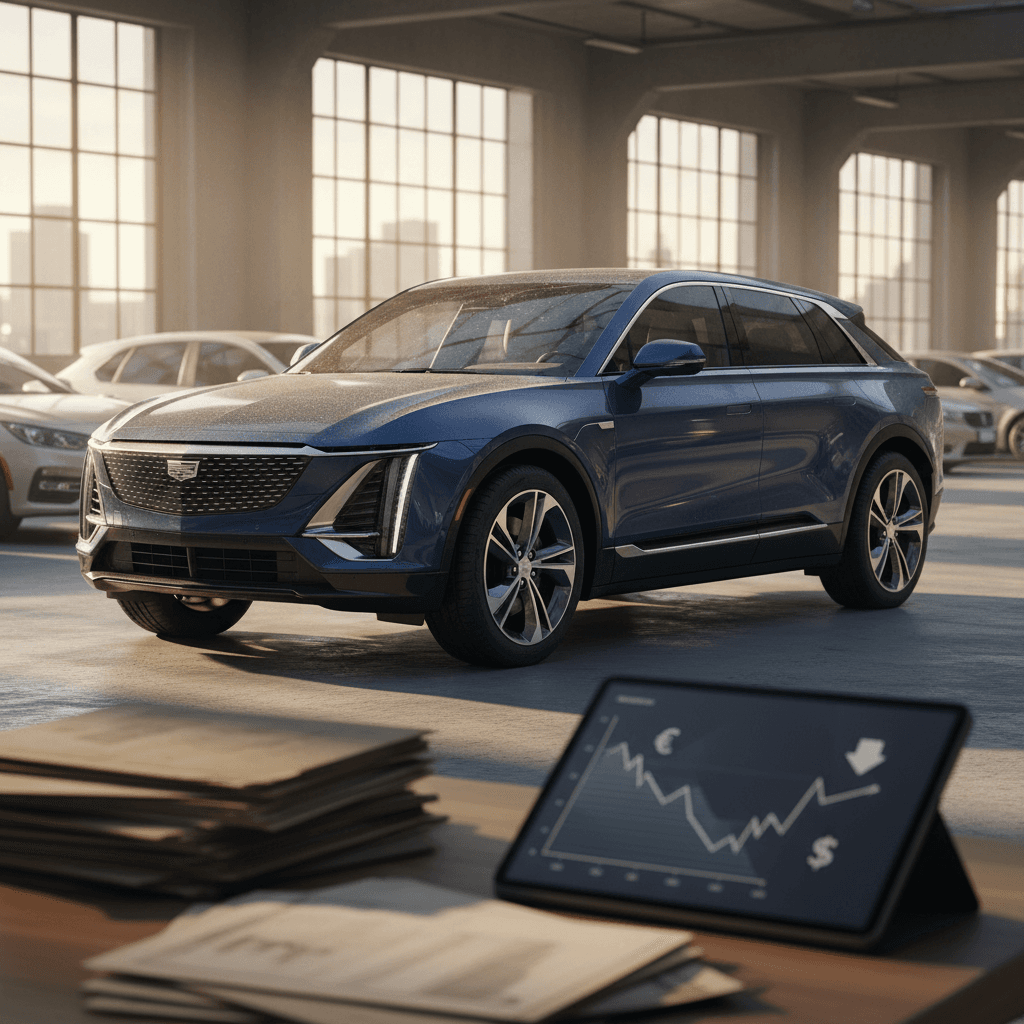
If you’re considering a Cadillac Lyriq, you’re not just buying a luxury electric SUV, you’re making a five‑figure bet on how well a first‑wave GM EV will hold its value in a rapidly moving market. Understanding the Cadillac Lyriq resale value forecast can help you decide whether to buy new, shop used, or wait for the dust to settle.
Why resale value matters more with EVs
Cadillac Lyriq resale value at a glance
Early Cadillac Lyriq resale snapshot (U.S.)
Because the Lyriq only launched for 2023 and volumes really ramped in 2024, hard resale data is still thin. But we can triangulate from early used listings, depreciation modeling tools, and how similar luxury EVs have behaved to sketch a realistic 5‑year outlook.
How the Lyriq is positioned in the EV market
The Lyriq is Cadillac’s first volume battery‑electric model, a midsize luxury SUV built on GM’s Ultium platform. After a slow start in 2022, U.S. deliveries scaled to more than 28,000 units in 2024, making it the brand’s breakout EV and one of the best‑selling luxury midsize electric SUVs in the country.
That matters for resale. Resale value typically improves when a model is no longer a niche science project but a mainstream product with nationwide service support, parts availability, and reasonable awareness among used buyers. The Lyriq has crossed that threshold, but it’s still competing in a crowded segment against Tesla Model Y, Mercedes EQE SUV, BMW iX, Acura ZDX, Audi Q6 e‑tron and others.
Production & policy volatility
5‑year depreciation forecast for the Cadillac Lyriq
Let’s start with what the market is already modeling. Automotive pricing tools that have begun publishing 5‑year depreciation curves for the 2025 Lyriq suggest a total 5‑year depreciation on the order of $50,000–$55,000 on a well‑equipped example. That implies a resale value of roughly 45–50% of original MSRP at year five, in line with many luxury EVs and slightly weaker than the strongest‑holding Teslas.
Illustrative 5‑year forecast: 2025 Cadillac Lyriq (well‑equipped trim)
Approximate retained value trajectory assuming typical mileage, good condition, and stable incentives. Numbers are illustrative ranges, not guarantees.
| Year in service | Estimated value | Approx. depreciation from prior year | Approx. % of original MSRP |
|---|---|---|---|
| Year 1 (2026) | $50,000–$52,000 | -$20,000 to -$22,000 | ~70–75% |
| Year 2 (2027) | $42,000–$45,000 | -$6,000 to -$8,000 | ~60–65% |
| Year 3 (2028) | $35,000–$38,000 | -$6,000 to -$7,000 | ~50–55% |
| Year 4 (2029) | $29,000–$32,000 | -$5,000 to -$7,000 | ~42–48% |
| Year 5 (2030) | $22,000–$26,000 | -$5,000 to -$7,000 | ~35–40% |
Actual resale value will depend heavily on battery health, mileage, feature changes, and EV tax policy.
A note on the numbers
- Steep first‑year drop: Like most luxury vehicles, Lyriq buyers absorb an outsized hit in the first 12–18 months as initial demand cools and incentives shift.
- Then a more gradual slide: Years 2–5 typically see $5,000–$8,000 of depreciation per year, depending on miles and macro conditions.
- Residual percentage is competitive: For a first‑generation EV from a legacy brand, a 5‑year residual in the high‑30s to ~40% range is competitive, especially if battery health remains strong.
Key factors that will shape Lyriq resale values
Four big levers on Lyriq resale
Some you can control, some you can’t, but all of them matter.
Incentives & tax credits
Federal and state EV incentives move the goalposts for new‑car pricing. When new Lyriqs qualify for big credits, used prices often soften; when credits expire or get harder to claim, late‑model used examples can look more attractive.
Competitive landscape
New rivals like Acura ZDX, Audi Q6 e‑tron, BMW iX and updated Tesla Model Y trims will keep pressure on used Lyriq pricing, especially if they offer longer range, faster charging, or lower transaction prices.
Battery longevity
Real‑world performance of GM’s Ultium battery packs will be a make‑or‑break factor. Stable range and low degradation support strong resale; widespread pack issues would do the opposite.
Software & feature creep
Over‑the‑air updates that add value (range, performance, features) help older Lyriqs feel less dated. But new model years with major hardware changes can also make early builds look old fast.
Market forces you can’t control
- Shifts in federal and state EV incentives
- Cadillac’s pricing and discounting strategy on new Lyriqs
- Arrival of new competitors with better specs or lower prices
- Overall EV demand swings driven by interest rates and fuel prices
Owner decisions you can control
- Maintaining low to moderate annual mileage
- Keeping up with software updates and service bulletins
- Protecting the battery (charging habits, climate, storage)
- Documenting all service and recall work for future buyers
Battery health: why it matters more than badges
On paper, the Lyriq’s large Ultium pack and competitive EPA range numbers are a plus for resale. In practice, what used buyers will pay for is verifiable battery health, not just a luxury badge or original window sticker.
Why independent battery reports help
Every vehicle sold on Recharged includes a Recharged Score Report, which uses battery health diagnostics plus pricing and history data to show how a specific EV compares to similar vehicles. For a model like the Lyriq, which is still proving itself long‑term, that kind of transparency is especially valuable, whether you’re buying or selling.
How the Lyriq compares to rival luxury EV SUVs
In resale terms, you can think of the Lyriq sitting between the rock‑solid brand power of Tesla and the more experimental early EVs from traditional luxury brands.
Resale positioning: Lyriq vs key luxury EV SUVs (big picture)
High‑level view of where the Lyriq is likely to land on depreciation relative to major rivals, based on brand strength, EV track record, and current pricing behavior.
| Model | Brand EV track record | Likely 5‑yr depreciation tier | Comments |
|---|---|---|---|
| Tesla Model Y | Mature EV leader | Stronger than Lyriq | Huge installed base, strong demand, but recent price cuts have pressured used values. |
| Cadillac Lyriq | Emerging Ultium lineup | Middle of the pack | Attractive product, improving volumes, but still proving long‑term battery/tech story. |
| Acura ZDX | New entrant | Similar to Lyriq | Leveraging Honda reliability perception but unknown long‑term EV performance. |
| Audi Q6 e‑tron / BMW iX | Premium German | Similar or slightly weaker | Strong brands, but high MSRPs and rapid tech change can mean heavy dollar depreciation. |
| Older compliance EVs | First‑gen experiments | Weaker | Short range and orphaned tech have punished resale. Lyriq is unlikely to fall this far if Ultium holds up. |
These are directional tiers, not precise rankings. Individual vehicles can buck the trend based on options, mileage, and history.
Where the Lyriq has an edge
Real‑world used Lyriq pricing: early signals
Because Lyriq production ramped meaningfully only in 2023–2024, most examples in the wild today are still under warranty with relatively low mileage. That means the used market is thin but informative:
- Lightly used 2023–2024 Lyriqs often list at a 15–25% discount to comparable new inventory when similarly equipped, with bigger gaps on heavily optioned trims.
- Higher‑mileage early builds (e.g., demo units, fleet vehicles) show steeper discounts, sometimes 30%+ off original MSRP, especially if they have cosmetic issues or incomplete software updates.
- Auction data points to strong but not overheated demand: dealers are bidding aggressively for clean used Lyriqs in desirable colors and trims, but they’re disciplined about price ceilings because they know new‑car incentives can change quickly.
Watch the incentive calendar
How to protect your Lyriq’s resale value
Owner playbook: 7 ways to defend your Lyriq’s value
1. Keep software and recalls fully up to date
Stay on top of over‑the‑air updates and any service campaigns. A Lyriq with current software and documented recall work is easier to sell and appraise.
2. Treat the battery kindly
Avoid frequent DC fast‑charging from very low state of charge, and don’t store the vehicle at 100% for long periods. Moderate charging habits support long‑term pack health.
3. Mind your mileage
High mileage matters more with EVs that don’t yet have a decades‑long durability track record. If you commute long distances, expect steeper depreciation and plan ownership duration accordingly.
4. Protect the interior tech
Infotainment screens, buttons, and switches are high‑touch items buyers notice first. Use screen protectors if needed and fix minor issues before they become negotiation leverage.
5. Keep thorough records
Retain digital and paper records of all services, tire replacements, software bulletins, and charging hardware. A well‑documented EV signals lower risk to the next owner.
6. Time your sale strategically
If possible, avoid selling right after a big price cut or new incentive announcement on fresh inventory. Conversely, a gap between allocation batches or incentive phases can slightly favor your used value.
7. Get a third‑party battery health report
Before you list or trade your Lyriq, invest in an independent battery diagnostic. On Recharged, this is built into the Recharged Score, giving buyers data they can trust.
Use multiple exit options
Shopping for a used Cadillac Lyriq: what to look for
If you’re coming at this from the other side, as a used buyer, the Lyriq’s early depreciation can actually work in your favor. You can often find a well‑equipped, low‑mileage example for the price of a new, lower‑trim EV from a mainstream brand. The key is separating strong candidates from risky ones.
Used Lyriq buyer’s checklist: key decision areas
These are the things that most influence value *and* your ownership experience.
Battery & charging
- Battery health report or diagnostics (ideally from a third party).
- Charging history if available (heavy DC use or mostly home Level 2).
- Inclusion of home charging equipment and adapters.
History & condition
- Accident and title history with a clean report.
- Service records and completed recalls.
- Signs of water damage or neglected cosmetic issues.
Tech & features
- Software version and feature set vs newer model years.
- Functional driver‑assist systems and cameras.
- Any paid OTA upgrades (performance, features) included in the sale.
On Recharged, every used EV, including the Lyriq, comes with a Recharged Score Report that rolls battery metrics, vehicle history, pricing data, and inspection results into one transparent view. That makes it easier to compare a 2023 Lyriq with 30,000 miles to, say, a 2024 with 10,000 miles and decide which is the better long‑term value, without guessing.
Is the Cadillac Lyriq a good long‑term bet?
From a pure resale‑value perspective, the Lyriq is shaping up to be a solid but not bulletproof long‑term bet. It’s unlikely to match the very best‑holding EVs on the market, but it also doesn’t look destined to fall into the bargain‑bin territory of first‑generation compliance cars.
Who the Lyriq fits well
- Drivers who prioritize comfort, design, and quiet over maximum performance.
- Buyers who plan to keep the vehicle 5–8 years and value the total ownership experience more than squeezing every last dollar of residual value.
- Shoppers who appreciate transparent battery health data and are willing to shop carefully in the used market.
Who might look elsewhere
- Buyers obsessed with resale above all else, especially those who flip vehicles every 2–3 years.
- Shoppers in markets with limited Cadillac EV service presence, where support and perception could lag.
- Drivers who want the largest, most liquid used‑EV market, where Tesla still has a clear advantage.
If you’re comfortable with a measured level of technology and policy risk, and you value the Lyriq’s driving experience and cabin as much as its spreadsheet performance, it can be a smart long‑term choice. The key is to buy (or sell) with eyes wide open, anchored in real battery data and current market conditions, not just MSRP and hope.