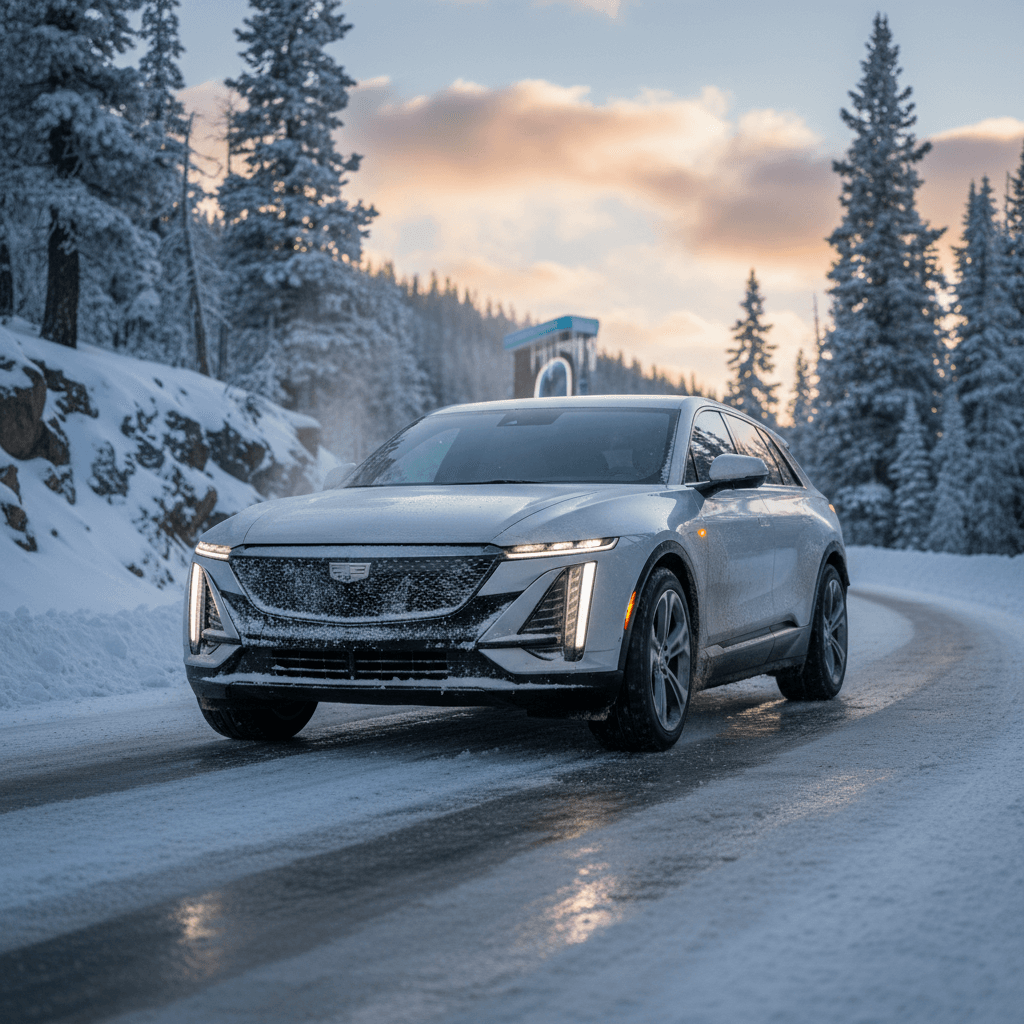
If you’re eyeing a Cadillac Lyriq and you live where roads turn white and greasy for months at a time, the obvious question is whether the Cadillac Lyriq is actually **good in snow and ice**, and which configuration is best. The short answer: a Lyriq can be a confident winter EV if you choose the right drivetrain, tires, and settings, but some setups are much better than others.
Key takeaway
Cadillac Lyriq in snow and ice: big-picture overview
- Curb weight around 5,600–5,900 lb and a low center of gravity help traction and stability in snow.
- Available Dual Motor eAWD gives much better pull away from slick intersections than RWD.
- Ground clearance of ~7 inches is fine for plowed roads, marginal for deep unplowed powder.
- Standard all-season tires are the limiting factor in real winter; winter tires transform the car.
- Cold weather cuts real-world range substantially versus the EPA ratings, just like other EVs.
On paper, the Lyriq has a lot going for it in winter. It rides on GM’s Ultium platform with a large battery pack low in the chassis, giving it a very **stable, planted feel**. The curb weight is over 5,600 pounds, which actually *helps* on packed snow by pressing those tires into the surface. And with an available **Dual Motor all-wheel drive system** making over 500 hp, there’s no shortage of controlled traction when conditions are ugly.
Where things get more nuanced is ground clearance, tires, and range. Roughly **7 inches of clearance** is typical for a luxury crossover, but it’s not a snow-plow. If your reality is unplowed backroads and rutted frozen slush, you’ll still want to slow down and avoid deep drifts. And like every EV, the Lyriq’s **range drops in cold weather**, especially at highway speeds and if you’re relying heavily on cabin heat. We’ll unpack each of these in the sections ahead.
AWD vs RWD Lyriq: which is best for winter?
How Lyriq drivetrains behave in snow and ice
Both can work in winter, but they’re not equal.
Single Motor RWD Lyriq
Best for: Mild climates, mostly plowed roads, occasional light snow.
- Rear-wheel drive only; traction control keeps things tidy but you can still overwhelm the rear tires on ice.
- Drives nicely in cold, dry conditions; feels balanced and refined.
- On proper winter tires, it can handle typical city and suburban snow days, but you’ll still need to respect hills and deep slush.
Dual Motor AWD Lyriq
Best for: Snowbelt states, mountain passes, frequent storms.
- Dual motors with electric all-wheel drive actively shift torque front–rear.
- Pulls away from slick intersections with far less drama, especially in Snow/Ice mode.
- Much better climbing and descending snowy grades, again assuming appropriate winter tires.
Which drivetrain should you pick?
From a traction standpoint, **AWD does two big things** for the Lyriq in winter. First, having power at both axles helps the car pull itself straight when one end starts to slip. Second, the software can meter torque with far more nuance than a traditional mechanical AWD system, subtly trimming wheelspin that you might never feel through the seat of your pants. RWD Lyriqs rely more on stability control and the rear tires’ grip, manageable on good snow rubber, but distinctly less capable on steep or icy terrain.
Winter strengths and weak points
Cadillac Lyriq: winter pros and cons at a glance
Where the Lyriq shines in winter
- Predictable handling: The Ultium battery keeps mass low, so the Lyriq feels composed rather than top‑heavy on slick corners.
- Fine-grained traction control: Electric motors can respond in milliseconds, smoothing out wheelspin that would have you sawing at the wheel in an older ICE SUV.
- Instant cabin heat: Electric heaters and heated seats/wheel warm the cabin quickly, which is a genuine quality‑of‑life upgrade on bitter mornings.
Where you need to be realistic
- Range hit in the cold: Combine highway speeds, sub‑freezing temps, and headwinds, and you can see range drops large enough to require an extra fast‑charge stop.
- Snow build-up: With moderate ground clearance and a long wheelbase, deep ruts, ice ridges, and frozen slush can scrape the underbody.
- Weight cuts both ways: That mass helps traction but also increases stopping distances; you must leave more space in traffic.
Don’t let weight fool you
Best tires and wheel setups for snow and ice
If there’s one decision that truly determines whether your Lyriq is **good or marginal in snow and ice**, it’s not AWD vs RWD, it’s **tires**. Cadillac offers 20‑inch and 22‑inch wheels; many owners report that downsizing to 20s or dedicated winter wheels with narrower tires significantly improves winter grip and comfort.

Common Lyriq tire strategies for winter
How different wheel and tire setups affect winter performance.
| Setup | Pros in winter | Cons / tradeoffs | Best for |
|---|---|---|---|
| Stock all-season tires (20" or 22") | Convenient; no seasonal swap; acceptable in light snow when roads are quickly plowed. | Limited grip on ice and packed snow; stopping distances remain long; easy to overwhelm on hills. | Mild winter climates, mostly rain, occasional dustings. |
| Dedicated winter tires on 20" wheels | Massive jump in traction and braking; narrower footprint cuts through slush; more comfortable ride. | Upfront cost of second wheel/tire set; slightly softer feel in dry conditions; needs seasonal storage. | Snowbelt commuters, frequent storms, mountain travel. |
| All-weather (3PMSF) tires on 20" wheels | Better winter performance than basic all‑seasons; can be run year‑round in many regions. | Still not as strong on ice as true winters; may wear faster in hot climates. | Mixed climates where you see several winter storms but don’t want a full second set. |
| 22" performance tires | Great dry‑road feel and looks; more direct steering. | Least suited to real winter; wide tread tends to float on snow; more prone to curb rash in ruts. | Style-first buyers in mostly dry or warm regions. |
When in doubt, prioritize rubber compound and tread pattern over wheel size or appearance.
Practical recommendation
How to use Snow/Ice mode and other settings
Every Lyriq comes with a dedicated **Snow/Ice drive mode** accessible through the Drive Mode app on the central screen. When you select it, the car softens accelerator response and changes how the electric all‑wheel drive system and steering behave to prioritize traction on slippery surfaces. In practice, that means smoother take‑offs and fewer sudden torque spikes that could break the tires loose.
Dialing in your Lyriq for slick roads
1. Engage Snow/Ice mode before you need it
If the road is already slick or you’re about to head into snow, select <strong>Snow/Ice</strong> in the Drive Mode app. Don’t wait until you’re already spinning; use it proactively.
2. Consider toning down one-pedal driving
Strong regenerative braking can unsettle the car on polished ice. On the slickest days, reduce regen or temporarily disable full one‑pedal driving so you can modulate braking more gently with the pedal.
3. Use Hill Descent Control sparingly
On steep, icy descents, let the car help you maintain low speeds with controlled braking. But still keep plenty of space and be prepared to override with very gentle manual braking.
4. Avoid sudden steering and throttle inputs
Even with Snow/Ice mode active, the laws of physics haven’t changed. Feed in steering and acceleration progressively; let the electronics clean up small mistakes, not big ones.
5. Precondition the cabin and battery
Use the app or scheduled departure to warm the battery and cabin while plugged in. This improves early‑drive efficiency and ensures you have full power for traction and heating.
Don’t rely on Snow/Ice mode alone
Cold-weather range: what Lyriq owners actually see
On paper, the Lyriq’s 102‑ish kWh battery delivers EPA ranges over 300 miles in several trims. In real winter use, especially **below freezing and at highway speeds**, owners commonly report **30–40% less range** than the sticker when you factor in cabin heat, battery conditioning, and thicker winter air. That’s not unique to Cadillac, it’s an EV reality, but it matters for trip planning.
Typical winter range scenarios
- Short city commutes (under 20 miles each way): Range isn’t usually the constraint; preconditioning and seat heaters keep things comfortable without big penalties.
- Suburban mix at 30–50 mph: Expect a noticeable hit but still manageable; many drivers see 20–30% lower range compared with mild weather.
- Interstate at 65–75 mph in the teens or 20s °F: This is where you can see 30–40% reductions, enough to compress a 300‑mile rated EV into something more like 180–210 usable miles between charges.
How to protect winter range
- Precondition while plugged in: Warm the cabin and battery before departure so the pack doesn’t have to do all the work on the road.
- Use seat and wheel heaters first: They sip power compared with cranking the HVAC fan and temperature to maximum.
- Plan extra charging margin: On road trips, target arriving at fast‑chargers with 10–20% buffer rather than running to near‑zero.
- Watch speed: Dropping from 75 mph to 65 mph in winter can meaningfully stretch range, especially into a headwind.
Range expectations vs gas SUVs
Winter setup checklist for Cadillac Lyriq owners
Prepping your Lyriq for snow and ice season
Confirm your drivetrain
If you’re car‑shopping, decide honestly whether RWD is enough. In true snowbelt regions, eAWD is strongly recommended. If you already own a RWD Lyriq, commit to high‑quality winter tires.
Choose the right tires
Budget now for either full winter tires on 20‑inch wheels or at minimum a quality all‑weather tire with the three‑peak mountain snowflake (3PMSF) symbol if you won’t run a separate set.
Protect your wheels and underbody
Consider wheels with a more robust finish for winter and periodically rinse road salt from the underbody. This won’t change traction, but it does protect your investment.
Set up your charging for winter
If you haven’t already, install or arrange access to a reliable Level 2 charger. Being able to leave with a warm, full battery makes winter ownership dramatically easier.
Learn and test your drive modes
Before the first storm, experiment with Tour, Snow/Ice, and your regen settings in an empty lot or quiet side street so their behavior isn’t a surprise when roads get slick.
Build a winter kit for the cargo area
Pack essentials: a snow brush and scraper, gloves, a small shovel, traction aids or sand, charging adapters/cables, and a warm blanket just in case.
Should you buy a Lyriq if you live with serious winter?
If your mental picture of winter is **occasional snow days and mostly wet pavement**, any Lyriq with good tires will likely feel solid, quiet, and confidence‑inspiring. The low center of gravity and gentle power delivery in Snow/Ice mode make it calmer than many tall, softly sprung gas SUVs.
If you’re in **true snow country**, think lake‑effect belts, Rockies passes, rural New England, your calculus changes. In that context, the **"best" Cadillac Lyriq for snow and ice** looks like this:
- Dual Motor AWD Lyriq (any trim) for maximum controlled traction.
- 20‑inch wheels with quality winter tires, not 22‑inch performance rubber.
- Regular use of Snow/Ice mode and reduced regen on days with polished ice or packed snow.
- A home Level 2 charger so you can start with a warm, full battery every cold morning.
- Realistic expectations about winter range and stopping distances.
Bottom line for winter shoppers
Finding a used Cadillac Lyriq that’s optimized for winter
If you’re shopping the used market, you can absolutely target a Cadillac Lyriq that’s already set up for cold climates. This is where buying from a specialist matters: you want more than just a pretty spec sheet, you want real insight into battery health, previous climate, and how the car was used.
How Recharged can help winter-focused Lyriq shoppers
Used EVs, especially in cold climates, reward extra transparency.
Verified battery health
Climate-aware vehicle history
Ownership support from day one
Ready to find your next EV?
Browse VehiclesIf a winter‑ready Cadillac Lyriq is on your radar, consider working with a retailer that lives and breathes EVs rather than treating them as an afterthought. With verified battery health, the right drivetrain and tire setup, and smart winter habits, a Lyriq can be more than just survivable in snow and ice, it can be a genuinely relaxing way to get through the season.