If you’re driving, or thinking about buying, a Cadillac Lyriq, it’s natural to worry about Cadillac Lyriq battery degradation per year. The Lyriq is still a relatively new Ultium‑based EV, so you won’t find 10‑year case studies yet, but we do have GM’s warranty promises, Ultium chemistry data, and early owner reports that paint a clearer picture than you might expect.
Quick takeaway
Why Cadillac Lyriq battery degradation per year matters
Battery degradation is simply the slow, irreversible loss of usable capacity in your Lyriq’s high‑voltage pack. As the battery ages, the car has less energy to work with, so range gradually shrinks even if you drive the same routes at the same speeds.
- It affects how far you can go on a charge, especially on road trips.
- It influences resale value when you sell or trade the Lyriq.
- It determines how long the car remains practical for your daily driving needs.
- It’s one of the biggest unknowns when you’re evaluating a used Cadillac Lyriq.
The good news is that modern EV packs like GM’s Ultium system in the Lyriq are engineered to retain most of their capacity for many years. Your job as an owner, or shopper, is to understand what “normal” looks like, how to avoid the big mistakes, and how to verify battery health on any used Lyriq you’re considering.
What we actually know about Ultium battery degradation
The Lyriq uses GM’s Ultium battery platform with nickel‑manganese‑cobalt‑aluminum (NCMA) chemistry. That last letter, aluminum, is part of GM’s push to reduce cobalt and improve longevity. While GM hasn’t published a year‑by‑year degradation chart for Lyriq, we can pull together three important pieces of information:
Ultium battery building blocks that shape degradation
These design choices are why Lyriq packs should age relatively gracefully.
NCMA cell chemistry
Wireless battery management
Conservative buffers
Important context
Cadillac Lyriq battery degradation per year: realistic estimates
Because real‑world use varies so much, no one can promise a precise number like “2.3% per year.” But we can talk about typical ranges that line up with GM’s warranty promises and early owner experience on Ultium vehicles.
Typical Cadillac Lyriq battery capacity over time (normal use)
Put simply, if you drive your Lyriq in a typical way, charging mostly to 70–80%, not constantly fast‑charging from empty, and avoiding sustained extreme heat, you should expect single‑digit total loss in the first 5 years and something like 10–15% by year eight. That works out to roughly 1–2% per year on average, with a slightly bigger hit in the first couple of years and a slower decline after.
How that translates to range
Warranty: how much capacity GM effectively promises
Cadillac advertises an 8‑year/100,000‑mile high‑voltage battery warranty on the Lyriq in the U.S. That coverage exists for two reasons: to protect you from outright defects and to put a floor under long‑term usable capacity.
Cadillac Lyriq battery warranty at a glance
Key high‑voltage coverage terms that indirectly define acceptable degradation.
| Item | Coverage | What it means for you |
|---|---|---|
| Battery warranty term | 8 years / 100,000 miles | If the Ultium pack fails or falls below Cadillac’s capacity standard within this window, it’s typically covered. |
| Capacity expectation | Around 70–75% usable | GM guidance for Ultium EVs indicates capacity is considered acceptable unless it drops significantly below this band. |
| What’s covered | Defects & abnormal loss | Sudden, abnormal degradation or module failures are handled as warranty issues. |
| What’s not covered | Normal wear | Gradual, small reductions in range over many years are expected and not considered a defect. |
Exact coverage details can vary slightly by model year and region; always confirm with current Cadillac documentation.
Cadillac doesn’t advertise an exact number on the window sticker, but looking across Ultium‑based models and GM guidance, the pattern is clear: GM expects these packs to stay well north of 70% capacity for at least 8 years or 100,000 miles under normal use. That’s the backdrop for any "per‑year" degradation discussion.
Real‑world Cadillac Lyriq owner experience so far
Because Lyriq deliveries began in earnest in 2023, the best real‑world data we have so far comes from early owners, dealer service feedback, and independent used‑EV analysts who track capacity estimates on vehicles in the 10,000–40,000‑mile range.
Early‑mileage capacity looks strong
- Many 2023–2024 Lyriqs with 20,000–30,000 miles still report over 95% of original capacity based on energy‑use logs and range estimates.
- Owners who mostly charge to 70–80% at home and reserve DC fast charging for trips tend to see very modest range loss.
Outliers tend to be use‑case driven
- A small number of drivers who frequently fast‑charge from low state of charge, or who leave the car at 100% in heat, report faster‑than‑average loss.
- Some perceived “degradation” is actually software estimation quirks or seasonal range swings rather than permanent battery loss.
Don’t confuse weather with degradation
6 factors that speed up or slow down Lyriq degradation
Every lithium‑ion pack ages, but how you use and charge your Lyriq has a huge impact on the per‑year degradation you see. Think of it like tire wear: aggressive use shortens life, gentle use stretches it out.
Key drivers of Cadillac Lyriq battery degradation per year
1. Time spent at very high state of charge
Regularly charging to 100% and letting the Lyriq sit full, especially in the heat, is one of the fastest ways to accelerate degradation. Using a 70–80% daily limit is far easier on the pack.
2. Deep discharges to near 0%
Running down to very low state of charge before charging, over and over, also stresses the chemistry. Occasionally is fine; making it a habit isn’t.
3. Frequent DC fast charging
Ultium is designed to handle fast charging, but repeated high‑power sessions from low SoC to high SoC add more wear than slower Level 2 charging at home.
4. High ambient and battery temperatures
Very hot climates and hard use in the heat can increase cell wear. The Lyriq’s liquid cooling helps, but parking in shade and avoiding unnecessary heat soak still helps.
5. High annual mileage
More miles equals more charge cycles. A Lyriq driven 25,000 miles per year will age faster than one driven 7,000 miles, all else equal.
6. Storage habits
If the car sits for weeks, storing it around 40–60% state of charge is healthier than at 100% or near empty.
How to limit Lyriq range loss over time
You can’t stop chemistry, but you can absolutely nudge it in your favor. The following habits won’t turn your Lyriq into an immortal EV, but they can trim your per‑year degradation to the low end of the normal range.
- Set a daily charge limit of 70–80% for normal driving, and only charge to 100% when you actually need full range for a trip.
- Whenever possible, charge on Level 2 at home or work instead of relying on DC fast charging for routine top‑ups.
- Avoid letting the car sit for days at very high or very low state of charge; aim to park around 40–70% if it’ll be unused for a while.
- In hot weather, use a garage or shaded parking, and pre‑condition the cabin while plugged in so the battery cooling system isn’t working off the pack alone.
- Keep software up to date; refinements to battery management, cooling, and range estimation can improve both longevity and displayed accuracy.
- Drive smoothly when you can, hard acceleration and high sustained speeds don’t just burn energy, they often mean higher battery temperatures.
Why this matters most if you buy used
Shopping used: how to check Cadillac Lyriq battery health
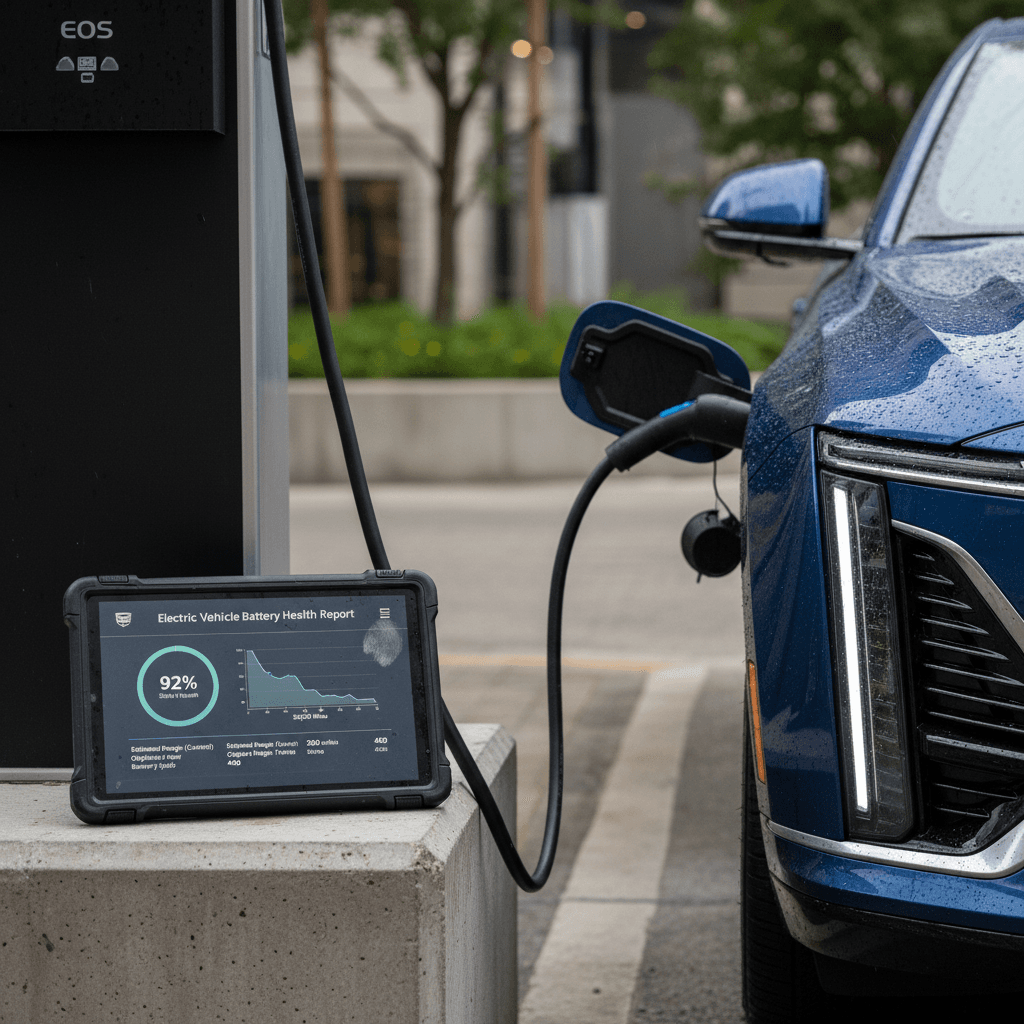
When you’re evaluating a used Cadillac Lyriq, you’re not just buying leather and screens, you’re buying a six‑figure piece of battery hardware. Two Lyriqs with the same model year and mileage can have very different pack health depending on how they were charged and driven.
Practical ways to assess Lyriq battery degradation per year
Combine these checks for a more complete picture.
1. Check in‑car range estimates
2. Review energy use history
3. Get a third‑party battery report
How Recharged helps with Lyriq battery questions
Battery degradation vs. depreciation: what really costs you money
Many shoppers fixate on “percentage of degradation per year,” but from a financial standpoint, what usually hurts most is vehicle depreciation, how quickly the Lyriq’s market value declines, rather than a handful of lost miles of range.
Degradation: gradual and predictable
- Most Lyriqs will lose a few percent of capacity over the first several years.
- As long as the car still easily covers your daily needs, this rarely changes your life dramatically.
- The battery warranty provides a safety net against abnormal or excessive loss early in life.
Depreciation: sharp early drop
- Like most luxury vehicles, the Lyriq takes its largest value hit in the first 3–4 years.
- Buying used often means someone else already absorbed that steep early drop.
- A used Lyriq with a healthy pack can be a tremendous value compared to buying new.
Red flags that should worry you
FAQ: Cadillac Lyriq battery degradation questions answered
Common questions about Cadillac Lyriq battery degradation per year
Bottom line: what to expect from a Lyriq battery
When you strip away the anxiety and rumors, the picture for Cadillac Lyriq battery degradation per year is reassuring. With normal charging habits and use, you’re likely to see only modest, predictable capacity loss, on the order of a few percent over the first several years and roughly 10–15% by the end of the 8‑year/100,000‑mile warranty period. For most owners, that still leaves plenty of real‑world range for commuting, errands, and even road trips.
If you’re already a Lyriq owner, the best thing you can do is set sensible charge limits, avoid unnecessary extremes, and let the car’s thermal management do its job. If you’re shopping used, focus on verified battery health just as much as features and color. At Recharged, every used EV, including any Cadillac Lyriq on our platform, comes with a Recharged Score battery report, fair‑market pricing analysis, and EV‑specialist support, so you can make a confident decision backed by data instead of guesswork.