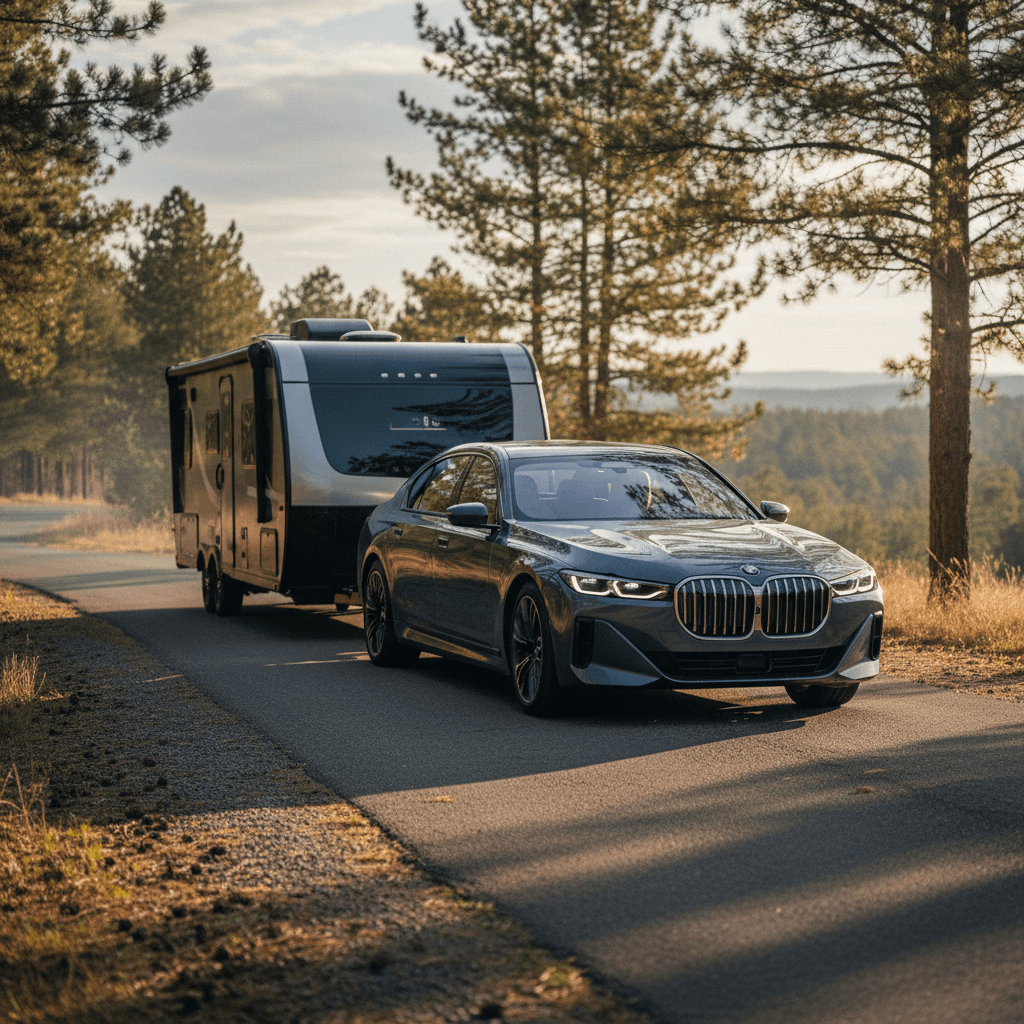
If you’re shopping for a BMW i7 or already own one, you’ve probably wondered about **BMW i7 towing capacity and range loss**. The big electric 7 Series looks like a natural road‑trip and trailer hauler, but the fine print around hitches, weight limits, and real‑world range is easy to miss.
Key takeaway up front
BMW i7 towing overview: the short version
- BMW does **not** currently advertise a factory tow rating for the U.S.‑spec i7, and there’s no OEM hitch option on the U.S. configurator as of early 2026.
- In some European markets, technical documents for the G70 7 Series platform list **towbar download limits** (tongue weight) and modest braked trailer ratings, but details vary by market and drivetrain.
- From an engineering standpoint, the i7’s battery, dual‑motor setup, and air suspension can handle light towing, but you’ll need to be conservative and understand that range drops sharply under load.
- If towing is a frequent, non‑negotiable part of your life, boat, 25‑foot camper, enclosed car trailer, you’re usually better off with something like a BMW iX, X5/X7 plug‑in hybrid, or a traditional SUV or truck.
Warranty and legal caution
Can the BMW i7 actually tow a trailer?
The honest answer is: **it depends where you live, and what you mean by “tow.”**
What BMW officially supports
- As of the 2024–2026 model years, the **U.S. BMW i7** is not sold with a factory tow package or tow rating.
- Owner’s documentation for some markets lists a permissible **towbar download (tongue weight)** and allows light braked trailers, typically in the neighborhood of a modest utility trailer or small camper.
- BMW’s gas and plug‑in hybrid 7 Series siblings in Europe often have a braked trailer rating, but that doesn’t automatically carry over to the i7 in every market.
What owners are actually doing
- In regions where an official tow rating exists, some owners use the i7 to tow **small cargo trailers, bike racks with e‑bikes, and lightweight campers**.
- In markets like the U.S., a handful of owners and aftermarket shops have discussed fitting **stealth hitches** or custom receivers for bike racks and very light duty towing, but these are off‑label solutions.
- Because the i7 is a long, heavy luxury sedan, it excels more at **carrying people and luggage** than serious towing duty.
Light towing vs. heavy towing
BMW i7 towing capacity by trim and market
Because BMW rarely advertises tow ratings for the i7 outright, you’re mostly dealing with **technical data sheets and regional regulations** rather than a big “7,000‑lb tow rating” headline. Here’s how to think about capacity in practical terms.
How to interpret BMW i7 towing capacity
High‑level guidance for common BMW i7 configurations. Always confirm against your local owner’s manual before towing.
| Region / spec | Typical hitch situation | Suggested use case | Weight range to stay within |
|---|---|---|---|
| U.S. i7 eDrive50 / xDrive60 / M70 | No factory hitch or tow rating | Bike rack or cargo carrier only (no towing recommended) | Use tongue‑weight limits for rack; avoid trailers |
| EU / UK i7 with listed towbar download | Dealer‑installed or aftermarket towbar possible, modest braked trailer rating in some docs | Small braked trailer or compact camper | Roughly 750–1,500 kg (1,650–3,300 lb) in markets that allow it |
| Other markets (Canada, Asia, etc.) | Very market‑specific, often mirrors U.S. in practice | Occasional light utility trailer where permitted | Confirm with local BMW dealer and registration rules |
These are conservative planning numbers, not official BMW ratings for your specific VIN.
Don’t copy someone else’s rating
How towing affects BMW i7 range
Even when towing is allowed, the big question is range. The i7’s EPA‑rated range spans roughly **274–321 miles** depending on trim and wheel choice, with many 2024–2025 cars landing in the high‑200s to low‑300s in mixed driving. In Recharged’s own testing and road‑trip reviews, a **xDrive60 on 21‑inch wheels can manage ~300+ miles at 70 mph** when not towing, roughly in line with or slightly above its official rating.
BMW i7 baseline range (no trailer, mild weather)
Once you hook up a trailer, three things gang up on your battery:
- **Aerodynamic drag**: A tall camper or boxy cargo trailer is like driving into a wall of air. At 65–75 mph, aero drag is the **single biggest range killer**.
- **Weight and rolling resistance**: Extra mass makes acceleration and hill climbs more energy‑hungry, and extra tires rolling on the pavement add friction.
- **Accessory and climate loads**: Using climate control harder (to keep a full cabin comfortable) plus any 12‑volt draw from trailer brakes or lights nibble at your remaining range.
EV towing vs. gas towing
Real‑world range loss estimates for the i7
Every trailer and route is different, but we can use conservative, real‑world patterns from other large EVs plus early owner experiences to sketch out **reasonable expectations** for BMW i7 towing capacity and range loss.
Typical BMW i7 range loss when towing
Assumes mild weather, mostly highway driving, and a driver who isn’t hypermiling.
Light, low trailer
Example: Small utility trailer, low sides, ~1,000–1,500 lb total.
- Expected range loss: ~30–40%
- 300‑mile i7 becomes roughly 175–210 miles.
- Best case if you keep speeds closer to 60 mph.
Mid‑size camper
Example: Compact camping trailer or taller cargo box around 2,000–3,000 lb.
- Expected range loss: ~40–50%
- 300‑mile i7 becomes about 150–180 miles.
- Higher frontal area matters more than raw weight here.
Tall, boxy load
Example: Enclosed trailer, tall toy hauler, or overloaded cargo trailer (not recommended).
- Expected range loss: 50%+
- 300‑mile i7 can drop toward 120–150 miles between charges.
- At that point, an SUV or truck is usually the better tool.
Speed is your superpower
Sample BMW i7 range loss with a trailer
Approximate planning numbers for a 2024–2025 BMW i7 with ~300 miles of baseline range in good conditions.
| Scenario | Baseline range (no trailer) | Estimated range while towing | Approximate loss |
|---|---|---|---|
| eDrive50, small utility trailer, 60 mph | 310 miles | 190–210 miles | ~30–40% |
| xDrive60, mid‑size camper, 65 mph | 300 miles | 150–180 miles | ~40–50% |
| M70 xDrive, tall cargo trailer, 70+ mph | 285 miles | 120–150 miles | 50% or more |
These are ballpark estimates to help route planning, not guaranteed outcomes.
Planning charging stops when towing with an i7
Once you accept that towing cuts your range, the next step is **planning your day around more frequent, slightly longer fast‑charge stops.** The good news: the i7’s DC fast‑charging speeds are competitive, and its ride comfort makes those breaks more pleasant than they sound.
Route‑planning checklist for BMW i7 towing
1. Use a realistic range budget
Take your usual highway range and assume a **40–50% hit** with a typical camper or boxy trailer. If you usually expect 280 miles, plan your towing legs around **130–160 miles** instead.
2. Target 10–80% SOC swings
The i7 charges fastest between ~10% and 60–70% state of charge (SOC). When towing, aim to **arrive near 10–20% and stop around 70–80%**, rather than topping off to 100% each time.
3. Prioritize higher‑power chargers
Look for DC fast chargers in the **150–350 kW** class along your route. Even though the i7 won’t pull the absolute maximum from a 350‑kW unit all the time, these sites often have better reliability and more stalls.
4. Think about trailer maneuvering
Some charging plazas are tight if you’re pulling a trailer. Scout locations in your app’s satellite view and favor sites with **pull‑through access** or enough room to safely back in and out.
5. Leave weather margin
Cold temperatures, strong headwinds, and heavy rain can hit your range on top of the towing penalty. Add at least **10–15% buffer** in winter or on exposed, windy routes.
6. Precondition before fast charging
Use the i7’s navigation to a DC fast charger so it can **precondition the battery**. That keeps charge speeds high, which matters more when you’re stopping more often with a trailer.
Comfort counts on tow days
Towing hardware: hitches, wiring, and brakes
If your market and owner’s manual allow towing with the BMW i7, you still need to solve for **hardware**: the hitch, electrical connection, and trailer brakes. This is where doing it right really matters.
Key towing hardware decisions for a BMW i7
If you can tow in your market, treat the install like a safety system, not an afterthought.
Hitch type & installation
- Prefer a **BMW‑approved hitch or towbar kit** in markets where one exists.
- If you must go aftermarket, choose a shop with documented **EV experience** so they don’t damage the high‑voltage battery or wiring.
- A **removable or stealth hitch** can preserve the i7’s clean looks when you’re not towing.
Wiring, lights, and brakes
- Use wiring harnesses that properly integrate with the car’s **CAN‑bus and lighting systems**.
- For heavier trailers, you’ll likely need **electric brakes** controlled by a brake controller that plays nicely with the i7’s regenerative braking.
- Always test lights and brake function in a safe area before hitting the highway.
Mind the rear axle and tongue weight
Is towing with a BMW i7 right for you?
When an i7 can make sense for towing
- You live in a market where **BMW explicitly allows towing** with the i7 and your VIN is rated for it.
- Your trailer is **small and relatively low‑profile**, think small camper, motorcycle trailer, or light cargo trailer.
- You only tow **occasionally**, and most of your miles are still normal commuting or long‑distance road trips without a trailer.
- You prioritize **quiet, comfort, and tech** over maximum tow capacity.
When you probably want something else
- You’re in the U.S. or another region where the i7 has **no tow rating** and no factory hitch support.
- You own a **large travel trailer, boat, or multi‑axle enclosed trailer** where loaded weight pushes well past 3,500 lb.
- You tow **frequently**, weekend race events, long RV trips, or commercial work.
- You’d rather not live with the **planning overhead** that comes with EV towing and frequent DC fast charging.
Consider a two‑vehicle strategy
Extra towing considerations for used BMW i7 shoppers
If you’re looking at a **used BMW i7** and towing is on your radar, even if only for a couple of trips per year, it’s worth digging into the car’s history and hardware before you sign anything.
Used BMW i7 towing & range checklist
1. Check for hitch history
Look under the rear bumper for evidence of a removed **aftermarket hitch**, extra holes, scuffed undertrays, or non‑OEM wiring. Heavy past towing isn’t necessarily a deal‑breaker, but it should factor into your negotiations.
2. Review the owner’s manual for your VIN
Confirm what your specific i7, in your market, is **officially approved** to do. The manual will spell out whether towing is permitted, tongue‑weight limits, and any special instructions.
3. Evaluate real‑world range
On a test drive, pay attention to **indicated consumption** and projected range at highway speeds. Recharged’s own range tests show that healthy i7 packs generally match or beat EPA estimates when driven sensibly.
4. Get a battery health report
Towing puts sustained loads on the battery, especially on hills and in heat. A **Recharged Score battery health report** can help you see how the pack has aged and whether it’s still delivering the range you’ll need, trailer or not.
5. Inspect tires and brakes
Frequent towing wears **rear tires and brakes** faster. Uneven tire wear or prematurely replaced rotors and pads can hint at harder use.
6. Budget for accessories
If towing is allowed for your car, plan for proper **tow mirrors, brake controller, and quality hitch hardware**. Skimping here can cost you far more in the long run.
How Recharged can help
Ready to find your next EV?
Browse Vehicles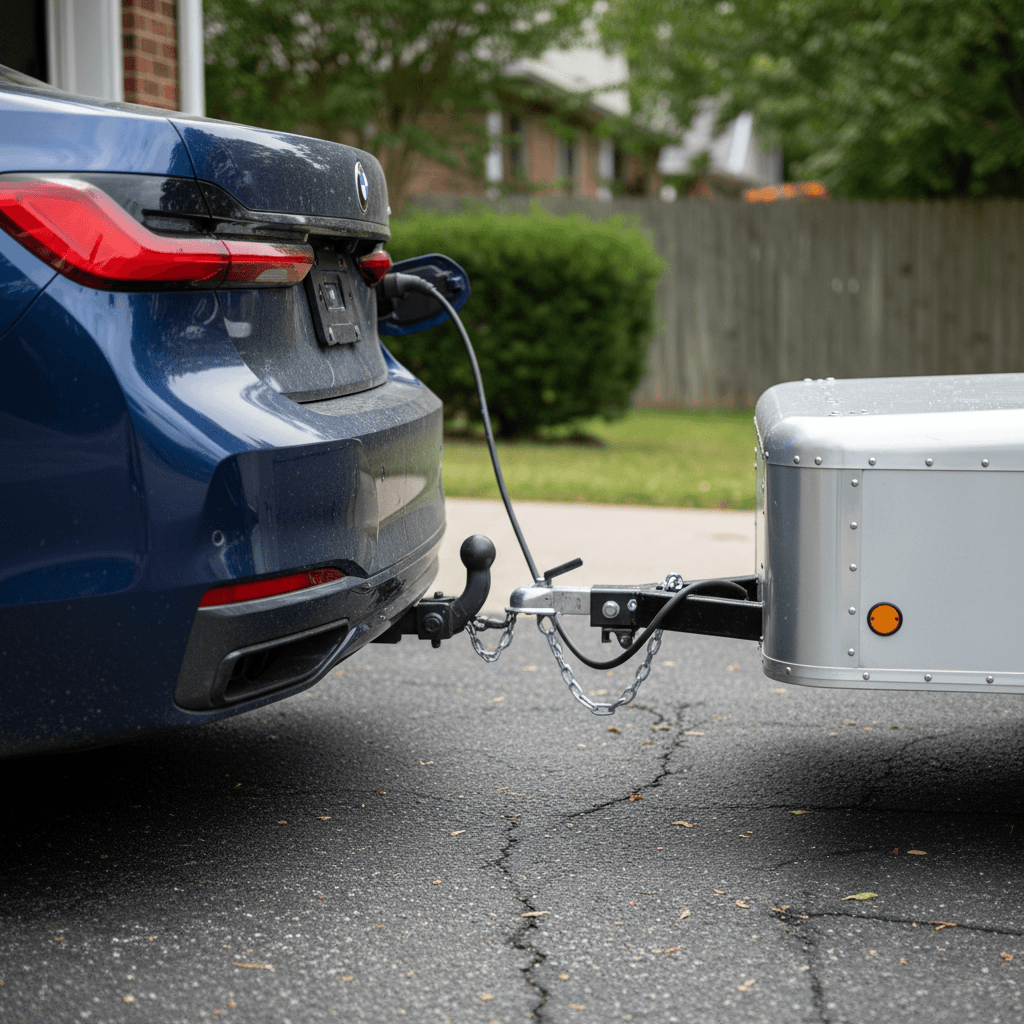
BMW i7 towing & range loss: FAQ
Frequently asked questions about BMW i7 towing capacity and range loss
The bottom line on **BMW i7 towing capacity and range loss** is that this flagship EV is built first and foremost as a long‑legged luxury sedan, not a work truck. In the right markets and with the right hardware, it can comfortably handle light trailers, but you’ll need to respect conservative weight limits and plan for a substantial hit to range. If you’re trying to decide whether an i7 fits your lifestyle, or you want help comparing it with other used EVs that might tow more confidently, Recharged’s EV‑specialist team can walk you through the trade‑offs, battery health, and ownership costs before you ever step into a showroom.