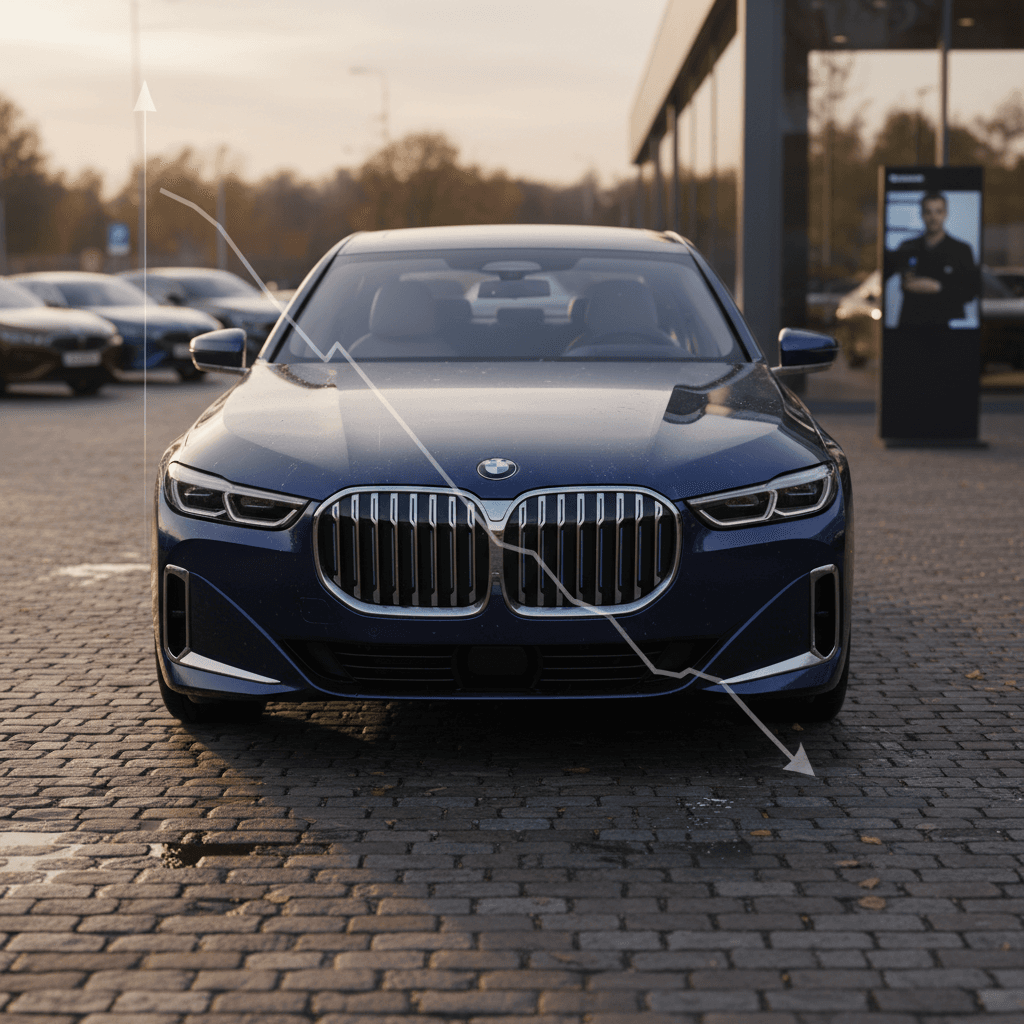
If you’re considering a BMW i7, you’ve probably heard the horror stories: steep prices when new, then a jaw‑dropping drop in value just a few years later. Understanding the BMW i7 depreciation curve over 5 years is the key to deciding whether you should buy new, shop used, or wait for the perfect moment on the curve.
Quick snapshot
BMW i7 depreciation basics in 2026
The BMW i7 launched in the U.S. for the 2023 model year as an all‑electric flagship sedan, with MSRPs commonly in the $110,000–$150,000+ range once options and destination fees are included. New 2024 and 2025 i7 models still sticker well into six figures, with trims like the eDrive50 and xDrive60 starting around $105,000–$125,000 before options and fees.
Because those MSRPs are so high and incentives have been strong, especially on leases, the used market is already seeing deep discounts on nearly-new i7s. In early 2026, lightly used 2023 and 2024 cars with low miles are routinely listing tens of thousands below their original window stickers. For value‑focused shoppers, that’s exactly why the depreciation curve matters.
BMW i7 depreciation snapshot (early data)
How fast does the BMW i7 depreciate? (years 1–5)
Exact depreciation varies by trim, options, mileage, condition, and local demand, but multiple data sources and asking prices point to a consistent story: the i7 behaves like many big luxury EVs, with an especially steep early drop followed by a slower glide.
- Year 1: Roughly 25–35% below MSRP is common once initial rebates, heavy discounts, and 12 months of age are priced in.
- Year 2: Total depreciation of about 45–55% vs original MSRP is realistic for a typical 2‑year‑old i7 with average miles.
- Year 3: Many analyses show the i7 around 60–65% down from original MSRP, meaning you’re often buying at 35–40% of sticker.
- Years 4–5: The curve flattens. Expect maybe another 5–10 percentage points of loss over two more years, assuming no major accidents or battery issues.
Depreciation ≠ bad car
BMW i7 5-year depreciation curve at a glance
To make this more concrete, here’s a simplified, ballpark 5‑year depreciation curve for a BMW i7 that originally stickered at $130,000 with options and destination. These are directional ranges, not guaranteed resale offers, but they capture what today’s market is signaling.
Illustrative BMW i7 5-year depreciation curve (original MSRP $130,000)
Approximate value trajectory for a typical BMW i7, assuming normal mileage and no major accidents. Actual values will vary by trim, options, location, and condition.
| Age of vehicle | Approx. value vs original MSRP | Estimated dollar value | Notes |
|---|---|---|---|
| Brand new (MSRP) | 100% | $130,000 | Typical sticker price for a well‑optioned i7 eDrive50/xDrive60/M70 when new |
| 1 year old | 65–75% | $85,000–$97,500 | Heavily discounted demo cars and first‑year lease returns often land here |
| 2 years old | 45–55% | $58,500–$71,500 | Many cars already through first lease cycle; market finds a new price floor |
| 3 years old | 35–40% | $45,500–$52,000 | Early data suggests around 60–65% depreciation by year three for i7s |
| 4 years old | 30–35% | $39,000–$45,500 | Curve starts to flatten; buyers worry more about warranty and battery life than model-year bragging rights |
| 5 years old | 28–32% | $36,500–$41,500 | Residual value stabilizes if the battery is healthy and maintenance is documented |
Use this table as a planning tool, not a precise quote. A Recharged Score Report can help you dial in the real value of a specific car.
A used buyer’s sweet spot
Why the BMW i7 depreciates so quickly
On paper, the i7 is one of BMW’s most advanced vehicles ever. In the used market, though, it gets punished. Here’s why the depreciation curve is so aggressive compared with mass‑market EVs and even some gas 7 Series models.
Main drivers of BMW i7 depreciation
Several structural factors push i7 values down faster than mainstream EVs.
High original MSRP
When a car starts around $105,000 and easily climbs past $140,000 with options, even a “routine” 50–60% loss means tens of thousands of dollars wiped out on paper.
Rapid tech turnover
Luxury EVs update fast: infotainment, driver‑assist, battery chemistry, and charging speeds all move quickly. Three‑year‑old tech can feel “old” to new‑car shoppers, pulling used prices down.
Narrow buyer pool
The audience for a six‑figure electric limousine is small. Used buyers in that budget also cross‑shop S‑Class, Lucid Air, Taycan, and high‑spec SUVs, which keeps i7 prices competitive.
Lease incentives & discounts
Deep discounts and subvented leases on new i7s lower the anchor price in shoppers’ minds, which forces used prices to adjust downward to stay attractive.
The risk if you buy new and sell early
BMW i7 vs other luxury EV depreciation
The i7 isn’t the only luxury EV dropping like a rock, but it is near the front of the pack. Large electric sedans from German and newcomer brands are all discovering the same thing: there’s a big gap between aspirational MSRP and what the second owner will actually pay.
BMW i7 vs gas 7 Series
- Historically, the gas BMW 7 Series has been a heavy depreciator, often losing 60%+ over 5 years.
- The i7 appears to amplify that trend: early data suggests similar or even steeper 3‑ to 5‑year drops than recent gas 7 Series models.
- For value shoppers, that means a used i7 can undercut a comparable S‑Class or 7 Series while offering lower running costs.
BMW i7 vs other luxury EVs
- Mercedes EQS and some early Audi and Jaguar EVs have shown 60–70% depreciation over five years in several analyses.
- Lucid Air and Porsche Taycan appear to hold a bit more value in certain trims, but they still drop far faster than mass‑market EVs.
- Put simply: the i7 fits right into the current wave of steeply depreciating $100k+ EVs, not an outlier.
Good news for used buyers
Best time to buy a used BMW i7 on the curve
You can’t control how BMW sets MSRPs, but you can choose where you jump onto the curve. The timing you pick can easily swing your total 5‑year cost of ownership by tens of thousands of dollars.
Choosing your entry point on the BMW i7 curve
1. Buying nearly new (0–12 months)
This is the most expensive point on the curve. You’re still paying a premium, often even after discounts and tax credits, and you’ll absorb most of the year‑1 drop. Only makes sense if you must have specific options and the latest model year.
2. Early off‑lease (18–30 months)
Lease returns and demos start hitting the market with 10,000–25,000 miles. Here, you might see <strong>45–55% depreciation</strong> already baked in, with plenty of factory warranty left.
3. Deep‑value zone (3–5 years)
For many shoppers, this is the sweet spot. Prices can be around <strong>35–40% of original MSRP</strong>, yet you still get a modern cabin, advanced safety tech, and a long‑range battery.
4. Beyond 5 years
Here, battery health, maintenance history, and out‑of‑warranty repair risks dominate the decision. You may find very low prices, but due diligence and a detailed battery report become non‑negotiable.
A simple rule of thumb
How battery health affects BMW i7 resale value
Unlike a gas 7 Series, a BMW i7’s long‑term value is tightly tied to how its big high‑voltage battery is aging. Two seemingly identical i7s can be worth very different amounts if one has significantly more degradation than the other.
Battery health: the hidden curve under the curve
Why you can’t judge an i7’s value by mileage alone.
State of health (SoH)
SoH compares the pack’s current usable capacity to what it had when new. A 90% SoH pack still delivers most of its original range; an 80% pack may feel like a different car on road trips.
Thermal & fast‑charge history
Repeated DC fast charging and extreme heat can accelerate degradation. A highway road‑warrior i7 that’s lived on fast chargers may age differently than a garage‑kept commuter.
Warranty and peace of mind
BMW’s EV battery warranty (typically 8 years/100k miles for capacity) underpins used‑market confidence. Cars well within warranty generally command stronger prices.
How Recharged uses the Recharged Score
Real-world used BMW i7 pricing examples
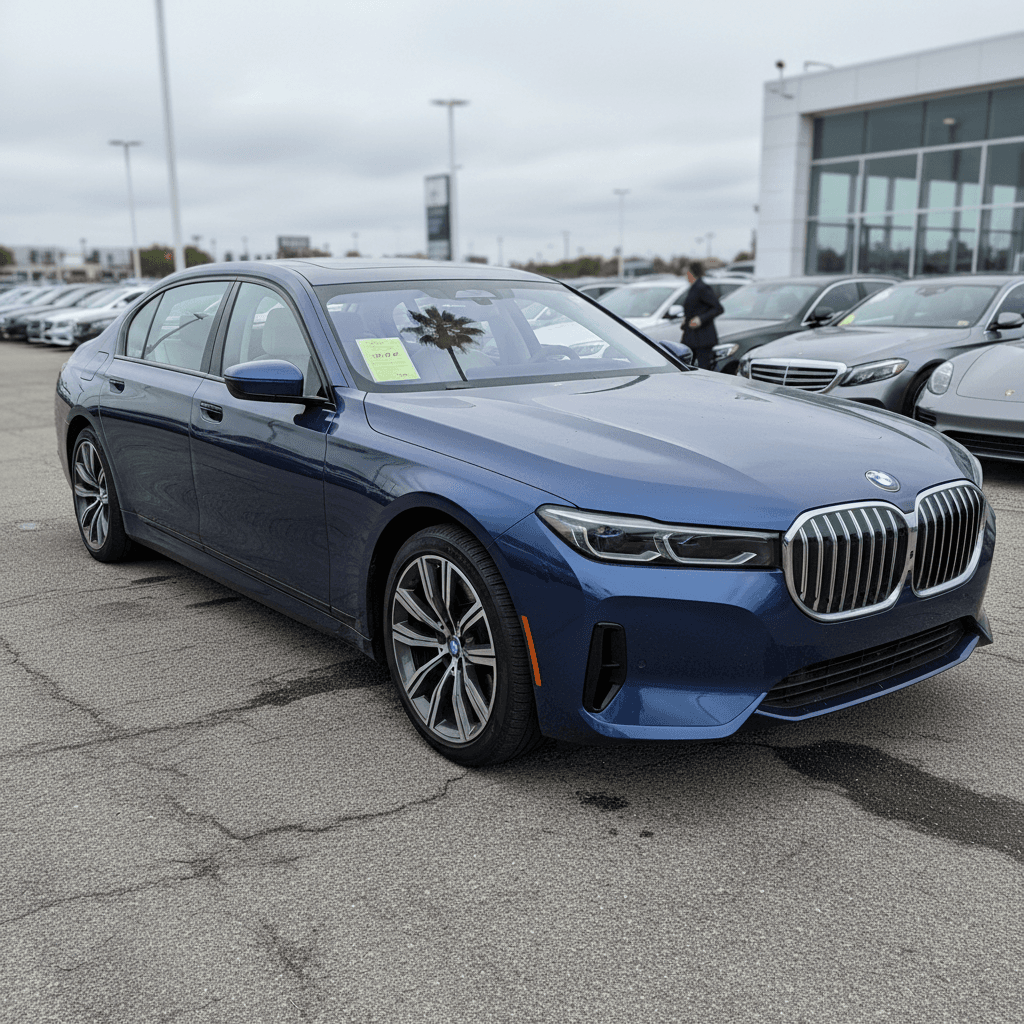
Listing data from major marketplaces in early 2026 shows clear patterns. While exact numbers vary daily, you’ll typically see ranges like these in the U.S. for clean‑title cars with normal mileage:
Typical asking-price ranges for used BMW i7s (early 2026, U.S.)
Directional ranges based on observed listings; tax, fees, and negotiation will change your out‑the‑door price.
| Model year & age | Typical mileage | Observed asking range | Implied depreciation vs $130k MSRP |
|---|---|---|---|
| 2025 (≤ 1 year old) | 5,000–15,000 mi | $95,000–$115,000 | ~12–27% below a $130k build, depending on original spec and discounts |
| 2024 (1–2 years old) | 10,000–25,000 mi | $75,000–$95,000 | ~27–42% below $130k; some heavily optioned cars dip further |
| 2023 (2–3 years old) | 20,000–40,000 mi | $55,000–$75,000 | ~42–58% below $130k; many cars in the heart of the curve |
| Older imports/demo oddballs | Varies | Occasionally lower | Structural outliers, investigate history and battery health carefully |
Always verify current pricing in your local market, and use tools like the Recharged Score Report to factor condition and battery health into your offer.
Don’t anchor to a single listing
Tips to protect your BMW i7’s value if you buy new
Maybe you’re set on buying a new i7 anyway. You love being first owner, you want exactly your build, or you’re structuring a lease through your business. In that case, your goal isn’t to avoid depreciation altogether (you can’t), but to manage and time it intelligently.
Ways to soften the BMW i7 depreciation hit
1. Negotiate hard on price or lease terms
Every dollar you shave off MSRP is a dollar you don’t lose later. Factory programs often stack with dealer discounts; look for 10–15% off heavily optioned inventory and strong lease money factors when available.
2. Pick options that matter on resale
High‑end audio, driver‑assist packages, and popular wheel designs tend to help resale. Ultra‑niche colors or ultra‑complex specs can narrow your future buyer pool.
3. Keep mileage and condition in check
Staying under major mileage thresholds (30k, 50k, 70k) and documenting all maintenance helps your i7 stand out in the used market. Curb‑rash and interior wear hurt you twice: once in repair costs, again in lower offers.
4. Charge and store the battery kindly
Avoid living at 100% or 0% state of charge, limit unnecessary DC fast charging, and garage the car in extreme climates when possible. Healthier batteries support higher resale.
5. Time your exit with warranty in mind
Selling just before major warranty milestones, like the end of the basic or battery warranty, can attract buyers who want coverage but don’t want new‑car prices.
Think in ownership “blocks”
How Recharged helps you shop BMW i7s smarter
Shopping a used BMW i7 can feel intimidating: six‑figure MSRPs, complex options, and big gaps between individual cars. Recharged is built to make that process simple and transparent, especially on high‑depreciation luxury EVs like the i7.
What you get when you shop a BMW i7 with Recharged
Designed around used EV shoppers, not franchise sales targets.
Recharged Score Report
Every vehicle on Recharged includes a Recharged Score Report with verified battery health, pricing context, and condition insights, so you can see where a specific i7 sits on the curve.
Fair market pricing
Our pricing engine benchmarks each i7 against the broader market, factoring in depreciation, options, and mileage, so you can spot truly good deals fast.
Flexible ways to buy & sell
Recharged offers financing, trade‑ins, instant offer or consignment options, plus nationwide delivery, all through a fully digital experience or at our Experience Center in Richmond, VA.
Ready to find your next EV?
Browse VehiclesBecause luxury EV values move quickly, especially models like the i7, having live market data, battery diagnostics, and an EV‑specialist team in your corner can be the difference between a great deal and an expensive experiment.
BMW i7 depreciation: FAQ
Common questions about BMW i7 depreciation
Bottom line: Is BMW i7 depreciation good or bad news?
BMW i7 depreciation is a double‑edged sword. If you buy new and exit quickly, the 5‑year curve can be brutal, especially compared with more mainstream EVs. But if you use that curve strategically, it turns into an opportunity: in just a few years, you can buy a flagship electric limousine for barely a third of its sticker price, with advanced tech and a long‑range battery still on your side.
The key is to decide where you want to land on the BMW i7 depreciation curve over 5 years, verify the specific car’s condition and battery health, and match your financing and ownership horizon to that plan. That’s exactly what Recharged is built to help with, so you can enjoy the upside of luxury‑EV depreciation without getting burned by the downside.