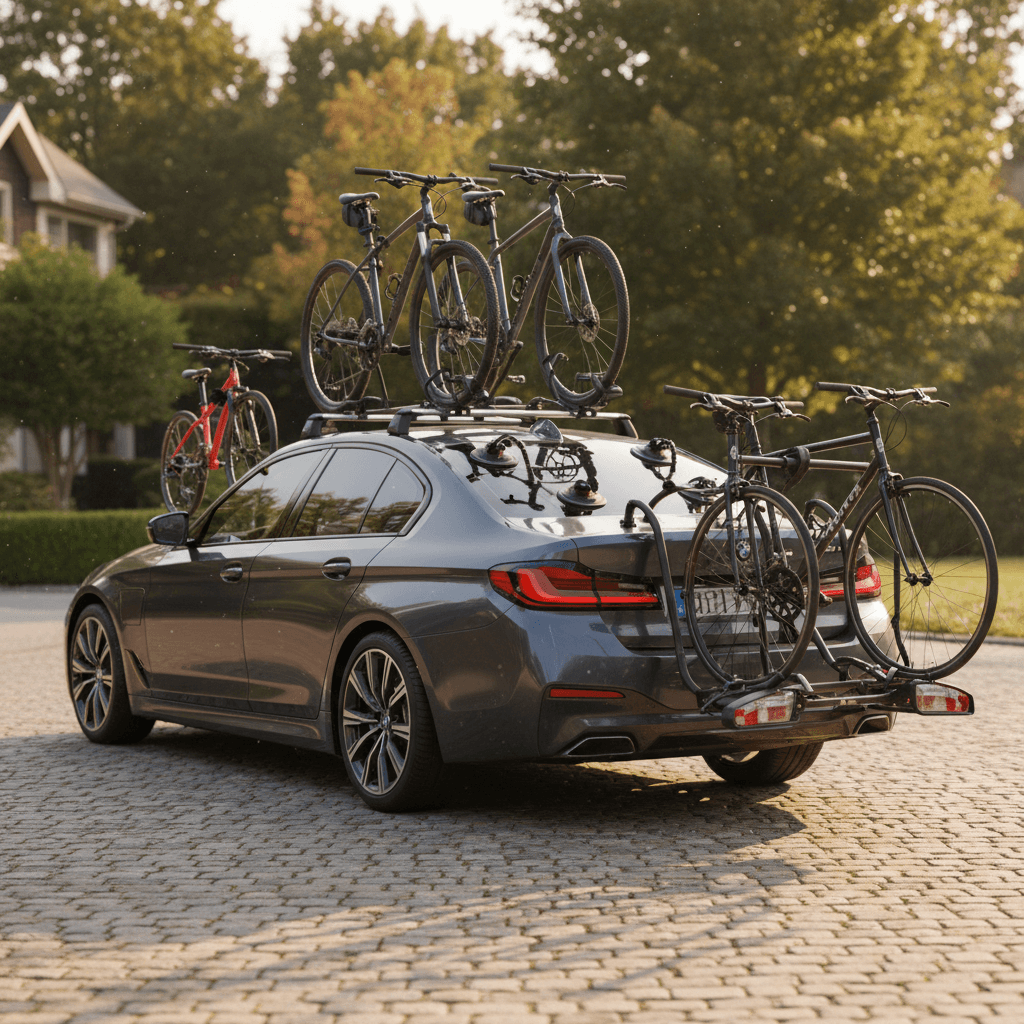
If you own a BMW i5 and love to ride, you quickly run into a practical question: which BMW i5 bike rack options actually work on this all-electric 5 Series, and what’s safe for the car, the bikes and your warranty? Between the sedan and Touring body styles, hitch options, roof systems and some newer vacuum-mounted carriers, the landscape can get confusing fast.
BMW i5 bike rack overview
BMW i5 bike rack basics: sedan vs. Touring
The BMW i5 comes primarily in two body styles: the G60 sedan and the G61 i5 Touring (wagon, currently more common in Europe). From a bike-rack point of view, the key differences are roof shape, rear hatch vs. trunk design, and regional availability of factory towbars.
BMW i5 Sedan (G60)
- Four-door sedan body with a conventional trunk lid.
- In the U.S., typically delivered without a factory towbar.
- Accepted by most aftermarket roof-rack systems that clamp to a “naked” roof or fixed points.
- Compatible with select trunk-mounted racks that are profiled to its decklid and bumper.
BMW i5 Touring (G61)
- Wagon body with a full rear hatch and long roof, great for bikes and cargo.
- In many European markets, can be ordered with a factory detachable towbar, ideal for hitch racks.
- Good fit for roof-mounted bike racks on OEM or Thule/Yakima crossbars.
- Some manufacturers explicitly state that boot-mounted racks are not compatible with the i5 Touring’s hatch design.
Always double‑check fitment
Hitch-mounted bike racks for the BMW i5
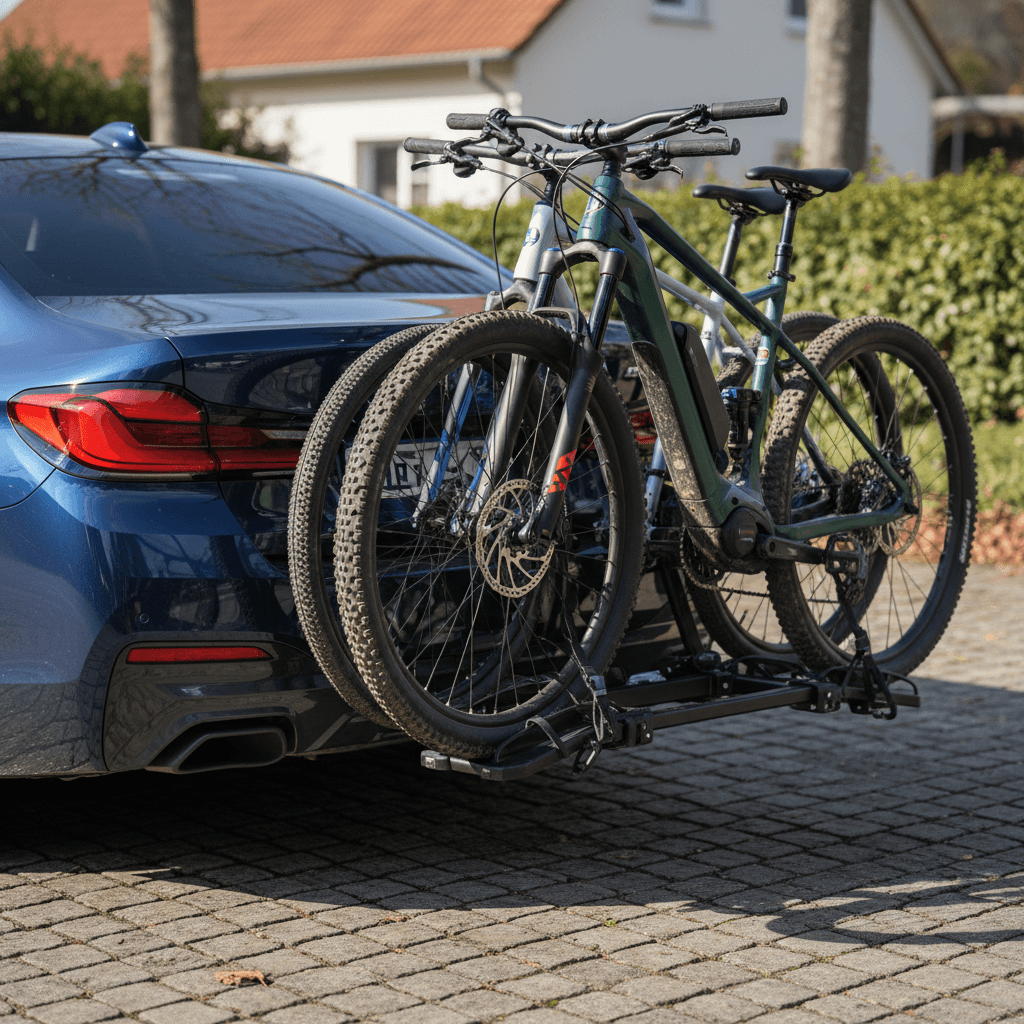
For many riders, especially e‑bike owners, a hitch-mounted bike rack is the most convenient option. It keeps heavy bikes low, behind the car and out of the wind, and most premium racks tilt away so you can still access the trunk or hatch.
Factory and aftermarket towbar options
The catch is that not every BMW i5 ships with a towbar or receiver, and retrofit support is still evolving. In Europe, several suppliers list invisible detachable towbars for the i5 (G60/G61). These provide a 1.25" or 2" receiver or Euro ball mount that can accept a platform or hanging-style rack. In the U.S., owners are often still waiting on fully tested aftermarket hitches, so you’ll want to talk with a specialist installer before you assume a tow hitch is possible on your specific car.
Warranty and towing mode
- Look for a hitch or towbar with a tongue weight rating at least 1.5–2x your fully loaded rack and bikes.
- Ask the installer whether body trimming is required or if the design is “invisible” with a removable receiver neck.
- Confirm that the hitch solution is tested on the i5 chassis, not just gasoline 5 Series variants.
- If you’re in Europe, ask your BMW dealer about OEM detachable towbars for the i5 Touring as a clean, warranty-safe option.
What type of hitch rack works best on an i5?
Once you have a receiver or towbar, choosing the right hitch-mounted bike rack comes down to weight, bike type and how often you load and unload.
Common hitch rack styles for the BMW i5
Match the rack to your bikes and how you use the car
Platform racks
Best for e‑bikes and heavy MTBs. Bikes roll onto trays at waist height and are secured by wheels or a vertical arm, minimal frame contact and easier lifting.
Watch tongue weight: a 2‑bike e‑bike setup can approach 120–150 lb including the rack.
Hanging (mast) racks
Good for lighter road and gravel bikes. They support the bike by the top tube on arms extending from a central mast.
They’re usually lighter and cheaper, but not ideal for step‑through frames or heavy e‑bikes.
Tilting & swing‑away racks
Premium platform racks that tilt or swing away are worth the money on a sedan like the i5, because they preserve access to the trunk.
Check that the motion clears the i5’s rear bumper and trunk arc before fully loading bikes.
Aim for over‑spec capacity
Roof racks and roof-mounted bike carriers
If you can’t or don’t want to install a hitch, roof-mounted bike carriers are the next most common solution for BMW i5 owners. Both BMW’s own accessory catalog and major brands like Thule and Yakima offer crossbar systems and bike trays that fit the i5 sedan and Touring.
Crossbars for the BMW i5
The BMW i5 is available with a standard painted roof, a glass sunroof or a large panoramic glass system, depending on market. That means you’ll see two main crossbar approaches:
- OEM BMW base support system – Factory-style bars that attach to fixed points or clamping positions pre‑engineered for the 5 Series. They integrate well visually and often carry higher dynamic weight ratings.
- Aftermarket systems (Thule Evo Edge, Yakima JetStream, etc.) – Vehicle‑specific kits with feet and aero crossbars that clamp to the i5’s "naked" roof or fixed points. Retailers already list BMW i5‑specific kits for both sedan and Touring; use their configurators to choose the exact bar length and foot pack.
Mind the roof load limit
Roof-mounted bike carrier styles
Roof bike rack options for the i5
Choose based on bike weight and how often you load them
Upright frame‑hold trays
Simplest option: you lift the bike onto the tray and a clamp or arm holds the down tube, with wheel straps front and rear.
Good for most standard road/MTB bikes, but be careful with fragile carbon frames and odd tube shapes.
Fork‑mount carriers
You remove the front wheel and clamp the fork dropouts to the tray. This lowers height and is popular for performance road bikes.
Great stability at highway speeds; front wheel rides inside the car or in a separate wheel holder.
E‑bike capable trays
A handful of roof carriers are rated for heavier e‑bikes, but vertical lift becomes the limiting factor.
Most i5 owners find it more practical to carry full‑weight e‑bikes on a hitch rack instead of the roof.
Loading safely at height
How bike racks affect your BMW i5’s range
Trunk-mounted bike racks for the BMW i5
If you don’t have a hitch and don’t want roof bars, a trunk-mounted (boot) bike rack can be an appealing middle ground, especially for sedan owners. These strap to the trunk lid and rear bumper with adjustable arms that support one to three bikes.
Fitment on BMW i5 sedan vs. Touring
Fitment guides already list trunk racks designed to fit the BMW i5 sedan, including premium adjustable models that contour around the rear decklid and taillights. At the same time, at least one major rack retailer explicitly notes that the BMW i5 Touring is not compatible with their boot-mounted carriers due to its hatch shape and spoiler design. That split makes it critical to select a rack that specifically calls out your body style.
- Use the manufacturer’s online configurator and select your exact year, body style and trim.
- Avoid trunk racks that contact painted surfaces near sharp edges or spoilers on the i5’s sculpted rear end.
- Look for wide rubber feet and padded hooks to protect paint and glass.
- Re‑torque or retighten straps after the first few miles of driving with bikes loaded.
Parking sensors and cameras
Vacuum-mounted bike racks: a no‑rails alternative
A newer solution gaining traction with EV owners is the vacuum-mounted bike rack. These systems use large suction cups and a small platform or fork mount to secure one or more bikes directly to the roof, panoramic glass or even the rear window. Several manufacturers market BMW i5‑specific vacuum racks aimed at drivers who don’t want permanent hardware.
Pros and cons of vacuum-mounted racks on the i5
Great flexibility, but they demand careful use
Why owners like them
- No roof bars or hitch required, ideal for leased BMW i5s or drivers who don’t want visible hardware.
- Quick to install and remove; easy to transfer between multiple vehicles.
- Compatible with glass and metal roofs when installed per instructions.
What to watch out for
- Require scrupulously clean surfaces and regular vacuum checks.
- Usually rated for 1–3 bikes with specific per‑bike weight limits.
- Some owners are uncomfortable mounting heavy e‑bikes on glass, even when the system is rated for it.
Clean and inspect every time
How to choose the right BMW i5 bike rack
So which of these BMW i5 bike rack options should you actually buy? Start with your bikes, where you live, and how often you transport them, then work backward to the hardware.
Step-by-step checklist for choosing a rack
1. List your bikes and their weights
Write down each bike’s approximate weight and type: e‑bike, full‑suspension MTB, road, gravel, kids, etc. If you regularly carry e‑bikes over 45–50 lb, focus on <strong>hitch platforms</strong> or sturdy vacuum racks rather than roof or trunk systems.
2. Confirm what your i5 can physically support
Check your owner’s manual for <strong>roof load limits</strong> and any notes about towing or towbar use. If your car already has a BMW towbar, note its <strong>maximum vertical load</strong> (tongue weight).
3. Decide how often you’ll use the rack
Frequent riders often prefer leaving a hitch rack installed during the season, or using OEM crossbars that can stay on the car. Occasional riders may value a <strong>compact trunk rack</strong> or vacuum rack that lives in the garage until needed.
4. Consider storage and home access
Where will you store the rack when it’s off the car, garage wall, apartment closet, trunk? Also consider low home garages or car parks; tall roof setups on the i5 Touring can approach clearance limits.
5. Factor in lease, resale and warranty
If you’re leasing your BMW i5 or planning to trade in soon, favor solutions that are easy to remove without trace, OEM crossbars, trunk racks or vacuum mounts, over aftermarket hitches that may complicate resale.
6. Test fit before your first big trip
Load the rack and bikes, drive a short loop at city speeds, and inspect all straps, bolts and vacuum indicators. It’s better to discover issues near home than 200 miles into a road trip.
Good, better, best use cases
Installation, safety and EV-specific considerations
No matter which rack you choose, installing it correctly and driving with EV‑specific constraints in mind is what protects your bike investment, and your BMW i5.
Key safety and EV considerations with bike racks
Weight and balance
Stay within roof load and towbar tongue limits, and keep the heaviest bikes closest to the car. Overloading can stress the body structure and suspension, especially over rough roads.
Range and charging
Expect a noticeable range drop with bikes exposed to the airstream. Hitch and trunk racks are usually more efficient than roof setups. When DC fast charging, remember that some rear racks can block access to charging ports or create awkward reach situations.
Sensors and driver assists
Parking sensors, lane-change assist and rear cameras may behave differently with racks and bikes installed. Turn down sensitivity where possible and rely on mirrors and direct observation when maneuvering.
BMW i5 bike rack types at a glance
Quick comparison of the main rack types for an i5 sedan or Touring
| Rack type | Typical capacity | Best for | Main pros | Main cons |
|---|---|---|---|---|
| Hitch-mounted platform | 2–4 bikes, high per‑bike weight | E‑bikes, MTBs, mixed fleets | Low lift height, stable, easy loading | Requires towbar/hitch, added cost, rear length |
| Roof-mounted tray | 1–4 bikes depending on bars | Road, gravel, hardtail MTBs | Leaves rear access free, great for wagons | Lifting overhead, more drag, roof load limits |
| Trunk-mounted (sedan) | 1–3 lighter bikes | Road and kids' bikes, occasional use | No hitch or bars needed, stores compactly | Sensor interference, paint protection, often sedan‑only |
| Vacuum-mounted | 1–3 bikes, model-dependent | Riders without rails or hitch | No permanent hardware, easy to swap cars | Requires meticulous setup, limited e‑bike capacity |
Use this table as a starting point, then verify exact limits with your vehicle and chosen rack brand.
Follow both sets of instructions
BMW i5 bike rack FAQ
Frequently asked questions about BMW i5 bike racks
How Recharged can help EV owners who ride
If you’re shopping the used market for a BMW i5, or another EV that can pull double duty as a bike shuttle, where you buy actually matters. At Recharged, every vehicle includes a Recharged Score Report with verified battery health, so you know how much real‑world range you have to play with when adding bikes, racks and highway miles.
Our EV specialists can walk you through practical questions that traditional dealers rarely answer: how a roof rack will affect your range on a particular commute, whether a given model supports a towbar for a future hitch rack, and what charging strategy makes sense if you’re heading to weekend races with bikes on the back. Because the process is fully digital, with optional nationwide delivery, and we operate an Experience Center in Richmond, VA, it’s easy to get expert, EV‑specific advice before you commit.
And if you’re planning to sell or trade an EV you’ve already outfitted with racks, Recharged offers trade‑ins, instant offers and consignment, so you can turn that setup into your next road‑trip‑ready electric vehicle without the usual hassle.
Key takeaways on BMW i5 bike rack options
The BMW i5 gives you several viable bike‑hauling paths, hitch racks where a towbar is available, roof systems with OEM or aftermarket crossbars, body‑specific trunk racks for the sedan, and modern vacuum-mounted options that don’t need permanent hardware. The right choice comes down to your bikes, how often you travel with them, and whether you’re comfortable modifying the car with a hitch.
Take the time to confirm fitment for your exact i5, respect the lower of the vehicle and rack weight limits, and think about range and charging when you’re fully loaded. Do that, and your i5 can be both a quiet, efficient commuter and a capable bike hauler that gets you, and your bikes, to the trailhead with confidence.