If you’re considering a BMW i5, or you’re already driving one, the first big question is usually the battery. You want to know not just how far it goes on a charge, but how well BMW stands behind that pack. The good news: the BMW i5 battery warranty is relatively straightforward and competitive, but the details of what it actually covers (and what it doesn’t) are easy to miss in the fine print.
Quick answer
BMW i5 battery warranty at a glance
Core BMW i5 warranty numbers (U.S., 2024–2026)
BMW’s EV warranty structure looks a lot like its i4 and iX siblings. For U.S.‑spec 2024–2026 i5 sedans, BMW pairs a 4‑year / 50,000‑mile bumper‑to‑bumper warranty with a dedicated 8‑year / 100,000‑mile high‑voltage battery warranty. That second warranty is the one that protects you from early battery failures or abnormal capacity loss.
What the BMW i5 battery warranty actually covers
1. Defects in materials or workmanship
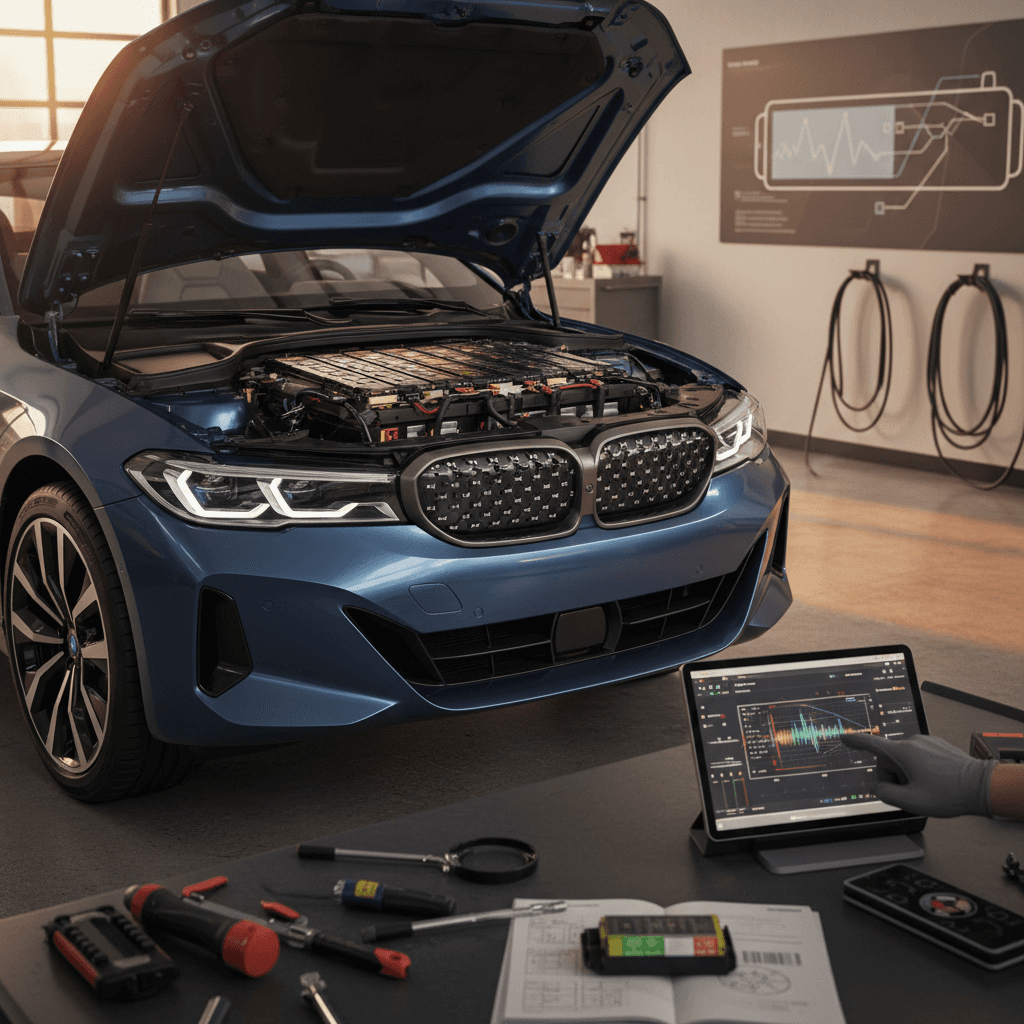
The core of the BMW i5 high‑voltage battery warranty is a promise that the battery pack was built correctly. If a cell, module, or pack component fails due to a manufacturing defect, BMW will repair or replace it within the 8‑year / 100,000‑mile window.
- Internal cell failures or short circuits
- Defective battery management electronics
- Faulty contactors, relays, or pack wiring
- High‑voltage safety faults traced to the pack itself
2. Excessive capacity loss (on recent model years)
Modern BMW EVs, including the i5, are generally backed by a minimum capacity guarantee. In practice, that means if the battery’s usable capacity drops below roughly 70–75% of its original level within 8 years / 100,000 miles, BMW will treat that as a warrantable condition.
This is separate from random failures: it’s about the pack staying within an acceptable degradation window under normal use.
Put simply: if your i5 throws a high‑voltage battery fault or loses significantly more range than BMW considers normal within those limits, and the root cause isn’t abuse or outside damage, the battery warranty is designed to step in.
How BMW usually remedies a bad pack
How long the BMW i5 battery warranty lasts
BMW i5 warranty timelines (U.S. market)
How BMW’s standard and high‑voltage battery warranties line up for a typical 2024–2026 i5.
| Coverage type | What it covers | Length | Example end date (i5 sold June 2024) |
|---|---|---|---|
| New‑vehicle limited warranty | Most non‑wear components across the vehicle | 4 years / 50,000 miles | June 2028 (or 50k miles, whichever comes first) |
| High‑voltage battery defect warranty | Defects in materials/workmanship in the i5’s high‑voltage battery | 8 years / 100,000 miles | June 2032 (or 100k miles) |
| Capacity loss / State‑of‑Health warranty | Excessive loss of usable battery capacity below BMW’s threshold | Up to 8 years / 100,000 miles | Same as high‑voltage battery window |
Remember: all clocks start on the original in‑service date, not the model year.
Two important details here: first, the 8‑year / 100,000‑mile battery coverage clock starts on the original in‑service date (when the first owner took delivery), not the model year. Second, whichever you hit first, time or mileage, ends the warranty. A high‑mileage commuter can time‑out battery coverage in five or six years if they blast past 100,000 miles quickly.
Watch the in‑service date, not just the model year
Battery capacity loss coverage on the BMW i5
No EV battery stays at 100% forever. BMW designs the i5’s 84.3‑kWh pack with some degradation in mind, and the warranty only steps in when capacity loss is considered abnormal. That’s where the capacity or “State of Health” (SoH) part of the warranty matters.
Normal vs. warrantable i5 battery degradation
Understanding when BMW is likely to treat capacity loss as a defect.
Normal degradation
- Gradual range loss over many years
- More drop in extreme heat or cold
- Small seasonal swings in estimated range
This is expected and not covered as a defect.
Borderline cases
- Noticeable range loss within 3–5 years
- Range drops more than peers with similar use
- Diagnostic SoH numbers near BMW’s floor
Dealer may run detailed tests to decide.
Warrantable loss
- Capacity falls below BMW’s SoH threshold (often ~70–75%) within 8 yrs / 100k miles
- Range loss can’t be explained by use pattern or environment
- High‑voltage diagnostics flag bad modules or pack health
This is where the capacity warranty is designed to help.
How BMW actually measures capacity
What is not covered by the i5 battery warranty
Automakers structure battery warranties to cover defects, not every possible outcome of how people use (or abuse) their cars. The BMW i5 is no exception. A few exclusions show up consistently in BMW warranty language and dealer practice.
Common exclusions and gray areas
Physical damage or accidents
If the pack is damaged in a crash, by road debris, or during improper lifting/towing, that’s typically an <strong>insurance claim</strong>, not a battery warranty case.
Water intrusion from flooding
Driving through deep water, flood events, or any situation where water gets where it shouldn’t can void coverage on the affected components, including the battery.
Improper modifications or repairs
Aftermarket tinkering with the high‑voltage system, non‑BMW software mods, or unapproved repairs can give BMW an easy reason to deny battery‑related claims.
Abuse, neglect, or non‑recommended use
Consistently ignoring warnings, overheating the pack, or using the car in ways the manual explicitly forbids can undermine warranty coverage.
Normal wear items outside the pack
The i5’s separate 12‑volt battery and routine maintenance items live under different warranty rules; they aren’t protected by the high‑voltage battery warranty.
Don’t DIY the high‑voltage system
New vs. used BMW i5: how the battery warranty transfers
From BMW’s perspective, battery coverage follows the car, not the owner. That means the i5’s 8‑year / 100,000‑mile battery warranty typically transfers automatically to the next owner in the U.S., whether you buy from a BMW dealer, an independent shop, or a private seller.
Buying a new BMW i5
- You get the full 8‑year / 100,000‑mile battery window starting from your delivery date.
- 4‑year / 50,000‑mile new‑vehicle warranty overlaps with the battery coverage.
- Optional BMW extended warranties can stretch the non‑battery coverage, but the battery clock is fixed at 8 years / 100k.
Buying a used BMW i5
- You inherit the remaining portion of that 8‑year / 100,000‑mile battery warranty.
- There’s no reset just because you’re the second or third owner.
- Certified Pre‑Owned (CPO) i5s can add an extra year of broader coverage after the 4‑year / 50k window, but the battery warranty still runs off the original in‑service date.
Where Recharged fits in
Ready to find your next EV?
Browse VehiclesBMW i5 battery warranty and total cost of ownership
The single biggest long‑term question with any used EV is, “What happens if the pack goes bad?” On a luxury sedan like the BMW i5, a full pack replacement out of warranty can easily climb into the five‑figure range once you account for labor, programming, and related components. That’s why the 8‑year / 100,000‑mile coverage window is such an important part of the i5’s total cost of ownership story.
How the i5 battery warranty affects your wallet
Three concrete ways coverage changes the economics.
Resale value support
Risk cap on early failures
Tipping point after year eight
Use remaining warranty as a negotiation lever
How to check remaining battery warranty on a BMW i5
Whether you’re already driving an i5 or test‑driving a used one, it’s not hard to ballpark how much battery warranty is left, as long as you know where to look and which dates actually matter.
Step‑by‑step: verify remaining BMW i5 battery coverage
1. Find the in‑service date
Ask the seller for the original BMW purchase paperwork, service history, or a screenshot from the MyBMW app. This date, not the model year, is the starting point for the 8‑year / 100,000‑mile clock.
2. Record the current mileage
Check the odometer with the car powered on. Jot down the exact mileage; the battery warranty cuts off at 100,000 miles, even if you’re still within eight years.
3. Do the quick math
Subtract the in‑service year from the current calendar year to see how many of the eight years have elapsed. Then compare current mileage to 100,000 miles. The <strong>sooner</strong> limit, time or mileage, wins.
4. Ask a BMW dealer to confirm
Call a BMW service department with the VIN and ask them to confirm high‑voltage battery warranty expiration. They can see the official dates in BMW’s internal system.
5. Request a battery health check
If you’re serious about a particular car, ask for a recent dealer battery health report or schedule one yourself. On Recharged, the <strong>Recharged Score</strong> includes third‑party battery diagnostics on every EV we list.
6. Keep documentation with the car
Save any warranty confirmations and battery health reports with the vehicle records. They’ll matter when you eventually sell or trade the car.
BMW i5 battery warranty FAQ
BMW i5 battery warranty: common questions
Key takeaways for BMW i5 battery coverage
- Every U.S.‑spec 2024–2026 BMW i5 gets an 8‑year / 100,000‑mile high‑voltage battery warranty on top of the 4‑year / 50,000‑mile new‑vehicle warranty.
- Coverage focuses on defects and abnormal capacity loss, not normal, gradual degradation or physical damage from accidents or flooding.
- The battery warranty follows the car, so used buyers inherit whatever time and mileage remain from the original in‑service date.
- Knowing the exact in‑service date and mileage lets you quantify remaining coverage, crucial data when you’re pricing a used i5.
- Independent battery health data, like the diagnostics included in a Recharged Score Report, can help you separate healthy i5s from cars you should walk away from.
When you cut through the fine print, the BMW i5’s battery warranty is actually one of the clearer parts of owning the car: eight years, 100,000 miles, and protection against defects and serious capacity loss. The real work is making sure you know how much of that window is left on any given car and whether its battery health matches the promise on paper. That’s exactly the gap tools like the Recharged Score help close, by pairing BMW’s warranty commitments with hard data about the specific i5 you’re looking at, so you can buy with your eyes open instead of crossing your fingers.