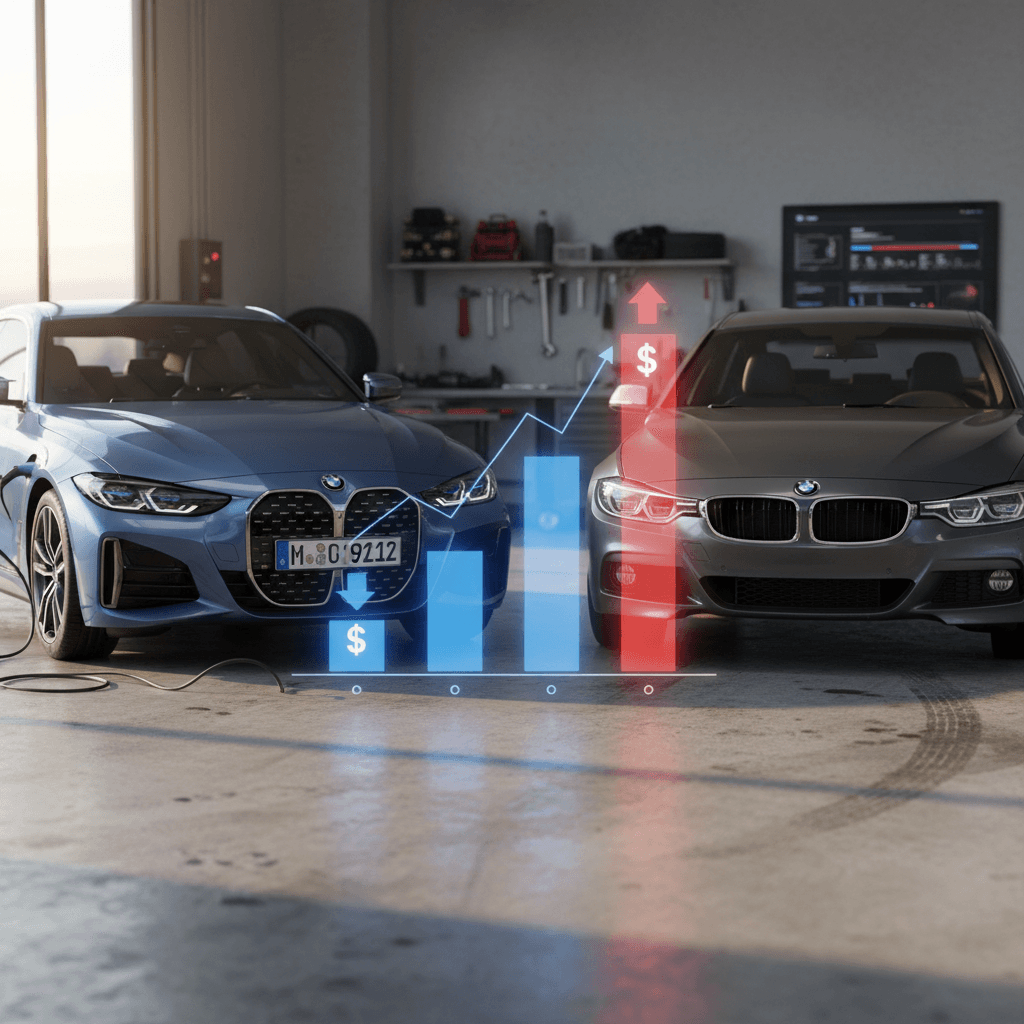
You don’t cross-shop a BMW i4 against a Corolla. You cross-shop it against a gas 3 Series or maybe a 4 Series Gran Coupe. The question smart buyers are asking in 2026 is simple: when you add up every dollar, does the BMW i4’s total cost actually beat a comparable gas BMW over five years, or is the EV just moving the expense from the pump to the power bill?
What this guide covers
Why compare BMW i4 total cost to a gas 3 Series?
BMW positions the i4 as an electric twin to its classic sports sedan: similar size, similar luxury, similar performance. If you’re debating between an i4 and a 330i / 430i Gran Coupe, you don’t just care about 0–60 times. You care about the monthly bite: payment, fuel, maintenance, insurance, depreciation.
Because the i4 is still a relatively new EV, a lot of shoppers default to sticker price. That misses the point. Electricity is typically cheaper per mile than gasoline, EVs need far less routine service, and many U.S. buyers can still tap tax credits or employer incentives. Over a five‑year span, these line items can easily overshadow a few thousand dollars difference in MSRP.
Think in total cost, not monthly payment
Baseline assumptions and key specs
To compare the BMW i4 with a gas equivalent in a way that’s fair and repeatable, we’ll define a typical U.S. ownership scenario. You can then tweak the inputs for your own commute, local prices, and whether you buy new or used.
BMW i4 vs gas BMW 3 Series: our baseline scenario
Approximate, U.S.-average assumptions for a five‑year cost comparison in 2026 dollars.
| Item | BMW i4 eDrive40 | Gas BMW 330i |
|---|---|---|
| Powertrain | Single‑motor RWD EV | 2.0L turbo gas |
| EPA efficiency | ~32 kWh/100 miles | ~30 mpg combined |
| Annual mileage | 12,000 miles | 12,000 miles |
| Ownership period | 5 years | 5 years |
| Energy prices (U.S. avg) | $0.17 per kWh home electricity | $4.00 per gallon gasoline |
| Driving mix | 80% home charging, 20% DC fast | 100% gasoline |
| Purchase type | Lightly used, similar age and mileage | Lightly used, similar age and mileage |
You can adjust these numbers to match your driving, but this gives us a realistic reference case.
Your numbers will vary
Energy costs: electricity vs gasoline
The BMW i4 is notably efficient for a premium EV. The eDrive40 is rated around 32 kWh per 100 miles (that’s roughly 3.1 miles per kWh) in U.S. testing for a common wheel setup. The gas 330i, meanwhile, hovers around 30 mpg combined in the real world when driven as BMW intends, briskly, not like a rental Corolla.
Estimated annual energy cost at U.S. average prices (2026)
- BMW i4: 32 kWh/100 miles → 0.32 kWh per mile. At $0.17/kWh, that’s about 5.4 cents per mile when charging at home. If 20% of your miles are on pricier DC fast chargers, blended cost might creep to ~6–7 cents per mile.
- BMW 330i: 30 mpg at $4.00/gal → about 13.3 cents per mile.
What if you mostly DC fast charge?
Maintenance and repairs: where EVs quietly win
BMW’s gasoline fours are sophisticated, turbocharged, and firmly on the “needs regular attention” side of the spectrum. Oil, filters, spark plugs, belts, gaskets, emissions hardware, the usual supporting cast of a modern internal‑combustion romance. The i4 deletes almost all of that.
Typical 5‑year maintenance profile
Lightly used, out‑of‑warranty BMWs driven 12,000 miles a year.
BMW i4 eDrive40
- No oil changes, spark plugs, or emissions checks.
- Brake wear is minimal thanks to strong regen; pads often last well past 60–80k miles.
- Routine items: cabin filters, brake fluid every few years, possibly coolant service for the battery/drive unit on BMW’s schedule.
- Likely 5‑year spend (out of warranty, normal use): roughly $1,500–$2,000.
Gas BMW 330i
- Oil and filter changes every 7,500–10,000 miles.
- More complex engine hardware, turbo plumbing, exhaust and emissions systems.
- Higher risk of out‑of‑warranty repairs (sensors, coil packs, carbon buildup cleanouts, etc.).
- Likely 5‑year spend (out of warranty, normal use): roughly $3,000–$4,000+.
The elephant in the room: BMW repair volatility
Depreciation and used BMW i4 values
New luxury EVs, including the BMW i4, depreciated hard in the early 2020s as technology advanced and lease returns swelled the used market. That’s bad news for first owners, and very good news if you’re shopping used in 2026. The steeper that first‑owner drop, the more value you scoop up.
BMW i4 depreciation pattern
- Many i4s have already taken a 30–40% hit from original MSRP after 3–4 years.
- There’s growing confidence around BMW battery longevity, which helps stabilize values.
- EV‑curious buyers like the idea of a 4‑door coupe with instant torque and low running costs.
Gas 3 Series depreciation pattern
- 3 Series resale is traditionally strong, but the market is getting nervous about long‑term ICE ownership as electrification accelerates.
- Fuel costs and potential future restrictions in some cities weigh on residuals.
- Well‑optioned models still hold value, but they aren’t immune to the shift toward EVs.
Where used i4s shine
Ready to find your next EV?
Browse VehiclesInsurance, tires and other running costs
Insurance actuaries don’t care about your moral stance on fossil fuels; they care about repair bills. EVs like the i4 can be slightly more expensive to insure than their gas twins because of pricier parts and fewer independent repair options. But the spread is rarely huge for mainstream premiums.
Secondary costs: roughly similar, with a few twists
These won’t make or break the decision, but they matter.
Insurance
In many U.S. markets, expect the i4 to be 5–15% higher to insure than a comparable 3 Series, especially if the EV’s replacement value is higher. Good driver discounts and telematics programs can erase much of the gap.
Tires
Both cars are heavy, performance‑oriented German sedans. They will eat through 18–19 inch performance tires if you drive them as intended. The i4 is heavier, which can mean slightly faster wear, but you’re in the same spending ballpark either way.
Home charging hardware
Budget $700–$1,500 to add a 240V circuit and a Level 2 charger if your home doesn’t already have one. In many states, utilities offer rebates that shrink this bill, and you’ll recover the cost through cheaper fuel over a few years.
Public charging premiums
Tax credits and incentives: how much can you save?
In 2026, the federal picture is a maze, but the broad strokes are simple: some new EVs qualify for a clean vehicle tax credit, some used EVs qualify for a separate, smaller credit, and many utilities and states layer on their own rebates for home charging or off‑peak use.
Where BMW i4 buyers may find extra savings
1. Federal used clean vehicle credit
Depending on income limits, vehicle price caps, and where the i4 was assembled, a <strong>used BMW i4</strong> might qualify for a federal used EV tax credit when bought from a dealer, potentially worth up to several thousand dollars. Always confirm eligibility for the specific VIN before you buy.
2. State & local EV rebates
Some states and municipalities offer <strong>point‑of‑sale rebates</strong> or post‑purchase checks for EV buyers, separate from federal incentives. They can stack with federal benefits and tilt the math heavily toward the i4.
3. Utility rebates for home chargers
Many utilities will help pay for your Level 2 charger or 240V circuit, or offer <strong>special off‑peak EV rates</strong>. These can drop your effective charging cost well below the national 17‑cent average.
4. HOV lane access and perks
In some regions, EVs get access to <strong>HOV or express lanes</strong>. That’s not a line item on a spreadsheet, but for a daily commuter, time savings and lower stress have value too.
Gas cars rarely get equivalent incentives
5‑year total cost: BMW i4 vs gas 3 Series
Let’s pull the threads together. We’ll look at a five‑year horizon for two lightly used cars that cost roughly the same to buy today: a BMW i4 eDrive40 and a BMW 330i. To keep the math clean, we’ll assume similar purchase price and financing terms, so we can focus on operating costs, where EVs tend to earn their keep.
Illustrative 5‑year cost of ownership: BMW i4 vs BMW 330i
Assumes similar used purchase price, U.S. average energy costs, 12,000 miles/year, and no huge surprise repairs.
| Category (5 years) | BMW i4 eDrive40 | Gas BMW 330i |
|---|---|---|
| Energy (electricity / gasoline) | ≈ $3,260 | ≈ $8,000 |
| Maintenance & minor repairs | ≈ $1,750 | ≈ $3,500 |
| Home charging equipment | ≈ $1,000 (net of any rebates) | $0 |
| Insurance difference | ≈ +$750 vs 330i | Baseline |
| Tires & misc. wear items | ≈ $3,000 | ≈ $2,800 |
| Estimated incentives impact | − up to several thousand (if eligible) | $0 |
| Approx. 5‑year operating total (before incentives) | ≈ $9,760 | ≈ $14,300 |
| Approx. 5‑year operating difference | i4 saves ≈ $4,500+ | Costs ≈ $4,500+ more |
Numbers are rounded estimates to show directionally how the costs stack up.
In this baseline, the i4 comes out roughly $4,500 ahead over five years on running costs alone, even after you’ve paid for a home charger and slightly higher insurance. If you qualify for a federal used EV credit or meaningful state incentives, you can lop thousands more off the i4’s net cost. If gas rockets above $4.00 for any sustained period, the gap widens again.
How to sanity‑check this for yourself
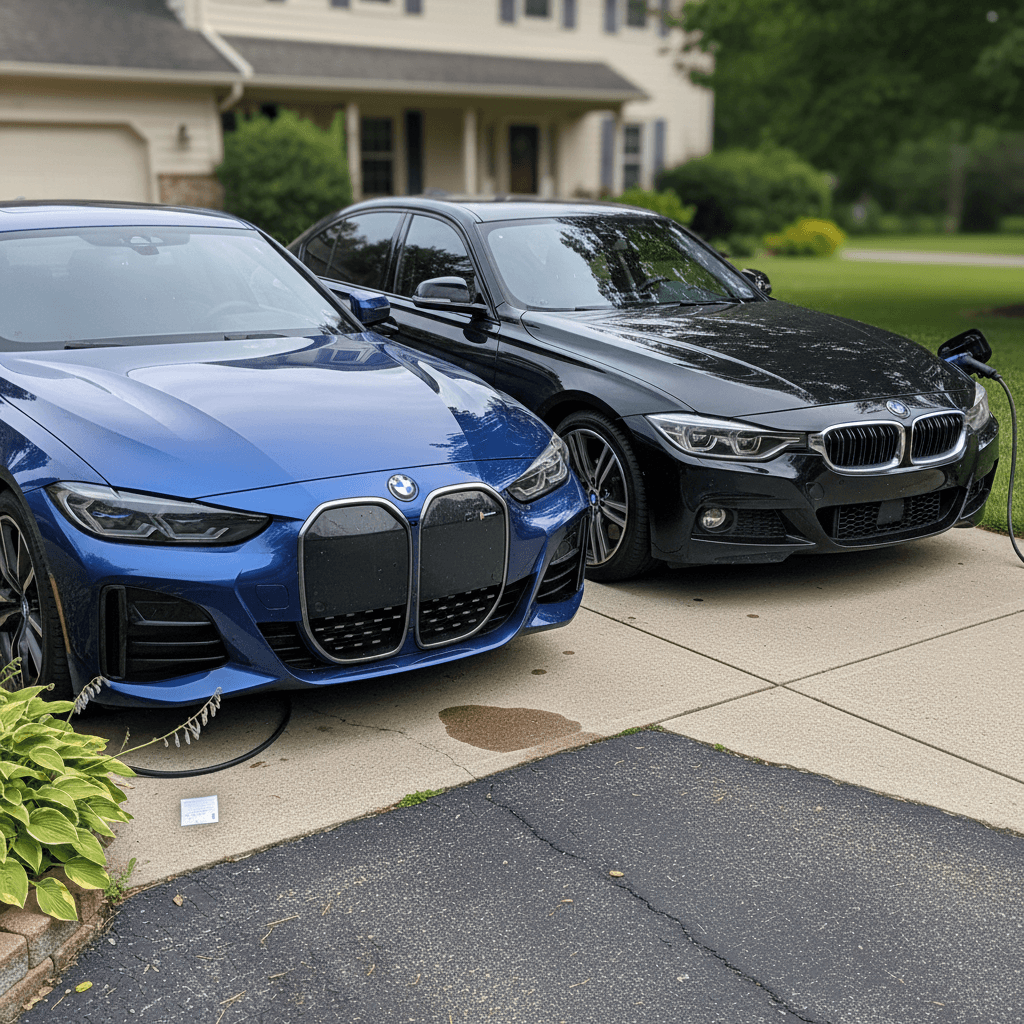
Used BMW i4: has the math already baked in?
The most interesting thing about the BMW i4 isn’t buying it new. It’s what happens when someone else already shouldered the first three years of depreciation and you walk in for the encore. At that point, the i4 and a similar‑age 3 Series can have very similar asking prices, but radically different future fuel and service bills.
Why the used BMW i4 sweet spot is so compelling
Especially when you buy with real battery data, not just miles on the odometer.
Battery health transparency
With Recharged, every used i4 comes with a Recharged Score and a detailed battery health report. Instead of guessing whether that pack still has its range, you see verified diagnostics, so you can price the car accordingly.
Depreciation already done
EV technology marches quickly, which pushed early i4s down the curve faster. As a second owner, you inherit the low running costs without eating the initial nose‑dive in value, often making total cost lower than a gas 3 Series of the same year.
The result is a car that drives like a modern BMW, quick, stable, beautifully appointed, but behaves more like a frugal commuter when it’s time to pay the monthly energy bill.
How Recharged helps you shop BMW i4 vs gas equivalents
If you’re weighing a BMW i4 against a gas 3 Series or 4 Series Gran Coupe, the hardest part is cutting through the unknowns: battery health, fair market pricing, and what your real‑world costs will look like two or three years down the road.
- Recharged Score battery diagnostics so you know exactly how healthy an i4’s pack is before you buy.
- Transparent, data‑driven pricing that reflects current EV market trends instead of wishful thinking.
- EV‑specialist support to walk you through total cost, incentives, and charging setup based on your ZIP code.
- Financing, trade‑in, and nationwide delivery in a fully digital experience, plus an in‑person Experience Center in Richmond, VA if you want to see and feel the cars.
From curiosity to confidence
FAQ: BMW i4 total cost vs gas car equivalent
Common questions about BMW i4 vs gas 3 Series costs
Bottom line: is the BMW i4 cheaper than a gas equivalent?
Viewed purely as a status object, the BMW i4 and a gas 3 Series live in the same ecosystem: compact, premium, brisk, with a roundel on the nose and a certain way of threading a back road. Viewed as a five‑year financial decision, the i4 quietly tilts the table.
For a typical U.S. driver who charges mostly at home and does 10,000–15,000 miles a year, the i4 can cut energy costs roughly in half, trim maintenance, and tap incentives that gas cars simply don’t get. Slotted into the used market, where depreciation has already done its worst, that can add up to several thousand dollars in net savings versus a similarly priced 3 Series or 4 Series Gran Coupe.
If you want help turning these broad numbers into a personal forecast, start by browsing used BMW i4 listings on Recharged, compare them to gas BMW equivalents, and lean on our EV specialists. The spreadsheet may be dry, but the conclusion usually isn’t: for many drivers, the BMW i4 delivers the BMW feel with a noticeably lighter long‑term cost footprint.