If you’re considering a BMW i4, especially a used one, the big question is obvious: how long does the BMW i4 battery really last, and what happens to range as the car ages? Battery health is the backbone of any EV’s value, so it pays to understand how the i4 holds up in the real world before you sign anything.
Short answer
BMW i4 battery lifespan at a glance
BMW i4 battery lifespan snapshot
Those numbers tell the high-level story: the BMW i4’s battery is designed to last as long as, or longer than, the rest of the car. But lifespan isn’t just a number on paper. It depends heavily on how you charge, how you drive, and where you live.
How long does a BMW i4 battery really last?
BMW builds the i4’s pack to function as a “lifetime component” under normal use. In practical terms, that means the original high‑voltage battery is expected to outlast the typical first ownership cycle and often the second as well. With sane charging habits and average mileage, most owners can expect:
- Around 10–15 years before capacity falls to roughly 70–80% of the original rating.
- Well over 150,000 miles of useful life, many packs will push 200,000+ miles.
- Gradual, predictable range loss rather than sudden failure.
EV batteries don’t usually “die” overnight. Instead, they slowly lose usable capacity. You might start with an i4 eDrive40 rated around 300 miles on paper and, a decade later, see something closer to 230–250 miles in similar conditions. For many drivers, that’s still plenty for a full day’s driving.
Big caveat: extreme use
BMW i4 battery warranty explained
Under U.S. regulations and BMW’s own coverage, the i4’s high‑voltage battery is protected by a long warranty. Exact terms can vary slightly by model year and state, but for most i4s sold in the U.S. you’ll see something very close to:
Typical BMW i4 high‑voltage battery warranty coverage (U.S.)
Always confirm specific terms for your VIN and model year in the owner’s documentation, but this is the general pattern.
| Coverage element | Typical value | What it means |
|---|---|---|
| Time limit | 8 years | Battery defects and excessive capacity loss are covered for a set number of years from in‑service date. |
| Mileage limit | 100,000–160,000 mi* | Coverage expires at the earlier of the time or mileage limit (*higher in some CARB states). |
| Capacity threshold | 70% of original | If usable capacity falls below this during the warranty, BMW may repair or replace the pack. |
BMW’s i4 battery warranty is structured to cover both time and mileage, and to guarantee a minimum remaining capacity threshold.
Check your specific car
That 70% capacity floor is important. It effectively defines the point at which BMW considers a battery no longer performing as designed. In real life, most i4 packs won’t approach that threshold until long after the warranty has expired, if at all, especially in temperate climates.
Battery degradation: what owners are seeing
We don’t yet have 15‑year‑old BMW i4s in the wild, but we do have early‑life data from owners who’ve been racking up miles since the car launched. The pattern looks a lot like other modern EVs:
- A small, relatively quick drop in the first 1–2 years (often 3–7% of original capacity).
- Then a gentler, slower decline, roughly 1–2% per year for well‑cared‑for cars.
- High‑mileage highway commuters seeing somewhat faster loss, especially with heavy DC fast‑charging.
Early life: the “new battery” drop
Many EVs, including the BMW i4, show a noticeable but modest step down in range in the first couple of years. Think of it as the pack settling into its long‑term capacity. This is normal and usually stabilizes.
Long term: slow and steady
After that initial phase, degradation tends to slow. An owner might see their indicated full‑charge range drop by a few miles every year, rather than in big chunks, as long as charging and storage habits aren’t abusive.
Good news for shoppers
What actually shortens, or extends, BMW i4 battery life
Battery lifespan isn’t just about model or brand. It’s about how the pack lives its life. With the BMW i4, these are the big levers that push degradation faster or slower:
Key factors that influence BMW i4 battery lifespan
Some you control, some you don’t, but they all add up.
Charging style
Frequent DC fast‑charging (especially from low state of charge to 100%) heats and stresses the pack more than Level 2 home charging. Gentle, overnight AC charging is easiest on the battery.
Climate & storage
Extreme heat is the enemy. Parking outside in hot sun and letting the car sit at 100% for days will age the pack faster than storing it in a shaded garage at moderate charge levels.
Driving patterns
Sustained high‑speed driving, aggressive acceleration, and heavy loads mean more current draw, more heat, and a bit faster degradation over many years.
Time at high or low SOC
Living at the extremes, very high (near 100%) or very low (near 0%) state of charge, for long periods is harder on the cells than hovering in the middle (30–80%).
Cold weather usage
Cold doesn’t permanently damage the battery the way heat can, but it does temporarily cut range. Using preconditioning and charging while the pack warms helps maintain performance.
Software & cooling
BMW’s thermal‑management system, software updates, and pack design all work quietly in the background to protect the battery, especially during fast‑charging and extreme temperatures.
Seven habits to keep your BMW i4 battery healthy
You can’t change chemistry, but you can change habits. Here are practical, owner‑tested ways to help your BMW i4 battery go the distance:
Battery‑friendly habits for BMW i4 owners
1. Don’t charge to 100% every day
For daily driving, set your charge limit around 70–90% instead of 100%. Save full charges for road trips or when you truly need maximum range. This reduces stress on the top of the pack where wear tends to be higher.
2. Prefer Level 2 over frequent DC fast‑charging
There’s nothing wrong with occasional DC fast‑charging, a BMW i4 is built to handle it. But relying on high‑power fast‑chargers several times a week can accelerate degradation. Regular Level 2 charging at home or work is gentler.
3. Avoid parking full in extreme heat
If you live in a hot climate, try not to leave the car sitting at 100% in direct sun for days at a time. Charge so it finishes near your departure time, and use shaded or indoor parking when possible.
4. Don’t regularly run it down to 0%
Running the car to the last mile now and then is fine. Making a habit of it isn’t. Aim to arrive home or at chargers with at least 10–20% left most of the time.
5. Use preconditioning smartly
Let the car precondition the battery before fast‑charging or driving in extreme cold, especially while plugged in. That helps the pack reach an efficient temperature without drawing heavily from stored energy.
6. Keep software updated
BMW’s software updates can refine thermal management and charging behavior. Staying current ensures your pack benefits from the latest calibration and protections.
7. Store around 40–60% if you’re not driving
If you’re leaving the car parked for weeks, store it at a moderate state of charge, roughly mid‑pack, rather than full or empty. That’s the most comfortable place for the cells to rest.
Think in averages, not one‑offs
Range loss over time: what BMW i4 drivers can expect
Battery lifespan is about more than chemistry and warranty fine print. It’s also about what you experience behind the wheel: how far you can go on a charge after years of commuting, errands, and road trips.
Illustrative BMW i4 eDrive40 range over time (mild climate, moderate use)
This table is a simplified illustration, not a guarantee. Real‑world range varies with speed, weather, terrain, tires, and driving style.
| Vehicle age | Approx. remaining capacity | Illustrative usable range* | Owner experience |
|---|---|---|---|
| New (year 0–1) | ~100% | ~300 mi | You’ll rarely think about range; the car easily covers normal days. |
| Year 3–4 | ~93–95% | ~280–290 mi | Some owners report a small drop in indicated full‑charge miles. |
| Year 6–7 | ~88–92% | ~260–275 mi | You may notice a little less highway cushion, but daily use is unchanged. |
| Year 10+ | ~80–85% | ~240–255 mi | Range is lower than new, but still more than enough for most commutes. |
Starting with an EPA rating around 300 miles, an i4 driven and charged gently is likely to retain most of its real‑world range over a decade.
Again, this is one plausible scenario with gentle use. Heavy fast‑charging, constant high‑speed driving, extreme heat, or towing can nudge those numbers downward faster. But for the typical i4 owner, range loss tends to be gradual and manageable.
Buying a used BMW i4: how to check battery health
If you’re shopping for a used BMW i4, battery health becomes a central part of the value equation. The pack is the most expensive single component on the car, and its condition can turn a good deal into a great one, or the opposite.
- Two‑year‑old i4 with low mileage but heavily fast‑charged? You might see more early‑life degradation than expected.
- Five‑year‑old i4 treated gently with mostly home Level 2 charging? It could have range very close to new.
- Cars from extremely hot regions may show more wear than identical cars from cooler climates.
The challenge is that you can’t see battery health just by walking around the car. And the dash readout alone doesn’t tell the full story. Here’s how to approach it thoughtfully:
Key battery checks when evaluating a used BMW i4
1. Ask for charging history and typical habits
If the seller can describe how they charged, mostly home Level 2, occasional fast‑charging on trips, rarely sitting at 100%, that’s a good sign. Vague or evasive answers? That’s when you lean harder on data.
2. Look at indicated full‑charge range
With the car fully charged and set to a normal driving mode, note the indicated range. Compare it to the original EPA figure for that trim, but remember driving patterns and recent conditions can skew the estimate.
3. Check remaining battery warranty
Verify the in‑service date and mileage. A car still under BMW’s high‑voltage battery warranty has an extra safety net if capacity were to fall below the coverage threshold unexpectedly.
4. Get a professional battery health report
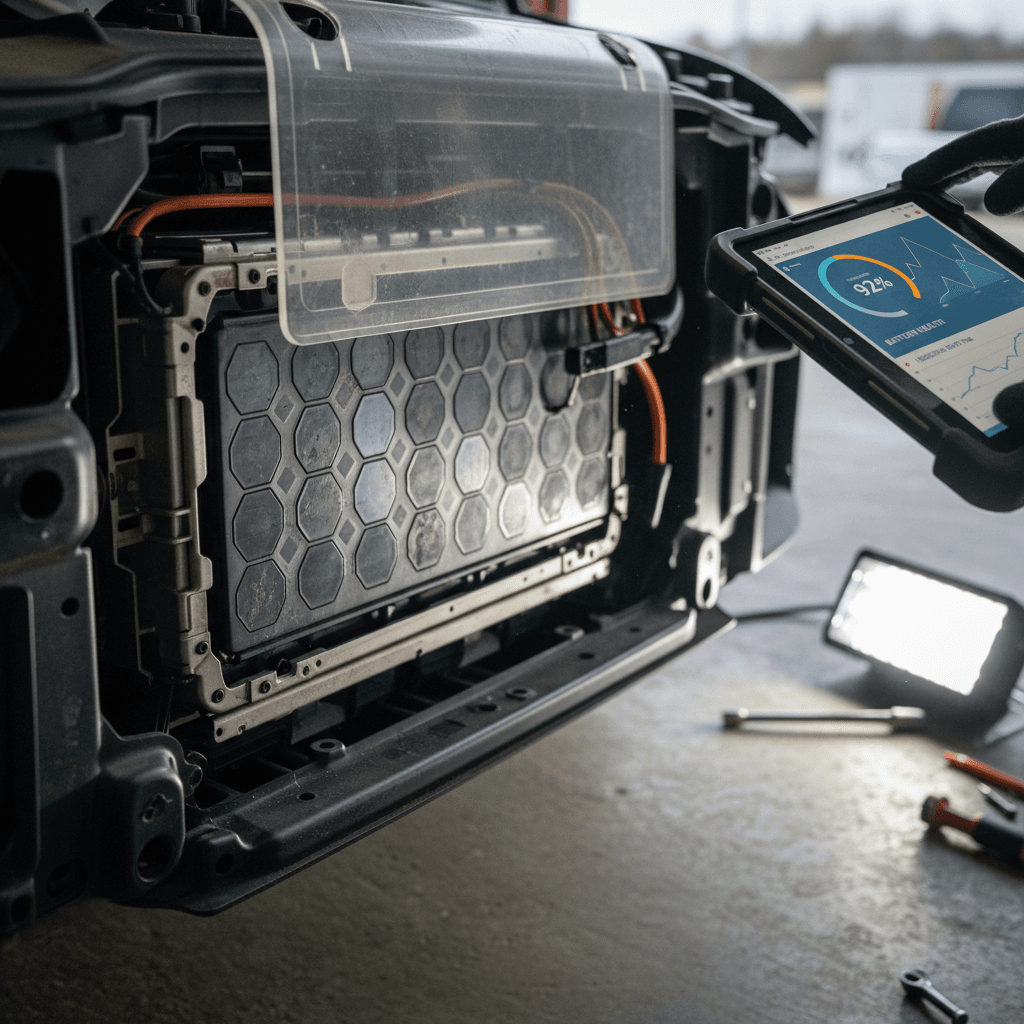
Raw voltage or state‑of‑charge readings aren’t enough. A purpose‑built diagnostic, like the <strong>Recharged Score battery health assessment</strong>, analyzes pack health, degradation, and balance across modules.
5. Road‑test for range behavior
On a decent‑length test drive, watch how predicted range drops relative to miles driven. Sudden, inconsistent swings can hint at underlying health or calibration issues that deserve a deeper look.
6. Watch for warning lights or reduced‑power modes
Any high‑voltage battery or drivetrain warnings, or repeated reduced‑power behavior, warrant a proper diagnostics session before you buy.
Don’t rely on range alone
How Recharged evaluates BMW i4 battery health
Because Recharged focuses on used EVs, including the BMW i4, we treat the battery like the heart of the car, not an afterthought. Every vehicle on our marketplace comes with a Recharged Score Report that digs into battery health in a way a casual test drive simply can’t.
What the Recharged Score tells you about a BMW i4 battery
Data‑driven, model‑specific, and designed for EV shoppers, not engineers.
Verified pack health
We use model‑appropriate diagnostics to assess the health of the i4’s high‑voltage battery, beyond simple range estimates, looking at degradation patterns, balance across modules, and error histories where available.
Fair market pricing
Battery health feeds directly into how we price each BMW i4. If one car’s pack is in better shape than another’s, that’s reflected in the Recharged Score and in the price you see.
Transparent ownership picture
You see how the battery’s condition impacts long‑term cost of ownership, not just today’s sticker price. That’s especially helpful if you plan to keep the car for many years.
Ready to find your next EV?
Browse VehiclesIf you’re trading in an EV or selling one, that same level of analysis works in your favor. Recharged can provide an instant offer or consignment, and our nationwide digital process makes it easy to move into another EV, like a BMW i4, with confidence in the battery you’re getting.
Want a second opinion on an i4 you found elsewhere?
BMW i4 battery lifespan FAQ
Frequently asked questions about BMW i4 battery life
Bottom line: is BMW i4 battery lifespan a concern?
For most drivers, BMW i4 battery lifespan isn’t something to fear, it’s something to respect. The pack is engineered to go 10–15 years and well beyond 150,000 miles, with a long warranty standing behind it in the early part of that journey. Treat it well, and you’re likely to see only modest, gradual range loss over the life of the car.
Where it does become critical is in the used market. Two BMW i4s that look identical on paper can have very different battery stories, and therefore very different ownership costs. That’s why Recharged puts battery health at the center of every listing with our Recharged Score Report, expert EV guidance, and nationwide digital buying experience.
If you’re ready for an i4, or just EV‑curious, start by exploring used electric vehicles on Recharged. You’ll see verified battery health, fair pricing, financing options, trade‑in support, and delivery, all from your couch. That way, when you finally take home your BMW i4, you’ll know the battery underneath you is built, and proven, to go the distance.