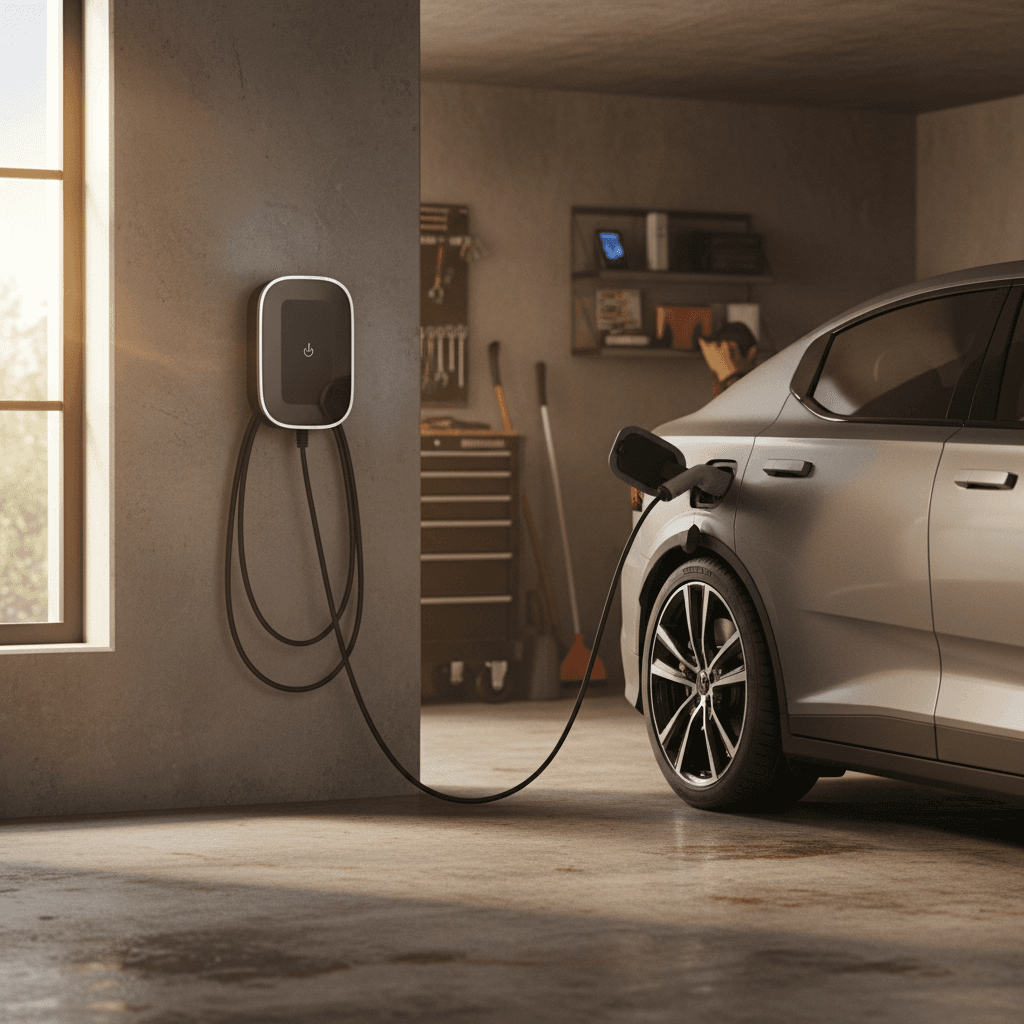
If you own an EV in 2025, a reliable home Level 2 charger is quickly shifting from nice-to-have to non‑negotiable. With residential chargers capturing well over half of all EV charging demand and global home-charger sales growing at double‑digit rates each year, picking the best home EV charger isn’t just about speed, it’s about safety, comfort, and future resale value for your home and your car.
Home is where most charging happens
Why home EV chargers matter in 2025
Home EV charging by the numbers
Most new EV owners start with the portable Level 1 cord that came in the trunk. It works, but at just 3–5 miles of range per hour on a 120V outlet, it can take days to fill a modern battery. A Level 2 charger running on a 240V circuit can add 15–40+ miles of range per hour. That’s the difference between waking up full every day and planning your life around public charging stops.
Home charging is also where you can save real money. When you combine a smart Level 2 charger with off‑peak electricity rates, or even rooftop solar, you can shrink your energy costs to just a few cents per mile. And if you ever sell your home, an installed, well‑sized charger increasingly looks like stainless appliances or fiber internet: a baseline expectation for buyers shopping in EV‑heavy markets.
Quick picks: Best home EV chargers right now
Top home EV chargers by use case
All of these are Level 2 (240V) units that work well in North American homes. Always confirm compatibility with your specific vehicle.
Best overall: ChargePoint Home Flex
Why it stands out: Widely reviewed, polished app, and flexible 16–50A output that fits everything from older panels to new construction.
- Amps: Up to 50A (hardwired or plug‑in)
- Connectors: J1772, NACS versions emerging via adapters and new SKUs
- Best for: Most single‑EV households that want a mature app and utility integration.
Best value: Emporia Smart EV Charger
Why it stands out: Often priced well under big-name rivals but still offers robust smart features and solar/load-management options.
- Amps: Up to 48A
- Connectors: J1772
- Best for: Budget‑minded buyers who still want smart scheduling and detailed energy data.
Best for Tesla & future‑proofing: Tesla Universal Wall Connector
Why it stands out: Tesla’s latest wall unit now supports both NACS and CCS1/J1772 via its built‑in adapter on compatible trims, simplifying life as more brands adopt Tesla’s plug.
- Amps: Up to 48A
- Connectors: Native NACS + integrated adapter for many non‑Tesla EVs
- Best for: Tesla households and buyers who expect their next EV to use NACS.
Start with your electrical panel
Top home EV chargers in 2025: Model profiles
There’s no single “best” charger for everyone. Instead, you’re balancing price, amperage, smart features, connector type, and how much you want to future‑proof for your next EV. Below are five standout models that consistently test well and show up at the top of independent reviews in 2025.
Comparison: Popular home Level 2 chargers in 2025
Key specs you’ll actually feel day‑to‑day: power, cord length, and smart features.
| Model | Max Amps / kW | Connector | Approx. Price | Smart App | Cable Length |
|---|---|---|---|---|---|
| ChargePoint Home Flex | 50A / up to 12 kW | J1772 or NACS variant | $549–$649 | Yes (ChargePoint) | 23–25 ft |
| Tesla Universal Wall Connector | 48A / ~11.5 kW | NACS + integrated adapter | ~$650 | Yes (Tesla app) | 24 ft |
| Emporia Smart EV Charger | 48A / ~11.5 kW | J1772 | ~$399–$429 | Yes (Emporia app) | 24 ft |
| Wallbox Pulsar Plus | 48A / ~11.5 kW | J1772 | ~$599 | Yes (Wallbox app) | 25 ft |
| Grizzl-E (Classic/Duo) | 40A / 9.6 kW (per port on Duo) | J1772 | ~$349 (single), $799 (Duo) | Limited (rely on vehicle) | 24 ft |
Pricing is approximate street pricing as of late 2025 and will vary by retailer and incentives.
If your EV uses a J1772 inlet (common on many non‑Tesla models through the 2020s), any of these J1772 chargers will work with no extra hardware. If you drive a Tesla, or another brand that has moved to the NACS port, you can either use a J1772 charger with an adapter, or go with a NACS‑native unit such as Tesla’s Universal Wall Connector or newer NACS versions of popular chargers as they roll out.
Watch for NACS–CCS transitions
How fast will a home EV charger actually charge?
On paper, most popular home chargers look similar: 40–50 amps, around 9.6–11.5 kW. In practice, charging speed depends on three things:
- Your EV’s maximum AC charging rate (often 7.2–11.5 kW).
- The charger’s maximum amperage, after you set its limit in the app or on the unit.
- Your home circuit’s breaker size and wiring (e.g., 40A vs 60A circuit).
A useful rule of thumb: every 1 kW of AC charging adds roughly 3–4 miles of range per hour for many EVs. So a 9.6 kW charger (40A on a 240V circuit) might add 30–40 miles per hour, while a 11.5 kW unit can add 35–45+ miles, assuming your car can accept it.
Level 1 (120V)
- 3–5 miles of range per hour.
- Fine for plug‑in hybrids or very short commutes.
- No electrician needed, but outlets can be overloaded if misused.
If you routinely drive more than 30–40 miles a day in a full EV, Level 1 usually isn’t enough.
Level 2 (240V)
- 15–80 miles of range per hour, depending on amps and the vehicle.
- Great fit for most daily drivers, including used EVs with larger batteries.
- Requires a dedicated 240V circuit and usually a licensed electrician.
For most Recharged customers buying used EVs, a 32–48A Level 2 charger hits the sweet spot between speed and installation cost.
Don’t overspend on excess amps
Key features to compare when choosing a charger
What to look for in the best home EV chargers
1. Amperage and adjustability
Look for a charger that can be dialed down in software or with a physical switch. A 48A unit that you can set to 32A gives you flexibility if you later upgrade your panel or move homes.
2. Connector type (J1772 vs NACS)
Today, J1772 still dominates non‑Tesla home charging, but NACS is becoming the North American standard. Make sure you have the right plug or a high‑quality adapter for your car.
3. Cord length and ergonomics
A 20–25 ft cable covers most driveways and garages without tight bends. Check how easy it is to coil the cord and holster the handle with one hand.
4. Weather rating and durability
If you’re mounting outdoors, look for at least a NEMA 3R, ideally NEMA 4/4X, enclosure. Metal housings like the Grizzl‑E can be more forgiving in harsh climates.
5. Smart features and app quality
Some owners are fine just plugging in and letting the car schedule charging. Others want detailed cost tracking, load sharing, and solar integration. Read app reviews before you buy.
6. Warranty and support
Three years is becoming the norm, with some brands offering longer coverage. Make sure there’s a clear support path if you ever need a replacement unit or firmware help.
Installation, electrical panels, and real-world costs
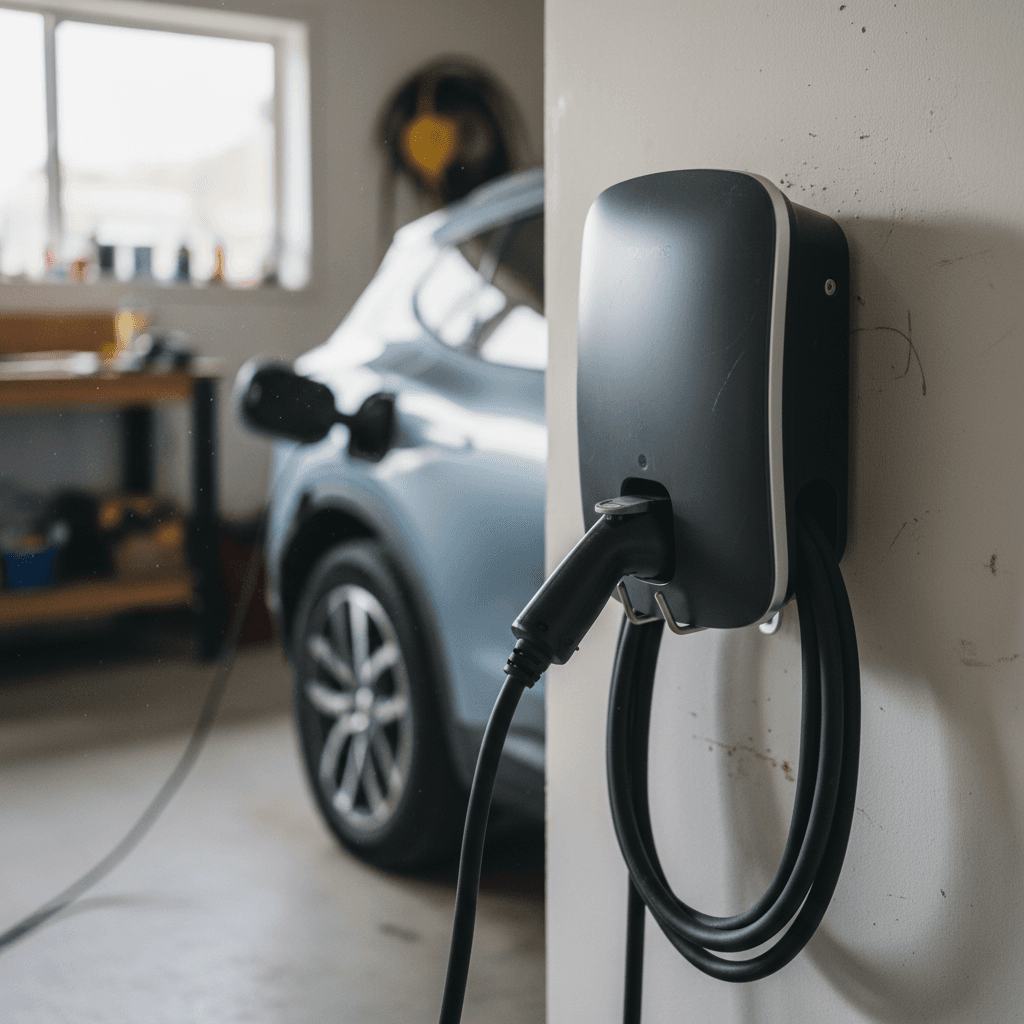
The sticker price of a charger is only half the story. The other half lives inside your breaker panel. A basic plug‑in install near an existing 240V outlet can be a few hundred dollars. A panel upgrade or a long trench to a detached garage can run into the thousands.
Typical home EV charger installation scenarios
Very rough ballpark ranges for U.S. single‑family homes. Actual costs vary by region, permit requirements, and panel condition.
| Scenario | Work involved | Typical Range |
|---|---|---|
| Simple plug‑in install | Install NEMA 14‑50 outlet next to panel; short conduit run | $300–$700 |
| Standard wall‑mount near panel | Hardwire charger, 20–30 ft of conduit, permit | $500–$1,200 |
| Detached garage, good panel capacity | Longer run (50–100 ft), trench or overhead, new breaker | $1,000–$2,500 |
| Panel upgrade needed | Service upgrade (100A → 200A), new panel + charger circuit | $2,000–$5,000+ |
Always get quotes from licensed electricians in your area before committing.
Safety first: hire a pro
If you’re buying a used EV through Recharged, you can talk through these scenarios with an EV specialist before you sign anything. Our team sees real‑world installs every week, from apartments experimenting with shared chargers to suburban garages getting solar‑ready panels. We can help you match a charger and installation approach to the car you’re considering and the home you live in.
Smart charging, time-of-use rates, and solar
The smartest home EV chargers don’t just pump electrons, they pay attention to when and how they do it. In many utility territories, overnight rates are far cheaper than late‑afternoon peaks. A good charger or vehicle app can automatically shift your charging to those off‑peak windows.
Ways smart chargers save you money
Not every household needs every feature, but these three are worth paying attention to.
Time-of-use scheduling
Tell your charger to run from midnight to 6 a.m. and let it do the rest. Combine that with a 40A+ unit and you’ll still wake up full even after a long day of driving.
Solar integration
Some chargers, like Emporia, can talk to your solar inverter or a separate power meter so you can prioritize charging from excess solar generation rather than grid power.
Detailed energy tracking
Apps from ChargePoint, Emporia, and others make it easy to see exactly how many kWh and dollars your EV used last month, useful for taxes, work reimbursement, or just keeping a budget.
"As EV adoption climbs, the biggest savings for drivers increasingly come from how they manage home charging, not from shaving a few cents off public fast‑charging sessions."
Rebates, tax credits, and builder programs
Before you pull out a credit card, check what incentives exist in your state or city. Between federal credits, state energy‑office programs, and utility rebates, many U.S. homeowners can claw back a meaningful chunk of their charger and installation costs.
- Federal incentives that can reduce the cost of qualifying charging equipment and installation in certain locations.
- State and city programs that add flat rebates or percentage‑based discounts for home chargers, especially when paired with time‑of‑use rate plans.
- Utility‑run programs that give you a free or discounted smart charger if you agree to off‑peak charging or occasional managed‑charging events.
- Automaker promotions, Ford’s free home‑charger initiatives are a good example, that effectively bundle a Level 2 unit with the purchase or lease of a new EV for a limited time.
Document everything
How to match a home charger to your life
Different drivers, different ideal chargers
Apartment & condo drivers
Look for shared charging options before investing in your own hardware, your building may be planning common chargers.
If outlets are scarce, a portable 32A unit you can plug into a 240V receptacle at work or a friend’s house may be more useful than a wall‑mount at home.
Check with property management about approved equipment and mounting locations before buying anything.
Suburban single‑EV household
A 32–40A wall‑mount charger near your parking spot is usually plenty for one EV and a moderate commute.
Favor reliability, outdoor rating, and app scheduling over cutting‑edge features you’ll rarely use.
If you’re shopping a used EV through <strong>Recharged</strong>, ask your specialist to sanity‑check your planned setup against your panel and driving habits.
Multi‑EV or growing family fleet
Consider load‑sharing chargers (like pairs of Emporia or Wallbox units) that can dynamically divide power between two vehicles.
You might not need two 48A circuits; two 30–40A circuits with smart sharing can still cover most overnight charging.
Plan conduit runs and panel space now for the second charger, even if you only install one unit this year.
Road‑trip and high‑mileage drivers
Invest in a 48A charger and make sure your EV’s onboard charger can actually use it.
Use smart scheduling to fully exploit off‑peak windows, especially if you regularly arrive home late with a low battery.
If public fast charging will still be a regular part of your life, choose a home charger with excellent session logging so you can track total fueling costs across all networks.
FAQ: Best home EV chargers
Frequently asked questions about home EV chargers
Bottom line: Picking the best home EV charger
The best home EV charger in 2025 isn’t the one with the highest amp rating or the flashiest app. It’s the one that matches your panel, your driveway, your driving habits, and the mix of EVs you’re likely to own over the next decade. For many households, a 32–48A Level 2 charger from a reputable brand, ChargePoint, Tesla, Emporia, Wallbox, or Grizzl‑E, will quietly do its job for years with only the occasional firmware update.
If you’re early in the journey and still deciding which EV to bring home, you don’t have to make these choices alone. Recharged pairs every used EV we sell with a transparent battery‑health report and one‑on‑one guidance on day‑to‑day ownership, including charging. Talk with an EV specialist about your commute, panel, and budget, and you can roll into your driveway with both the right car and the right charger plan in place.