Choosing the best electric car for teens in 2026 is a balancing act. You want something that’s safe, slow enough to keep their impulses in check, affordable to buy and insure, and still cool enough that they’re not begging for your keys instead. The good news: today’s crop of small electric cars and crossovers can check all those boxes if you know what to look for, especially if you’re open to a smart used EV.
Quick take
Why an electric car can be a smart first car in 2026
Core reasons EVs work well for teen drivers
Safety, simplicity, and predictable costs help parents sleep better
Built-in safety tech
Predictable performance
Lower running costs
On top of that, an EV naturally encourages good habits. Teens who plug in at home overnight tend to start each day with a full “tank,” which makes them less likely to push their luck on a low-fuel light. And because range is finite, they’re less tempted to disappear for impromptu 300‑mile road trips without a plan.
One catch: charging access
How to judge safety: ratings, size, and driver-assist tech
Why safety matters so much for teen drivers
When you’re picking an EV for a young driver, treat safety ratings as a hard gate. Once a car passes that, you can weigh style, features, and price. In 2026, the best information still comes from the Insurance Institute for Highway Safety (IIHS) and the National Highway Traffic Safety Administration (NHTSA). Look for EVs that earn IIHS Top Safety Pick or Top Safety Pick+ in recent model years and 5‑star overall ratings from NHTSA where available.
- Focus first on small and midsize hatchbacks and crossovers, they’re easier to maneuver and park than big SUVs or trucks.
- Within a size class, pick models with the best crash-test scores and strong rear-seat protection; that’s where their friends will sit.
- Make sure advanced driver-assistance features like forward collision warning, automatic emergency braking, and lane-keeping assist are standard, not buried in pricey option packages.
- Avoid high-performance variants and huge wheels. You don’t want a teen’s first car to be a 3‑second 0–60 missile with ultra‑low‑profile tires.
How to sanity-check safety quickly
Best new electric cars for teens in 2026 (U.S.)
This isn’t a list of the flashiest or quickest EVs, it’s a curated group of 2025–2026 models that line up well for teen drivers in the U.S. market based on safety focus, practicality, and price. Always confirm current incentives and safety scores for the specific model year and trim you’re considering, because ratings can change with updates.
New EVs worth a close look for teen drivers (2025–2026 MY)
Representative trims and specs; always verify details for the exact model you’re shopping.
| Model | Vehicle type | Why it works for teens | Approx. base MSRP (2026) |
|---|---|---|---|
| Hyundai Kona Electric | Subcompact SUV | Strong safety tech suite, tidy size for parking, reasonable power and range; widely available used and new. | Low–mid $30,000s before incentives |
| Hyundai Ioniq 5 | Small SUV | IIHS Top Safety Pick+ in recent years with excellent crash-test performance and advanced driver assists; more space for growing families. | Mid–high $40,000s |
| Chevrolet Equinox EV | Compact SUV | Designed as a value EV with modern safety features and good range; a practical choice if you want a roomy family-and-teen vehicle. | Mid $30,000s (varies by trim and incentives) |
| Nissan Leaf (latest generation) | Compact hatchback | One of the more affordable new EVs with simple controls; modest performance makes it appropriate for inexperienced drivers. | High $20,000s–low $30,000s |
| Volkswagen ID.4 | Compact SUV | Good space and everyday comfort, plus robust safety and driver-assist offerings; a solid fit for taller teens or shared family use. | Mid–high $30,000s |
Key safety- and budget-friendly traits for new EVs that suit teen drivers.
Why you don’t see performance EVs on this list
Best used electric cars for teens: high value, lower cost
If you’re trying to keep the budget in line, or simply don’t want to hand a brand‑new vehicle to a brand‑new driver, a used electric car can be a fantastic choice. EVs like the Chevrolet Bolt EV and EUV, older Hyundai Kona Electric models, and early Volkswagen ID.4s routinely undercut new-car prices while offering modern safety and driver-assist features.
Used EV standouts for teen drivers (typical 2019–2024 models)
These used EVs often combine strong safety, reasonable range, and approachable pricing.
| Model | Typical used price range* | Pros for teen drivers | Potential cautions |
|---|---|---|---|
| Chevrolet Bolt EV / Bolt EUV | Often mid–high teens to low $20,000s depending on age and miles | Compact footprint, good crash scores for many years, strong range for commuting and school; widely available nationwide. | DC fast-charging is slower than some newer EVs; confirm recall and battery replacement history. |
| Hyundai Kona Electric (earlier years) | Generally high teens to mid $20,000s | Small SUV body, plenty of range, good safety tech for the era; many off-lease examples. | Check for battery warranty coverage and any open software or charging updates. |
| Nissan Leaf (2nd generation) | Mid-teens to low $20,000s | Simple to drive, modest performance, often the least expensive EV on many used lots. | Earlier batteries may have more degradation; CHAdeMO fast charging is being phased out in many areas. |
| Volkswagen ID.4 (early years) | Low–mid $20,000s+ depending on trim and options | Spacious cabin, advanced safety tech, comfortable ride for parents and teens alike. | Early software versions could be buggy; verify updates and test-drive all driver-assist systems. |
| Kia Niro EV (previous generation) | High teens to low $20,000s | Compact crossover footprint, decent range, good set of safety features. | Availability can be regional; confirm charging port and cable condition. |
Used EVs that frequently represent good value and appropriate performance for young drivers.
Used EV caution: don’t guess on battery health
Battery health, range, and charging for a teen’s daily life
How much range does a teen really need?
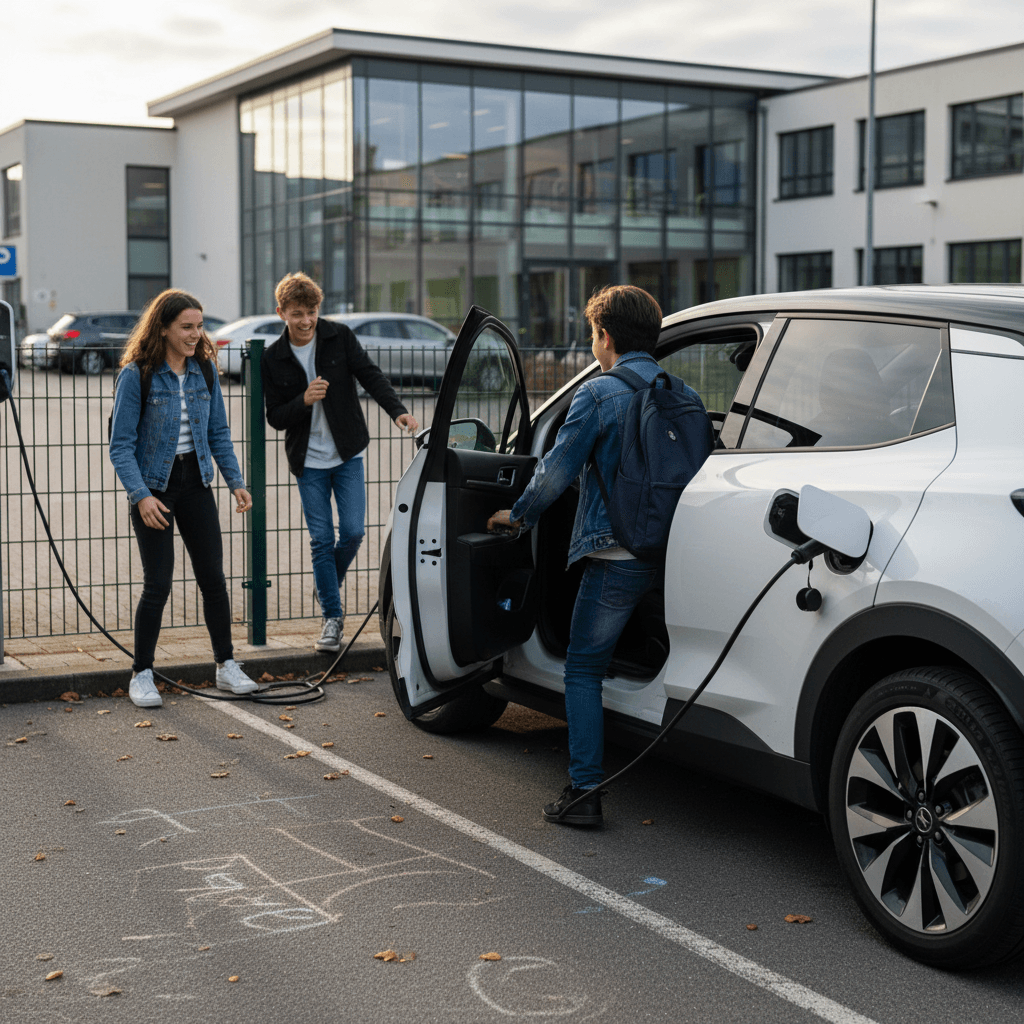
Most teens drive short hops, school, practice, part-time work, friends’ houses. For that pattern, a car that can reliably deliver 120–180 miles of real-world range between charges is usually more than enough. Extra range is nice to have but shouldn’t be your main decision driver if it forces you into a more expensive or more powerful car.
What matters most is healthy, predictable range and a charging routine that fits your home situation.
Understanding battery health in plain English
Battery health is essentially how much of the original capacity remains. A car that started with a 64 kWh pack but has 90% health effectively feels like a ~58 kWh battery in daily use. That translates directly into range.
For a teen driver, aim for an EV whose battery can still support your family’s typical week without constant fast charging or range anxiety.
Use data, not guesswork, on battery health
- If you have only 120‑volt (Level 1) charging, expect slower refills, still fine for 20–40 miles a day, but not ideal if they stack long trips.
- Adding a 240‑volt (Level 2) circuit at home usually lets a typical EV recover 20–35 miles of range per hour of charging, perfect for overnight.
- Teach your teen to avoid living on fast charging. It’s a useful tool on highway trips, but constant rapid charging can accelerate battery wear.
Costs, budget, and insurance realities for young EV drivers
EVs can save money on fuel and maintenance, but teenage drivers are still expensive to insure, and new electric cars aren’t cheap. It’s important to look at the whole cost picture: purchase price (or monthly payment), insurance, charging, and maintenance over several years.
Cost factors to weigh for a teen’s EV
Think beyond the sticker price to the full ownership picture.
Purchase price & payment
Insurance
Charging & maintenance
Financing help without guesswork
Checklist: buying an electric car for your teen
Step-by-step checklist for a smart teen EV purchase
1. Confirm your charging situation
Decide where the car will live at night and what power you have available. Can you add a 240‑volt circuit in the garage or driveway? Is there reliable charging at their school or job if needed?
2. Set a realistic total budget
Include taxes, fees, and the cost to add a home charger if necessary. Then get insurance quotes on a few likely candidates so you understand the full monthly cost, not just the loan payment.
3. Shortlist safe, right-sized models
Focus on small hatchbacks and crossovers with strong IIHS and NHTSA scores, standard driver-assist features, and moderate performance. Avoid heavy trucks or oversized SUVs for first‑time drivers.
4. Prioritize verified battery health
For used EVs, insist on an independent battery health report, not just the dash estimate. A platform like Recharged provides a <strong>Recharged Score Report</strong> so you can compare vehicles apples‑to‑apples.
5. Test drive with your teen, not just for them
Let them drive the car on familiar roads. Pay attention to visibility, ease of parking, how intuitive the controls are, and whether the driver-assist features behave predictably.
6. Set expectations and boundaries
Before you sign, agree on rules: who pays for energy, mileage limits if needed, where they can drive, whether friends are allowed in the car initially, and how you’ll handle speeding tickets or at‑fault accidents.
How Recharged helps families buy used EVs confidently
Shopping for a used electric car for a teen can feel intimidating if you’re used to conventional vehicles. You’re not just kicking tires, you’re trying to evaluate battery life, software, and charging hardware on top of the usual concerns. That’s where a specialist marketplace like Recharged can simplify the process.
Battery health made transparent
Every vehicle on Recharged comes with a Recharged Score Report, which includes verified battery diagnostics, real‑world range estimates, fair market pricing data, and a clear explanation in plain language. Instead of hoping the battery is fine, you see exactly how it stacks up against similar EVs.
For a teen driver, that clarity translates into predictable daily range and fewer surprises the week after you bring the car home.
Support from EV specialists
Recharged pairs that data with EV‑specialist support. Whether you’re asking if a Bolt EV or Kona Electric is better for a nervous new driver, or wondering how a specific car’s battery health will feel in winter, you can get guidance from people who look at used EVs all day, not just once in a while.
Financing, trade‑in options, and nationwide delivery are built into a fully digital buying experience, and there’s even a physical Experience Center in Richmond, VA if you prefer to see vehicles in person.
FAQs: best electric car for teens in 2026
Frequently asked questions about EVs for teen drivers
Bottom line: the best EV for your teen in 2026
The best electric car for teens in 2026 isn’t the one with the longest range or the flashiest badge. It’s the one that quietly combines strong crash protection, standard driver-assistance tech, modest performance, and a price you can live with, ideally backed by clear battery-health data and a support team that understands EVs. For many families, that will mean a well‑chosen small crossover or hatchback, often bought used rather than new.
If you’re ready to start shopping, use the checklist in this guide, verify safety scores, and don’t compromise on battery health transparency. A marketplace like Recharged can streamline that process with Recharged Score Reports, EV‑savvy advisors, and flexible financing so you can put your teen into the right electric car, not just the first one that looks good on the lot. Done right, their first EV can be safe, affordable, and confidence‑building, for them and for you.