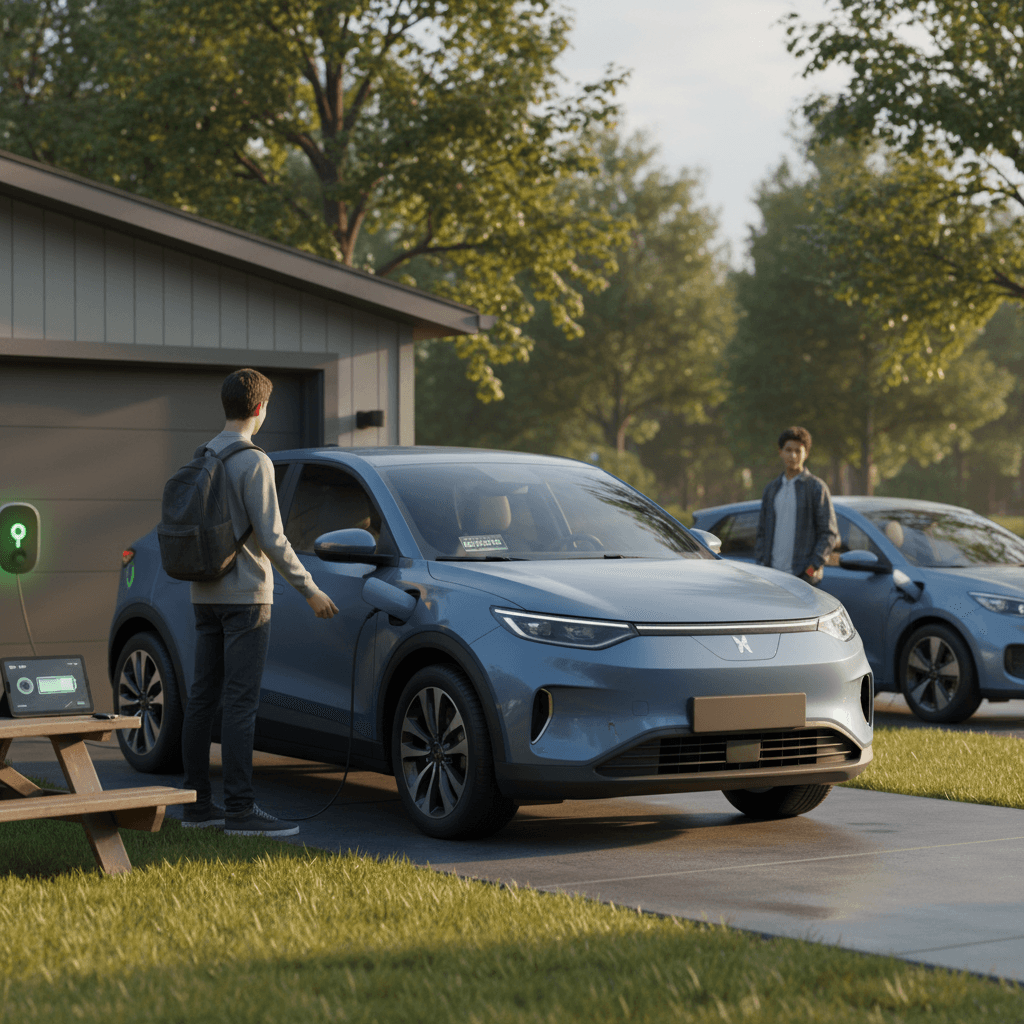
If you’re shopping for the best electric car for teenagers in 2026, you’re trying to solve a tough puzzle: keep your teen safe, keep monthly costs in check, and still give them a car they’ll actually want to drive. The good news is that today’s EVs, especially the right used ones, can hit that sweet spot when you know what to look for.
The ideal teen EV in one sentence
Why an EV can be a great first car for teens
Built‑in safety and tech
- Most modern EVs include automatic emergency braking, lane‑keeping assistance, and multiple cameras as standard equipment.
- Instant torque is fun, but software also allows manufacturers to limit speed and acceleration with teen‑driver settings.
- Over‑the‑air updates can improve safety systems and fix bugs without a trip to the dealer.
Predictable running costs
- Electricity is typically cheaper per mile than gasoline, and EVs have fewer moving parts to maintain, no oil changes, timing belts, or exhaust system.
- For a teen mostly driving to school, work, and practice, a modest‑range EV can slash fuel bills.
- Used EVs have dropped sharply in price since 2023, making them surprisingly competitive with used gas compacts.
The catch: insurance and repair costs
How to choose the best electric car for a teenager
Instead of starting with a specific model, start with a checklist of what your teen really needs. You’re looking for the right size, safety, range, performance, and total cost, not just the coolest badge on the grille.
Key priorities for a teen’s first EV
Use these as non‑negotiables before you look at specific models
Top‑tier safety
Look for strong crash ratings from IIHS and NHTSA, plus standard driver‑assist features like automatic emergency braking and lane‑keeping assist.
Affordable to own
Compare not just purchase price, but insurance, charging costs, and maintenance. A slightly higher price can still win if monthly costs are lower.
Sensible performance
Skip the wild 0–60 times. For new drivers, prioritize smooth response and good visibility over raw speed.
- Compact or small SUV size (easier to park and maneuver, but with enough crash protection).
- At least one full suite of active safety tech (automatic emergency braking, lane‑keeping, blind‑spot monitoring).
- Real‑world range that comfortably covers a week of school and activities with simple home or workplace charging.
- Solid reliability record and, on used EVs, remaining battery warranty coverage.
- No “performance” or track‑focused variants that encourage risky driving.
Think like an insurance underwriter
Top electric cars for teenagers in 2026
With hundreds of EV nameplates worldwide, this list focuses on models that are widely available in the U.S. used market by 2026, offer strong safety tech, and don’t break the bank. In many cases, buying used instead of new is the smarter play for a teen.
Best electric cars for teenagers in 2026 (high‑level snapshot)
Representative trims and years that balance safety, value, and teen‑friendly driving manners.
| Model (Used) | Body Style | Why it works for teens | Typical used price* |
|---|---|---|---|
| Chevrolet Bolt EV (2019–2023) | Compact hatchback | Small, easy to park, strong safety tech, great value in used market | Low‑ to mid‑$10,000s |
| Hyundai Kona Electric (2020–2023) | Subcompact SUV | Higher seating position, good range, lots of standard features | High‑teens to around $20,000 |
| Nissan Leaf Plus (2019–2022) | Compact hatchback | Affordable, simpler tech, enough range for local use | Often under $15,000 |
| Hyundai Ioniq 5 (2022–2024) | Compact SUV | Excellent safety tech, roomy for growing teens and gear | Low‑ to mid‑$20,000s |
| Volkswagen ID.4 (2021–2024) | Compact SUV | Family‑friendly, calm driving manners, good crash protection | High‑teens to mid‑$20,000s |
Always verify safety ratings and equipment for the exact model year and trim you’re considering.
About prices
Best used electric cars for teen drivers
New EVs are nice, but putting a brand‑new electric car in the hands of a brand‑new driver is rarely the smartest financial move. A carefully chosen used EV can deliver the same safety tech and daily usability for thousands less, and you won’t lose as much sleep over the first door ding in the school parking lot.
Used EV picks that make sense for teens
These models tend to balance price, safety and practicality in 2026
Chevrolet Bolt EV
A perennial value champion among used EVs. The Bolt’s compact size and strong efficiency make it ideal for commuting and campus life.
- Simple, upright cabin with good visibility.
- Plenty of range for a week of typical teen driving.
- Watch for battery recall work already completed on earlier years.
Hyundai Kona Electric
A small SUV shape many teens and parents prefer. Later‑model Konas gained more interior space and tech, while 2020–2023 models can be sharply priced.
- Comfortable seats and easy‑to‑use controls.
- Good real‑world range for daily driving and weekend trips.
- Look for examples with remaining battery warranty coverage.
Nissan Leaf (especially Leaf Plus)
The Leaf isn’t glamorous, but that’s part of its charm for parents. It’s slower than most new EVs, has a straightforward interior, and earlier models can be very affordable.
- Best suited for short to moderate commutes.
- Later "Plus" models have more range; avoid very short‑range early cars for teens with long drives.
- Older fast‑charging tech (CHAdeMO), but fine if your teen charges mostly at home.
Hyundai Ioniq 5 and Volkswagen ID.4
These compact SUVs cost more than a used Leaf or Bolt, but they also bring stronger crash protection, more space, and a more modern feel.
- Good pick if the EV will be shared with the rest of the family.
- Comprehensive safety tech suites are common on 2022+ models.
- Look at total monthly cost, not just purchase price, especially insurance.
Where Recharged fits in
Ready to find your next EV?
Browse VehiclesSafety first: crash tests and driver assistance
Why safety should be your starting point
Two organizations set the tone for vehicle safety ratings in the U.S.: the Insurance Institute for Highway Safety (IIHS) and the National Highway Traffic Safety Administration (NHTSA). When you’re shortlisting EVs for a teen, focus on models that earn high marks from both, particularly under the latest (stricter) testing criteria.
- Aim for IIHS Top Safety Pick or Top Safety Pick+ where available, and at least a 4‑ or 5‑star overall rating from NHTSA.
- Check that forward collision warning and automatic emergency braking are standard, not optional on a long‑lost package.
- Prioritize vehicles with lane‑keeping assist and blind‑spot monitoring, especially for highway‑heavy driving.
- If the car has teen‑driver or valet modes, use them to limit speed, audio volume, and time of day when the vehicle can be driven.
Avoid the “fast one”
Insurance and total cost of ownership for teen EVs
Putting a teen on the road is expensive no matter what you buy. EVs can be a mixed bag: they usually cost less to "fuel" and maintain, but their higher purchase prices and repair costs can push insurance premiums north of what you’d pay for a basic gas sedan.
Why EV insurance can be higher for teens
- EVs often cost more to repair after a crash, and some low‑speed collisions can total the car if the battery is damaged.
- Insurers price in the strong acceleration of many EVs, which can correlate with harder launches and rear‑end impacts from inexperienced drivers.
- Advanced driver‑assist sensors in bumpers and windshields are costly to replace.
Ways to keep premiums in check
- Get quotes before you commit to a specific model, different EVs can vary widely.
- Ask about discounts for telematics or safe‑driver programs that monitor behavior.
- Consider listing the teen as an occasional driver on a family policy rather than taking out a separate policy, if allowed.
- Avoid performance trims and large luxury EVs; insurers see them as higher risk.
Include electricity in your budget
Range, charging and where your teen will drive
The right amount of range for a teen isn’t "as much as possible", it’s enough to cover their weekly routine with some buffer, without paying extra for capacity they’ll rarely use. For most high‑schoolers and college students, a real‑world range of 150–250 miles is plenty.
Match the EV to your teen’s driving pattern
Think in miles per week, not marketing claims
Mostly school and activities
If most trips are to school, work, and sports within 10–15 miles, even shorter‑range EVs can work.
- Home Level 2 charger is ideal.
- Can often charge just a few times per week.
Longer commute or college
For 30–50‑mile one‑way commutes or off‑campus housing, look for 200+ miles of real‑world range.
- Check for charging at school or work.
- Make sure winter range is still sufficient.
Limited home charging
If you can’t install home charging (apartments, street parking), prioritize EVs with good DC fast‑charging performance and access to public stations.
- Teach your teen how to plan charging stops.
- Look up networks near school and work.
Don’t ignore the charging plan
Should you buy or lease an EV for a teenager?
Because EV tech is evolving quickly and teens don’t stay teenagers for long, many families wrestle with the buy‑versus‑lease decision. There’s no universal right answer, but there are patterns that tend to work well.
Leasing an EV for a teen
- Good if you want a new car with the latest safety tech for a fixed period.
- Mileage limits can be a headache for teens with unpredictable driving habits.
- Excess wear charges are more likely with new drivers (curbed wheels, bumper scrapes).
- Works best when an adult is the primary driver and the teen uses the car occasionally.
Buying a used EV instead
- Often delivers more car for the payment versus leasing new.
- You’re not on the hook for lease‑end inspections or mileage overages.
- A well‑chosen used EV can later be passed down to younger siblings.
- Pairing a used EV with a verified battery‑health report (like a Recharged Score) keeps surprises to a minimum.
Recharged can simplify the decision
Checklist for buying a used EV for your teen
10 steps to a smart teen‑EV purchase
1. Define the daily driving radius
Estimate your teen’s typical miles per day and per week, then add a buffer for unexpected trips. This will drive your minimum acceptable range.
2. Set a realistic all‑in budget
Include payment, insurance, registration, charging, and a small maintenance reserve. Decide what you can truly afford each month before you shop.
3. Shortlist safe, modest‑performance models
Focus on compact hatchbacks and small SUVs with strong safety ratings and sensible acceleration, not high‑performance variants.
4. Verify crash‑test ratings
Check both IIHS and NHTSA sites for the exact year and trim you’re considering. Not every version of a model earns the same ratings.
5. Confirm driver‑assist features
On a test drive, confirm that automatic emergency braking, lane‑keeping assist, and blind‑spot monitoring are present and functioning.
6. Review battery health carefully
Ask for a recent battery‑health report. Platforms like Recharged include a <strong>Recharged Score</strong> so you know how much usable capacity remains.
7. Check remaining warranties
Look at both basic and battery warranties. Many EV batteries carry 8‑year/100,000‑mile coverage from original in‑service date, hugely important for a teen car.
8. Inspect tires and brakes
EV torque can wear tires and brakes differently than gas cars. Ensure there’s plenty of life left, or budget for replacements soon after purchase.
9. Get insurance quotes on specific VINs
Before signing, call your insurer with the actual VINs of your top candidates. Premiums can vary dramatically between similar‑looking EVs.
10. Set ground rules and use tech tools
Once you buy, use teen‑driver modes, app‑based alerts, and clear family rules about passengers, night driving, and phone use behind the wheel.
Frequently asked questions about teenagers and EVs
Teen EV questions, answered
Bottom line: what’s the best electric car for teenagers in 2026?
When you cut through the marketing and the hype, the best electric car for teenagers in 2026 isn’t defined by a specific badge on the hood. It’s a compact, well‑rated EV that fits your teen’s daily life, charges easily, keeps insurance reasonably affordable, and has verified battery health so you’re not gambling on a major repair.
For many families, that will mean a used Chevrolet Bolt EV, Hyundai Kona Electric, Nissan Leaf Plus, Hyundai Ioniq 5, or Volkswagen ID.4, bought carefully, checked for safety and battery condition, and paired with clear rules and tech tools that encourage safe habits.
If you’d like help sorting through options, Recharged can streamline the process with transparent battery‑health reports, fair pricing, financing, and EV‑savvy guidance tailored to teen drivers. However you choose to shop, keep safety and total cost of ownership at the top of your list, and you’ll give your teenager what really matters: a car that gets them where they’re going, and back home, dependably and safely.