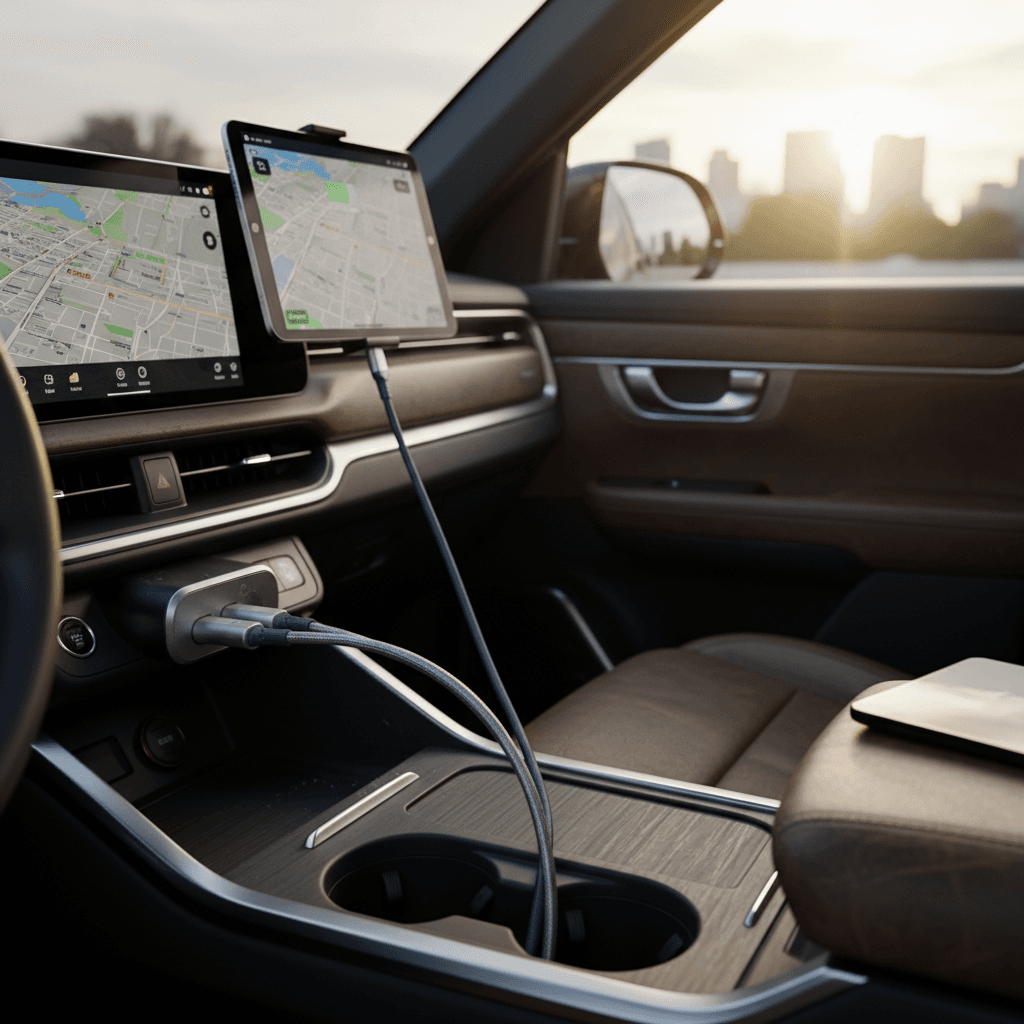
If you drive any modern EV or gas car, an auto USB-C charger has gone from “nice extra” to essential gear. Phones, tablets, and even lightweight laptops now charge over USB‑C, and the right in‑car charger can turn your center console into a fast, reliable power hub on every commute or road trip.
What we mean by “auto USB-C charger”
Why auto USB-C chargers matter in 2025
Over the last few years, USB‑C has become the default charging port for phones and accessories. Apple’s iPhone 15 and 16 families, modern Android flagships, wireless earbuds, e‑readers, and even many laptops now charge over USB‑C. That means the 12V outlet in your car is no longer just for a basic 5W charger, it can deliver serious power if you pick the right adapter.
The shift toward USB‑C and fast charging
When you’re depending on your phone for navigation, streaming, and payments, running out of battery halfway through a trip isn’t just annoying, it can be dangerous. A modern auto USB‑C charger solves that with fast charging that keeps up with heavy use instead of slowly losing ground.
How an auto USB-C charger actually works
An auto USB‑C charger plugs into your vehicle’s 12V accessory socket (or “cigarette lighter” port) and converts that 12V DC power into the 5–20V range that USB‑C devices expect. Inside the tiny housing is a DC‑DC converter, plus a controller chip that negotiates power with your device using fast‑charging protocols like USB Power Delivery (PD) or PPS.
Basic USB car charger
- Old‑school USB‑A port only
- Fixed 5V, ~2.4A (≈12W) output
- No communication with your device beyond basic USB
- Feels slow on modern phones and tablets
Modern USB‑C PD car charger
- USB‑C with Power Delivery (PD) up to 20V
- Negotiates power profiles (e.g., 9V/3A, 15V/3A)
- Often supports PPS (Programmable Power Supply) for Samsung and others
- Can safely deliver 30–100W when your device requests it
Tip: the weakest link sets your charging speed
Key specs to look for in a USB-C car charger
When you search for an auto USB‑C charger, product listings can feel like alphabet soup: PD3.0, PPS, 67W, GaN, QC 4.0. Here’s how to read those specs without needing an EE degree.
The four specs that matter most
Focus on these, and you’ll avoid 90% of bad purchases.
1. Total wattage (W)
This is the maximum power the charger can output across all ports combined. For phones and tablets, 30–40W total is fine. For laptops, look at 60–100W+ models.
2. Per‑port wattage
A “100W” charger might only give 30W per USB‑C port when two devices are connected. Check the per‑port breakdown chart in the listing, not just the big headline number.
3. Charging protocols (PD, PPS, QC)
USB PD is the baseline standard for modern USB‑C fast charging. PPS is extra useful for Samsung and some Android phones. Quick Charge helps with older devices, but is less critical today.
4. Safety & certifications
Look for over‑current, over‑temperature, and short‑circuit protection, plus certifications like UL and USB‑IF. This is what separates a $15 keeper from a $5 gamble on your phone’s battery.
Don’t chase more watts just for bragging rights
Single vs. multi‑port auto USB-C chargers
You’ll see compact single‑port chargers that sit nearly flush with the dashboard, and larger multi‑port bricks promising to charge the whole car. Both have their place, it comes down to how many devices you realistically charge at once.
Single‑port vs. multi‑port USB‑C car chargers
Use this to quickly decide which style fits your car and habits.
| Type | Best for | Typical power | Pros | Cons |
|---|---|---|---|---|
| Single USB‑C port | Solo drivers, minimalist setups | 20–45W | Small, clean look; fewer cables; often cheaper | Only one device fast‑charges at a time |
| Dual‑port (USB‑C + USB‑C or USB‑C + USB‑A | Driver + passenger phones | 40–90W total | Covers two phones, or phone + tablet; still compact | Power is split when both ports are active |
| Triple‑port | Families, road trips, rideshare | 60–130W+ | Can power phone, passenger phone, and accessory simultaneously | Bulkier; easier to over‑commit power if you plug in too many hungry devices |
For most drivers, a 2‑port charger hits the sweet spot between size and flexibility.
Most people should buy a dual‑port charger
Top auto USB-C charger examples in 2025
To make this concrete, here are a few representative auto USB‑C chargers you’ll see in 2025. These aren’t sponsored picks, think of them as reference points so you can recognize good specs and pricing when you shop.
Representative USB‑C car charger options
Use these as benchmarks when comparing products.
High‑power multi‑device: ~160W class
Chargers like Anker’s Nano Car Charger (≈167W, 3 ports) can push up to 100W on one USB‑C for a laptop, plus 45W on a second USB‑C and ~20W on USB‑A. Great for work trips with a MacBook, phone, and a third device all charging at once.
Mid‑range dual‑port: 60–90W
Brands like Ugreen, AINOPE, and LISEN sell 60–90W dual‑USB‑C chargers. Typical configurations: 45W + 45W or 65W + 25W. These are ideal if you want to fast‑charge two modern phones, or a phone plus a tablet or small laptop.
Budget everyday: 30–40W
Budget options from Ugreen, Baseus, and others offer 30–40W total with one USB‑C PD port and one USB‑A. Perfect if you mostly charge a single phone, with occasional use on a second older device.
A good car charger doesn’t just make your phone less likely to die, it lets you treat the downtime of driving as useful charging time, so you arrive with more flexibility at your destination.
Safety and reliability: what actually protects your devices
Cheap, no‑name car chargers usually cut corners on the one thing you can’t see: safety electronics. When you’re plugging $1,000+ worth of phone and laptop into a $9 adapter, it’s worth knowing what keeps voltage spikes and heat under control.
- Over‑current protection (OCP): Limits the amperage so a shorted cable or failing battery doesn’t pull more current than the charger or wiring can safely deliver.
- Over‑voltage protection (OVP): Prevents the charger from sending more voltage than the device negotiated, which can stress batteries and power management chips.
- Over‑temperature protection (OTP): Monitors internal temperature and throttles or shuts down if things get too hot, critical in summer or in tightly packed center consoles.
- Short‑circuit protection: Detects near‑instant drops in resistance and cuts power to avoid arcs or melted connectors.
- Certifications & testing: UL, ETL, and USB‑IF certification, plus published safety features, show the manufacturer invested in proper design and validation instead of just chasing the lowest price.
Avoid these red flags
Match the charger to your phone, tablet, or laptop
The best auto USB‑C charger for you depends on what you actually plug in. A 15W‑only iPhone doesn’t benefit from a 100W monster, but a USB‑C laptop will absolutely demand more than a bargain 20W adapter can dish out.
Modern iPhone (USB‑C)
- Look for 20–30W USB‑C PD.
- Any higher wattage mostly gives you headroom for other devices.
- Single‑port 30W or dual‑port 40–60W is plenty.
Android & Samsung Galaxy
- Samsung in particular benefits from PPS support for “Super Fast Charging”.
- A 45W PD/PPS port is ideal for recent Galaxy flagships.
- Other Android phones tend to max out between 25–45W.
Laptops & tablets
- Check your device’s USB‑C charger rating (e.g., 65W).
- Match or exceed that on at least one USB‑C port in the car charger.
- Don’t expect full performance on very power‑hungry gaming laptops from a 12V outlet.
How to check your device’s needs
Installation and real‑world usage tips
Once you’ve picked a good auto USB‑C charger, a few practical habits will help you get the most out of it and avoid clutter or damage over time.
Smart ways to use your auto USB‑C charger
1. Plan your cable routing
Use right‑angle USB‑C cables or short leads from the charger to your phone mount to keep the shifter area clear. For rear passengers, consider a slightly longer braided cable that can snake between seats without dangling near pedals.
2. Don’t block EV controls or storage
In many EVs, the 12V socket is near drive‑mode buttons or storage bins. Choose a low‑profile charger so you’re not constantly bumping it when grabbing sunglasses or switching drive modes.
3. Unplug in extreme heat
In very hot climates or when parking in direct sun, unplug the charger before you walk away. Electronics baking in a sealed car can age faster; removing the charger cuts that exposure.
4. Use labeled cables for different jobs
Mark one cable for high‑power devices (laptop/tablet) and another for casual phone charging. That way you’re less likely to use a flimsy freebie cable where you need a 100W‑rated one.
5. Test new setups on a short drive first
If you’re relying on the charger for navigation on a big road trip, test it on a short errand with your usual apps running. Confirm the battery level actually climbs instead of slowly dropping.
How in‑car USB-C charging fits into EV ownership
If you’re driving, or considering, a used EV, in‑car USB‑C charging is part of a bigger ecosystem: how you keep every device powered between home, public chargers, and the office. A solid auto USB‑C charger doesn’t replace home Level 2 charging, but it does make your cabin feel more like a rolling office or living room.
At Recharged, we focus heavily on battery health and charging behavior for the car itself through our Recharged Score, but it’s the little details, like whether the car’s 12V outlets, USB‑C ports, and wireless pad fit your life, that determine how enjoyable ownership feels day to day. When you browse used EVs on Recharged, it’s worth asking our EV specialists how owners typically set up phone mounts, auto USB‑C chargers, and accessories in a given model.
Thinking about upgrading your EV?
Quick checklist before you buy an auto USB-C charger
Auto USB‑C charger buying checklist
1. Confirm your devices and priorities
List what you’ll actually charge in the car, e.g., iPhone 16, passenger’s Android phone, occasional USB‑C laptop. That determines whether you need 30W, 60W, or 100W+ and how many ports make sense.
2. Choose wattage with a margin, not overkill
Aim for a bit more than your heaviest‑draw device needs, but don’t pay a premium for 150W+ bricks if you never plug in a laptop. For most drivers, <strong>60–90W dual‑port</strong> is a sweet spot.
3. Check for USB‑C PD (and PPS for Samsung)
Make sure the spec sheet lists <strong>USB Power Delivery</strong>. If you use a modern Samsung or other PPS‑enabled phone, look for PD + PPS specifically so you get the best possible fast‑charge behavior.
4. Read the per‑port power breakdown
Look for a table that shows how power is allocated with one, two, or three ports in use. This is where you find out if that 100W rating actually gives your laptop the 60–80W it wants when other devices are connected.
5. Look for safety features and real reviews
Favor brands that talk explicitly about over‑current, over‑voltage, and thermal protection, and skim reviews for themes around heat and reliability. A well‑built charger should feel warm under heavy load, not hot to the touch.
6. Pick cables that match the charger
Buy at least one USB‑C cable rated for the maximum wattage you intend to use (e.g., 100W). A high‑power car charger is only as good as the cable connecting it to your device.
Auto USB-C charger FAQ
Frequently asked questions about auto USB‑C chargers
Bottom line: choosing the right auto USB-C charger
An auto USB‑C charger is one of those small purchases that quietly rewires your daily driving experience. The right adapter turns your car into a fast‑charging hub where phones stay topped up, tablets survive road‑trip videos, and even laptops can gain meaningful charge between stops.
You don’t need to overspend or memorize every charging standard. Focus on wattage that matches your devices, at least one USB‑C PD port (with PPS if you’re a Samsung user), clearly stated safety protections, and enough ports for the people who actually ride in your car. From there, thoughtful cable choices and clean routing will do the rest.
If you’re also rethinking the vehicle itself, not just the charger, Recharged can help you evaluate used EV options, understand battery health, and set up home and on‑the‑road charging to fit your life. Pair a solid EV with a smart auto USB‑C charger, and you’ll spend far less time worrying about batteries and far more time just driving.