If you’re shopping for an electric SUV, the **Audi Q4 e-tron cost per mile to drive** is just as important as the sticker price. The good news: when you plug in at home, the Q4 e-tron is typically dramatically cheaper to run than a similar gas-powered luxury crossover, though fast charging can narrow that advantage.
Key idea
Audi Q4 e-tron cost per mile: the short answer
Typical Q4 e-tron cost per mile (U.S. averages)
Put simply, if you mostly **charge at home**, you’re likely in the **8–15 cents per mile** range for electricity + maintenance in an Audi Q4 e-tron. Rely heavily on **DC fast charging**, and your fuel cost alone can approach (or occasionally exceed) a comparable gas SUV.
Rule of thumb
How efficient is the Audi Q4 e-tron?
To get from electricity prices to cost per mile, you first need efficiency: how many kilowatt-hours (kWh) the Q4 e-tron uses to go 100 miles.
- Recent EPA figures and independent tests put most U.S.-spec **Q4 e-tron trims around 29–33 kWh/100 miles** (roughly 3.0–3.4 miles per kWh) in mixed driving.
- Many real-world owners of 2023–2025 Q4 50/55 e-tron models report **around 3.1–3.4 mi/kWh** over thousands of miles in moderate climates.
- Sportback versions tend to be slightly more efficient than the squared-off SUV, and 2WD trims are usually a bit better than AWD.
For cost-per-mile math, we’ll use **32 kWh/100 miles** (3.125 mi/kWh) as a **reasonable, slightly conservative U.S. average** for mixed driving in a Q4 e-tron. If you consistently see 3.5–4.0 mi/kWh on your dash, your real costs will be lower than the examples here.
Cold weather penalty
What electricity price should you use?
The other half of the formula is what you pay for electricity. In the U.S., that varies wildly by state and utility, and it’s been moving up in recent years.
Typical residential electricity prices to use in your math
Use your own bill if you have it. If not, these are reasonable 2024–2025 U.S. ballparks.
| Scenario | Example states | Home rate (¢/kWh) | Dollars per kWh |
|---|---|---|---|
| Low-cost power | WA, ID, parts of TX | 11–13 | $0.11–$0.13 |
| Near U.S. average | Midwest, much of South, interior West | 16–18 | $0.16–$0.18 |
| High-cost power | CA, HI, Northeast coasts | 24–32+ | $0.24–$0.32+ |
Rates shown are per kWh (kilowatt-hour) for home charging.
Recent nationwide data puts the **average U.S. residential electricity rate in the mid‑ to high‑teens cents per kWh**. If you don’t want to dig out a bill, assuming **$0.17/kWh** is a fair starting point for a U.S. Q4 e-tron owner in 2025–2026.
How to find your exact rate
Home charging cost per mile for the Q4 e-tron
Now we can do the simple math. Start with the efficiency assumption **32 kWh/100 miles**, and plug in different electricity prices.
Audi Q4 e-tron home charging cost per mile
Estimated electricity cost only, assuming 32 kWh/100 miles in mixed driving.
| Home rate | Cost per 100 miles | Cost per mile |
|---|---|---|
| $0.12/kWh (cheap power) | 32 kWh × $0.12 = $3.84 | 3.8¢/mi |
| $0.17/kWh (U.S. average) | 32 × $0.17 = $5.44 | 5.4¢/mi |
| $0.20/kWh (expensive-ish) | 32 × $0.20 = $6.40 | 6.4¢/mi |
| $0.28/kWh (high-cost state) | 32 × $0.28 = $8.96 | 9.0¢/mi |
Use the row closest to your home rate to estimate your cost per mile.
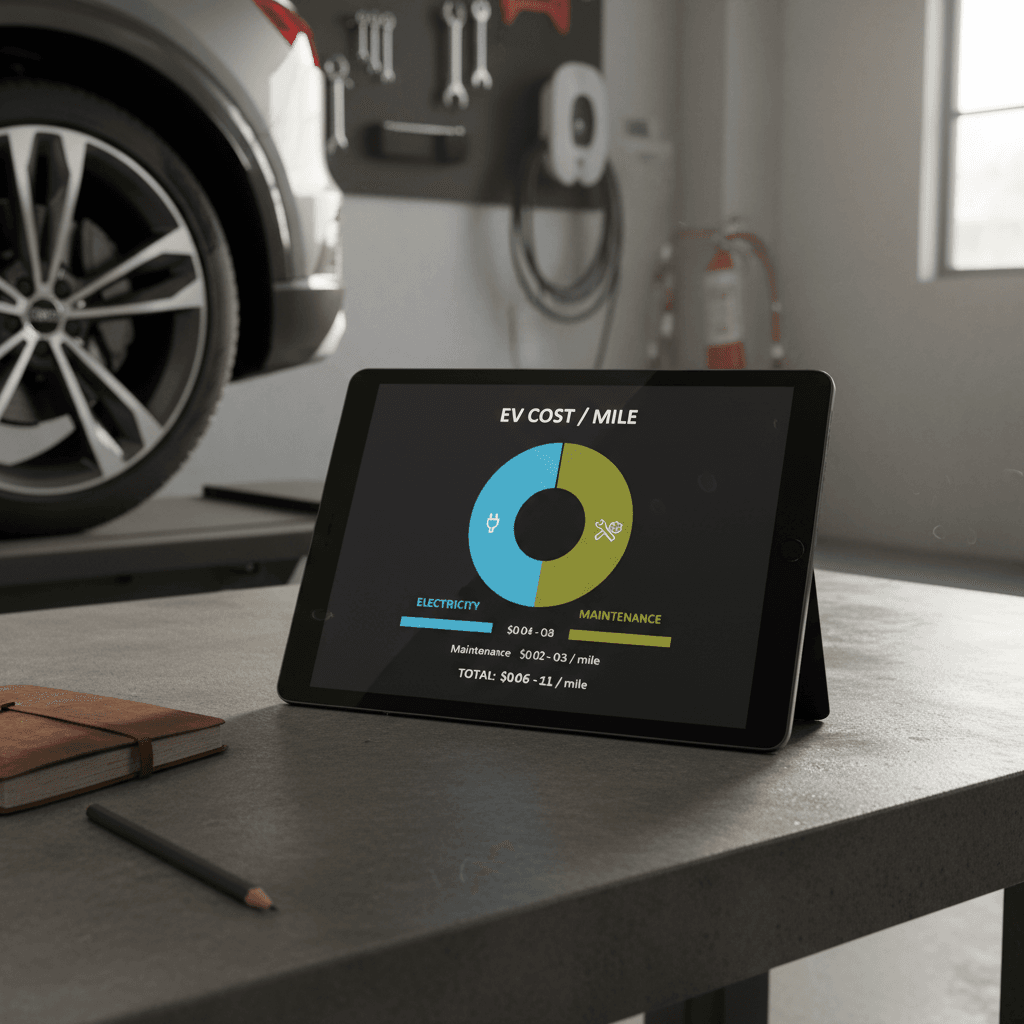
In other words, for most U.S. households **plugging in at home**, the **Audi Q4 e-tron electricity cost per mile is roughly 4–9 cents**, clustering around **5–7 cents** for typical owners.
How that compares to gas
Public DC fast charging cost per mile
Fast charging is where many EV drivers get sticker shock. You’re not paying for cheap residential power; you’re paying for high‑powered hardware, real estate, and demand charges baked into the rate.
As of 2025–2026, common U.S. **pay‑per‑kWh DC fast-charging rates** typically fall in the **$0.35–$0.55/kWh** range, with some outliers higher or lower depending on region, network, and membership discounts.
Audi Q4 e-tron DC fast-charging cost per mile
Same 32 kWh/100 miles assumption, but using typical fast-charging prices.
| Fast-charging rate | Cost per 100 miles | Cost per mile |
|---|---|---|
| $0.35/kWh (good membership rate) | 32 × $0.35 = $11.20 | 11.2¢/mi |
| $0.45/kWh (typical walk‑up) | 32 × $0.45 = $14.40 | 14.4¢/mi |
| $0.55/kWh (high-cost area) | 32 × $0.55 = $17.60 | 17.6¢/mi |
If you road-trip a lot on DC fast charging, use this table instead of home rates.
So if you lean heavily on DC fast charging, your **electricity cost per mile can creep into the mid‑teens cents**, much closer to that 25‑mpg gas SUV at $3.75/gal.
Fast charging shouldn’t be your only fuel
Maintenance cost per mile: Q4 e-tron vs gas SUV
Energy is only half the story. The other big line item in cost per mile is **maintenance and repairs**: tires, brakes, fluids, and the occasional surprise bill.
Large national studies and insurer data consistently show **EVs tend to run roughly 30–50% cheaper to maintain than comparable gas vehicles** over the first 5–10 years. For mainstream EVs, that typically pencils out to **about 3–6 cents per mile** in maintenance and repairs, versus something like 6–10 cents for similar gas cars.
Audi Q4 e-tron (estimated)
- No oil changes, no spark plugs, no exhaust.
- Brake wear is generally lower thanks to regenerative braking.
- Tires, cabin filters, brake fluid, coolant service, and the occasional software or hardware fix still add up.
Across 10+ years, a realistic estimate for a Q4 e-tron is around 3–5¢ per mile in maintenance and repairs if it’s cared for and not abused.
Comparable gas luxury SUV
- Regular oil and filter changes.
- More complex engine, emissions, and transmission systems to service.
- Same tires and similar brakes, but often more frequent service intervals.
For a similarly sized Audi Q5 or BMW X3-type SUV, many long‑term studies land in the 6–10¢ per mile range for maintenance and repairs.
Where these estimates come from
Total cost per mile: electricity + maintenance
With both energy and maintenance in hand, you can get to a more holistic **“what does each mile really cost me?”** view.
Audi Q4 e-tron vs gas SUV: illustrative cost-per-mile scenarios
Simple scenarios combining energy and maintenance. Assumes 32 kWh/100 miles for Q4 e-tron and 25 mpg for the gas SUV.
| Scenario | Energy cost/mi | Maint. cost/mi | Total cost/mi |
|---|---|---|---|
| Q4 e-tron, mostly home charging at $0.17/kWh | $0.054 | $0.04 (midpoint) | ≈ $0.09 |
| Q4 e-tron, frequent DCFC at $0.45/kWh | $0.144 | $0.04 | ≈ $0.18 |
| Gas luxury SUV, 25 mpg, $3.75/gal | $0.15 | $0.08 (midpoint) | ≈ $0.23 |
Your numbers will vary, but these examples show how much charging habits matter.
For a typical U.S. driver putting **12,000 miles a year** on a Q4 e-tron and charging mostly at home, that **9 cents per mile** total adds up to roughly **$1,080 per year** in running costs (energy + maintenance), versus something closer to **$2,700 per year** for the gas SUV example above.
Where the Q4 e-tron shines
7 factors that change your real-world cost per mile
Cost-per-mile wildcards to watch
1. Your local electricity rate
A Q4 e-tron in Washington state at ~12¢/kWh has a dramatically lower cost per mile than the same car in California at ~26–30¢/kWh. Two identical cars, very different fuel bills.
2. How much you fast charge
An owner who uses DC fast charging for 10% of miles will have a much lower average energy cost per mile than someone who relies on it 70% of the time.
3. Driving style and speed
Aerodynamic drag rises quickly above 65–70 mph. Aggressive acceleration and high average speeds can easily push your Q4 e-tron from 3.4 mi/kWh down into the 2s, adding several cents per mile.
4. Climate and cabin comfort
Frequent use of resistive cabin heat in cold climates, or blasting AC in extreme heat, eats into your range. Preconditioning while plugged in can blunt this impact.
5. Tire choice and size
Sticky performance tires and larger wheels look great but usually cost range. Efficient all-season tires in OEM sizes tend to preserve mi/kWh and lower your cost per mile.
6. Annual mileage
High‑mileage drivers feel the per‑mile savings more. If you only do 5,000 miles a year, gas vs. EV fuel differences are smaller in absolute dollars than for a 20,000‑mile commuter.
7. How you maintain the car
Regular tire rotations, alignments, and staying on top of minor issues before they become major repairs help keep that 3–5¢/mile maintenance estimate realistic.
How used Audi Q4 e-tron costs compare
If you’re considering a **used Audi Q4 e-tron**, the cost-per-mile story gets even more interesting. Because EVs depreciate quickly in the first few years, you can often buy a lightly used Q4 e-tron for far less than new while keeping the same low per‑mile running costs, provided the battery is healthy.
Battery health matters
This is exactly why Recharged builds every used EV listing around a **Recharged Score battery health report**. For a used Q4 e-tron, that means you can see **verified usable capacity, pack health trends, and fair market pricing** before you commit, rather than guessing whether a tempting low price hides a tired battery.
Why a used Q4 e-tron can be a cost-per-mile sweet spot
Lower purchase price, same quiet EV drive, predictable running costs.
Lower capital cost
Depreciation has already hit the first owner, so you’re not burning as many dollars per mile in purchase price.
Modern efficiency
The Q4 e-tron launched with competitive efficiency and over‑the‑air update capability, so even earlier model years can deliver solid mi/kWh.
Verified battery health
With a Recharged Score report, you can quantify pack health and avoid the rare cars whose future cost per mile could jump due to looming battery work.
Because Recharged also offers **financing, trade‑ins, and nationwide delivery**, you can run your own cost‑per‑mile math and then search exclusively for **used Q4 e-tron examples that fit your budget and driving pattern**, without being limited to whatever happens to be on a single local lot.
FAQ: Audi Q4 e-tron cost per mile to drive
Frequently asked questions
Is an Audi Q4 e-tron worth it on running costs?
When you strip out the marketing and just look at numbers, the **Audi Q4 e-tron cost per mile to drive is compelling, provided you control your charging costs**. With home electricity near the U.S. average, many owners see all‑in running costs around **9–12 cents per mile**, versus **20+ cents per mile** for a comparable gas-powered luxury SUV. Live in a cheap‑power state and drive a lot? The spread only gets better.
If you’re shopping new or used, the right move is to **run your own numbers** for electricity, mi/kWh, and annual mileage, and then cross‑check that against actual vehicles. On Recharged, every used Q4 e-tron comes with a **Recharged Score battery health report, transparent pricing, financing options, and trade‑in support**, so you can understand not just the monthly payment, but **what every mile will really cost you** over the years you plan to own the car.
From an ownership‑cost perspective, the Q4 e-tron is at its best when it’s **plugged in at home more nights than not**, driven reasonably, and bought with its long‑term battery health in mind. Do that, and you’re not just driving an Audi, you’re quietly out‑competing gas stations on price, one mile at a time.